Feeds:
Posts
Comments

Archive for the ‘Weekly Post’ Category

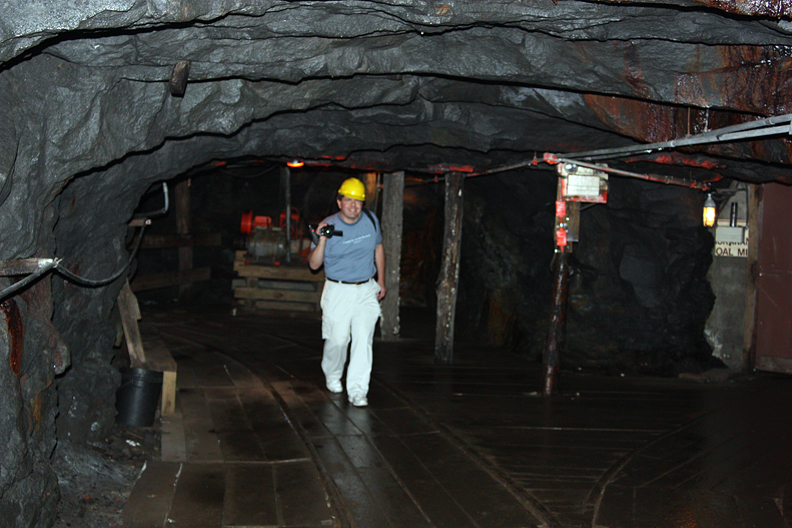
David Black in Lackawanna Coal Mine

David Black in Lackawanna Coal Mine

    For the last two weeks I have been so busy collecting materials for The Elements Unearthed project that I haven’t had time to write any blog entries. My daughter flew in from Utah to visit us in Philadelphia and she has helped me videotape and photograph some local mines and minerals. I’ve collected materials for four new podcast episodes, including anthracite coal mining in Pennsylvania, minerals and gems of the Smithsonian, zinc mining in New Jersey, and the history of the Periodic Table of the Elements. Let’s take a look at samples from each of these future episodes:
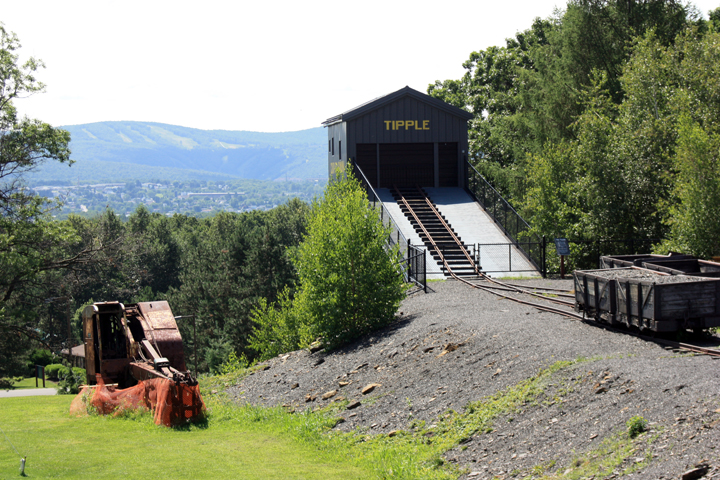
Coal tipple at Lackawanna Coal Mine

Coal tipple at Lackawanna Coal Mine

 Lackawanna Coal Mine:

    On Thursday, August 6 we traveled to Scranton, PA and visited the Lackawanna Coal Mine and the Anthracite Heritage Museum. The tour into the mine lasts about an hour, and our guide, Roger Beatty, was informative and funny. He allowed us to attach a wireless microphone system to him, which we then fed into my small HD camera so that we could have good audio regardless of where we were standing underground. The video itself is pretty good for being hand-held and in the semi-darkness of a coal mine. The coal here in northeastern Pennsylvania is anthracite or metamorphic coal and has to be mined using hard rock techniques. The veins that were mined and which underlie the Lackawanna Valley (Scranton) range from 8-10 feet seems to 18 inches tall. These thin “monkey” veins had to be mined on all fours, usually at a steep incline. Since the coal seems are broad and stretch for miles in all directions, the technique for mining is to create a grid of galleries and cross-cuts with pillars of coal left in place in between to support the weight of the rock above. Some galleries are made wider as gangways for cart tracks and ventilation; once the edge of the mine property is reached, the mining procedes backwards as the pillars are robbed. If too much coal is mined, the entire area may collapse.
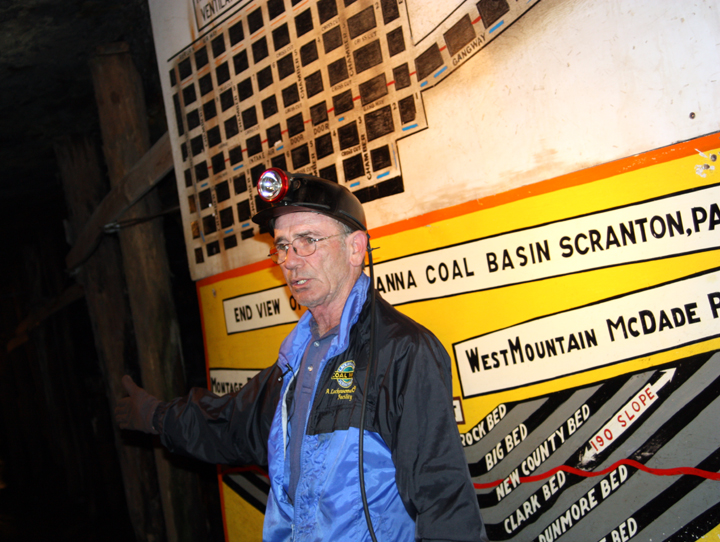
Roger Beatty, Tour Guide

Roger Beatty, Tour Guide

    In the Wyoming Valley nearby, unsafe mining techniques led to a stope in the Knox Mine being cut only three feet under the muddy bottom of the Susquehanna River, and on Jan. 22, 1959 the weight of the water punched a hole into the mine and eventually flooded all the mines in the valley and drowned 12 miners. Anthracite coal was already having hard economic times when this disaster led to the closing of most of the anthracite mines in Pennsylvania. It is estimated that if the mines could be pumped out, there still remaines over 8 billion tons of anthracite coal in Pennsylvania alone.

Centralia, PA:

    In addition to roof collapse and mine flooding, coal mines can have other hazards. Over 30,000 men died in the anthracite mines from the time records were kept in the 1870s until now. But in one case, no one died except a town.
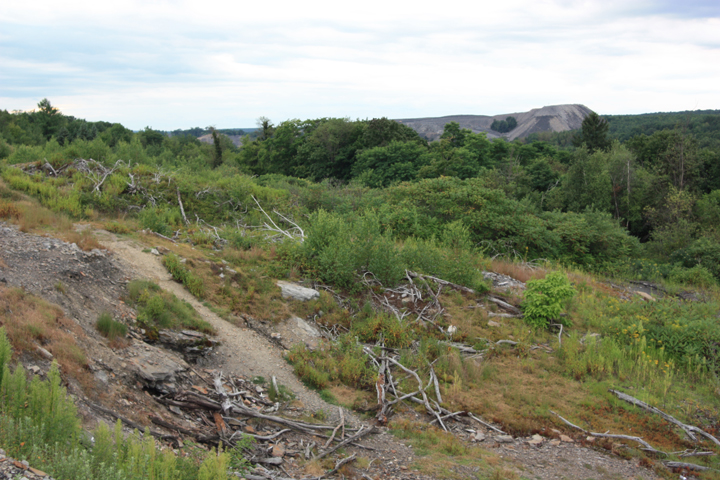
Fumes coming from hillside near Centralia, PA

Fumes coming from hillside near Centralia, PA

    In 1962 the coal town of Centralia, PA was a prosperous village near Ashland and about ten miles from Frackville. Then burning trash in an abandoned open pit mine set a seam of coal on fire. When the fire was put out on the surface, the coal continued to burn underground, and repeated efforts to extinguish the slowly burning seams have all failed. The fire has gradually spread and the fumes (sulfur dioxide, carbon monoxide, etc.) were deemed too hazardous for the residents to stay, so the town has been evacuated and the houses moved into the next valley (except for a few die-hards who refuse to leave).
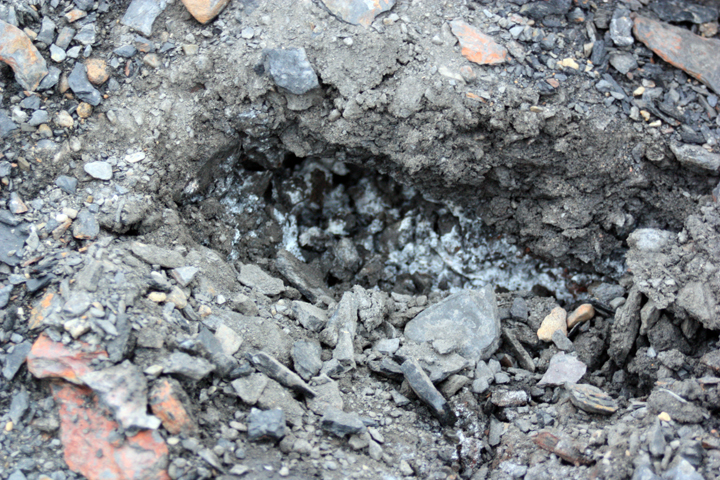
Layer of smoldering ash under the surface

Layer of smoldering ash under the surface

    Now you can visit the town, as we did on our way back to Philadelphia, and see roads that lead  nowhere and a hillside near the cemetary that is still smoldering. In one small mound we could see several vents with fumes wafting out, so we took our video equipment over and documented it. We found that you certainly don’t want to breathe the fumes! I tried to pick up a few pieces of slate mixed in with the gray coal to see what was underneath, and the ground was hot to the touch. Once the slate was pulled out, a layer of coal ash could be seen in the hole left behind. After 47 years, Centralia is still on fire.
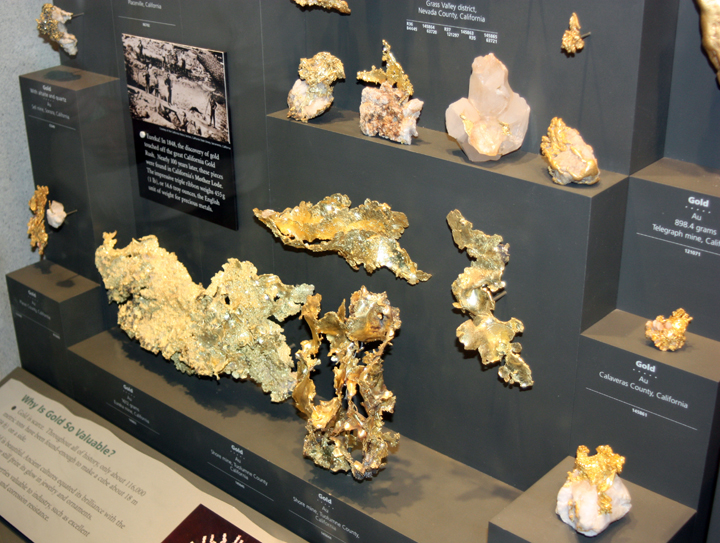
Gold nuggets in the Natural History Museum

Gold nuggets in the Natural History Museum

Minerals and Gems at the Museum of Natural History:

    We visited Washington, D.C. on August 7-9 and I spent some time in the Natural History Museum photographing the rocks, minerals, and gems. The Smithsonian has such an extensive collection that all the specimens are amazing; they have enough to even show displays of unusual crystals and mineral colors and crystal shapes. They also have samples of many famous meteorites, of all types of rocks from the rock cycle, examples of deposition and erosion, families of minerals (such as sulfates and silicates) on display, and, of course, some of the most famous gemstones in the world, including the Hope Diamond. Although the Hope is certainly nice, I personally like the emeralds better.
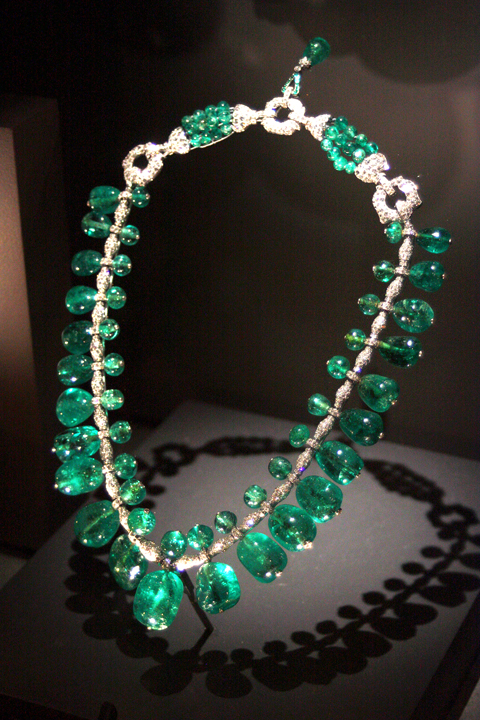
Indian Emerald Necklace from Columbia

Indian Emerald Necklace from Columbia

    I have often been accused of having rocks in my head, and all the photos I took (I filled up about 3.5 GB of disc space) certainly proves that at least I have rocks on my mind.

Sterling Hill Zinc Mine:

    On Wednesday, Aug. 12 we drove to northern New Jersey about 30 miles due west of New York City to the town of Ogdensburg where the Sterling Hill Zinc Mine is located. Operations shut down here in 1986 and the mine facilities have been turned into a museum of mining artifacts and a world-class mineral exhibit, including fluorescent zinc minerals such as the green-glowing willemite seen here. They have a display of the elements of the periodic table, and even have a sample of ore from the Tintic Mining District in Utah (the Mammoth mine).
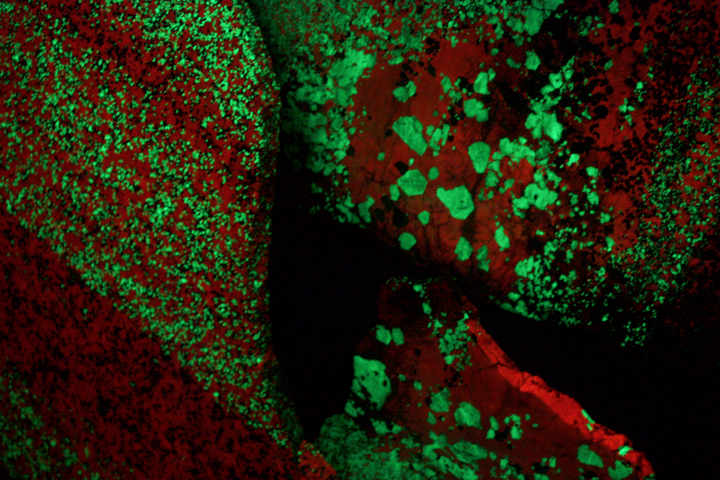
Willemite (green) and calcite (red) fluorescence

Willemite (green) and calcite (red) fluorescence

    After touring the museum, we spent 90 minutes touring the mine. The zinc was deposited through igneous activity in ancient sea floor limestone deposits, which were then uplifted and metamorphosed into marble with the zinc as veins running through the marble.

The Periodic Table:

    In addition to all of this, Chemical Heritage Foundation hosted the International Society of the Philosophy of Chemistry (ISPC) annual symposium Aug. 13-15  and I attended some of the sessions. Although some of the philosophy was beyond the scope of this project, there were some sessions that tied in directly, including the history and philosophy of the periodic system. Dr. Eric Scerri, a noted authority on the history and structure of the periodic table, presented at the conference and consented to be interviewed by me.
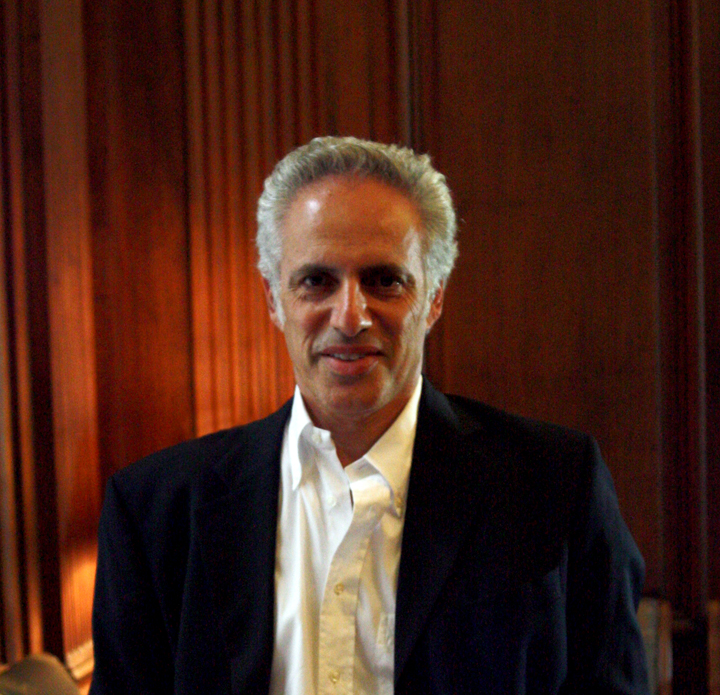
Dr. Eric R. Scerri

Dr. Eric R. Scerri

He is the author of the book: The Periodic Table: Its Story and Its Significance (2007, Oxford University Press), and I asked him a series of questions about the discoveries and knowledge that led to Mendeleev’s successful table and some of the issues that still remain, such as whether or not the periodic system can be fully deduced from quantum mechanics (a central point of discussion at the symposium). In addition to Dr. Scerri’s interview, I hope to visit several installations of periodic tables on my way back to Utah along with the one here at CHF and the one at the zinc mine and have enough materials to create several podcast episodes specifically on the periodic table.

    Couple of final notes: As part of the symposium, one of our curators, Jim Voelkel, put out some of the rarer of our rare books and this time included a hand-written manuscript of Issac Newton’s, with notes on his alchemical experiments. I finally got to see it, and here is a photo of it.
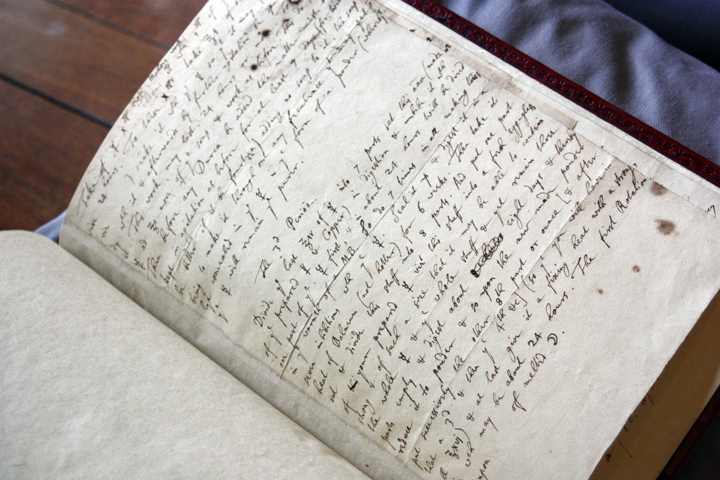
Notes on alchemy by Sir Isaac Newton

Notes on alchemy by Sir Isaac Newton

    One of my goals this summer was to gain at least 2000 images related to this project; since I have bought my new camera in May, I have taken almost 7000 images, over half of which are for The Elements Unearthed. I am looking forward to using them in upcoming episodes. I certainly feel I have succeeded in my goals so far at CHF, and now have two more final weeks to finish up my research, then drive back to Utah. On the way, I am planning on a few more stops such as a lead mine in Missouri and a gold mine in Colorado. By the time I return to Utah, my students and I will have collected video and photos that can be used for at least 30 podcast episodes on subjects ranging from beryllium to zinc. I’ll have some video samples of the coal and zinc mines and Dr. Scerri’s interview next time, and some final podcast episodes ready by August 29.
Read Full Post »

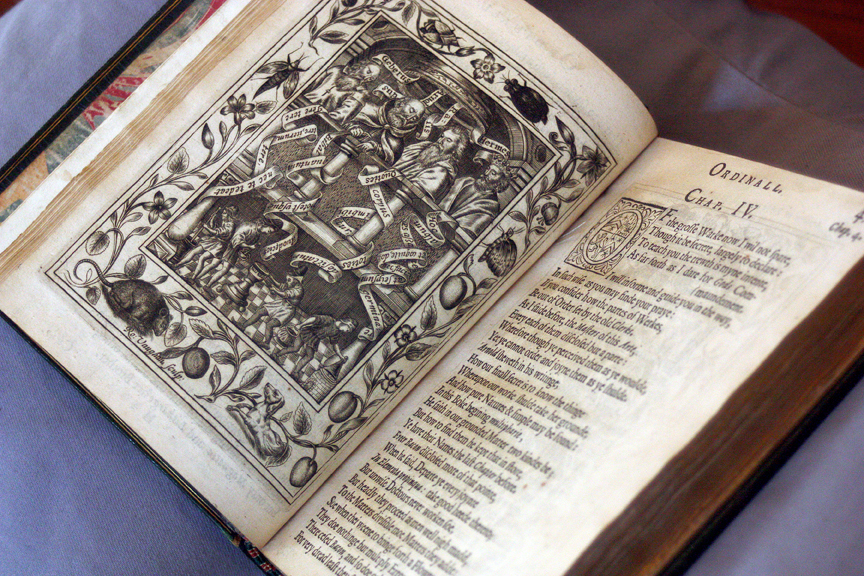
Norton's Ordinall of Alchemy

Norton's Ordinall of Alchemy

    One of the points I hope to make as I build podcast episodes for The Elements Unearthed project is to show the threads that lead to modern chemistry as an empirical science. I have seen from my research here at Chemical Heritage Foundation that there are at least three major threads that all came together in the 17th and 18th Centuries to define what we call Chemistry today.
    The first thread was that of Theory or Logical Speculation – beginning with the Greek philosophers (such as Democritus and Aristotle) and continuing with attempts through the Middle Ages and Early Modern periods to reconcile atomic theory with church dogma (such as the attempts of Pierre Gassendi) or to refine and build on elemental (Aristotelian) theory, such as the Summa Theologica of St. Thomas Aquinas. This thread wasn’t concerned with experimental proof – that would only come later – but instead valued logical consistency and careful reasoning. The culmination of this thread was the revised (modern) atomic and corpuscular theories of Daniel Sennert, Robert Boyle, and John Dalton.

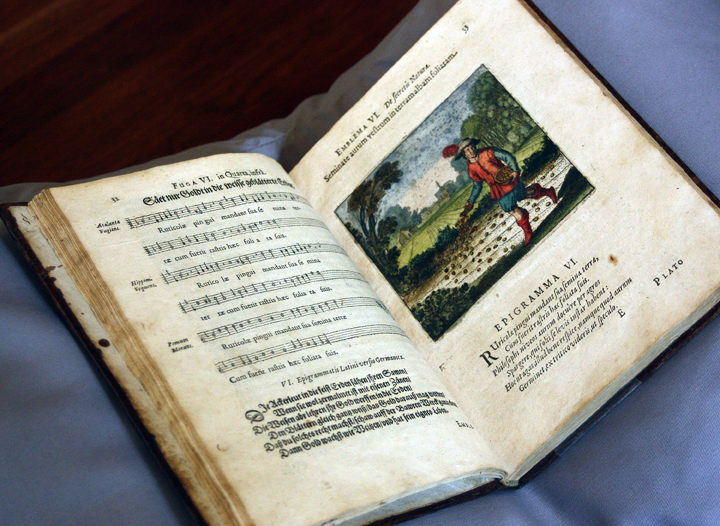
Emblem VI in Atalanta Fugiens by Michael Maier

Emblem VI in Atalanta Fugiens by Michael Maier

    The second thread was that of Alchemy, which I have been pursuing these past three weeks by locating related books in the CHF archives and photographing interesting pages. The alchemists had several goals in mind – the transmutation of base metals into gold, the creation of immortality (or at lest the cure of diseases) through the Elixir of Life or Philosopher’s Stone, and the purification of the inner self (spriritual alchemy). Despite their tendency to become secretive and overly allegorical, their constant experiments toward these goals laid a basic foundation for modern chemistry through all the compounds and materials they created which were failures. Sometimes the symbolism can be a lot of fun, such as this page from Michael Maier’s Atalanta Fugiens (Atlanta Fleeing). In a series of emblems representing different alchemical processes, Maier created a publishing masterpiece that includes symbolic drawings (the first eleven are even hand colored), epigrams (riddles), songs, and other brain teasers. Perhaps even his title is a pun; maybe Fugiens is a play on the word fugue (again my lack of Latin training could be steering me wrong). If so, it would place his work in the company of Bach and Escher. I photographed all the emblems and all the music, and I hope to try out the songs and see if they have any fugue-ish qualities. If so, it would be fun to record them and use them for background music for the podcast episodes. 

A page from Pyrotechnia by Birringuccio

A page from Pyrotechnia by Biringucci

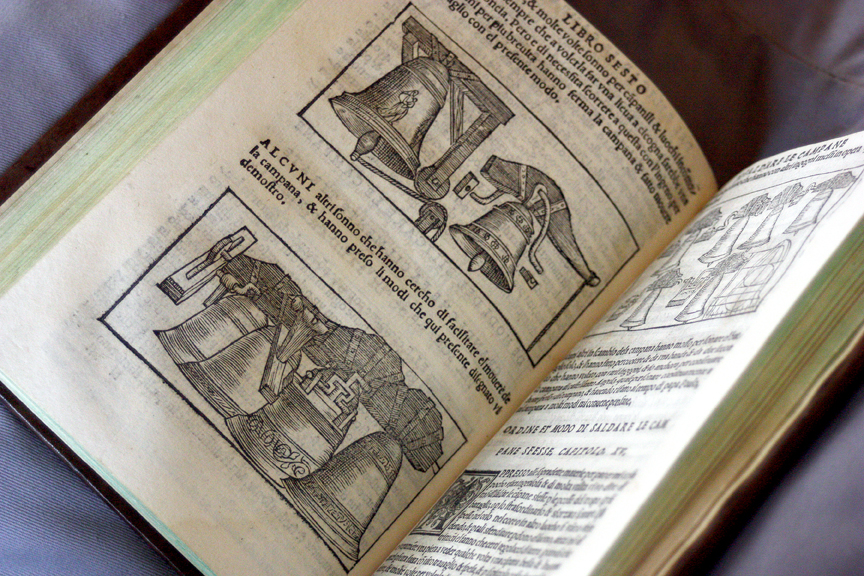
    The final thread, which is perhaps under appreciated, is that of the craftsman. These were the metalworkers, glass makers, stonecutters, painters, masons, engravers, sculptures, dyers, miners, printers, book binders, potters, jewelers, and other people who made practical materials and works of art. They developed high levels of technical skill during the Middle Ages (one of the reasons we don’t call them the Dark Ages anymore). Their skills were rarely written down, and even then usually as a set of lab notes of basic recipes without much explanation. Some of these lab notes have come down to us, recopied and much garbled, such as the Leydon Papyrus X, the writings of Pseudo-Democritus (Bolos of Mendes), the Natural History of Pliny, the Mappae Clavicula, and a very few others. I have been looking over a modern translation of the Treatise of Theophilus, who has been identified as one Roger of Helmarshausen, a talented metalworker who lived around 1100. Some of his works, such a portable alters and elaborate book covers, still exist in museums. His book is much more than the standard lab recipes; he gives detailed instructions and his chapter on metalwork is especially vivid and shows the first-person perspective of someone who did metalwork every day. His work was very influential in later technical books, such as the Pyrotechnia of Biringucci (1540) shown here or Antonio Neri’s Art of Glass or Agricola’s De Re Metallica. In this page, Biringucci shows how to hang bells that have been cast. Theophilus discussed how to cast and hang bells as well, showing this to be an ancient and highly technical skill.

The Sceptical Chymist by Robert Boyle

The Sceptical Chymist by Robert Boyle

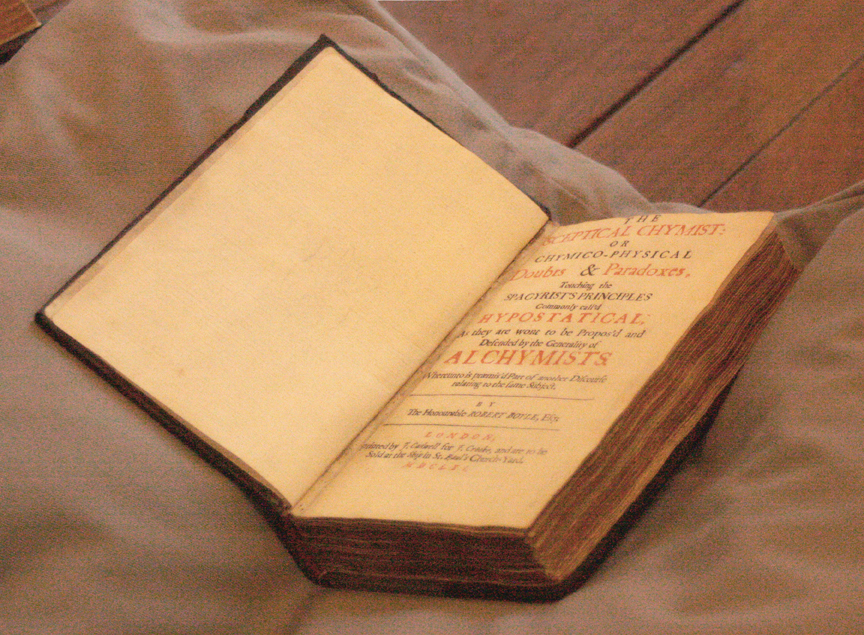
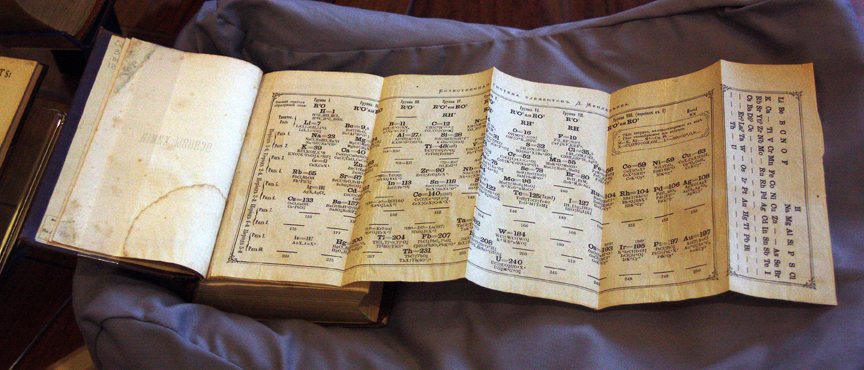
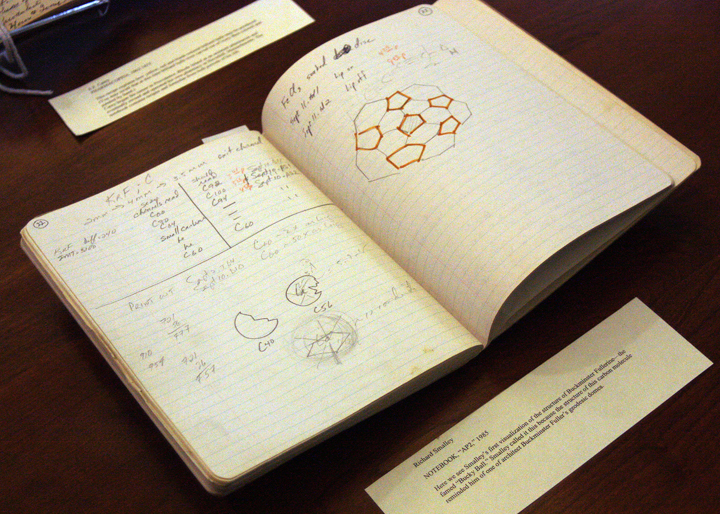
    This past week I have begun to tie these threads together into the beginnings of modern chemistry. Although Antoine Lavoisier is credited with finally turning chemistry into a quantitative science, it was Robert Boyle who first proposed that chemistry should be based on experimentation and observation rather than logic and speculation. If there was one moment when Aristotle was finally cast into the fire, it was 1661 when Boyle first published The Sceptical Chymist. You see here a photo of the title page of a first edition of that book, which is extremely rare (less than 35 copies remain). We held an open house at CHF this Wednesday for invited guests (mostly chemistry experts and historians) and the archivists brought this book out and I managed to get a few photos of it. In addition, they had the first full printed version of Mendeleyev’s periodic table, and the notebook of Richard Smalley from 1985 where he first drew the structure of buckminsterfullerine (the famous bucky ball) that won him a Noble Prize. All very cool stuff for us chemistry geeks.

First fold-out periodic table

First fold-out periodic table

Richard Smalley's drawing of a Bucky Ball

Richard Smalley's drawing of a Bucky Ball

    Finally, more on the order of a teaser than for any other reason, here is another Earth animation. The texture this time is a NASA photographic montage of the Earth taken in May, 2007 (notice the recent snow in Europe) with ocean bathymetric data added. This is the most detailed Earth texture I have tried yet. I haven’t created any new animations this week because I’ve been having so much fun with the rare books, but the progress toward final editing of the student episodes is continuing; my plan remains to have serveral episodes ready to upload by August 31, with more shortly thereafter. I’ll have more teasers in the weeks to come. August will be a productive month for this project as I am planning to duplicate some of the CHF photo collection; interview several experts on matter theories, the history of chemistry, and the periodic table; and to visit several mine sites including a zinc mine in New Jersey, a coal mine in Scranton, and the mineral exhibit at the Natural History Museum in Washington, D.C. All of this will be shown in future posts. Until then . . . . TTFN.

Read Full Post »

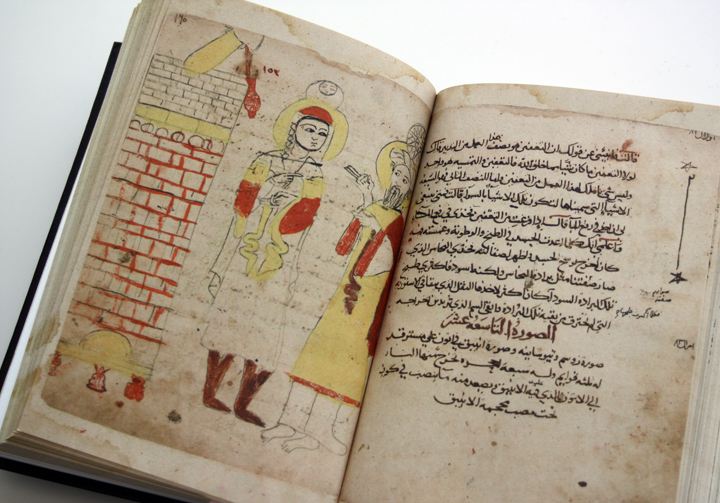
Zosimos, Theosebeia, and a Distillation Furnace

Zosimos, Theosebeia, and a Distillation Furnace

    For the last two weeks I have continued my research into the alchemists of the Middle Ages and Early Modern period, including such shadowy figures as Hermes Trimegistos (the mythic father of alchemy who, according to some medieval writers was a grandson of Thoth, the Egyptian god of wisdom, to others was a contemporary of Moses or Abraham) and Zosimos of Panopolis, the first verifiable real person whose alchemical writings have survived. Zosimos lived in Egypt, probably Alexandria, during the late 3rd and early 4th Centuries A.D. His teachings were written in Coptic Greek and later translated into Arabic. One book he wrote was the Mushaf as-Suwar, or Book of Pictures. The Chemical Heritage Foundation has a book edited by Theodor Abt with a facsimile copy of this manuscript, which was discovered in Istanbul and apparently dates from pre-Islamic times. This is seen from the fact that the book contains over forty color illustrations depicting Zosimos, his student Theosebeia, and various gods, demons, and angels. Depicting the human form is forbidden in the Quran, so these drawings predate Islam. In the Mushaf as-Suwar, Zosimos used allegorical language and the symbolism of gnostic Christianity to describe a series of dreams in which the processes of grinding and roasting and distillation where used to purify substances, but which also symbolized the inner transmutation of the soul; the purification of the alchemist himself. In the image above, Zosimos and Theosebeia with the sun and moon with faces over their heads (representing their eternal, perfected souls) are standing by a furnace with a distillation alembic on top. The size of the furnace (the same size as the figures) indicates an inner or spiritual transformation. Interestingly enough, these same symbols – sun god and moon queen standing by a distillation vessel – are quite common in alchemical allegorical symbology.

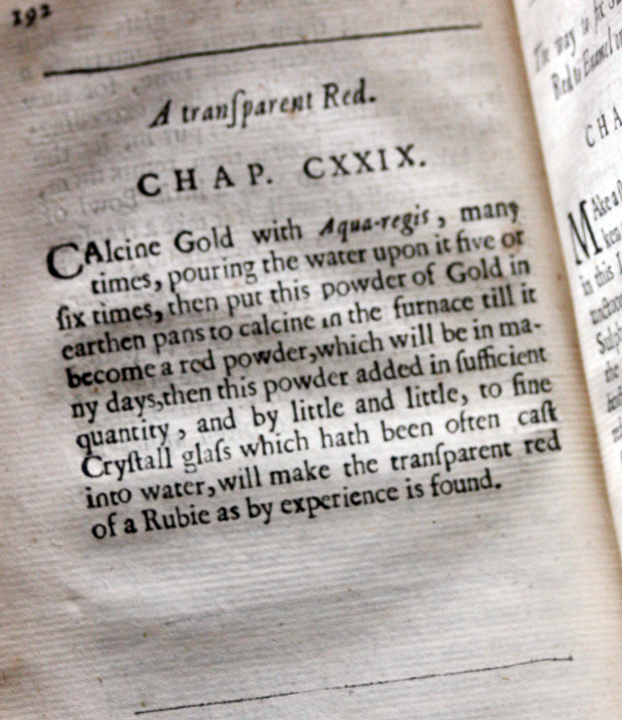
A recipe for red glass using gold powder

A recipe for red glass using gold powder

    In addition to this “deep alchemy” research, I’ve begun to photo books that document technologies and processes used in the Middle Ages and Early Modern periods. One such book is Antonio Neri’s Art of Glass, written in Florence around 1612. Neri was a master glassmaker and his book details recipes and techniques for glass blowing, enamels, paints, etc. One page of the English translation by Merritt shows Neri’s recipe for red glass using gold powder that has been “calcined” using Aqua Regis and roasting. The diagrams in the book show the use of tools very similar to those used today; this is one art form that has not changed all that much. A modern glass blower could go back in time 400 years and still be perfectly qualified to practice the art; the only real difference is that back then, the glass factories would make their own colored frit (hence Neri’s recipes) instead of buying the frit ready-made.

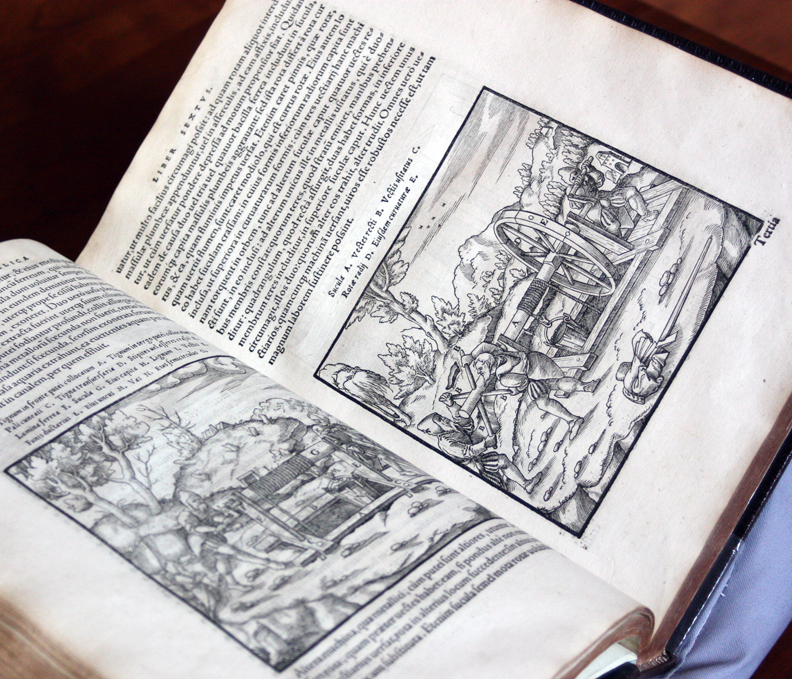
A windlass for raising ore

A windlass for raising ore

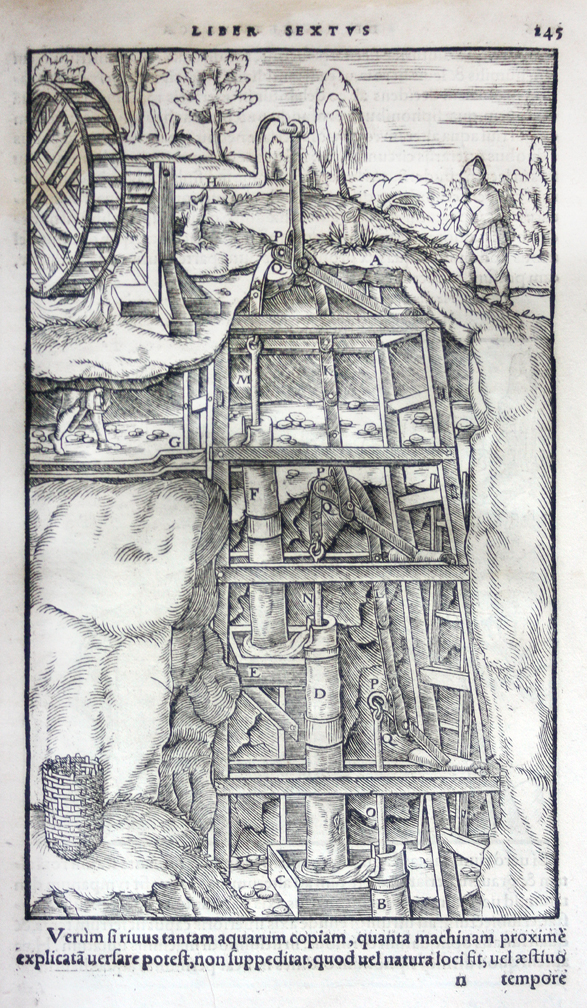
    Another fascinating book of technology that I’ve started to photograph is De Re Metallica by Georg Agricola, first published in 1556. It details mining practices in Germany at that time, and Agricola goes into elaborate detail on the types of mineral deposits and veins found, how to survey them, what tools to use to dig the ore out, how to raise and lower the ore buckets (as in the windlass diagram shown here), and even several techniques to pump water out of the mine shafts. Here he has a diagram of a multi-stage sump pump that is powered by an overshot waterwheel above the mine. Interestingly enough, Pliny the Elder talks about a similar technique that used human-powered treadmills to raise sump water in stages inside the Rio Tinto gold mines in Spain during Roman times.

Multi-stage water pump

Multi-stage water pump

    Agricola’s book required over 270 woodcut illustrations which held up its printing for years. It was a masterwork, a book of beautiful design and quality, as you can see. I feel very priveleged to even look at it, let alone photograph it.  Unfortunately, Agricola died in 1555, a year before it was finally printed. I guess that’s a lesson to scholars to not be too perfectionistic in our work!

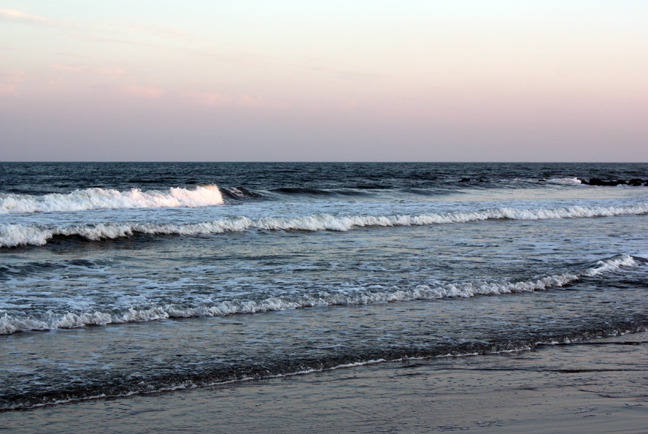
    Finally, I continue to explore the area surrounding Philadelphia with my family. We traveled to Ocean City, New Jersey last Saturday and I took some good photos and video of the ocean, which will surely come in handy. I’m already thinking of places to use it. Here’s a sample photograph:

Beach at Ocean City, New Jersey

Beach at Ocean City, New Jersey

It reminds me of Isaac Newton’s saying, that he considered himself merely a boy playing on the beach looking at interesting shells and pebbles, while all around him the ocean of knowledge lay unexplored.

    I have also continued working on illustrations and animations for forthcoming podcast episodes. Here is a video clip of an animation of the Earth rotating. It was created in Daz Bryce 6 using a brass sphere surround by a gold sphere, the texture of which contains a world ocean mask (which I found at a NASA website) to cut out the ocean areas. I’ve been using this to create animations which zoom in to Greece, Egypt, Rome, etc. for various parts of the Greek atomic theory episode that will be posted at the end of August.

Read Full Post »

Historia Naturalis by Pliny the Elder

Historia Naturalis by Pliny the Elder

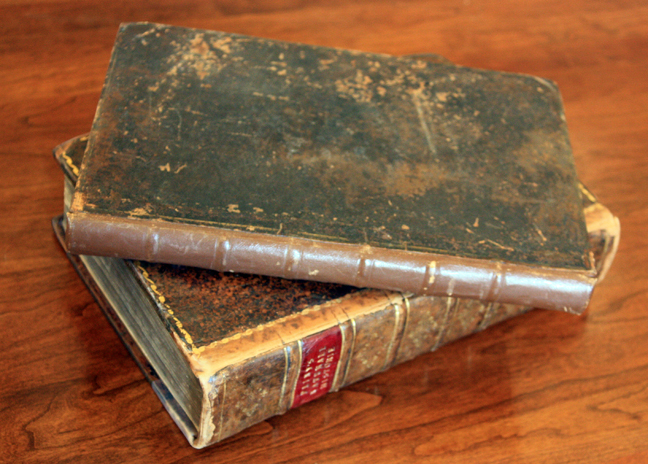
    This last week at Chemical Heritage Foundation I have begun to photograph some of the ancient books and manuscripts that are housed here. After researching CHF’s online catalog, I identified several books to start with including Pliny the Elder’s Historia Naturalis, Basil Valentine’s Twelve Keys, and others. The research librarians of the Othmer Library then located the books in the rare book storage and brought them up to the Jacobs Reading Room where I have been photographing selected pages. 

    The fun has come through the realization that I am handling books that are 400 years old or more. I’ve handled some old books before where the paper has become so brittle that you can’t turn a page without tearing the paper; I was very nervous about that happening here, but found that these older books actually hold up better than many of the books printed in the 20th Century. 400 years ago, if you could afford a book, you could afford to do it right, with high-quality paper and leather binding. The paper of these books has an amazing feel (this coming from someone who’s dabbled in drawing and painting) and can be handled if proper precautions are taken, such as resting the books on a special pillow to avoid stressing their spines and making sure my hands are clean and oil-free.

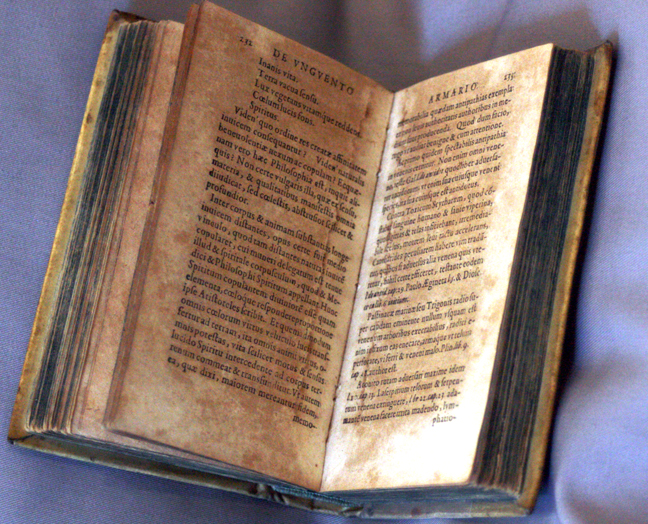
Pages on Love Potions from Trinum Magicum

Pages on Love Potions from Trinum Magicum

    Once I got over my nervousness at handling the books, I began trying to decipher the Latin and German. I’m not very good at either language, but I did run across some interesting things. In a compilation book titled Trinum Magicum, I found a section labeled “De Unguento Armario” which I believe means “Love Potion” (those Latin scholars out there please correct me!). The author (unknown) didn’t seem to be in favor of love potions, and listed some of the symptoms one could expect from their use, such as “Inanis vita” or an empty or useless life. On the right page he mentions a “contra toxicum” or antidote. It occured to me that this was a perfect thing to discover given that the sixth Harry Potter movie, The Half-Blood Prince, is coming out this week and love potions figure prominently in the plot. I half expected Romilda Vane to be hiding behind one of the columns at CHF. Certainly these books bear more than a passing resemblance to those in the library at Hogwarts.  One of the other books I’ve photographed even included a summary of the works of Nicholas Flamel . . . !

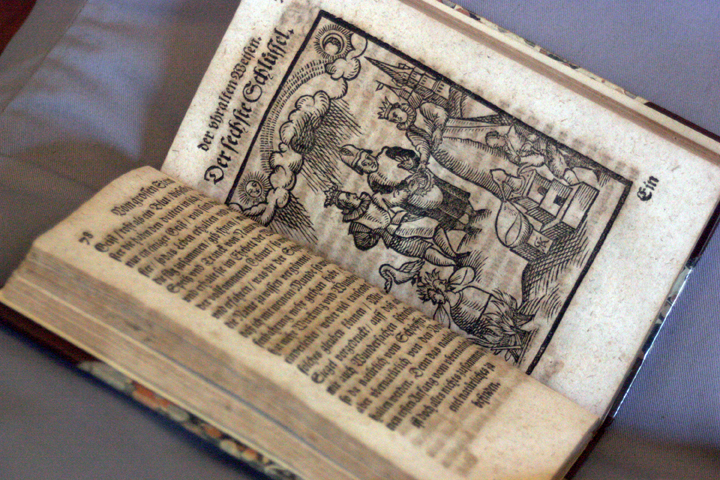
The Sixth Key, from Basil Valentine, 1626

The Sixth Key, Basil Valentine, 1626

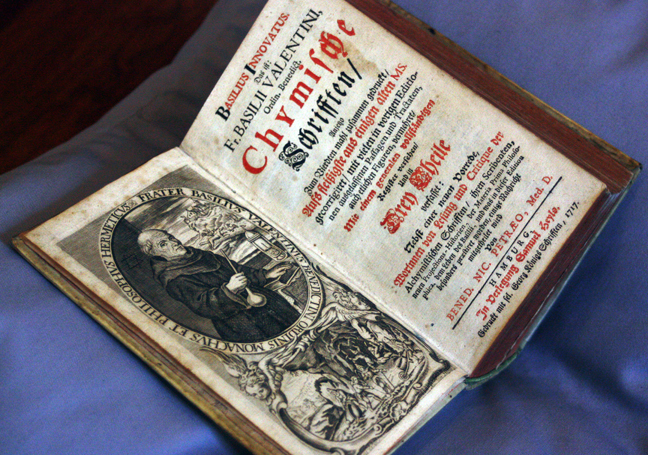
    Two of the other interesting books I’ve photographed are both editions of Basil Valentine’s Twelve Keys (Zwolfe Schlussel) in German. In this work, Valentine, a Benedictine monk, describes the twelve steps for making the Philosopher’s Stone (shades of HP again) and describes these steps through twelve allegorical drawings that are rich in symbols meant to confuse the uninitiated. Although much of the work was probably written at least a hundred years after Valentine’s death, it was still fascinating to realize how seriously all of this was taken back then. The first edition was a 1626 version, with the illustrations printed from woodcuts. The second was a 1717 edition, much expanded, with the illustrations printed from engravings and much more detailed. It has been fun to compare the two.

1717 edition of Basil Valentine's The Twelve Keys

1717 edition of Basil Valentine's The Twelve Keys

    Meanwhile, my wife ‘Becca, my two youngest children, and I ventured out to Delaware to the Du Pont gunpowder mill on the Brandywine River near Wilmington. From 1802 through 1921, the mill used water power from the Brandywine to produce the best black powder in the United States. Eleuthère Irénée du Pont de Nemours was an apprentice to Antoine Lavoisier, the famous chemist who was in charge of French gunpowder manufacturing. When du Pont’s father found that American gunpowder was of inferior quality, his son was sent to build a gunpowder factory using the techniques he had learned from Lavoisier. By refining the raw materials further to increase their purity, adding automation to the compositing process (where the saltpeter, sulfur, and charcoal were ground up and mixed through water power and rolling mills), and by improving the consistency of size and finishing of the powder grains, the Du Pont company became the leader in gunpowder manufacturing. They expanded into polymer manufacturing and other materials and are a leader today in the chemical manufacturing industry.

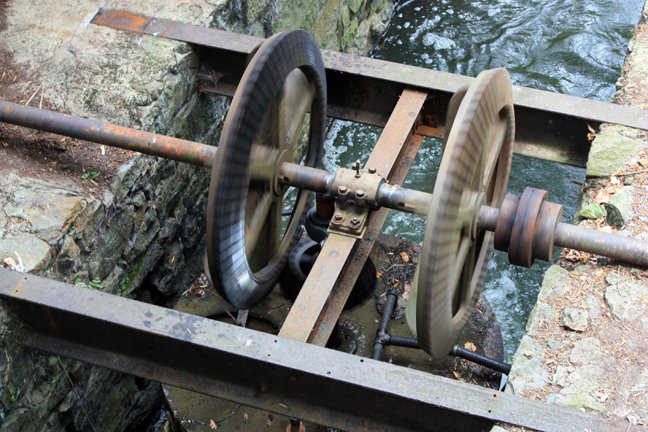
Water turbine at Du Pont gunpowder mill

Water turbine at Du Pont gunpowder mill

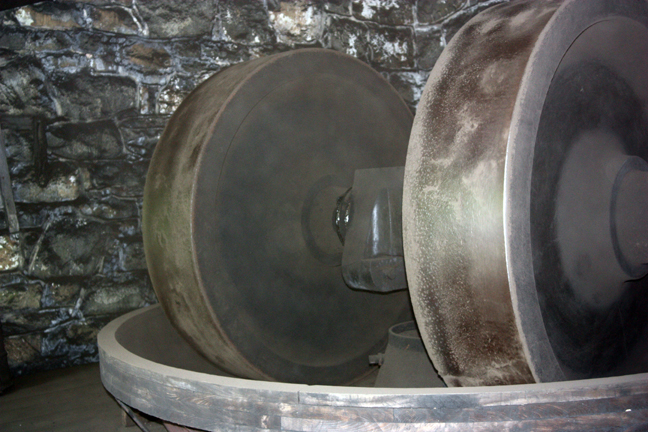
    To run the mills, a diversionary dam was built on the Brandywine to push water into a mill race that had less fall that the river. Along the mill race, headgates allowed the water to be diverted onto overshot waterwheels and later onto water turbines (shown here) to run two rolling mills each. Huge metal wheels rolled around in a trough, where the correct mixture of ingredients had been placed, until they were ground to a fine powder and thoroughly mixed. The powder was then compressed into cakes to increase its density (and power), then broken up into same-sized grains and glazed, then packaged and stored in a magazine far from the processing plant. Each of the mills was built with three strong stone walls, a flimsy roof, and an open fourth wall facing the river. In case of an explosion (which happend fairly often) the force of the explosion would go out over the river.

Gunpowder roller mill

Gunpowder roller mill

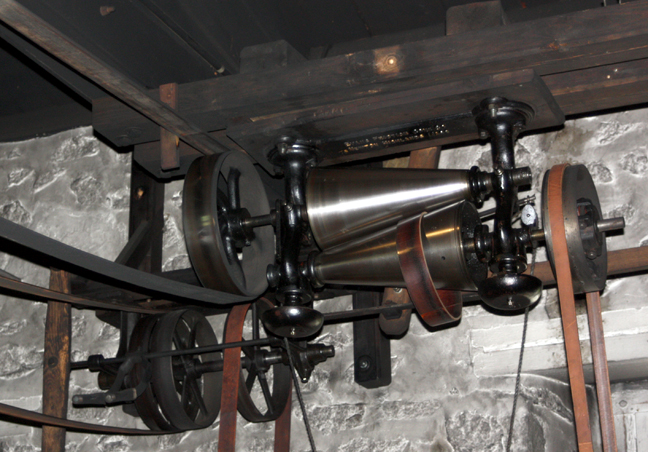
    All of this water-powered machinery required considerable maintenance, and there was a full machine shop with all the needed equipment also water powered through a system of shafts and belts. Gear cogs and other parts could be cut or repaired in this shop. One particularly interesting device was a transmission system for a variable drill; the two cones seen here are almost but not quite touching. The belt in between creates a point of contact and can be moved left or right to speed up or slow down the drill press, which runs off the belt at far right. I’ve seen similar belt-driven milling equipment at the Tintic Mining Museum in Eureka, Utah but it is all sitting outside rusting. Here at Du Pont’s Hagley Museum it was all in working order.

Transmission system for variable speed drill

Transmission system for variable speed drill

    Finally, here is a sample video of the Synthetic Diamond Manufacturing project, as promised. In this clip, Francis Leany, the Product Development Manager for Novatek, tells the story of how H. Tracy Hall invented the belt apparatus that successfully created the first artificial diamonds in Dec., 1954. I hope you enjoy it!

Read Full Post »


Stained glass artwork at National LIberty Museum

Stained glass artwork at National LIberty Museum


    Each day as I travel to Chemical Heritage Foundation, I walk through the heart of old Philadelphia, where history is found in layers. This city is over 325 years old, whereas the towns in Utah where I come from can barely claim 150 years. Just about every building either is historic in its own right or is built over an historic spot. CHF is located at 315 Chestnut Street, which is diagonal to Carpenter’s Hall (where the First Continental Congress met in 1774). Just a couple of weeks ago I realized that the alley next to our building leads to Franklin Court, which is where Benjamin Franklin’s house was located as well as his printing office. There is a museum that is almost literally underneath our museum at CHF (talk about layered history!) that includes replicas or originals of Franklin’s many inventions and scientific instruments among other exhibits. 

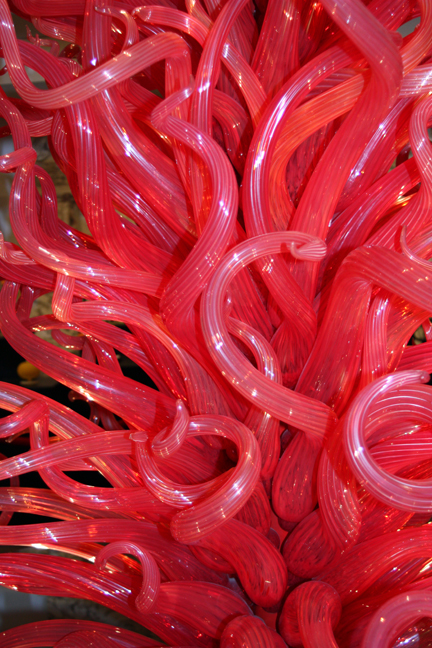
The Flame of Liberty by Dale Chihuly

The Flame of Liberty by Dale Chihuly


    I was hoping to have some of these sorts of synergies occur as part of my fellowship, but sometimes opportunities come up that are completely unexpected. One such happens to be next door to Franklin Court – only about ten feet away from our building. It’s called the National Liberty Museum, and it has an excellent display of the struggle for liberty and some of the heroes that have helped to achieve it. I didn’t realize this until I finally walked in last week, but it also is a museum of modern glass art. Each historical display is paired with blown and stained glass artwork that compliments and emphasizes its theme, ranging from highly realistic to abstract. Given how much work we’ve done this spring on stained and blown glass, I was pleasantly surprised to find this. I was amazed at the beauty of the glass work and the power of the displays. They have a piece called the Flame of Liberty by Dale Chihuly, as well as several others by him. He is one of the great current masters of blown glass. They also have some beautiful stained and sculpted glass pieces.


Blown glass platters by Dale Chihuly

Blown glass platters by Dale Chihuly


    I’m also finding there are opportunities in the vicinity of Philadelphia that could become possible episodes. There is a zinc mine in northern New Jersey that gives tours; a coal mine up in the Poconos; the Drake oil well (the first one) in Titusville, in the extreme northwest corner of Pennsylvania (I would have to stop there on my way back to Utah); and other possibilities. If I take advantage of all of these, then I will have enough materials to last for months.

    Speaking of episodes, here is a video clip, as promised, that was presented at my Brown Bag Lunch two weeks ago. I’ve added a few images and finished out some animations since then. It is meant to show two samples of the episodes on the origins of atomic and elemental theories in ancient Greece. I am showing this here to get some feedback from anyone on how well they like (or don’t like) the animations and illustrations used, as they are representative of what you’ll see in all the episodes. Please feel free to comment on these video samples; the more specific, the better. 

    Meanwhile my research into how atomic theory changed and developed in the Middle Ages is continuing, and I will have some things to say about that next time.

Read Full Post »

    This has been a busy week for me here at the Chemical Heritage Foundation. On Tuesday, June 23 I presented The Elements Unearthed project at a Brown Bag Lunch here. It’s pretty informal; people bring their lunches and eat while the speaker presents. I had 20 people attend, which was very nice. I would have been happy with five!. After a couple of technology glitches  I switched to Plan B and everything went well. In addition to talking about the purpose of the project (which is to document the history, uses, sources, mining, refining, and hazards of the chemical elements and industrial materials through student-created podcasts (whew!)), I showed some short samples of the student videos created this last semester for glass blowing and synthetic diamonds. I also showed some animations with narration of a podcast episode I’m working on this summer on the history of atomic theory. You saw a sample image on the last post of Aristote’s hylomorphism. That’s just one frame of a whole animation. But just so that you can have a sneak peak at what will be posted to iTunes and YouTube by the end of August, here is the first video clip of the students’ work:

This is a clip edited and narrated by Alex Anderson, who also took the photos of the rejects at the end of the clip. Videotaping was done by Sam Comstock, Megan Parish, and Bernardo Martinez. My only contribution was some final tweaking of the video color balance and lighting to match up the two cameras and smooth up some transitions; otherwise, the editing is all Alex’s work.  This is a representative sample of the kind of work you’ll see when these episodes are finally posted. I’ll post the samples for Synthetic Diamonds and Aristotle/Empedocles next time.

    Here is the PDF version of my presentation, sans video clips:   Elements_Unearthed_Presentation_6-23-09

    After my presentation, Ron Brashear, the Director of the Beckman Center here at CHF, took me out to lunch. As we talked, I was surprised to find that we knew some of the same people. He had worked at the Huntington Library in California, researching Edwin Hubble’s letters and personal papers. As part of his research, he visited Mt. Wilson Observatory where Hubble did most of his work. I’ve been up there several times with the NASA Explorer School workshops that I did for JPL, and so we’ve both met some of the astronomers and docents at Mt. Wilson and we’ve both visited the Lowell Observatory in Flagstaff, AZ. It is a small world, as they say.

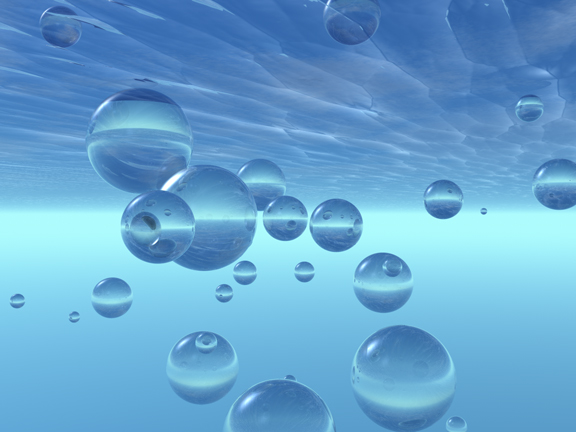
Intersecting Bubbles

Intersecting Bubbles

    I find, however, that as I have these opportunities to work in the science education and science history fields, that I increasingly meet the same people, or at least find that we have the same aquaintances. Academic and scientific circles become increasingly rarefied and specialized, but sometimes they intersect in interesting ways. One of the great privileges of my life has been to meet some of the best minds in several scientific disciplines, including space exploration, astronomy, and now science history. I’m not going to drop names here, but when comparing them to so-called “celebrities” I’ve met, the scientists are the truly great ones, the ones we should be holding up as heroes. My fellowship here at CHF has already helped me to make contact with some of these personal heroes and to at least intersect their circles, and that may be the best part of all for a science groupie like me.

    The other activity I’ve worked on is a Preliminary Proposal for an Informal Science Education grant from the National Science Foundation, which was due yesterday at 5:00. After writing with blazing speed (I hope it makes sense), I wrestled with NSF’s Fastlane submission system and finally hit the submit button a few minutes after 5:00, only to realize that I forgot to justify one of my budget entries – to provide stipends for time and equipment to the mentor teachers/schools of the participating teams. Hopefully that won’t be enough to kill it.  I am submitting the Summary Page and the Project Description here for your evaluation. I would appreciate any feedback you can give.

Elements_Unearthed_Summary_6-25-09

Elements_Unearthed_Description_6-25-09

Read Full Post »

    In this blog entry I’d like to discuss some of the ideas that I have been researching so far here at Chemical Heritage Foundation, report on a conference I attended last week, and give an overview of my plans for the next week.

Empedocles of Akragas

Empedocles of Akragas

    I’ve been conducting my research at CHF for about 2 1/2 weeks. So far I am on schedule for the topics I wish to cover while I’m here in Philadelphia. My goal for these first two weeks was to survey the theories of elements and atoms proposed by the ancient Greek philosophers, then use the third week to research how these theories were carried into the Middle Ages. I used to think that Greek scientific thought on the nature of matter could be divided into a neat dichotomy, with theories of elements (stoicheia) as proposed by Empedocles and Aristotle on one side, and theories of atoms as proposed by Democritus and Epicurus on the other. As I have dug deeper, however, I find that the issue isn’t nearly so simple. Not only did the Greeks theorize about the nature and structure of matter, they also looked at the nature of change, the origin and fate of the universe, and the underlying forces that drive it all. This creates whole sets of conceptual dichotomies. Attempting to sort through all of this while getting to know the personalities and lives of these philosophers has been a fun challenge. I can’t say I’m much of an expert yet, but I have enough to begin to put together a podcast episode on this topic, to be completed and uploaded by the end of August.

    At the risk of over-simplifying, here is what I’ve found: the Greeks were already thinking about where the universe came from and what it was made out of by the time of Thales of Miletus, around 585 B.C., who was considered one of the first philosophers (independent thinkers – “lovers of wisdom”). Thales proposed that everything was made of water, although his follower Anaximenes thought it was air. By about 500 B.C., Parmenides of Elea taught that change was an illusion, that the senses weren’t to be trusted, and that there could only be Being and Non-being. He denied the possibility of empty space (a void) saying it was a logical impossibility. His student Zeno, in a series of famous paradoxes, such as the one about Achilles and the Tortoise, showed that motion (and therefore change) was impossible.

Democritus of Abdera

Democritus of Abdera

     In contrast to the Eleatic School, Heraclitus of Ephesus taught that change was the only constant in the universe, that you can’t step in the same river twice because both you and the river have changed in between. He felt that fire, as a symbol of change, was the universal element. As a compromise between the extremes of Parmenides and Heraclitus, Empedocles of Akragas proposed that there were four elements (earth, water, air, and fire) and that although these elements were eternal and changeless, they could combine and break apart to form new materials. He felt that their were two opposing forces, what he called Love and Strife, which tried to bring the elements together or break them apart.

    Also in contrast to the Eleatic School, Leucippus of Abdera proposed that all things were made of small, indivisible, unchanging atoms which traveled in a void, combined by the forces of a primordial vortex into larger clumps of matter. His pupil, Democritus, took these ideas further and said that nothing existed except atoms and the void, and that atoms combine from necessity (he was a bit vague on what this meant). Unfortunately, most of his original works (some 70 books) are lost and we know of them only from the references of others.

Aristotle's Hylomorphism Theory

Aristotle's Hylomorphism Theory

    One of those others was Aristotle, the pupil of Plato and teacher of Alexander the Great. Aristotle tried to create a system of knowledge that tied everything together, including the material world and the heavens, and that explained the nature of change. Like his teacher Plato, he felt that there were ideal forms that created the patterns for all things, and that all things had purpose.  He taught that the primordial subtance (hyle) took on the forms (morphe) of the four pure elements, and that these elements had properties including hot and cold and wet and dry. All other materials were mixtures of these elements. By changing the properties of one material, it could be transmuted into another, such as base lead maturing into precious gold. He also felt that the elements were arranged in spherical shells with earth at the center, surrounded by water, then air, then fire. The heavy elements sank because of a force he called gravity and the lighter elements rose through a force called levity. Finally, he proposed that a fifth element (literally the “quintessence”) called ether surrounded fire and was the material from which the incorruptible heavens were made.

Aristotle and the Elemental Spheres

Aristotle and the Elemental Spheres

    Aristotle’s views were brought into harmony with the Catholic Church by the Summa Theologica of St. Thomas Aquinas. Democritus’ views on atoms were supported by Epicurus and therefore seen as too materialist and hedonistic by the church, and they fell out of favor (but never entirely died, as I’m finding out this week). It wasn’t until the Enlightenment that atomic theory began to revive.

    Now, of course, this is a very simplistic overview. I’m in the process of writing this all up in more detail, including some interesting though apocryphal stories of the philosophers, for a podcast episode of The Elements Unearthed. I’ll be presenting this information, and giving an overview of the project, at a Brown Bag Lunch next Tuesday, June 23, from 12:00 to 1:00 here at Chemical Heritage Foundation (315 Chestnut St., Philadelphia). The public is invited, so if you’re in the area, please stop by. It will be in the 6th floor conference room. I will have some samples of animations and images with narration for this new episode, as well as previous episodes created by my students at MATC and a presentation on the project as a whole.

Epicurus

Epicurus

    One final note from this last week. I had the opportunity to attend a conference entitled “Composition to Commerce: Chemistry, History, and the Wider World” held June 12-13 at CHF. It was set up as an opportunity to hear experts in the field of chemistry history present some of their current work and to discuss the historiography of chemistry; that is, how one goes about telling the history of chemistry. Although I felt myself to be a bit of an interloper, I was excited to find that some of the best experts in the field were there – people like Lawrence Principe, William Newman, Alan Rocke, Ursula Klein, and others. In my researches here I keep coming across their names. I didn’t get the chance to talk to all of them, but at least being there and seeing them lets me know who they are. I hope to enlist their aid in this project, perhaps as Subject Experts on alchemy and the history of atomic theory that I can interview later this summer. I also found the conference interesting in how various historic alchemists/early chemists were treated and how some names I’d never heard of are now surfacing as having had an important impact on the history of chemistry, such as Gassendi, Sennert, Starkey, and others. I’ll enjoy getting to know their stories as well as the those of the better known figures such as Boyle and Lavoisier.

    Anyway, wish me luck on my presentation next Tuesday. Stop in if you can. After that, I must dig into revising my application for the National Science Foundation which is due on Thursday. But more on that next week . . . .

Read Full Post »

   Last week I drove 2300 miles from Utah to Philadelphia to take up my three-month residence at the Chemical Heritage Foundation. Today I’ll describe more about what CHF is, how I came to have this fellowship, and what I will be doing with it.

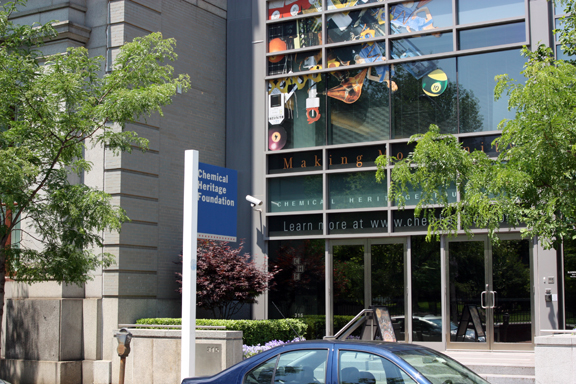
Entrance to Chemical Heritage Foundation, Philadelphia

Entrance to the Chemical Heritage Foundation, Philadelphia

   The Chemical Heritage Foundation was established as the Center for the History of Chemistry in 1982 at the University of Pennsylvania with support from the Americal Chemical Society (ACS) and later from the American Institute for Chemical Engineering (AIChE). In 1987 it incorporated as the non-profit National Foundation for the History of Chemistry, and in 1992 it was renamed the Chemical Heritage Foundation. In 1995, the foundation purchased the old First National Bank building in downtown Philadelphia, having outgrown its space at the U. of Pennsylvania. Today it has several divisions and research arms, including the Othmer Library of Chemical History which houses over 100,000 titles including journals, reference books, portraits, photos, oral histories, and even scientific instruments. It also houses the 6000 titles of the Roy G. Neville Historical Chemical Library, a collection of rare books from the 15th Century and later, some 400 titles being unique to this collection.  The Beckman Center for the History of Chemistry manages the research of visiting scholars and fellows at the library.

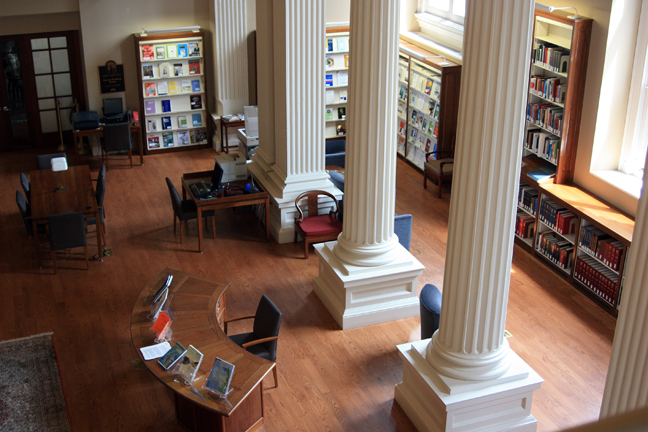
The Reading Room at CHF.

The Reading Room at CHF.

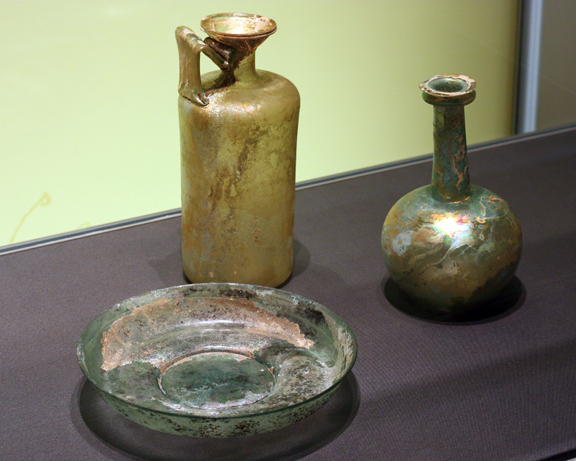
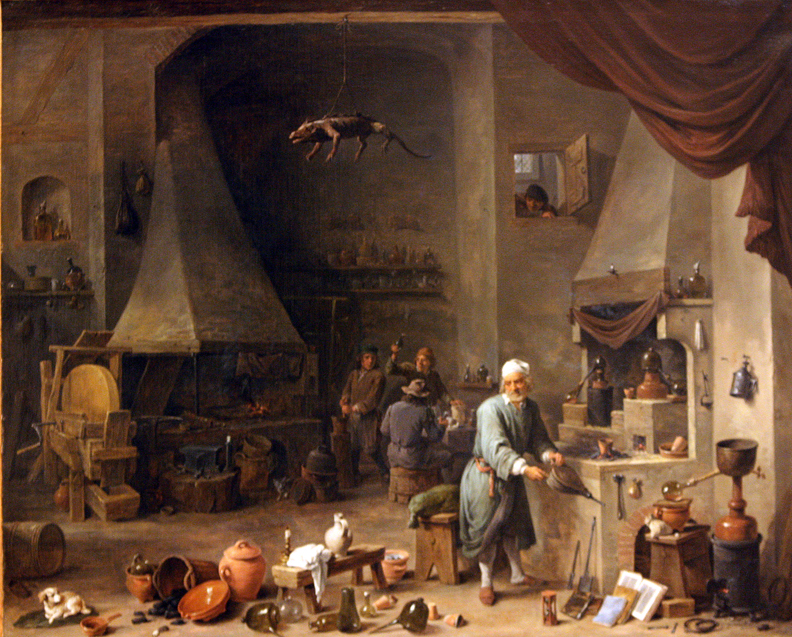
   In addition to the holdings in the library, CHF has museum spaces and exhibits and a convention center/meeting hall. The First National Bank building was rennovated and turned into museum space which opened last fall for the permanent exhibit called “Making Modernity,” which is a collection of instruments and artifacts that helped define the rise of chemistry as a science, with everything from samples of ancient Roman and medieval glassware to 20th Century pH meters, electron microscopes, and mass spectrometers. They also have changing exhibits such as “sLowlife,” a look at the adaptations and movements of plants; “The Whole of Nature and the Mirror of Art: Images of Alchemy” which is a series of photographic reproductions of illustrations from medieaval manuscripts; and “Transmutationa: Alchemy in Art” which displays paintings of alchemists by various artists. CHF also has traveling exhibits and the Ullyot Meeting Hall for conferences and conventions. It is a unique space for such meetings, since we are located right in the historical district of Phildelphia at 315 Chestnut St., diagonal to Carpenter’s Hall (where the First Continental Congress met in 1774) and just two blocks down from Independence Hall.

Roman glass display in the "Making Modernity" exhibit at CHF.

Roman glass display in the "Making Modernity" exhibit at CHF.

   The fellowships and travel grants managed through the Beckman Center are provided by the donations of individuals and 3rd party organizations. My fellowship is sponsored by the Societe de Chimie Industrielle (American Section), which has as its mission to provide better public understanding of the chemical industries, which is precisely what my project intends to do. I found out about this fellowship while researching grants about 18 months ago, and before that had not heard of CHF. I didn’t think I would qualify, since I don’t have a PhD or a disseration, but then I read the requirements for the Societe fellowship and found I might just qualify. I wrote a proposal and asked two people who know me and my work to write letters of recommendation, and sent the whole in by e-mail in Feb., 2008, thinking my chances were slim. When I received an e-mail from CHF  in April, 2008, I wasn’t able to read it at first because it came into my inbox as Chinese characters. I assumed it was the “thanks for your application we had many great applicants sorry we can’t accept all of them” and so on letter I’ve received before. I hit the reply button so I could get the Chinese translated into English and was amazed to find out this wasn’t a rejection letter at all. I had been selected! What remained was deciding when I would be here. My term of appointment is September 2008 through August 2009, but in discussions with my managers at MATC, they were not willing to let me take a sabbatical, especially in the fall when classes were beginning. Finally we compromised on this summer, the last three months of my fellowship term, when I would have fewer students to leave at MATC. They gave me such a difficult time about it, however, that I decided perhaps the time had come to leave MATC, which I have now done. 

Painting of an alchemist in the "Transmutations" exhibit at CHF.

Painting of an alchemist in the "Transmutations" exhibit at CHF.

   During my three months here, I will be conducting background research into atomic theory and its origins and development through the Middle Ages until revived by Dalton and others. I’ll also be looking at the instrumentation and labware of alchemists and chemists through the ages, and anything else that might be useful (there are some great reference works here, and those oral histories). Basically, this will all become background material for The Elements Unearthed, with images and information used to provide historical depth and richness to our project. I hope to take the illustrations of labware that I find, for example, and turn them into 3D models and animations, perhaps re-create entire laboratories of famous chemists. For all this work, this is the place to be; no other library has so much information specifically related to this project, and this fellowship comes at an ideal point to move into Phase II. I am very fortunate to be here, and so far I am being treated very well indeed.

   My goal is to not only use my time here to finish editing the students’ projects into final video podcast episodes, but to create several new episodes based on the information and images I acquire here, so that about ten episodes will be ready for uploading at last by the end of August. I’m going to stuff as much information as I can find, as many photos as I can get, into a hard drive and use them over the next several years as the project develops. I can’t afford to waste any time, so I’ve set up a detailed research schedule and so far I’m following it well, with some wonderful new information about Democritus and Aristotle that I didn’t know before. I’ll share more of what that is and how my research is going in my next post.

Read Full Post »

   As mentioned in my last post, I am leaving Mountainland Applied Technology College and will be taking up a Fellowship at the Chemical Heritage Foundation in Philadelphia. I have been selected to be the Societe de Chimie Industrielle (American Section) Fellow for 2008-09 at CHF, where I will be studying the history of atomic theory, chemistry’s development as a science out of alchemy, and the types of labware and equipment used during the Middle Ages and later. I’ll discuss more about how this fellowship fits into the larger project in future posts, but in this one I’d like to give a final report on Phase I of the Elements Unearthed project as well as describe my four-day drive across the country from Orem, Utah to Philadelphia, PA.

   My students at MATC have completed as much of their projects as was possible before the end of the school year. They are all in a rough cut format, with only the audio tracks laid in in some spots (narration only or audio from our wireless microphone system). In other places, we have video as well but it needs to be color balanced. Other spots have some images but so far the cuts are rough and the story is also. We showed these rough edits in an Alpha test before other students at MATC and had them fill out evaluation forms. Most of the comments were that they liked the information and presentation so far, but that they were too long, a bit dry, and needed more images and animations. This is to be expected when the rough cut for the blown glass project, for example, is 43 mintues long not counting credits. It is my goal to cut it down to two podcast episodes under 15 minutes each, so roughtly 1/3 of the material must go while keeping the storyline intact and improving the video, audio, and imagery. That will be part of my work this summer, to prepare these segments for Beta testing and final deployment on this blog and to iTunes, YouTube, etc.

   Overall the students did very well, learning not only how to plan and execute a video shoot, but also how to research and structure a documentary-style video, how to capture and transcribe the footage, and how to edit the footage using Final Cut Pro. If we had more time, they would have continued the process through beta test, whereupon I would have taken over for final editing. But the year is done, the Media Design Technology program at MATC is now cancelled, and I am in Philadelphia.

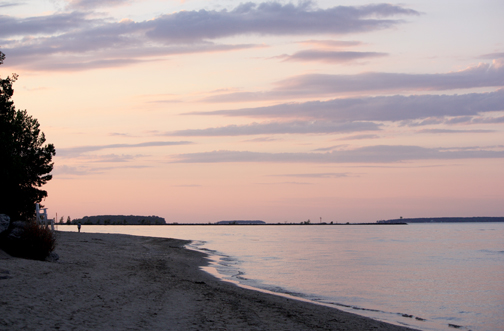
Sunset on Lake Erie

Sunset on Lake Erie

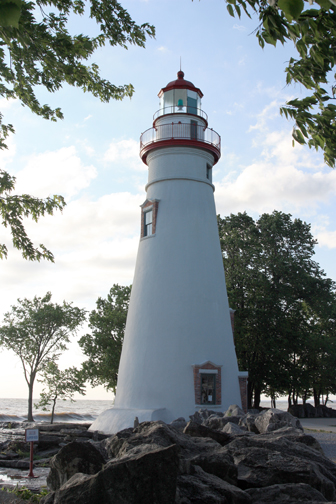
   It has  been quite a trip. I had four days to make it to Philly, leaving at 9:00 a.m. on Thursday, May 28 and averaging about 550 miles per day. That’s about nine hours of driving each day, and I am certainly feeling the effects of it now. I took I-80 most of the way, only moving over to I-76 at Youngstown, Ohio. Fortunately the trip went by without major incident. The only bad thing was that one of my contact lenses decided to pop out at about mile marker 80 in Illinois. I pulled over onto the next exit and searched around for 20 mintues before finally finding it. I stayed the first night at Little Thunder Campground on Lake McConaughy, NE; the second night in a motel in northern Davenport, Iowa; and the third night at East Harbor State Park at the tip of Sandusky Pennisula on Lake Erie in Ohio. I had planned out these stops carefully in advance (Google is wonderful!) and everthing worked out – I arrived at the Drexelbrook Apartments in Drexel Hill, PA at 4:30 eastern time on Sunday, May 31, just in time to sign the rental contract.  My wife and children will be flying in today.

Marblehead Lighthouse, Sandusky Penninsula

Marblehead Lighthouse, Sandusky Penninsula

   Even though I was driving, I wasn’t taking a vacation from this project. I took a few detours and took a lot of photos both of scenery and of things related to the Elements Unearthed. One thing I noticed was how energy production technology is such a large part of our landscape. Near Rawlins, Wyoming, for example, is the large Sinclair oil refinery shown here. Lake McConaughy in Nebraska is not only an irrigation lake but generates hydroelectric power. It is becoming all too apparent that neither of these technologies can sustain our energy needs – the sites for hydroelectric power have pretty much been maximized already and crude oil has already passed the point of peak production in the last several years. We are running out of crude oil, and the prices will only escalate until we are well past the high price point of last summer. The average price I found crossing the country was about $2.50 per gallon, and it won’t get better.


Sinclair oil refinery near Rawlins, Wyoming

Sinclair oil refinery near Rawlins, Wyoming

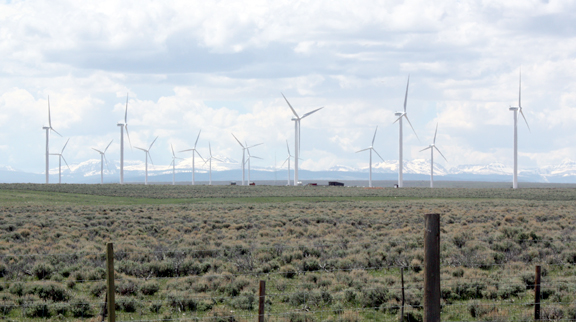
   On an encouraging note, I noticed a huge increase in wind powered generators. New wind turbines are sprouting up all along I-80 and more are being constructed; I saw new turbine blades on the backs of several 18-wheelers as I traveled. There was a new wind farm just west of Evanston, Wyoming and groups of turbines here and there across Nebraska, Iowa, Illinois, Indiana, Ohio, and Pennsylvania. Certainly wind is a largely untapped resource, and with new composite materials the turbines can last much longer and generate more power than the first generation of turbines that were installed in the late 1970s.

Wind turbines near Evanston, Wyoming

Wind turbines near Evanston, Wyoming

    Another stop I made was at Elmore, Ohio where Brush Wellman’s Engineered Materials Division operates a plant that refines beryllium hydroxide pellets into final beryllium metal and alloys. The pellets themselves come from the concentration plant near Delta, Utah which my students have already documented (you’ll see the final result by the end of August). Coincidentally, U. S. Highway 6 runs through both towns, and coincides with I-80 for some of its length. It was good to finally get some decent photos of the Elmore plant to add to the beryllium project.

   Now that I am at CHF, I will begin pulling together all the images and other media that I can to tell the background history of the elements – something that my students couldn’t do very easily because there aren’t comtemporary sources or sites that we could go to and film. So this part of the project has to be done by me. Questions I hope to answer are how the Greeks first proposed the ideas of elements and atoms and how these ideas developed through history. I also hope to digitize illustrations and portraits of laboratories and equipment, with the goal of re-creating this equipment in 3D, perhaps even re-building historical laboratories such as those of Lavoisier or Priestley. I hade my orientation yesterday (June 1) and today I will start my researches in earnest.

Brush Wellman beryllium refinery, Elmore, Ohio

Brush Wellman beryllium refinery, Elmore, Ohio

   In my next entry, I wll describe CHF and its parts and functions and the resources that are available here. I am already finding it to be an incredible place for anyone that has a passion about the history of science.

Read Full Post »

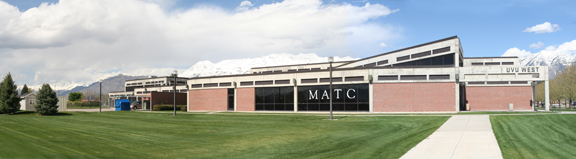
Panoramic photo of MATC

Panoramic photo of MATC

   So far, The Elements Unearthed Project has operated out of Mountainland Applied Technology College (MATC) where I teach courses in Media Design Technology. My students have worked on this project as part of their coursework in media design; by forming teams and planning and executing a complex professional-level project, they are learning marketable skills, which is the main mission of our school. As such, the expenses for this project have been covered by my school program budget.

   However, the time is now here when this project must move away from MATC and find its own way; if I continue to pursue what is essentially my own idea and have students work on it further, I would risk running into conflict of interest issues. Also, to do this project justice will take more than the part-time work I have donated so far; it will require an almost full-time effort by me as well as much effort by other people, such as team mentors and project advisors. It can’t just be my project any more but needs the involvement of additional people to guarrantee success.

   That’s where you come in. Those of you who have begun to read this blog (and the stats show that your numbers are growing) can help this project in several ways. You can contribute through (1) commenting on these posts; (2) acting as evaluators and beta testers for our scripts and podcasts (once posted); (3) mentoring a team in your local area; (4) acting as a Subject Matter Expert for a local team; or (5) contributing funds through your buisness for the continuation of this project or for team equipment needs. Let’s look at each of these.

   Commenting on These Posts: I haven’t done much to advertise or link this blog into other related blogs, such as Citizen Science, etc. I have been waiting until we have this first round of podcast episodes done well enough to post to this blog and upload to aggregate sites. At that point we’ll have something substantial to show and will need all the feedback we can get, both here in the form of comments on these posts and in iTunes and YouTube and by sending in the feedback questionnaire (here is the PDF link again).

Feedback Questionnaire PDF:    Elements_Unearthed_Feedback

We’ll be ready for this by June 1.

   Acting as Evaluators or Beta Testers: We’ll need more detailed feedback on our scripts and videos than what can be done in a blog post comment. Those who wish to provide such feedback will be given passwords to our wiki site and can start to act as official testers and assessors, adding to and editing our wiki pages. These wiki pages haven’t been updated for a while, but will be by May 27. Here’s a link to our wiki site:

Elements Unearthed Wiki Site

We’ll add the final scripts as new links and ask for comments and feedback. We’ll also post the rough draft video clips and ask for editing advice and other constructive criticism. Anyone can help, especially if you have expertise in the subject.

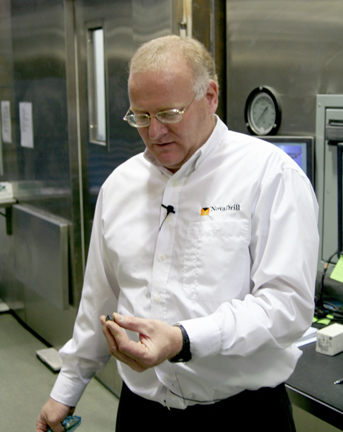
Francis Leany, our Subject Matter Expert at Novatek.

Francis Leany, our Subject Matter Expert at Novatek.

   Forming Your Own Team: I hope to begin Phase II (see previous posts for the phases of this project) at the start of September by soliciting teams of students and/or community members from specific towns in Utah. Instead of MATC students doing the work, I will travel to these towns and provide necessary training to local teams, then help them set up, plan, and carry out their tours, videotaping, and final editing. If you are a high school chemistry, history, or media teacher or you are a member of a community historical society or similar organization and would like to put together a project on the history of science and chemistry in your own town, then please contact me. I have a link here for the PDF form to apply for a team.

Team Application Form:  Elements_Unearthed_Application

Ideally, the team would have about 6-8 official members including 5-6 students, a teacher, a community leader, and a Subject Matter Expert such as a local historian, museum director, or scientist or engineer at a chemical plant. The students should be either in high school or be highly motivated middle school students. They can be science students, media students, history students, or even art students (we need all these skills). Their parents can also join the team as members; our goal is to make this truly a community-based project, much as citizen science efforts are being formed presently. Consider this to be a citizen history project.

   Contributing Funds to this Project: Since this project is now becoming independent, it will need funding in order to continue. I have applied to various grant agencies, with mixed success so far. I have been turned down by the Sloan Foundation and the Corporation for Public Broadcasting for an earlier version of this project; the National Science Foundation turned down my initial application but encouraged me to reapply, saying all that is still needed is more sponsorship and better assessment strategies but that the idea itself is sound and very much needed. My major success so far has been my acceptance to a Fellowship this summer at the Chemical Heritage Foundation in Philadelphia (here’s the link) which is supported by the American Section of the Societe de Chimie Industrielle (here’s their link, too). This generous support will allow me to stay in Philly for three months researching the foundations of chemistry and acquiring images and diagrams from CHF’s vast collection of historical manuscripts that can be used for episodes of this project. They are already doing an audio podcast called Distillations (here’s the link) that I highly recommend; I hope our video podcasts will also find a home at CHF in addition to this blog.

   The funds that are donated can be used for the general development of the project (paying for my travel expenses, for example, to visit the teams) or they could be donated to specific teams to help them buy necessary equipment such as video cameras, tripods, microphones, and computer software. For example, if your business was involved in chemical manufacturing, you might sponsor a team to tell the story of your business and industry. You help them with funds and expertise (in the form of a Subject Matter Expert) and provide access to your company for tours and information. Then any video or photos the team shoots, including the finished podcasts, can be used by your company for PR or marketing purposes (although we’ll retain the copyright on the materials). It’s a win-win situation: you help support your local schools (a tax write-off) and get students excited about STEM careers; they help advertise your business. I hope to develop a number of partnerships for our next group of teams. We’ve already had great cooperation and help from such companies as Novatek in Provo, Utah; Holdman Studios at Thanksgiving Point; Brush Engineered Materials in Delta; and Ash Grove Cement in Leamington.

Phil Sabey at Brush Wellman plant; Dec., 2007.

Phil Sabey at Brush Wellman plant; Dec., 2007.

   I will be contacting some specific industries, organizations, and individuals that can be sponsors or advisors for this project. My goal is that before I leave for Philadelphia, we will have several sponsors on board for the next phase.

   To contact me about contributing either your expertise or funds for this project, please e-mail me at:  dblack@mlatc.edu  or you can phone me at:  801-787-0512. I hope to hear from you.

Next time: Completion of Phase I

Read Full Post »

« Newer Posts - Older Posts »