Feeds:
Posts
Comments

Archive for the ‘Weekly Post’ Category

The following posts will detail my expedition to document the history of mining in Colorado. Funds for this trip were provided through Teachers Without Borders and the MIT BLOSSOMS project, sponsors of the What If Prize competition.

Colorado day 1 map

Map of my route for Day 1: Orem to Durango

I began my journey on Monday, July 9. After getting everything packed in my Dodge Grand Caravan mini-van, I left my home in Orem, Utah about 11:00 and traveled south on I-15 to Spanish Fork, then east on U.S. 6 through Spanish Fork Canyon. I stopped to take a few photos of the Thistle mudslide and what’s left of the town of Thistle itself. In the fall of 1982, after two weeks of constant rain brought in by a tropical storm, a large section of the canyon wall gave way and slid into the bottom, damning the river and flooding the small town of Thistle. The main Denver and Rio Grande Railroad had to build tunnels through the slide and U.S. 6 had to be routed around the disaster. Now, thirty years later, the slope is still unstable but is beginning to get a re-growth of oak brush, but no pine trees yet.

Thistle slide

The mudslide that destroyed Thistle, Utah: Thirty years later.

The Western Mining and Railroad Museum in Helper, Utah

Coming down the east side of Price Canyon, I stopped at a road cut where a nice coal seam is visible. This one is too thin to be economically mined, but it gives an idea how the coal is interbedded with sandstone and shale layers. The coal began as swamps during the Jurassic Period that ringed a shallow inland sea which covered eastern Utah. Rivers drained from a tall mountain range on the Utah-Nevada border eastward into the sea, depositing layers of mud and sand over the swamps, which became compressed into coal. Dinosaurs walked in these mudflats and left footprints in the peat moss, which filled in with sand and are now found in the roof of the coal seams.

Coal seam

Coal seam in a road cut along U.S. 6, near Helper, Utah.

The layers were later uplifted when the Rocky Mountains rose along with the rest of the Colorado Plateau. The center of the plateau bulged into a giant syncline, the San Rafael Swell. The coal seams became exposed in the edges of the Book Cliffs in a giant crescent, now called the Carbon Crescent that stretches from Green River around to Emery. In the early 1880s the Denver and Rio Grande Railroad was built between Denver and Salt Lake City. My own Great-Great-Grandfather, Joseph S. Black, worked to build the railroad grade with scrapers and horse teams. He discovered a large coal seam that he sold for $3000. It became the Castle Gate Coal Mine, one of the first large mines in the district.

Big miner

A very big coal miner. This statue is at the library in Helper, Utah.

Helper museum

The Western Mining and Railroad Museum in Helper, Utah.

The town of Helper was built to provide extra locomotives to help pull the trains over the top of Soldier Summit. It also became a transport center for the coal coming out of Carbon and Emery Counties. Today, the town’s history of coal and railroads is preserved in the Western Mining and Railroad Museum at 294 South Main St. in Helper. Here’s their website:

http://www.wmrrm.org/

Helper main street

The Main Street of Helper, Utah during the early days of coal mining.

The museum takes up the rooms of an old hotel, plus a new annex, and is organized by topic (such as the shadier side of life in Helper, with gambling tables and whiskey stills from Prohibition days) and by community (with rooms for each town in the district, such as Clear Creek or Sunnyside). There was a room on doctors and dentists, with a complete dentist’s chair and equipment, a room on schools, one on laundry facilities, one on sports teams, one for grocery and dry goods stores, etc. Downstairs was a large room with equipment used in the mines, such as rescue breathing apparatus, miner’s helmets, lamps, coal assaying equipment, and diagrams of how coal is mined.
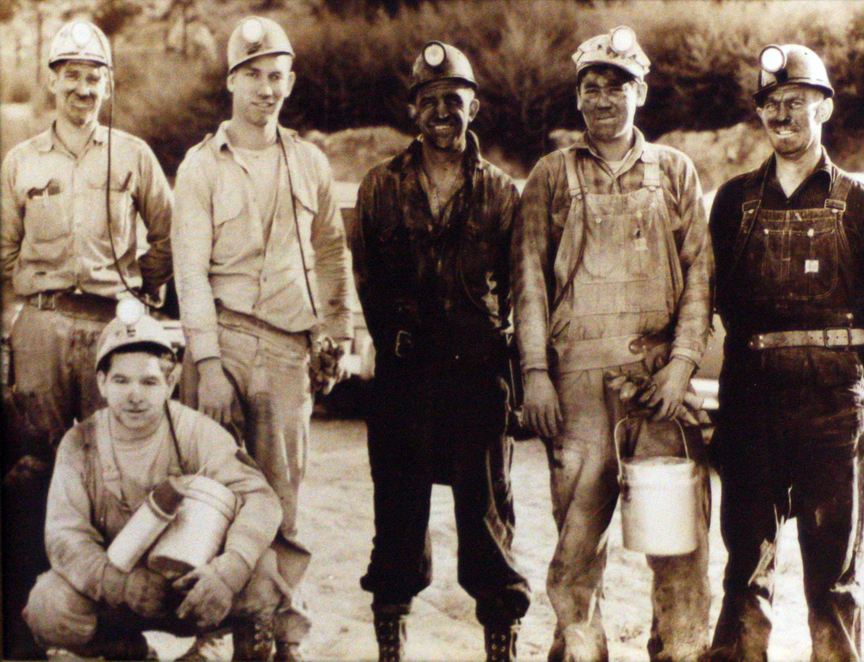
 

Sunnyside miners 1955

Miners at the Sunnyside coal mine, circa 1955.
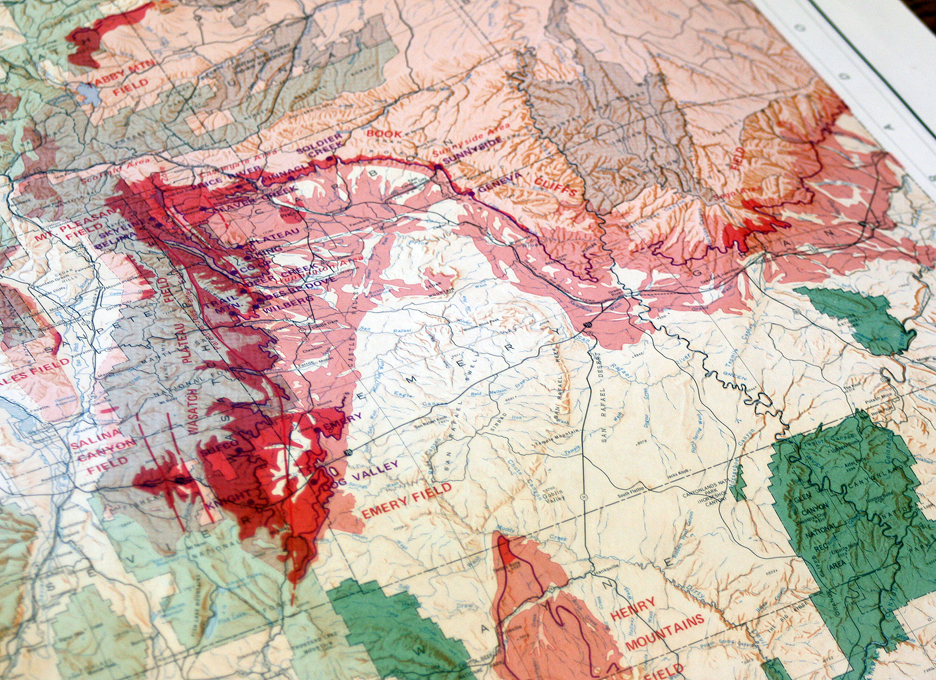
Carbon crescent

Map of the Carbon Crescent, represented by the red and pink coal deposits around the San Rafael Swell and Book Cliffs in eastern Utah.

A large coal seam is basically a layer that is at least six feet thick and extends left and right of the main portal and into the side of the hill, often for miles. After over 100 years of mining, the coal seams are still extensive and there is enough here in the Carbon Crescent of Utah alone to serve all of the United States for at least 200 years.
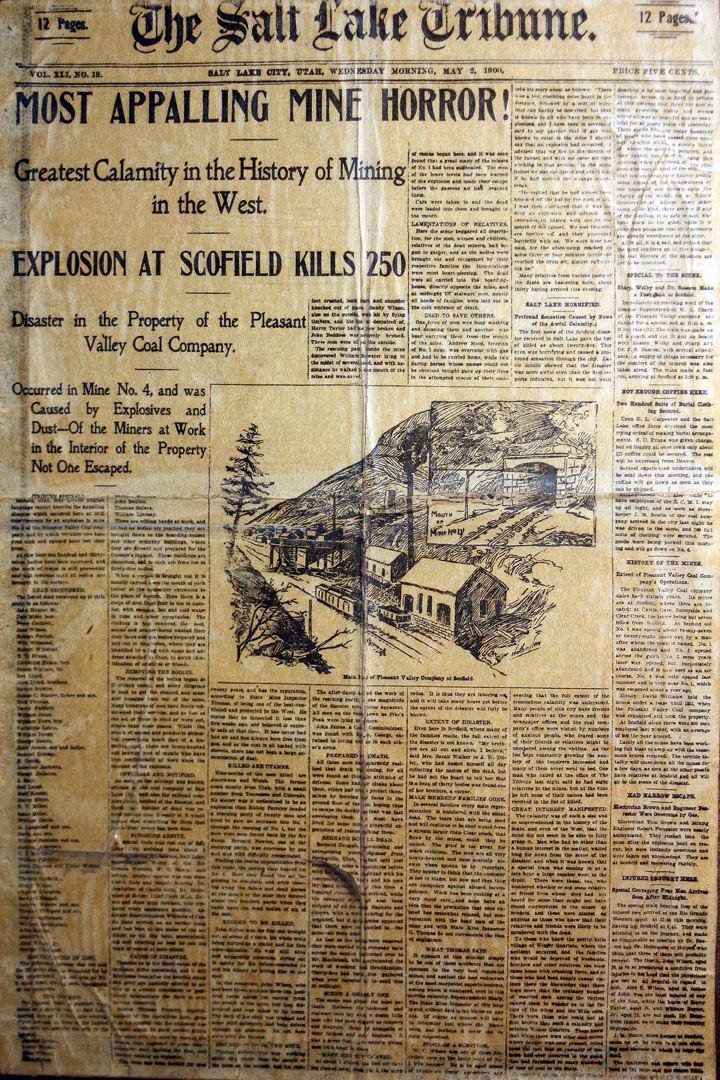
Winter quarters disaster

Newspaper announcing the Winter Quarters mine explosion in Scofield, Utah on May 1, 1900.

One room was dedicated to the Winter Quarters mine disaster of 1900. On May 1, 1900, a new shift had just entered the Winter Quarters Mine Portal 4 when a huge explosion blew out of the portal, sending timbers and coal cars across the canyon as if they had been shot out of a rifle barrel. About 250 men were killed, in some cases wiping out every male member of entire families. At the time, it was the worst mining disaster in U.S. history. This photo is from the Salt Lake Tribune the day after, and was found glued to a board hanging in a school that was torn down many years later. The cause of the accident was eventually ruled to be a dust explosion, and new safety procedures were put into place in coal mines to try to prevent it from happening again.


The coal was slow to get out when miners used the standard hard rock tools of picks, shovels, mules, and dynamite. In the 1950s, automated mining machines were installed, culminating in the long-wall mining machine. The long-wall miner (or continuous miner) is a large shearing blade that slices left and right along a seam, taking three feet of coal in one pass. Behind the blade is a continuous conveyor belt that transfers the coal to the side, then to another belt that transports it out of the mine to the processing center where it is broken, sorted, and shipped off in trains and trucks. Behind the shearer, hydraulic lifts hold the ceiling in place until the machine is advanced. The machine usually is placed at the back of the mine and cuts forward, so the ceiling collapses behind it as it cuts its way out.


Long wall miner

Display showing how a long-wall mining machine works.

It was a much more extensive exhibit that I realized, and I stayed longer than I intended, about three hours. I left at 5:00.
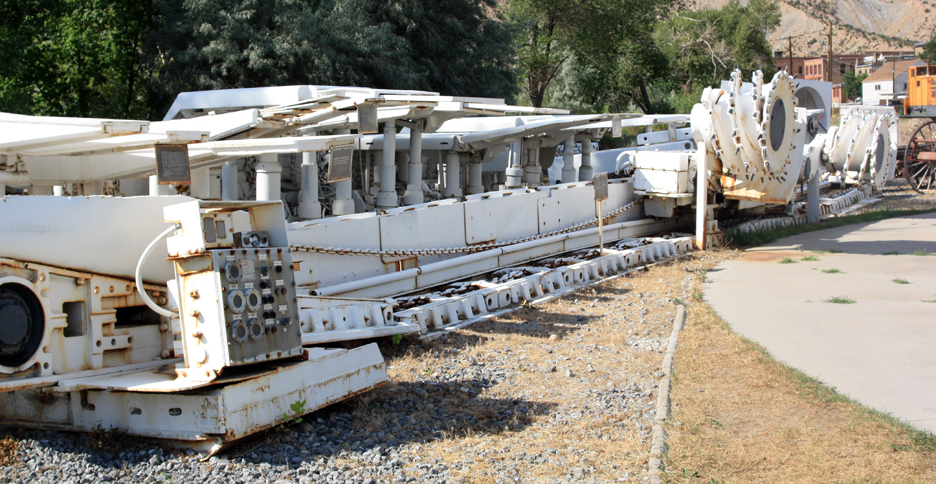
long wall miner

Long-wall mining machine (continuous miner)

A Little Problem with a Rock

On my way beyond Wellington, some rocks had fallen off of a truck and were scattered across my lane. I didn’t see them in time to dodge, and my right front wheel struck one and immediately began to vibrate. Within a couple of miles my tire was flat. I had to get out the spare (not easy in a mini-van) and change the tire. The rim was dented and the tire itself looked damaged. I drove on the spare about 50 miles to Green River, where I found an open shop. They didn’t have a rim to fit, after several tries and much wasted time. Eventually I had them put the spare tire on the right rear and the right rear on the front and traveled on. It was 9:30 by the time I left.

BTU analysis kit

Kit for analyzing the BTU (heat) content of coal.

I had to drive slowly to protect the spare, and it was already dark when I drove down State Road 191 through Moab and beyond to Monticello, where I picked up Highway 491 (formerly 666) through Cortez. I had to pull over in a place called Pleasant Valley in order to take a nap, as it was very late and I was getting drowsy. I finally pulled into the Lightner Creek campground near Durango at about 2:00 in the morning. I was too tired to try to pitch my tent, so I threw a tarp on the ground, laid down a thick comforter and my sleeping bag, and wrapped the tarp over me like a burrito to protect myself from a light drizzle of rain and slept tolerably well.
Read Full Post »

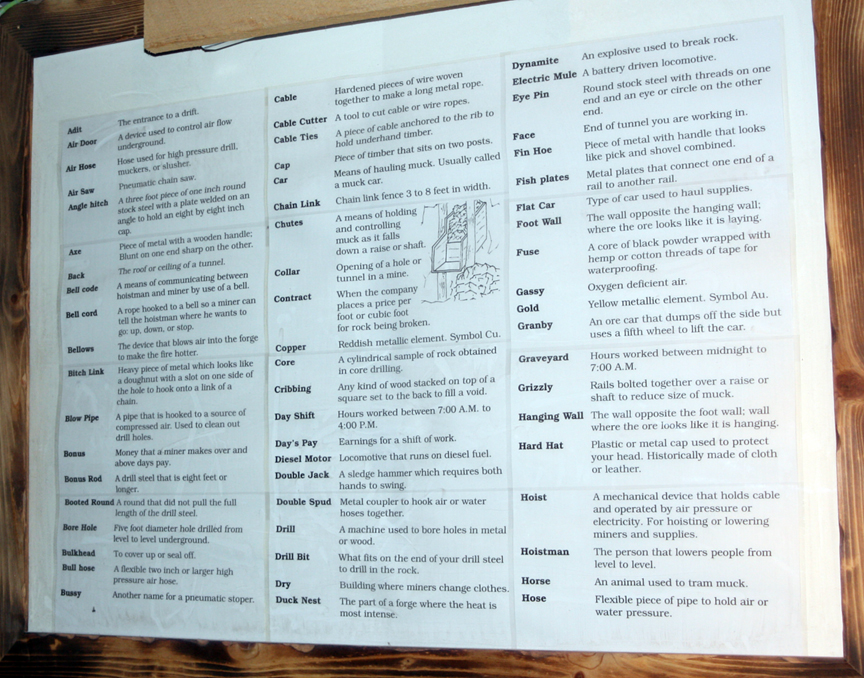
mining terms

Mining terminology, at the Creede Underground Mining Museum

As mentioned in my last post, I am embarking on a two-week tour of Colorado mining towns. Before I go, there are some basic mining terms that any greenhorn or tenderfoot like me should know before venturing into a mine. Many of these terms come from the Cornish miners who came to America to work when the tin mines in Cornwall played out in the 1800’s.

First, the basic parts of a mine: you always refer to a mine as if you are facing into it. The part of the mine you are working to drill, load, and blast is called the “face.” The left-side wall is the “left rib” and the right-side wall is the “right rib.” The ceiling is the “back” and the floor is the “foot.” The back is also called the “hanging wall” and the floor the “foot wall” depending on the orientation of the ore vein.

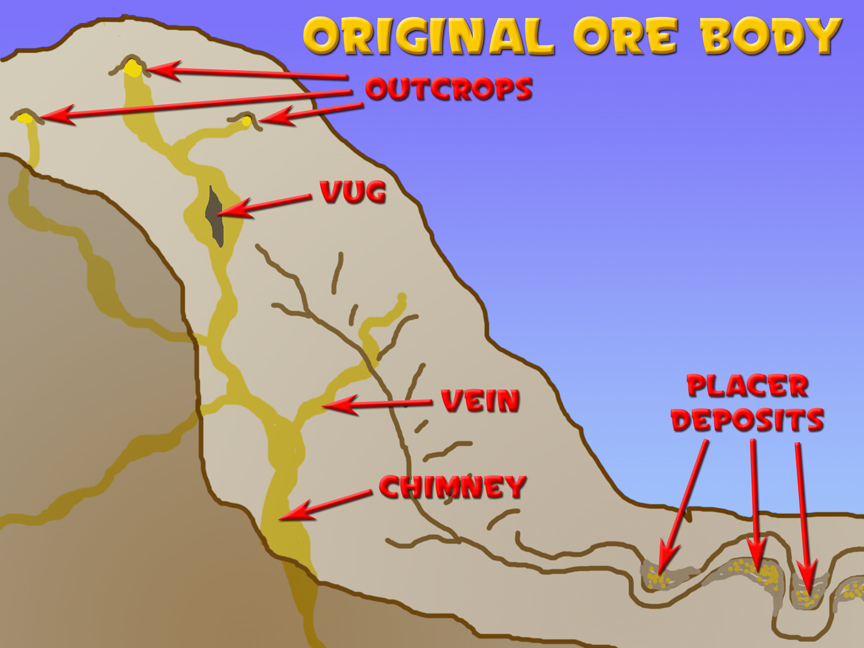
Ore body diagram

Diagram of the original ore body.

A “tunnel” is horizontal and must see daylight at both ends. If it only opens to the outside on one end, it is called an “adit.” If it doesn’t connect to the outside at all, it is a “level.” Levels are like the various floors of a building, only underground in a mine, and they provide access to the ore body. A vertical hole that connects with the surface is a “shaft.” If it is a hole that is dug down from a level or an adit, it is a “winze,” and if it is dug upward it is a “raise.” A hole dug to follow a vein horizontally away from a level or an adit is called a “drift” and to dig out a large ore body going up or down is called a “stope.”

The valuable mineral that you are trying to dig out is the “ore,” along with useless rock called “tailings.” Usually the ore is injected as a hydrothermal body along a fault or other natural zone of weakness in the rock, and the entire mineralized zone is called the “ore body” or “lode.” If it is found as a large vertical mass with branches, it is an “ore chimney” and if it is a thin line following any direction it is a “vein.” Sometimes ore is found as crystals deposited along the walls of a natural chamber. This is called a “vug.” When a vein reaches the surface, it is an “outcrop,” and when parts of the outcrop erode away and are carried down into river valleys by water, avalanches, and gravity it will pile up in still areas of the stream, such as the inner parts of meanders along with gravel. These are called “placer” deposits (pronounced “plah-cer” and not “play-cer”).

exploratory mining

Prospectors mine the placers and conduct exploratory mining

The first miners in a new mining district are prospectors, because they are looking to find, develop, and sell a good “prospect.” Typically the first discoveries are placer deposits, because they are easy to find and work using pans, rockers, and sluices. Once the placers are played out, the prospectors head upslope to find the source outcroppings, or the “Mother Lode.” Once they find evidence of ore (such as associated minerals like iron pyrite or chalcopyrite, quartz, etc.) they will “stake a claim” by pounding stakes in the corners of the land and starting to dig exploratory shafts or adits using hand tools such as picks and shovels. They will use a windlass to haul the “muck” or loose rock out of a developing shaft with a bucket. Claims have to be an allowed size (a long, thin swath of land) and registered in the county mine office to be legal. It’s good to set up with a partner so that when one of you leaves to register a claim, the other can guard it from “claim jumpers.”

Samples of the ore are taken to an “assay” office where they are analyzed chemically to see how much valuable metals are actually in the ore. If the ore is rich, or “high grade” or if the vein widens and appears to continue, the prospector will usually sell out to a mining company with the resources and capital needed to further develop the mine.

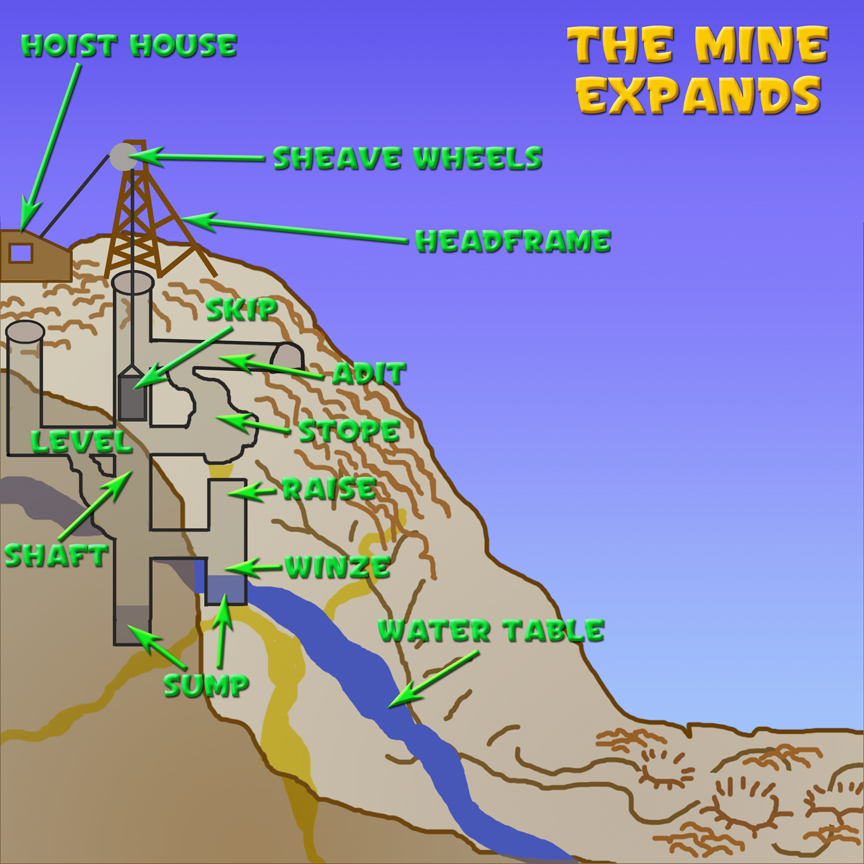
Once the mining company buys out the prospectors, it starts to build the infrastructure needed to enlarge the mine. The irregular prospector shafts and adits are enlarged and shored up with timbers. The top of a shaft is boxed in with a “collar” and an adit’s entrance is shored up and extended outward to prevent loose rock from falling into it. This becomes a “portal.” At the top of a shaft, a “headframe” or “gallows frame” is erected out of large timbers or steel with pulleys called “sheave wheels” at the top. A braided rope or cable is brought over the sheave wheel and attached to a metal cage called a “skip” which can carry men or ore buckets in and out of the shaft. The other end of the cable is brought to a “hoist,” which is an electric or diesel winch. As the skip is raised and lowered in the mine, a series of electric bell chimes are used to signal the “hoistman” how far to raise and lower the skip. A mark on the cable tells the hoistman when the skip is “on the level.”

mine expands

After a mining company buys the prospect, it expands the mine and adds infrastructure

As the mine deepens, it will usually encounter underground aquifers or water tables which become a major problem as they start to flood the lower mine shafts. The main shaft must be dug lower than the lowest level and a pump installed to remove the water. This low-lying shaft is called a “sump” and the pumps used ran on steam, diesel, electricity, or compressed air. The biggest of these were the famous Cornish pumps found in some mines.

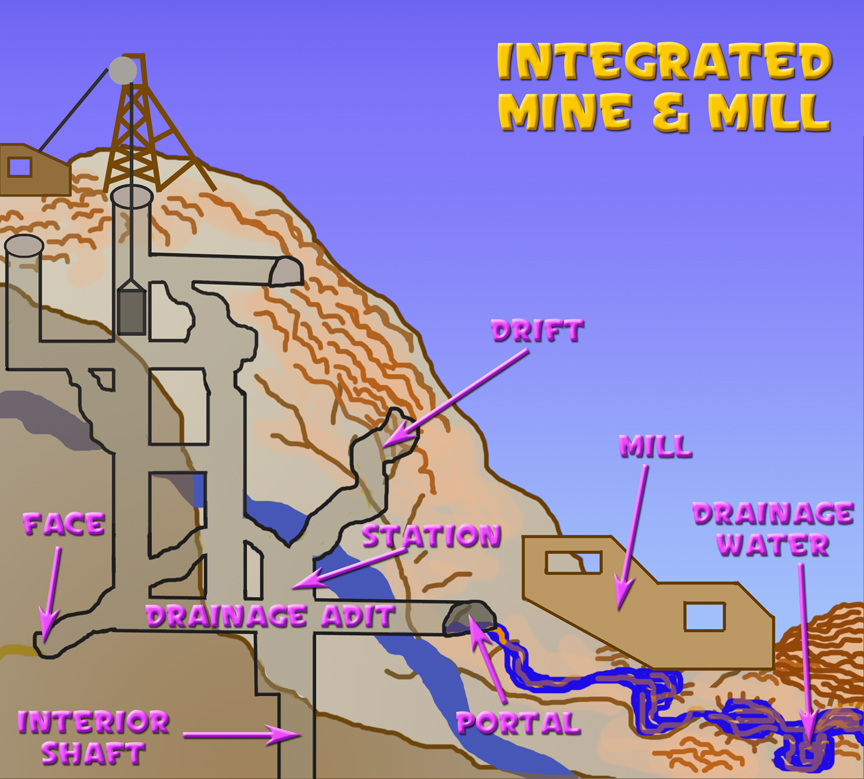
Eventually the shafts are too deep to economically raise all ore cars, sump water, and men to the top of the shaft. A drainage and ore removal adit is sometimes dug at the bottom of the mine that will drain out the waste water and allow easy passage of ore cars out of the side of the mountain. These adits usually have a slight downward slope to the outside so the loaded ore cars can be more easily moved. Waste rock was simply dumped out of the shaft or portal and created a “tailings pile” downslope from the mine or mill.

integrated mine

Integrated mine and mill. As the mine develops, drainage adits, interior shafts, reduction mills, smelters, and other structures are built.

As the mine gets bigger, with additional levels every 100 feet and a complex set of drifts, adits, winzes, raises, interior shafts, stopes, etc. it becomes advantageous for the owners to build their own mill instead of sending their ore elsewhere for processing. A mill is built on the side of the mountain below the lowest portal. It first sorts, then pulverizes the ore into powder, then concentrates the ore mechanically or chemically. The concentrate is then shipped by rail to a smelter for final processing and purification. Sometimes the concentrated ore is heated in a retort or furnace but not separated into its final constituent metals. This combination of metals is poured into bar-shaped or cone-shaped molds and cooled, creating “dore bars” or “buttons” which contain gold, silver, and other metals.

Once the mine is exhausted of ore, or the shaft extends down below where it can be economically drained of groundwater, or the price of the final metal drops so the mine can no longer turn a profit, it is closed down (sometimes temporarily). Today, mines have to post bonds that force them to reclaim the mine and make it safe once mining has concluded. But in the old west, the mines simply shut down and left everything where it was. Tailings piles are the most obvious evidence of mining, and the rocks are often stained a yellow, orange, or reddish brown color from iron sulfides and sulfates. Rotting timbers poke from the ground, and rusted metal scraps adorn the slopes. Drainage water still seeps from adits, often contaminated with metals or other effluents. And the shafts and portals remain, too often a temptation for the unwise to explore. A few people die each year from cave ins while exploring old mines, or get killed by handling old dynamite left in mines. In some states, such as Utah, a concerted effort is underway to close all of these abandoned mines in the name of public safety but at the expense of history. Other states, such as Colorado, seem to strike a better balance between history and safety.

Mining terms B

More mining vocabulary terms. From the Creede Underground Mining Museum.

Now there are many more terms, such as how a typical miner spends his shift to drill, load, shoot, and muck the face. We’ll talk about these later as they come up on my journey. I’m amazed at how many mining terms have made it into general vocabulary, such as “big shot” [blasting out a large section of the face], “hang-up” [when ore is blasted to fall into a lower chute but gets stuck], “getting the shaft” [to buy a worthless mine], etc. For better or worse, hard-rock mining has had a big impact on our history and our culture.

Read Full Post »

About a year ago I wrote a post about the grant game. Since returning from the NSTA conference in Indianapolis I have been writing as many grants as I can, both medium and large. Altogether, I have written seven different grant or program opportunity applications since September 2011. I have been quite successful this year, winning three of the seven.

The first success was to be selected, along with Carolyn Bushman of Wendover Jr./Sr. High School, as an Airborne Astronomy Ambassador for NASA’s SOFIA project. Much of the details are on my other blogsite, www.spacedoutclass.wordpress.com, since it is about astronomy instead of the chemical elements. I found this out in January, and was even interviewed by the local Fox news station (but the story never aired). From February through May I prepared for this opportunity by taking an online astronomy course through Montana State University. We will be flying aboard SOFIA (the Stratospheric Observatory for Infrared Astronomy) sometime this school year. We are still waiting to hear which group of astronomers we will be teamed with and when we’ll spend a week at NASA’s Dryden Flight Research Center preparing for our night flights.

what if prize winner

Website describing my lesson plan for the What If Prize competition

The second success I had was the What If Prize competition. It involved writing and submitting a lesson plan related to astronomy that also involved engineering, math, and technology. I figured my chances were small, given it was an international competition, but it gave me an excuse to update my lesson plan on using trigonometric parallax to measure the distance to nearby stars. I was very busy all last fall editing a video for the Utah School Boards Association and finally got the video done and sent to the DVD duplicators three days before the What If deadline. I had two days to re-write the lesson plan, create new graphics, etc. and submit the whole thing right at the deadline (Dec. 31 at 12:00 midnight). I heard people shouting “Happy New Year!” as I hit the submit button. Then four months passed with no word and I had almost forgotten about the whole thing. I had finished the new version of the lesson plan, which was my real goal. But then, in April, I received an e-mail that I won first place! Here’s the website:  What if Prize announcement.

The award includes a $2000 stipend toward professional development costs. They gave a list of possibilities to apply to, and one certainly caught my eye: a week-long workshop on astrobiology in Hawaii.! But the deadline for that had already passed (Drats). I decided to create my own professional development opportunity and do something to advance the Elements Unearthed project and this blog. I have been neglecting it lately as my teaching career has moved more towards astronomy and astrobiology, but now I have the funds to come back to the story of the elements.

This is what I have decided to do: take about $1750 of the award and use it to travel through Colorado, visiting mining towns and taking as many mine tours and visiting as many museums as possible over a two-week period, documenting the whole thing on video. I have wanted to do this for several years, and did accomplish part of it two years ago when we visited Cripple Creek Mining District in 2010. The remaining $250 will be used to learn how to program apps for the iPad and how to write iTexts.

One of the sponsors of the What If competition is MIT BLOSSOMS, a program to create a series of STEM lesson plans on video that can be distributed freely online and in physical form to worldwide audiences, especially to schools in other countries that may not have Internet connections. I’ve spoken with Dr. Dick Larson at MIT about my parallax lesson plan, have written up an outline and complete script, and began filming it in June (the outside shots). I’ll continue to film it this August and September as my astronomy class begins. It was interesting figuring out how to use Walden School’s building as part the setting for the video, but the final results should be fun.

ACS Hach website

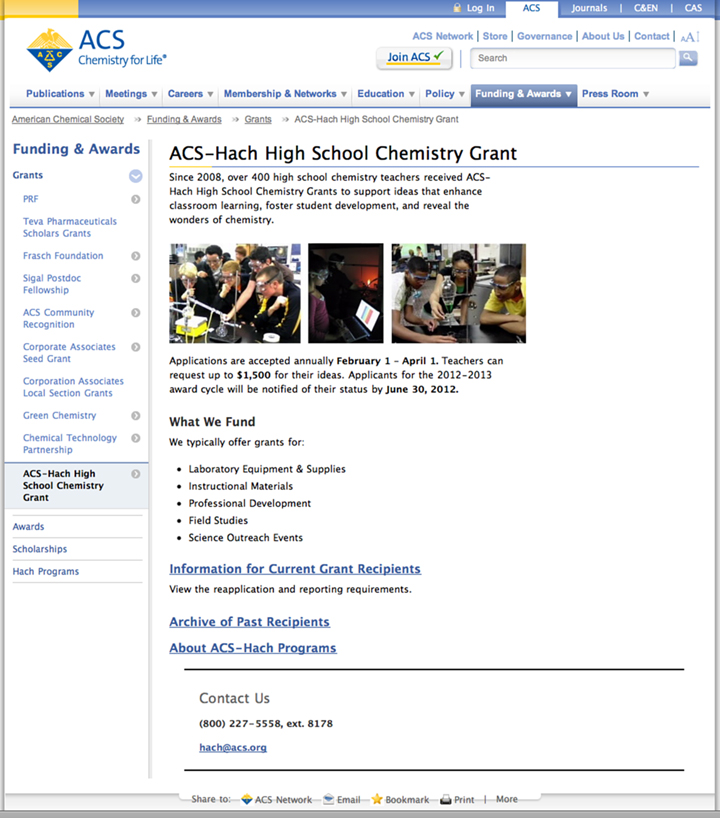
Website for the ACS Hach grant award. This year’s winners have not yet been posted.

My third success I found out in late June. I had applied to the American Chemical Society for the ACS Hach grant for $1500. We have been selected! (The website URL is ridiculously long. You can Google “ACS Hach grant.”  They should announce this year’s winners soon). It will allow me to move forward finally on the project to document the Tintic Mining District and to test the effectiveness of the EPA Superfund clean-up there. We will collaborate with Greg Thornock of Tintic High School, and our students will work together to do two things: to collect and analyze soil samples inside and outside the remediated zone to see if contamination still remains; and to interview local residents, collect photos and stories, and use it all to complete the video my students at MATC began in 2009. My ultimate goal is to edit and produce an hour video in three segments, on the early years (1869 to 1893), the middle years (to 1955), and the later years. Hopefully it will be good enough to air on KUED, Salt Lake City’s PBS station.

These last two successes will provide a great deal of material for this blog and for my chemistry class. Over the next several months, I should be adding at least three posts per week, as well as guest posts from my students. This has already been an incredible year, but my astronomy and chemistry students will have a rich selection of projects to work on and a chance to do some real science. I’ll report our efforts here.

Read Full Post »

Soda springs palms

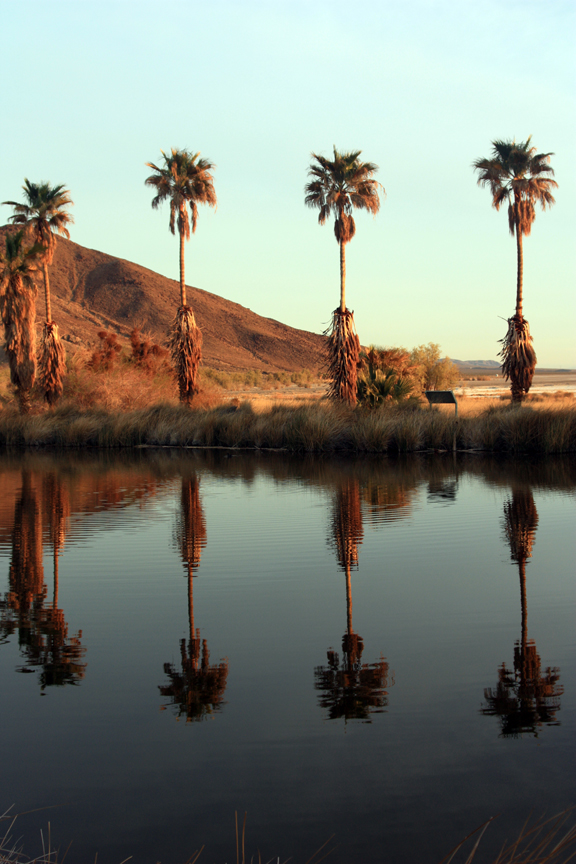
Palms planted at Soda Springs on Zzyzx Road

In this blog, I have been reporting on activities we did during the Mojave field study that have to do with chemistry and the elements, but since the purpose of the field study was to look at Earth analogs for possible Martian organisms, much of what we did is and will be recorded on my other blog site (www.spacedoutclass.wordpress.com). I will do much more with that site in late July as I prepare to teach astronomy this fall. At that point, the “wordpress” portion of the URL will be eliminated and the site will go “live” so to speak. I have many topics that need to be written about, including more on the Mojave experience.

Preparing the weather balloon

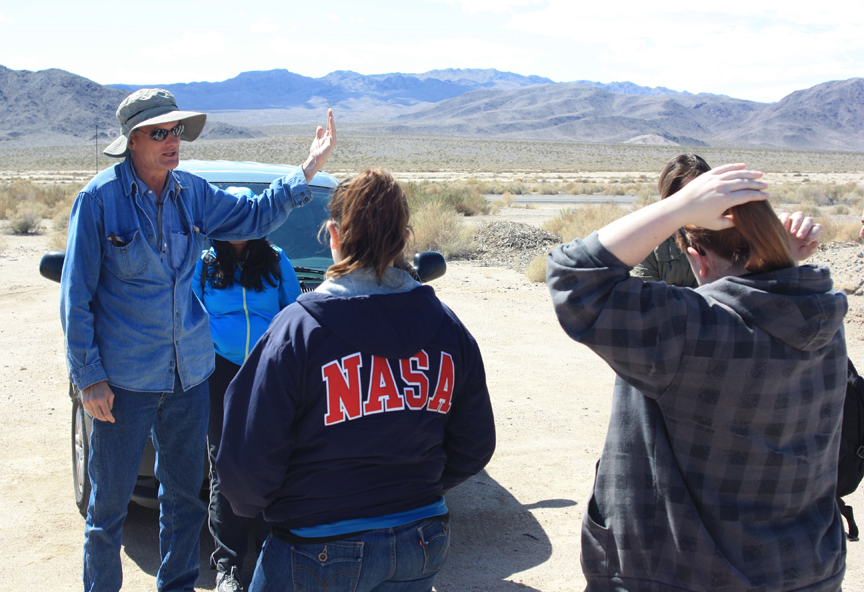
Chris McKay (in denim jacket) and CSU students preparing the weather balloon for launch.

But meanwhile, our last day in the Mojave was Friday, March 23. We prepared and launched a weather balloon, then each group presented their interim reports on the results of the study. I helped Mary Beth talk about the geology and soil chemistry analyses, and I also presented the 3D model of the test soil sample I worked on with Geoff Chu and his group (more on this in the other blog). I plan on having students at Walden School take the grayscale images and the actual altitude data and create 3D models and textures for each crust site which can be manipulated online.

I also took the opportunity to interview Dr. Rakesh Mogul, who was with CSU and is the organizer of this event, but is now moving to the NASA Office of Planetary Protection. He talked about the protocols that NASA uses to determine now clean a space probe needs to be so as not to contaminate a planet with our microorganisms and so as not to mess up our science results when looking for life.

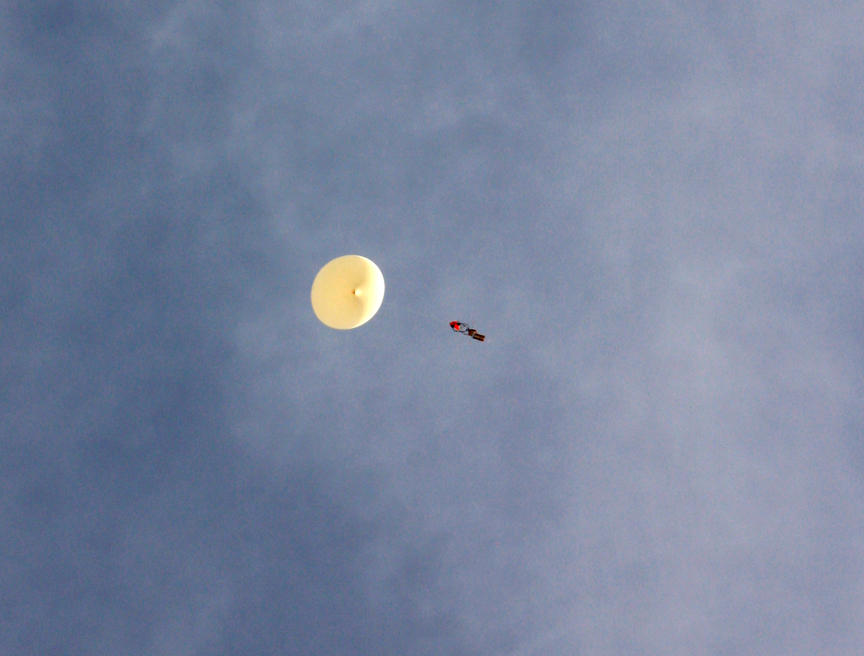
Weather balloon

Weather balloon after launch.

Once I had packed up my video equipment and other gear, I drove back to Utah, stopping in Las Vegas to drive through on the Strip. It has been about 15 years since I’ve actually done this, and it’s changed quite a bit – gotten larger, more crowded, and not very enticing for me, since I don’t gamble (I’ve taken too many operant conditioning classes in college to ever do that). It was a long drive back, but the trip was very much worth it. All told, I took about 15 hours of video, which will now take some time to capture and edit. I hope to do at least some of it (the interviews) this summer.

I wasn’t home for long (about four days) before I flew out to Indianapolis for the annual National Science Teachers Association conference. Much of what I did there was related to space science and astronomy (including attending a luncheon where an astronaut spoke; the awards ceremony for this year’s Mars Education Challenge, where I was asked to be the official photographer while Bill Nye introduced the winners and handed out the awards; and my own presentation on the SOFIA Airborne Astronomy Ambassadors program). However, I did attend a number of excellent sessions that were related to chemistry and the elements.

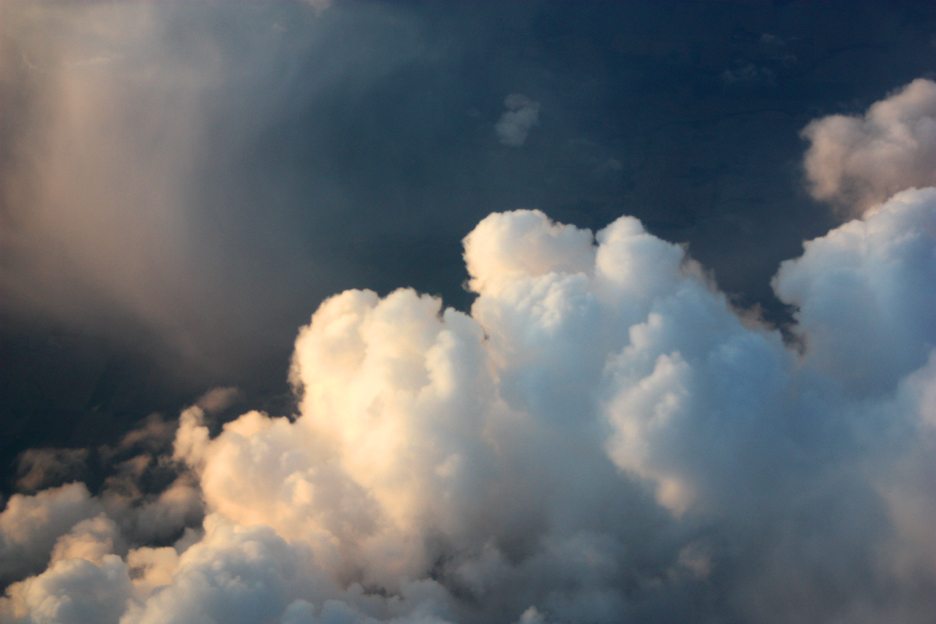
Above the clouds

Above the clouds on the way to Indianapolis

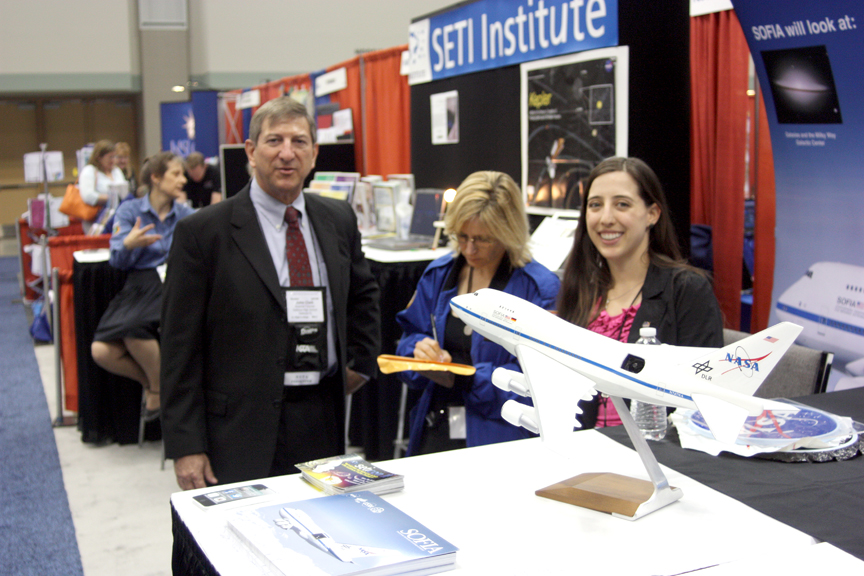
On Thursday, March 29 I had to take the local buses from my motel out by the airport to downtown, and I was slightly late for the bus and had to wait 30 minutes for the next one, so I was a bit late getting into the conference. I went to the first session I could find in the booklet that was near where I was standing in the convention center and that sounded interested. It was a presentation on an activity that introduces the periodic table to students. The room was packed and I had to sit on the floor while the presenter talked. Something about him looked familiar, and suddenly I realized that the presenter was John Clark, a fellow SOFIA AAA. I had seen his photo on the discussion board.

John Clark and the SOFIA team

John Clark and the SOFIA team from NASA Ames and the SETI Institute

His activity is done early on in a chemistry class, and involves handing 3 x 5 index cards to each student. They decorate their card, choose a name for their personal element and a symbol, then decide on properties of their element that describe their own personalities from a list, such as “science nerd” or “techy” or “drama king.” Other properties could be chosen from a list, such as number of electrons, etc. The students group themselves into “element” families according to the properties they selected, such as the colors they choose. From this they create a type of periodic table of their class, which the class as a whole has to discuss and justify. Not only does this get the students thinking about elements, properties, symbols, and other aspects of the periodic table, but it helps the teacher get to know the students better.

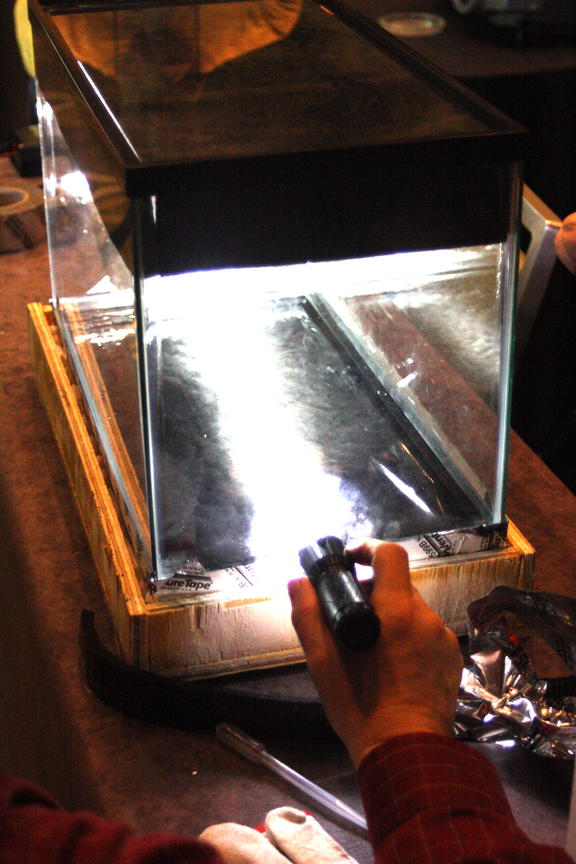
cloud chamber

Cloud Chamber

I also attended a session by April Lanotte on how to build your own cloud chamber, which worked quite well. I’d tried to do this with a kit in the past, but could never get it to work. The secret is to not allow any air in or out as the internal air must be saturated with alcohol fumes and cooled with dry ice before stray cosmic rays can be seen or radiation from an alpha or beta source as vapor trails in the alcohol gas. She had built hers out of an aquarium that was carefully sealed. She also showed us amore sophisticated digital cosmic ray counter. She is an Einstein Fellow this year, and I also attended a number of sessions on that program and on the Presidential Award program.
Another session I attended was by L. Diener (I didn’t catch her first name) on the science of chocolate. Since my students and I just finished videotaping a tour of Amano Artisan Chocolates in our town (more on this later), I was interested in attending and she presented a simple activity about solubility and chocolate. Take a piece of chewing gum, such as candy coated Chiclets, and chew it for a few minutes until the flavor begins to decrease. At this point your saliva has dissolved all the sugars and flavors that are water soluble. Then take a Hersey’s kiss and chew it with the gum. Suddenly the remainder of the gum dissolves in your mouth, because the chocolate’s cocoa butter will dissolve the remaining fat soluble portions of the gum. But as soon as the chocolate has melted and dissolved in your mouth, the gum will start to re-solidify, although there will be less of it. It can be a big gross to feel this happening in your mouth, but it is a great way to talk about food science and how various substances do or don’t dissolve in each other.

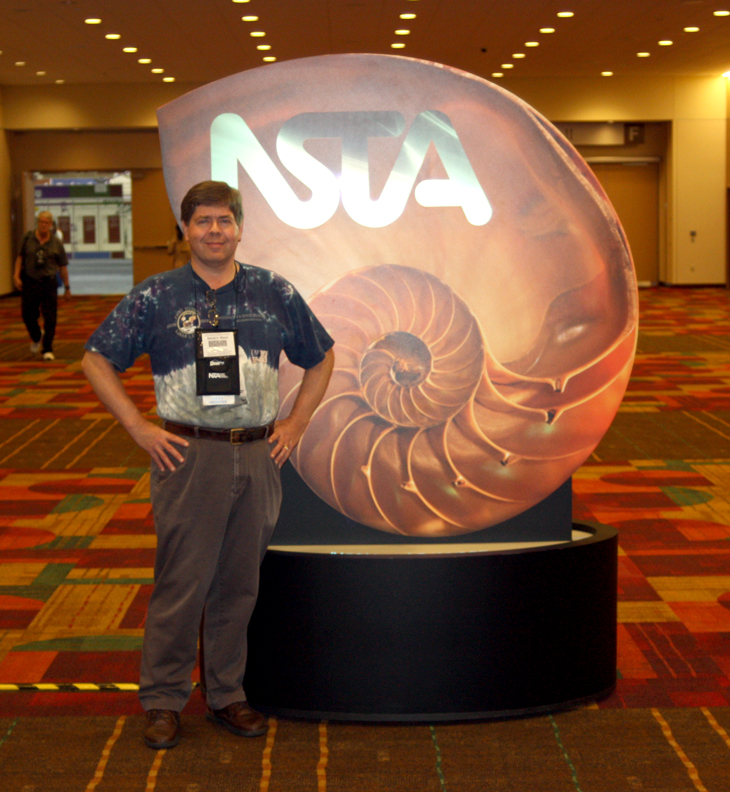
David Black by the NSTA sign

David Black by the NSTA sign, Indianapolis Convention Center.

It was a busy conference. I walked through the dealers’ room and priced sensors and probeware for both the Vernier and Pasco systems, hoping that I’ll get some grant money to be able to use sensors with an iPad. I ran into old friends, such as Martin Horejsi (we were on the same flight going to Indianapolis, as he has to fly to Salt Lake from Missoula to pick up most connections) and Eric Brunsell. They were the only people from the Solar System Educators Program that I saw. But I did get to know some of my new associates, the SOFIA AAAs.

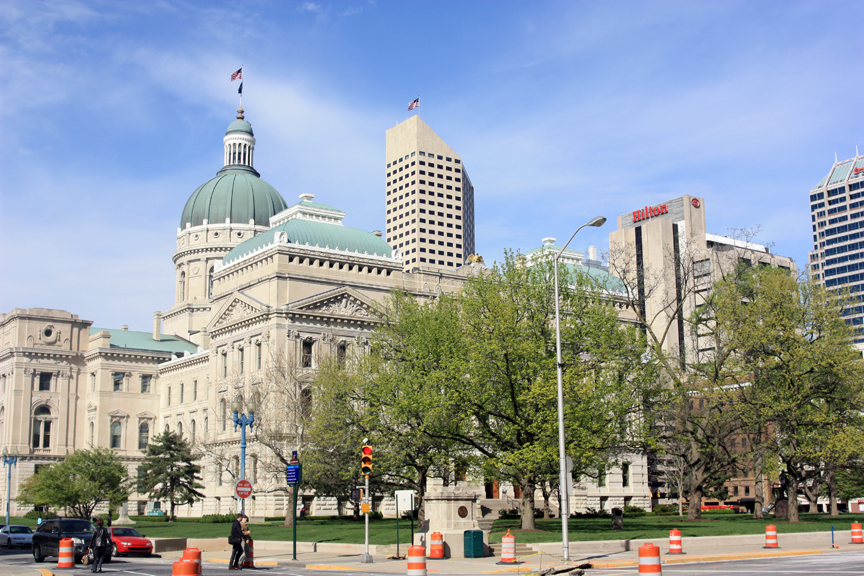
Downtown Indianapolis

Downtown Indianapolis


I did get a chance to do something quite unusual. I was selected (how I don’t know) to sit in on a panel discussion on NSTA’s The Science Teacher journal and on the NSTA website. We were given a nice luncheon, then were asked a series of questions by Tyson Brown, whom I had known before back when I was doing the NASA Explorer Schools program. It was a fascinating discussion, and I put in a plug or two for Martin and Eric’s column (Science 2.0). There were several people in the back of the room writing notes, and one looked familiar. Once we opened up the journal and started going through it, I realized who he was – Steve Metz, the editor. I have decided that I really must submit an article as soon as possible. But my schedule has become so crazy that I’m not sure when that will be or which of several possible topics to write on. For our participation in the panel, we also received a $50 certificate to use in the NSTA bookstore.

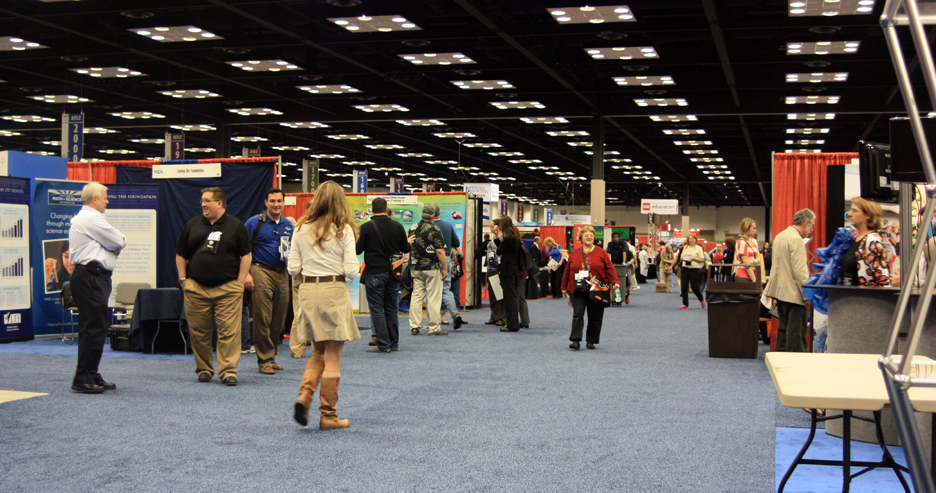
Dealer room at NSTA conference

Dealer room at the NSTA conference. Eric Brunsell is in the black shirt at the left of the photo.

Much of what I did and learned will be written (eventually) on the other blog site, as it is more related to astronomy than chemistry. There is, however, one other presentation I went to that I want to discuss here, and that was a lecture on ingenuity and creativity given by author David Macaulay. He is writing a book on how ingenuity has brought about marvelous ideas and inventions through the ages, and he basically walked us through his own creative process in developing the book. When I first started teaching in California, I taught world history for several years and used films based on his books Cathedral and Pyramid in my classes. They were very well done, and he has since created such books as The Way Things Work.

Between this lecture and the panel discussion luncheon, I did a lot of thinking while waiting for the bus on Sunday morning (only to find it doesn’t run on Sundays, so the motel’s shuttle van driver took me downtown instead). But while waiting, I thought of several ideas for books and series of books I could write for NSTA Press, such as how to use authentic science data in the classroom. I’m doing more of this all the time, and many of the sessions I chose to attend were based on real data analysis. I realize that in some ways what I am doing is unique, since I blend science and computer graphics/3D animation technologies. Yet the one session I attended Sunday morning was all about this – the art of science, and Randy Landsberg of the U. of Chicago showed examples of collaborations between artists, the Kavli Institute for Cosmological Physics, and the Adler Planeterium, including an incredible animation taking the viewer to the edge of the universe and another showing cosmic ray showers from the Pierre Auger data. I scribbled notes as fast as I could, and I still need to check up on all the possibilities. It was invigorating to see that others are pushing the edge and blurring distinctions between art and science, which is one of my goals as well.

It was an incredible conference. I was very involved, learned much, brought back many ideas, and made good connections.

Read Full Post »

Soil Samples Context

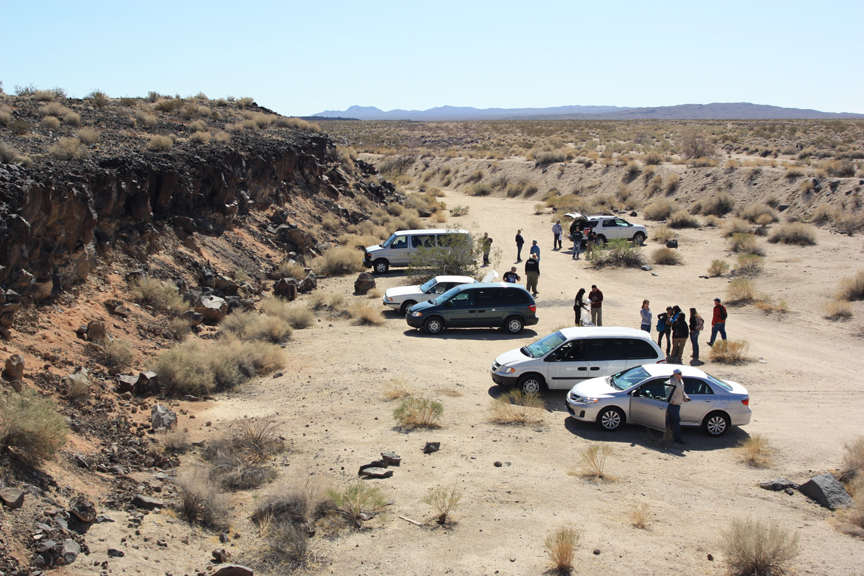
Sites for our soil samples: Site 1 was on the side of a hill (where people are gathered) and Site 2 was in the wash at the foot of the hill.

On my fifth day at Zzyzx Road (Thursday, March 22) we turned our attention to the soil mechanics and chemistry of the Mojave National Preserve. We traveled with soil experts from the Natural Resources Conservation Service to conduct several digs of soils typical of this area.

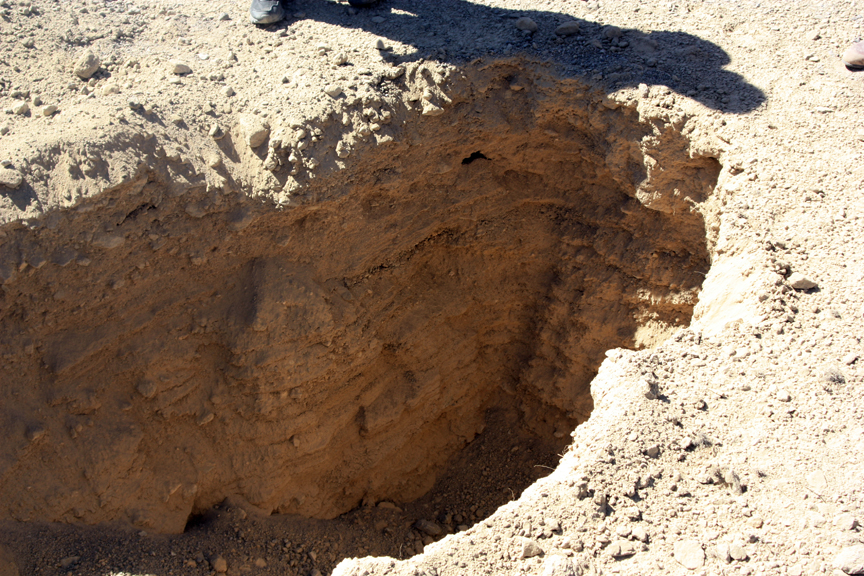
Soil trench 1

Soil Trench 1. The lime layer is about 6 inches down.


About one mile off I-15 along the south side of Zzyzx Road we climbed a low hill and dug a small trench into the soil about three feet deep, keeping the upper slope sharp so that we could look at the soil profile. At first glance this hill would seem to be volcanic (that’s what I thought as I drove past it coming in) but it had a mixture of rocks carried down to it from uphill, and the hill itself is probably an erosional remnant. Across the freeway we could see similar layers, mostly ancient, tilted limestones.

Soil site 1 group

Group at Soil Site 1

Digging down, we found fairly well sorted layers, some containing mostly sand, others small pea gravel, etc. About six inches down was a hard white layer that looked almost like chalk – which is what it basically turned out to be, as it fizzed quite nicely with a simple acid test. As the limestone uphill erodes, it dissolves into the runoff water and is carried downhill and soaks into the ground, turning into calcium oxide. But the rains here are so infrequent that the lime doesn’t soak in further than about six inches before it deposits out, much in the same way cave formations precipitate from solutions in caves. This hard, alkaline layer combined with low humus and low rainfall makes this soil inhospitable to most plants, but there are a few that manage through some remarkable adaptations.

Soil trench 2

Soil Trench 2, in the wash near Zzyzx Road.

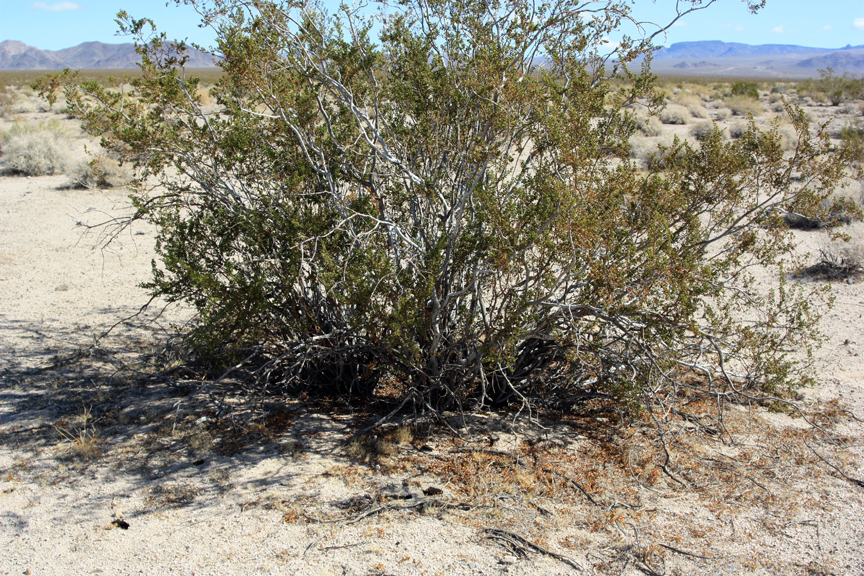
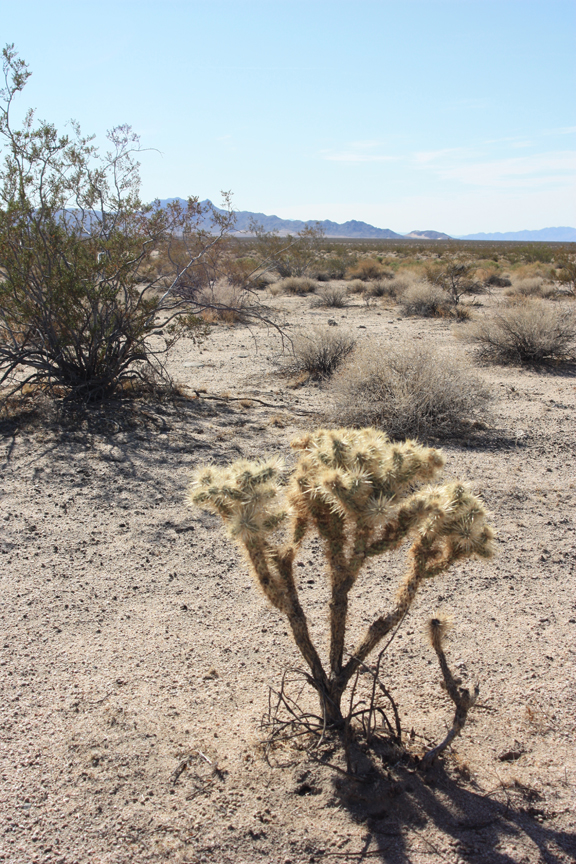
My personal favorite is the ubiquitous creosote bush. Each bush is an island of life, with small plants growing in the decayed material under the creosote’s shade. The creosote leaves are small and intensely green, covered with a pungent waxy sap that prevents evaporation. This chemical is extracted and used to coat railroad ties to prevent them from rotting. Its most amazing adaptation is the root system, which extends into the soil through the lime layer and down about 12 feet, spreading out underneath. This is why creosote bushes don’t grow in clumps but are separated by about 12-20 feet on average. This huge system of fine roots is able to draw out any moisture that exists in the soil. We saw the roots extending down through our profiles, forming an important part of the desert ecosystem.

Creosote bush

Creosote Bush at Intermediate Crust Site

We also used a backhoe to dig a trench into the soil in a nearby wash (which had some young soil crusts beginning to grow). We used soil sieves and water to separate the materials and get a rough estimate of the abundance of sand, silt, fine pebbles, and rocks. This data is being used to map the soils of the Mojave Preserve, much as geologists have already mapped out the rock outcroppings. On a geological map, the valley floors are simply listed as “unconsolidated fill.” These studies will help add more detail to the maps.

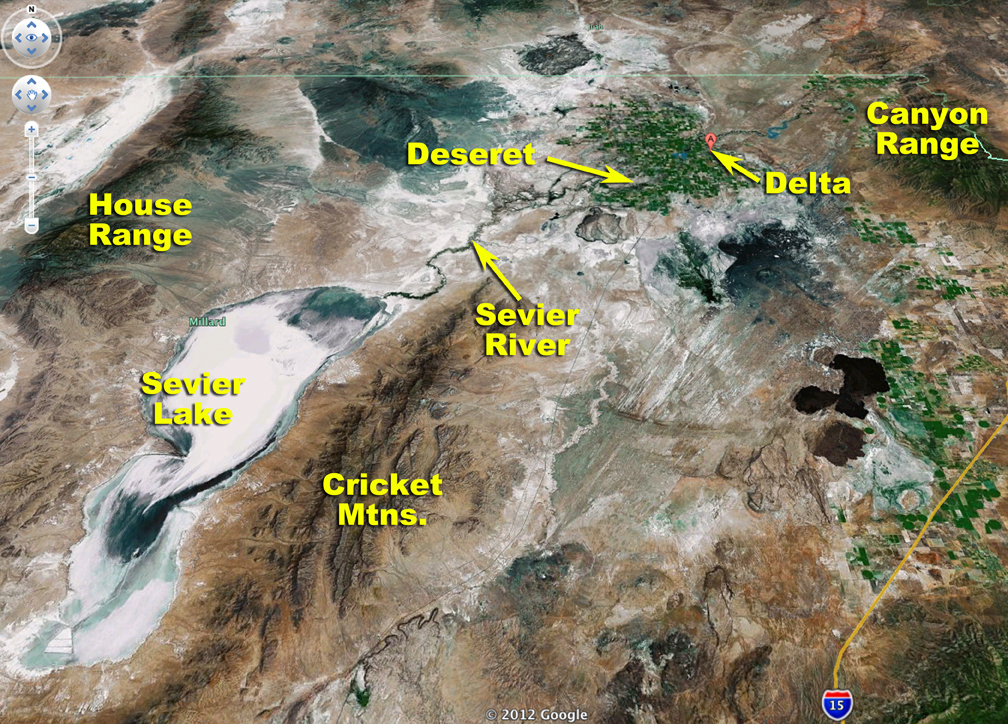
I find myself drawing comparisons between the soils here and what I grew up with in the Sevier Desert of western Utah, part of the Great Basin province. My hometown of Deseret lies on an ancient delta of the Sevier River, and the river runs through it (right past our house).

Millard County features

Features along the Sevier River drainage system in Millard County, Utah.

In the past, before being used for irrigation, the river would see large spring runoffs since it drains a large area of central Utah. In fact, if you stand on the ridge at the top of Bryce Canyon National Park, everything in the canyon and beyond drains into the Paria River and eventually into the Colorado and to the Sea of Cortez. Everything behind the ridge drains into the East Branch of the Sevier River. This ridge is a watershed divide. The West Branch drains the back side of Cedar Breaks and Panguitch Lake. The river then travels along U.S. 89 to Yuba Lake, where it hooks through Leamington Canyon and then southwest past Delta to the Gunnison Bend Reservoir and on through Deseret, eventually ending in Sevier Lake, which now is mostly dry.

Before irrigation, the river cut a series of distributaries as it left the bluff north of Delta, and it was a large runoff that cut a new channel one mile north of the first settlement of Deseret, leaving the town high and dry. The Old Mud Fort is actually on the north side of the old settlement. The town was mostly abandoned, until my own ancestors came from the area at the mouth of Zions Canyon to resettle Deseret at its present location. Yet the river is still not entirely tamed. In 1983, a very large runoff caused a dam north of Delta to burst and Deseret was flooded. I spent much of the remaining summer cleaning up the mess. We had an even bigger runoff last year (2011) but we’ve learned a few lessons from the 1983 flood and were able to make room for all the water, even allowing some of it to flow unused down to Sevier Lake.

All this runoff took any minerals from the central Utah region, including large salt and gypsum layers near Richfield and Salina, and deposited them in the soils as the water spread out, leaving high salt and alkali content. I’ve tested the soils around Deseret and my father’s farm and they average a pH of about 8-9 (in some places almost 10). The alkali creates white-rimed hardpans in places where nothing will grow and only alkali bees can live. The Sevier River water has about the same pH – after being passed and drained through farms all along the river, it is very brackish by the time it reaches us. It’s a miracle that anything can grow besides greasewoods and rabbit brush, yet with crop rotation and fertilizers, along with drainage channels and an excellent irrigation system of canals and ditches, we are able to grow good crops of alfalfa, corn, and grain.

Delta to Deseret Utah

Area around Delta and Deseret, Utah.

But the soil chemistry does exact a toll. The ground water aquifers that we used for drinking water not only had a high level of natural fluoride in them (we’ve got tough teeth) but were found to have high levels of arsenic salts as well. No one knows the original source of the arsenic, just that it’s there in the groundwater. New wells had to be drilled that went deeper, beyond the contaminated zone, and a town water system installed instead of individual family wells.
My chemistry students sometimes wonder what chemistry has to do with them. I point to the example of arsenic in my groundwater as just one way that the elements have affected me.

Read Full Post »

Chlorophyll analysis

Dr. Rakesh Mogul and students conducting chlorophyll analysis of soil crust samples using IR absorption

On our fourth day at the CSU Desert Studies Center on Zzyzx Road, we continued our analyses of the biological soil crusts and began to put together the results of our studies. The CSU students extracted chlorophyll from the crusts and the soils underneath, then measured amounts by looking at infrared absorption lines at several wavelengths that are characteristic for chlorophyll.

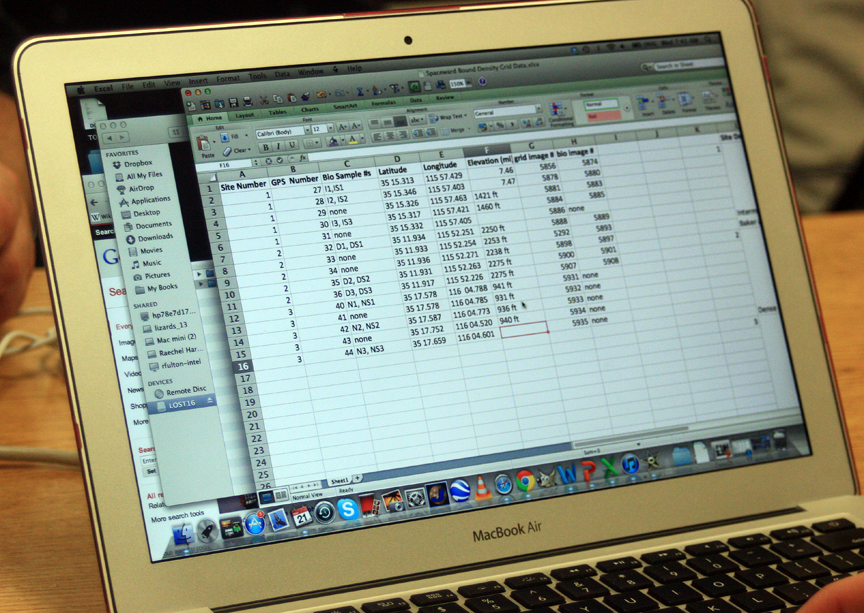
GPS data for soil samples

Mapping the GPS coordinates for our samples


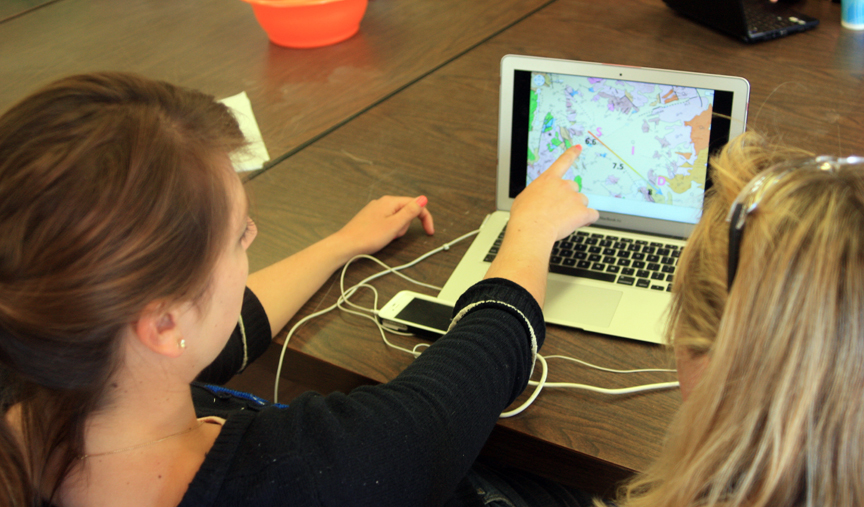
I helped Mary Beth start mapping out the trends we saw in the various chemical analyses of the soils at the three main sites. She did most of the work, looking up geological maps of the area around Baker and the various types of rock outcroppings and unconsolidated valley fill deposits, then located all our sample sites from the GPS coordinates we’d recorded on Monday and created gradient arrows across the maps showing how the various elements and compounds trended between locations.

geologic map of area

Charting soil chemistry changes onto a geological map along Kelbaker Road

Most of the trends were to be expected, but a few were surprising. For example, there was more aluminum and calcium in the soil at the low density site than at the other two. We joked that all the pop cans left as trash scattered around the low density site (which was near Baker) might have been the source, but of course that would be impossible – it would take a huge number of cans, completely oxidized away, to leave any kind of aluminum residue. So we looked at the maps for possible sources. This site was in more of a playa lake bottom and probably has more clay in the soil (which we can confirm with the soil mechanics group), and clay is an aluminum silicate. The calcium could come from nearby limestone deposits.

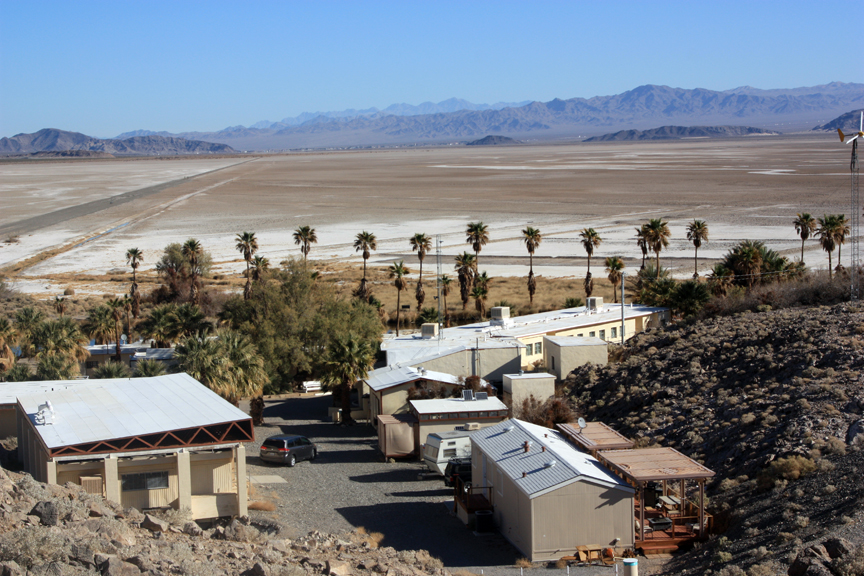
Desert Studies Center

CSU Desert Studies Center on Zzyzx Road in the Mojave National Preserve. Baker, CA is in the distance.

Overall, our project is a good example of how field research is carried out –you start with a question and a site to test it at, consider the possible ways to isolate the data you need from all the other variables in the environment (such as pop cans), come up with experimental procedures and protocols, then travel to the site, collect the data, conducting both field and laboratory analyses, then analyze the results and try to make sense of it all. It isn’t quite the formal scientific method we teach in middle school science classes. Often the statistics aren’t as strong as you would like because you’re using ANOVA (analysis of variance) or MANOVA (multiple analysis of variance) techniques. Since many different conditions are being tested, and you have to see how they all stack up and compare, often there are only a few data points per data set.
Soda Lake playa

Soda Lake playa in the Mojave Desert

It’s not as neat and predictable and controllable as a lab experiment, but it’s a lot more fun. For us, our biggest problem was trying to draw conclusions from the tests we ran, which were more qualitative and less reliable than we would like. The one test kit was designed for gardeners to use, and had test strips that only showed low, medium, and high results without any kind of ratio data. We also had some more individual tests for specific elements and compounds (such as chlorides or sulfates) that were a bit more numeric (at least they had scales) but not much more reliable. Often when we tried to do a sample a second time, the results weren’t very consistent. So we’d have to run the test a third time, or try to filter the soil better, etc. For our final results, we can’t rely on these inaccurate field tests. We’ll have to send the samples in for detailed lab analysis to find out the precise percentages of different elements. It will be interesting to see if our field results match up.

Borax stripes

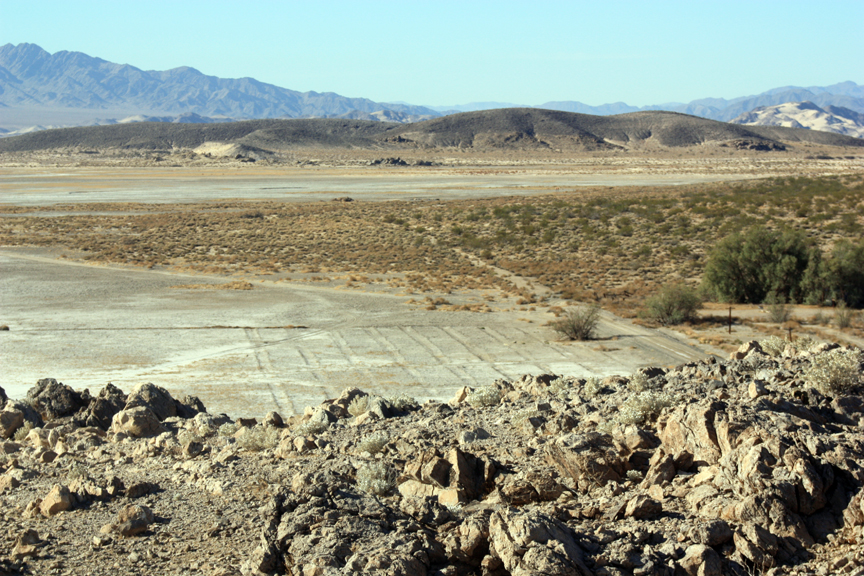
Stripes in salt falt where borax and soda have been scraped up.

I also took the opportunity to climb a low hill behind the lab with my camera equipment to get a good look at the surrounding desert. From up there, I could see back to Baker and I-15 in one direction and toward the Kelso Dunes and deeper into the Mojave National Preserve in the other direction. This research station was originally a way station on the overland stage route, then eventually became a center for borax mining. On the other side of the hill, parallel trenches can still be seen where the borax powder was scraped up and piled, to be shipped out by the famous 20-mule teams. This is the low point in this valley and a salt flat/playa lake surrounds the Soda Springs area. It probably looks pretty barren and inhospitable to most people, but this is the kind of scenery I’m used to growing up in the Pahvant Valley of western Utah, with Sevier Lake and frequent evaporated alkali deposits to the west of my father’s farm. The weather has gradually warmed up from the freezing wind that greeted me on Sunday night.

borax minerals

Borax minerals and a model of the 20-mule teams that hauled the borax.

The commons room has some displays showing borax crystals and brief descriptions of how the mining was done, as well as the natural history of the station with local flora and fauna. The boron compounds (usually borates such as sodium and calcium borate) are generally known as borax, and have many uses. Borosilicate glass is highly heat resistant and is used in chemical lab ware, where we know it as Pyrex. It is also being used to contain and store radioactive wastes; since glass is highly stable chemically, the spent nuclear fuel rods are mixed with the glass in the form of marble-sized spheres or as sheathed glass columns. Borax also helps to extend laundry detergent, and provides the green color for fireworks.

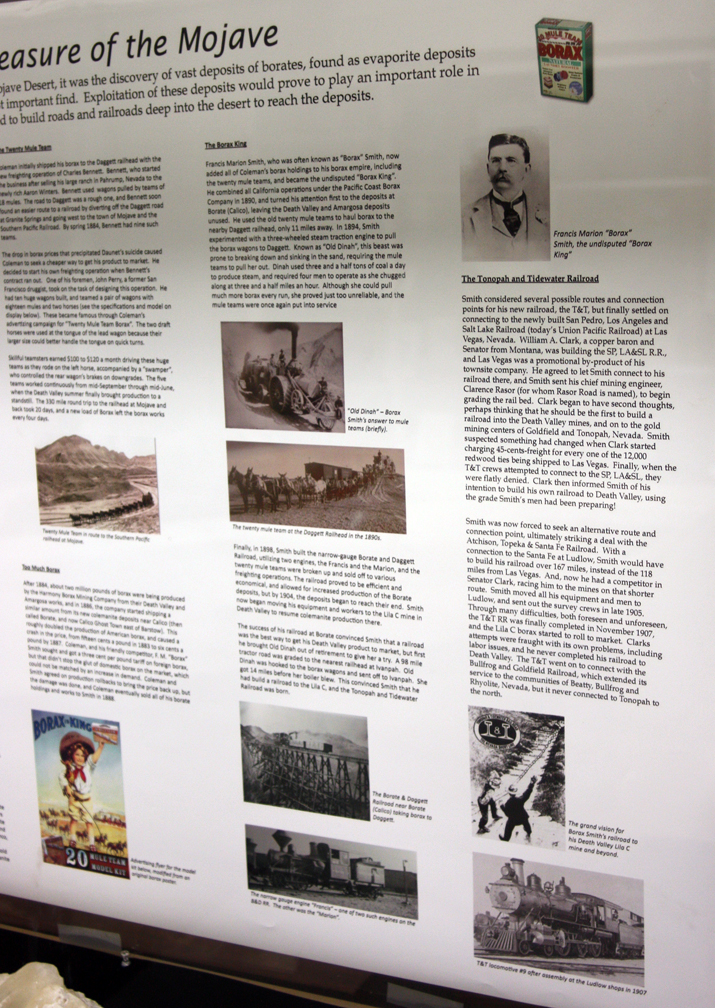
History of borax mining part 1

The history of borax mining, part 1

I use borax to create the cross-linked polymerization when I make “gak” in my chemistry classroom. Here’s the recipe: take two paper cups. In one, fill it about ¼ full of warm water and ¼ full of white glue, plus a little food coloring. In the second cup, fill it about 1/3 full of warm water and about 10-15 grams of borax powder. Stir it up well, then mix the two cups together and keep on stirring. At first it will be a sticky mess, but in a minute or so the cross-linking between the glue strands will begin and water molecules get trapped in the borate links, making the whole thing into a fun, gloopy concoction that can be kneaded and molded.

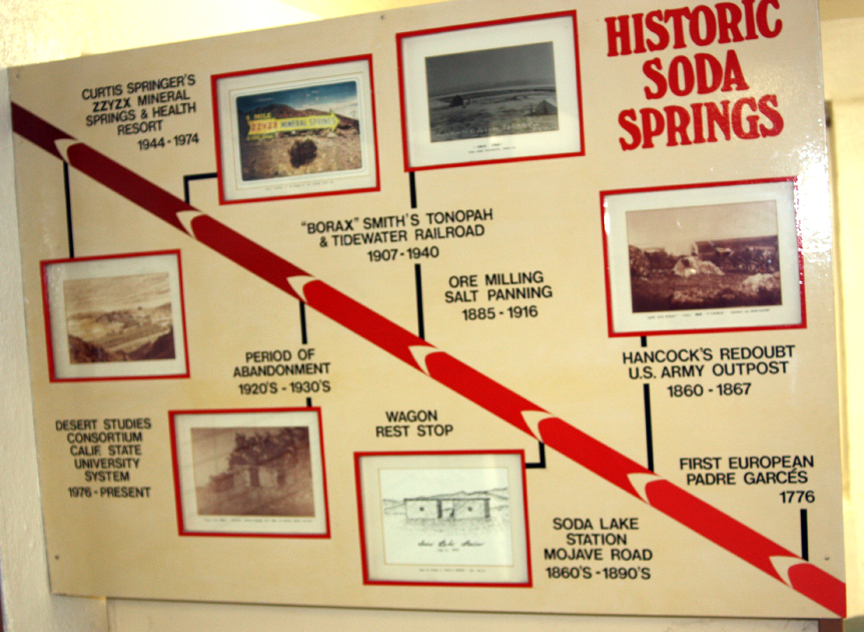
I am including here two photos of the poster that describes borax mining, which you can read to find out more of the history. I’ll create a dedicated post later on going into more detail after I do some more research.

Timeline for Soda Springs Station

Timeline for Soda Springs and Zzyzx station

History of borax mining part 2
History of borax mining, Part 2

Read Full Post »

Lab at Zzyzx

Lab Building at the Desert Research Station at Zzyzx Road, CA.

On this third day of our research project in the Mojave Desert, we did a series of tests on the biological soil crusts and soil samples we collected yesterday at three sites along Kelbaker Road near Baker, CA.

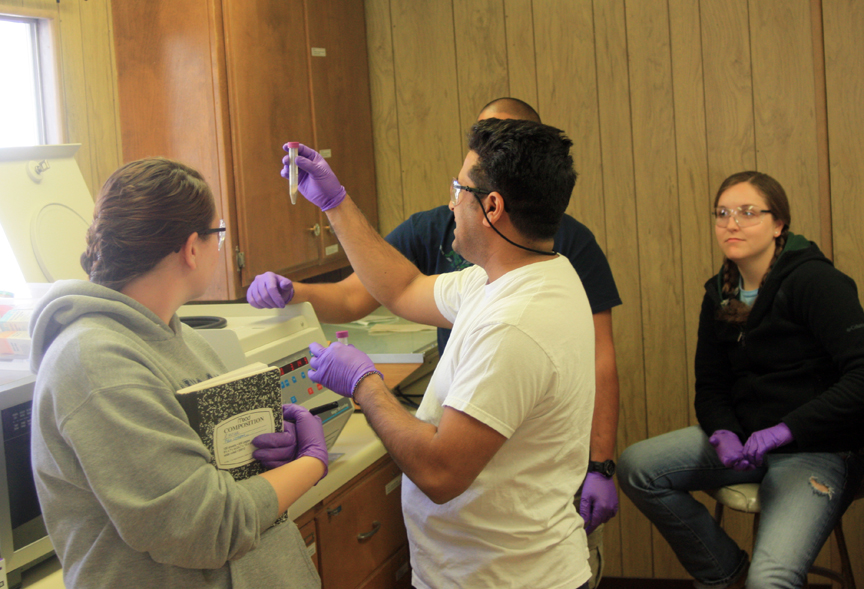
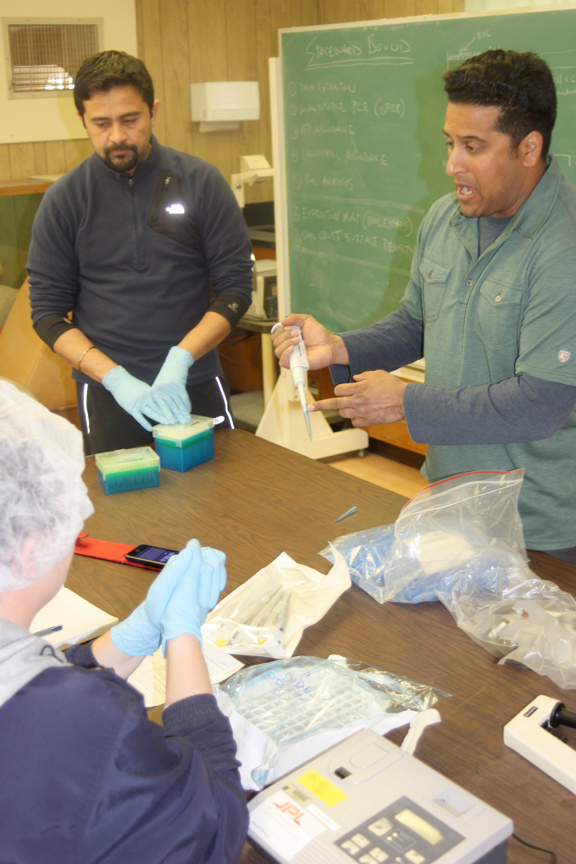
Parag and Rakesh

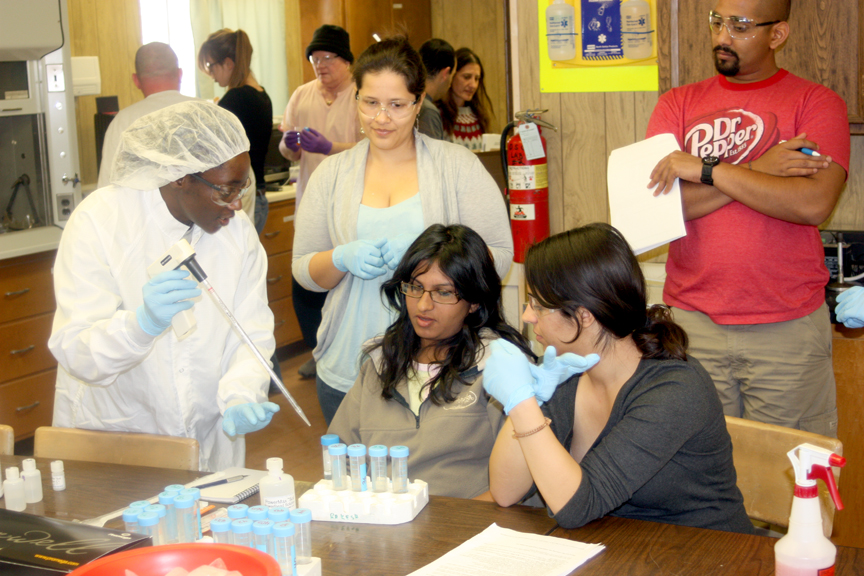
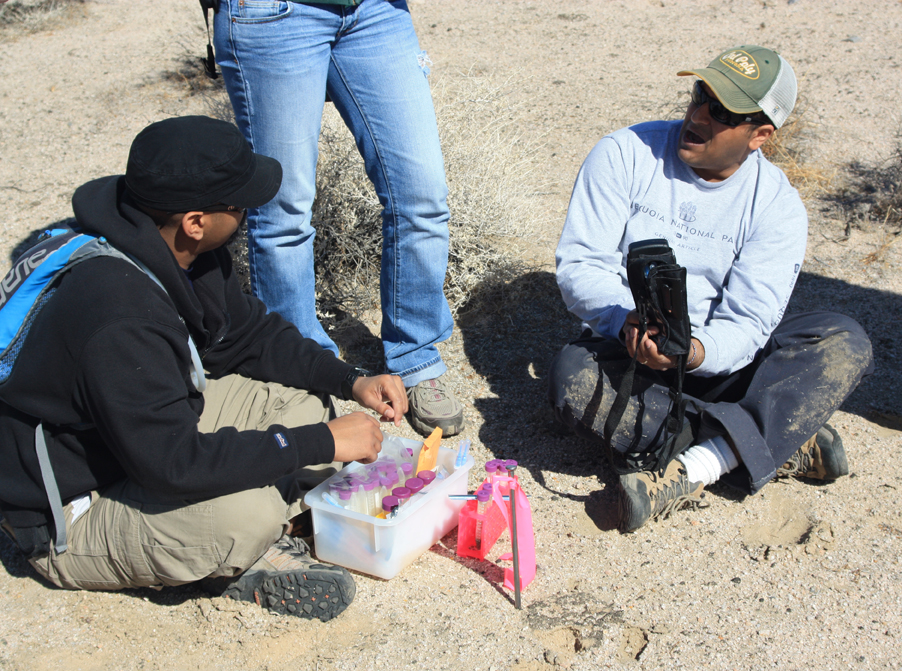
Parag and Rakesh demonstrate extraction protocols

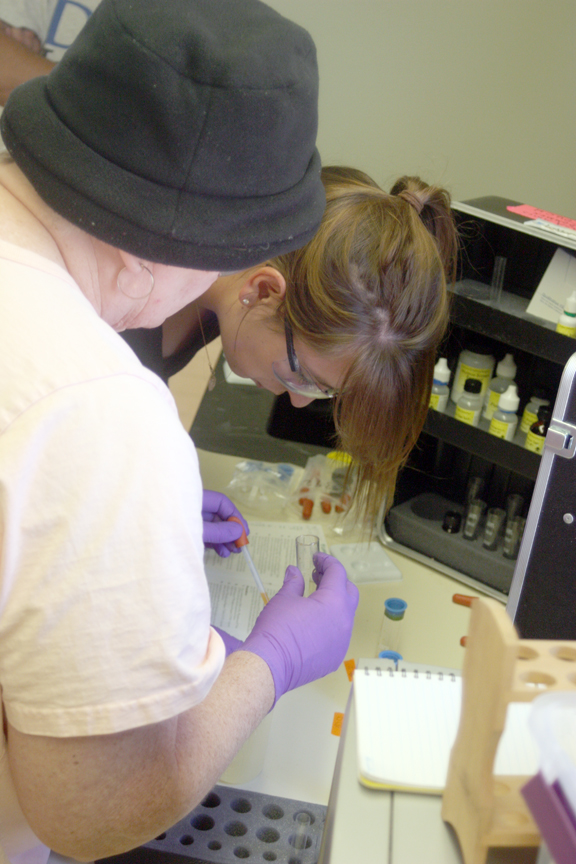
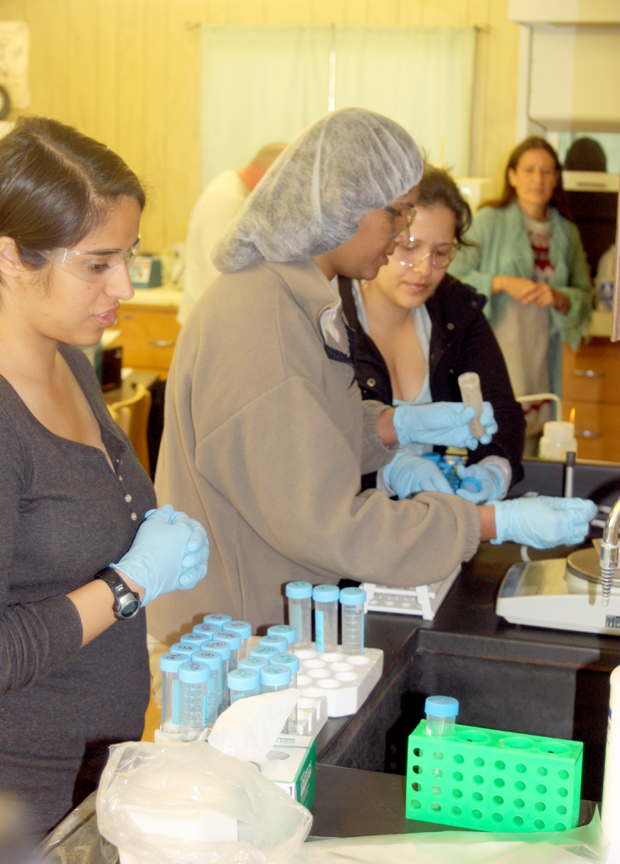
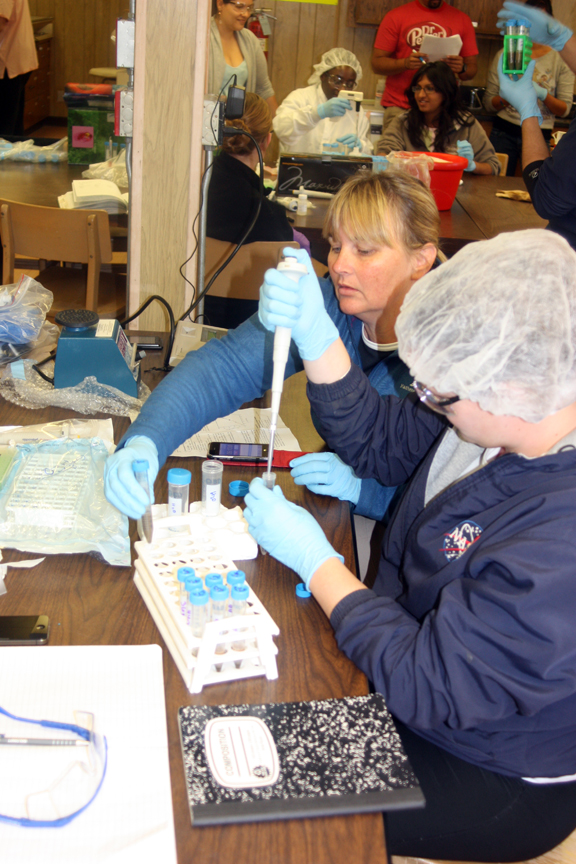
The laboratory building at the Desert Research Station is set up with standard equipment for chemical and biological tests, including flasks, test tubes, Bunsen burners, sinks, a fume hood, etc. Most of the detailed equipment and supplies was brought by Rakesh Mogul and the other scientists working on this project, including a centrifuge, a spectrometer, pipettes and pumps, and test kits and reagents for the extractions and analyses we’d be doing.

Interior of lab

Inside the lab building at Zzyzx Road

The students and scientists had set up a series of protocols for the tests and a plan of attack for how to identify each sample. First, a group were taking samples of the crusts at each location and extracting the DNA from them. Each time, the scoop was sterilized with a Bunsen burner. The solution was then centrifuged to settle out the non-dissolved portions. Another group was at work using polymerase chain reaction techniques to increase the DNA yield so that the final sequencing could be done in a specialized lab. We’ll have the lab look at the specific species in the crusts, including the cyanobacteria, fungi, lichens, mosses, and archaea present in these symbiotic communities.

Extracting DNA

Extracting DNA from the biological soil crusts

Parag Vaishampayan worked with a group to extract ATP (adenosine triphosphate), which will give us a measure of metabolic rate in the crusts at each site. We sampled not only the crust itself but the soil directly underneath each sampled crust, and will look at ATP of the crust compared as a ratio to the ATP in the soil. The hypothesis is that the healthier crust will have a higher ratio.

Extracting ATP

Testing for ATP

Meanwhile, the soil itself was analyzed. Mary Beth Wilhelm and Liza Coe used a soil test kit to look for trace elements in the soil, such as aluminum, iron, chlorine, and magnesium. I helped do some of this analysis, since my background is in chemistry and geology. Rosalba Bonaccorsi, Ruben Hovanesian, and Leonard Bacon separated the soils using sieves to find the relative sizes of particles and materials at each site.

Soil tests

Testing the soils chemically

A final group of pre-math teachers developed a series of statistical tests to look at results of all these tests, including some ANOVA (analysis of variance) tests, which I vaguely remember from my masters degree program.

Pipette instruction

Instruction on pipette techniques

We got quite far with the tests today – it helps to have a group of people who are experienced and work well together. Although they come from all over the California State University system, the students are all in their second year in the program and know what to do and what each other’s strengths and weaknesses are. We all helped out where we had experitise. It was fun to see what college students can accomplish. We have one major remaining test for tomorrow: chlorophyll extraction and spectral analysis.

Statistical tests

Allison and Kristen working on statistical models

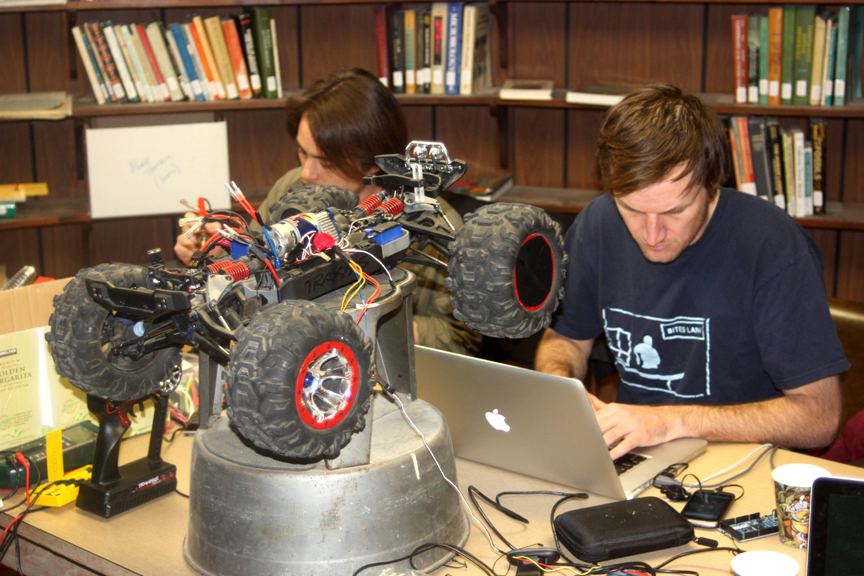
I also talked with Geoff Chu, Paul Mans, and Ryan Piaget from NASA Ames who are developing a prototype rover built from a commercial off-the-shelf RC car, with video camera provided by an Android phone controlled from a laptop over a local network. Motor servos are controlled by an Arduino brick. The point of this rover is to analyze the soil crusts remotely without having 20-odd people stomping around on them. The rover will be equipped with a stereoscopic IR camera that can read 3D depth, along with an RGB camera. My goal is to take the height data from the IR camera and convert it into a grayscale heightmap of the various crust locations, then turn the heightmap into a 3D model in Daz3D Bryce. The RGB photo will be mapped over the top of the model as a texture. Ultimately, the model can be uploaded to an online app where people can rotate and explore the crusts themselves.

Geoff and Paul

Geoff Chu and Paul Mans working on the RC rover

We had a preliminary results meeting after supper to look at what we have so far. The ATP analysis was not consistent across sites, possibly because the results changed as the day warmed up, but we’ll send the samples to labs for more accurate results.

Review session

Review session for today's results

Read Full Post »

Test site 1

Site 1 for testing biological soil crusts in the Mojave Desert

I’m in the Mojave Desert with a group of astrobiologists from NASA Ames, JPL, and the California State University system, along with student teachers in the Spaceward Bound program.

Planning samples-site 1

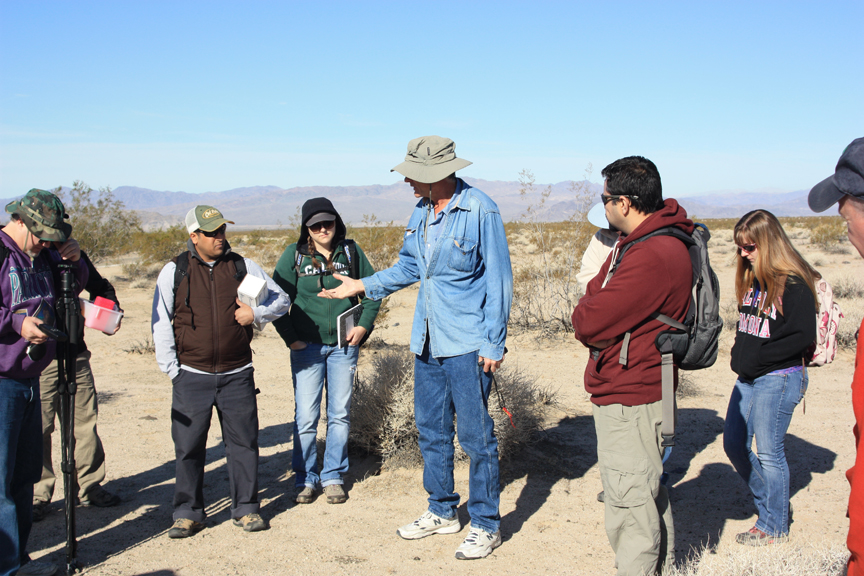
Rakesh Mogul, Chris McKay, and Parag Vaishampayan

Today, March 19, 2012 we officially began the main activity of this field research: collecting samples of biological soil crusts. We hope our research is on the cusp of crusty research . . . or something like that. We have two questions: First, what are the components and abundances of crusts in various locations; and second, what causes these crusts to change density from site to site? We discussed how to approach these questions on Sunday night and decided on an experimental procedure. Dr. Rakesh Mogul first led us in an activity on assigning planetary protection protocols to various types of space missions as a way of looking at the variables and possibilities of contamination. Then we got down to business on the study itself. We decided to sample three locations along Kelbaker Road, which heads east from Baker across the Mojave National Preserve to Kelso Depot. We brought with us sampling tools and equipment, including a field handheld ATP analyzer and collection tubes.

Photographing site 1

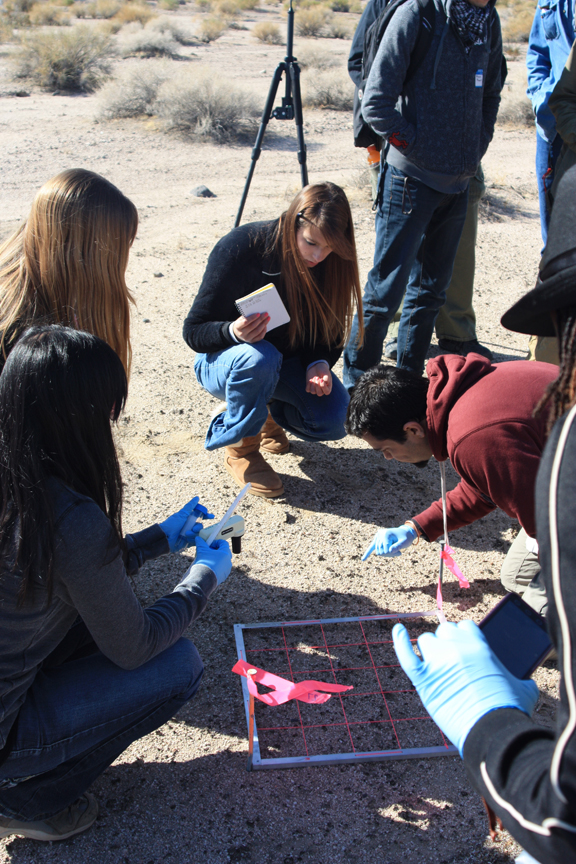
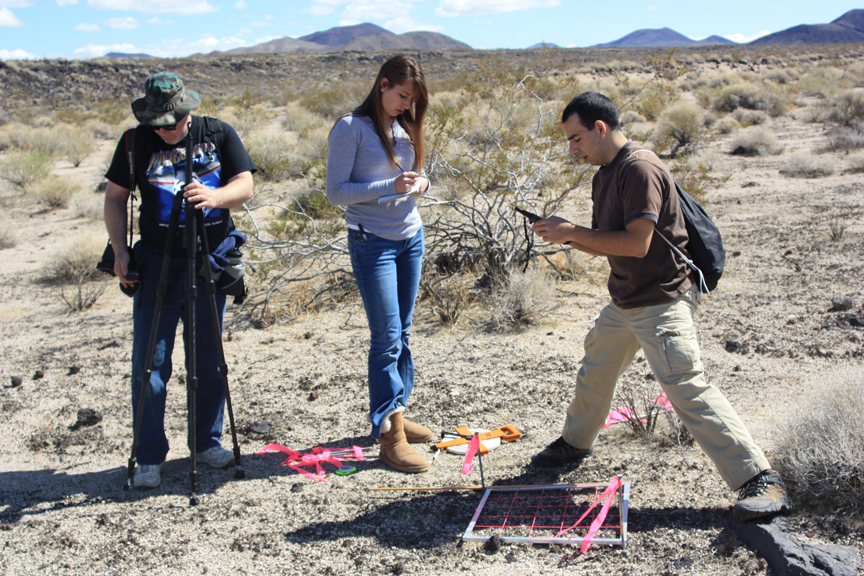
Photographing Site 1 location A

We collected after breakfast on a cool morning. The wind had calmed down from the night before and it looked to be a beautiful day as we loaded the vans and headed out. We stopped first at a site about five miles east of Baker which had been scouted out earlier. This site had an intermediate or average amount of biological soil crusts (BSC). Chris McKay described the general goals at each site, and Rakesh worked through the procedures as we divided up tasks.

We had several things we needed to do: First, locate an origin point with an average amount of soil crust and lay down a frame and grid aligned to the compass and its GPS coordinates recorded. Then we set up a vertical tripod and took photos of the location. All of this was to allow for determining the density of the crust – how many of the grid squares were covered.

Second, Rakesh and some of the teachers collected samples to test for ATP using a handheld analyzer. This wound up being a slow procedure and took some

Sampling ATP at site 1

Sampling ATP at Site 1

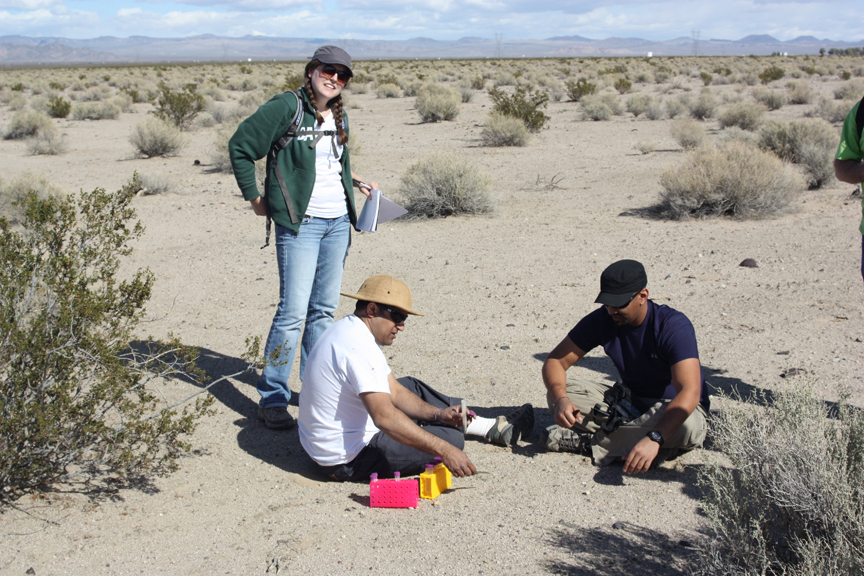
Third, Dr. Parag Vaishampayan of JPL collected samples near the grid, both of crust and non-crust areas, that we would use to extract the DNA and perform polymerase chain reaction (PCR) procedures to increase the DNA for testing (this would be done back at the Desert Station lab). We also collected soil samples to analyze chemically. At each location, we also sampled four other locations, each randomly selected using GPS coordinates in an array around the original location.

Collecting soil samples

Collecting soil samples at Site 1

With all this done and samples labeled and stored, we moved on down the road to the second site, this one with a dense growth of BSC. We ate lunch, then followed the same procedure to collect samples at five locations at the site. Since the crust was so dense, we had to be very careful not to step on any areas unless there was a wash or stream without crust.

Site 2 sample square

Sample grid at Site 2

Site 2 dense crust

Dense, mature soil crust at Site 2

We then loaded up again and travelled back through Baker to our third site about two miles west of town across the road from Silver Lake. Here, the soil was very poor in soil crusts – we found a few small spots about the size of a quarter coin, all surrounding small puddles where organic matter and water had ponded. The BSC was much lighter in color and much sparser. We followed the same procedures, setting up grids, collecting samples, testing ATP, etc.

Site 3

Site 3 near Baker, CA.

Collection site 2

Collection Site 2

By then the afternoon had worn on and it was time to head back to the Zzyzx station. As soon as we got there our math wizards started setting up statistical searches and crunching the numbers. Tomorrow we’ll do the laboratory tests and prepare the samples by extracting DNA, sorting the soil, and testing the soil chemistry. We hope our results will be worthy of publication in their own right, as well as point to future ideas and techniques for studying life on other planets.

Chris McKay at Site 3

Chris McKay at Site 3

ATP at site 3

ATP sampling at Site 3

Read Full Post »

Nuremburg Chronicles Empedocles

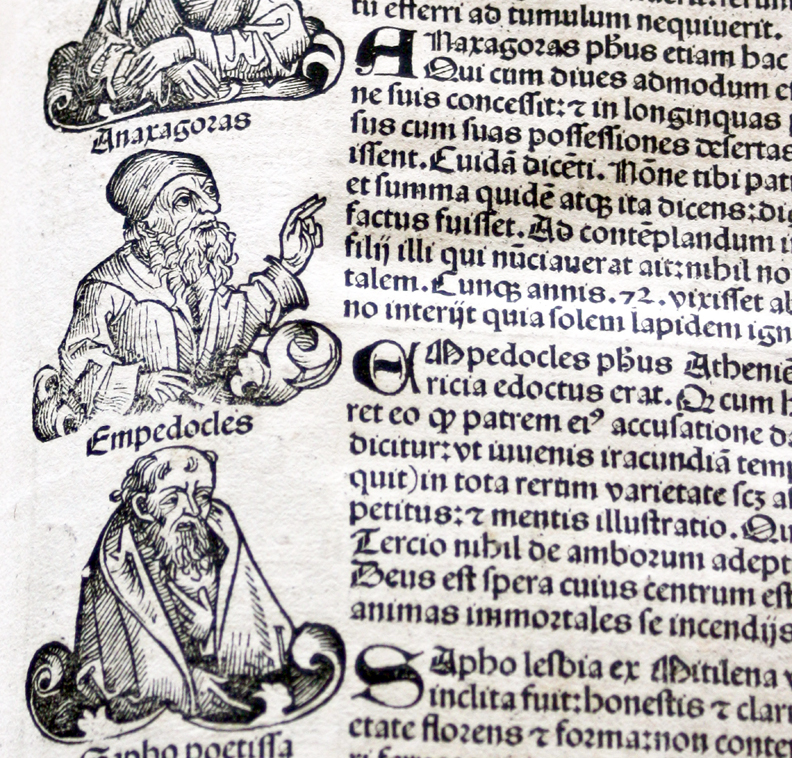
Anaxagoras and Empedocles, from the Nuremburg Chronicles

In my last post, I showed the statistics of what this blog has accomplished so far. I feel very good about where we’ve been, but now it’s time to describe where I plan on going this coming year.

Given that I am not teaching chemistry this school year, my work on the Elements Unearthed project has slowed down a bit as my attention has been diverted elsewhere by the astrobiology projects (the podcasts and CLOE animations) and other projects that I’ll describe next week. I anticipate teaching chemistry again next year, and I am in the process of writing up a series of grant proposals (all of which have to be done by Feb. 1) that, if successful, will provide funds for purchasing some iPad tablets and probeware that will allow us to do some environmental field research.

fluorite and emerald

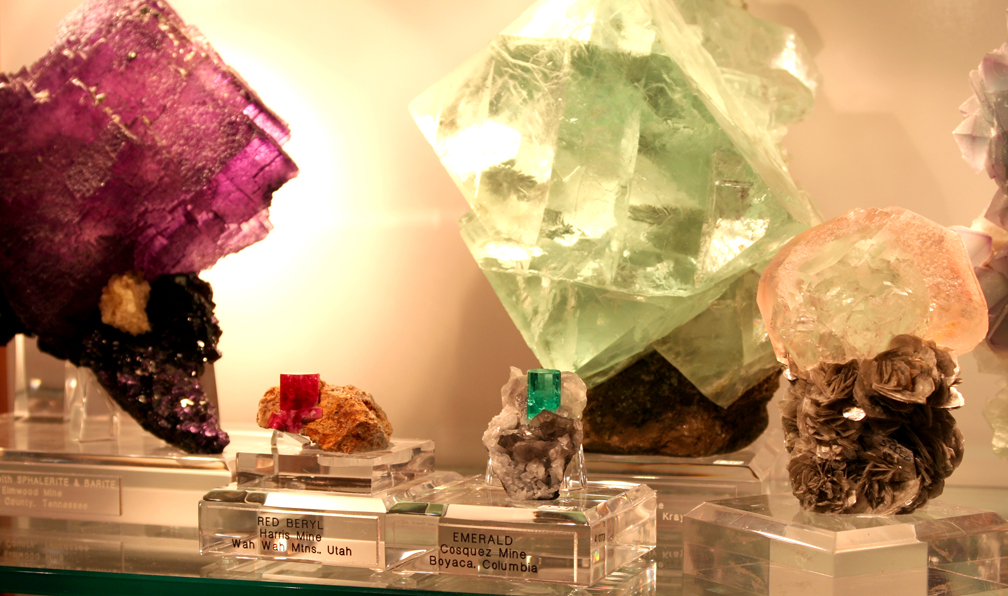
Fluorite and emerald crystals in the collection of Keith Proctor

In the meantime, I have a large backlog of videos that I have taped of various mine tours and interviews I’ve done across the country. I need to edit these into final videos and report on them in detail on this site. In order to keep myself on track, I’ve created a schedule for when I’d like to do each video and the topics I’ll cover here as I work on them.

This January, 2012, I am going to start at the beginning and look at ancient chemistry and our knowledge of the elements in prehistoric and early historic times. Then in February, I will start to work on my Greek Matter Theories videos. I have previously created all the script and narration and have even set up the video files and begun the graphics and animations. It’s high time I finished these. I’ll start with an overview of the Greek Ideal in philosophy and science, then talk about Thales and the Miletian School, then Parmenides and Zeno and the Eleatics. In March, I will talk about Heraclitus and Empedocles and the atomic theory and Plato. In April, I’ll move on to Aristotle, Epicurus, and the debate on elements versus atoms, ending in the theology of St. Thomas Aquinus and how atomic theory came down through the Middle Ages.

In May and June I’ll discuss the practical side of chemistry, with a look at ancient crafts, including metalworking, glass making, and other medieval technologies, including a detailed look at Agricola’s De Re Metallica (which I have many photos of).

Dalton molecules

Diagrams of molecules by John Dalton

By July I should have the funding I need in place to start the field research. My plan is to partner with another school, perhaps Tintic High School or Wendover High School, to travel out to nearby mining sites and use the probeware and iPads to collect and record data on soil and water environmental conditions, such as the pH of soil and runoff water near old mine dumps. I’m especially interested in seeing if the EPA efforts to mitigate contaminated soil in and around Eureka, Utah have been successful. I’ve talked about those efforts in previous posts (especially here: https://elementsunearthed.com/2010/06/09/the-legacy-of-the-tintic-mining-district/ ), so I won’t talk about them again now. We would use GPS coordinates and GoogleEarth to set up a grid of sample sites both in and out of the recovered area. We would sample the surface and two feet below ground. It would require several trips and coordination with local students to gather the data, but it is a project that would fit very nicely with the research I’ve already done. If I can get enough money together, I would like to rent a portable X-Ray Fluorescence Spectrometer which can read element abundances nondestructively on the site.

In preparation for all this, I need to make one more trip to the Tintic district in June to photograph and videotape the mines in the southwest area, which were the first mines discovered, including the Sunbeam and Diamond mines. One of my great grandfathers, Sidney Tanner Fullmer, died as a result of injuries suffered in an accident while working in the Diamond mine, leaving my grandmother an orphan to be raised by her aunt and uncle. So this history has a particular interest to me.

One thing I plan on doing, if we can work out a partnership, is to set up an evening in Eureka at Tintic High School where townspeople can come in with photographs and tell their stories of mining and life in Eureka before and after the EPA efforts. We’ll scan the photos and videotape the recollections, then combine all that with the video I’ve already done of the Tintic Mining Museum and local area. Ultimately, my students will help me script and edit a three-part video on the Tintic District, perhaps even done well enough that we could market it to KUED, the PBS station in Salt Lake City.

Tintic load site

Ore loading platform in the Tintic Mining District

The months July, August, and September will be dedicated to this effort and will result in the best documentation created so far on video of the history and present of the Tintic Mining District.

October will be dedicated to Zosimos of Panopolis and such Arabic alchemists as Jabir ibn Hayyan. November will begin a discussion of European alchemists, from Roger Bacon and Ramon Llull through the Middle Ages. I’ll draw on the many photos I’ve taken on alchemical texts at the Chemical Heritage Foundation. The history of alchemy will continue through December, 2012 and on into January, 2013. In February and March, 2013, we’ll discuss the emergence of modern chemistry through Boyle, Priestley, and Lavoisier through Dalton, Avogadro, Berzelius, and others.

In April through June of 2013 we will switch gears and talk about nucleogenesis and the origin of the elements, then the physicists and chemists that have helped us understand the structure of the atom and quantum mechanics. From there, I will probably begin to talk about individual elements and how they are mined and refined, with examples of the mining districts where they come from, such as the history of the Viburnum Trend in Missouri and the lead mines there, or the gold mines of Cripple Creek, Colorado. I really do have enough materials now to keep this blog going for at least two years. And I’ll be gathering more all the time. I will also dedicate occasional posts to my efforts as a chemistry teacher and to science education in general, including my experiences at conferences, etc.

Van Helmont

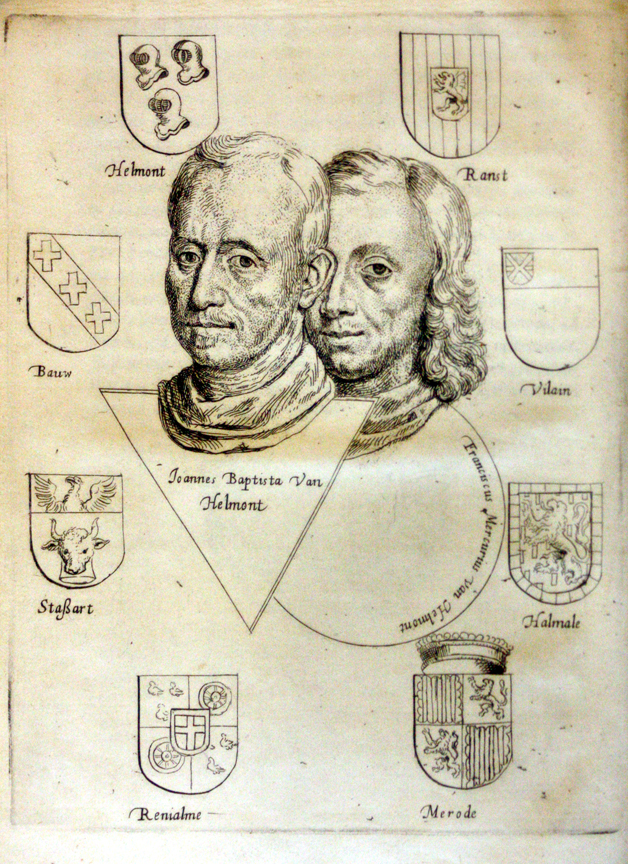
Portrait of Joannes Baptista van Helmont

Well, it is an ambitious schedule. I hope to do at least one post per week, probably on weekends. I hope to complete at least one video segment every two months or so. Next week, I’ll start us off with an overview of the history of chemistry.

Read Full Post »

Once each year I like to go over the statistics for this blog in detail to see what posts have been the most popular, which search terms are finding this blog, which videos are most watched, etc. I’m not doing this just for an ego trip, but to be able to report the impact this site is having. I have had some very generous sponsors over the three years this blog has been running, especially the American Section of the Société de Chimie Industrielle (which paid for my fellowship in 2009) and the Chemical Heritage Foundation, which provided such a wealth of resources in its collections on the history of chemistry. It was during the time of my fellowship that this blog really began to find an audience, and it has been growing ever since.

Stats for the Elements Unearthed

Monthly Stats for the Elements Unearthed Blog

So here is where this blog stands: As of today, there have been a total of 67,620 visits to this site. As seen by the histogram, the number of visits has shown a definite annual pattern consistent with the school year – visits are lower in the summer when school is not in session, rise in August and September, stay high in October and November, dip a bit in December due to Winter Vacation, then rise again in January and February and peak in March, then gradually decrease as the school year winds down in April and May. This same pattern has repeated for the last three school years, but has grown each year. Last year, in the 2010-2011 school year, my best months were slightly above 3000 visits. Now they are topping out above 4000 and I hope they will hit 5000 by March.

Granted, compared to some popular blogs with thousands of hits per day, 5000 per month doesn’t sound like much. However, I am pleased – this is a rather esoteric blog dedicated to the history of chemistry and chemistry education. The yearly pattern shows that I am reaching my intended audience of high school students and teachers. This is also shown by the types of searches that reach my blog.

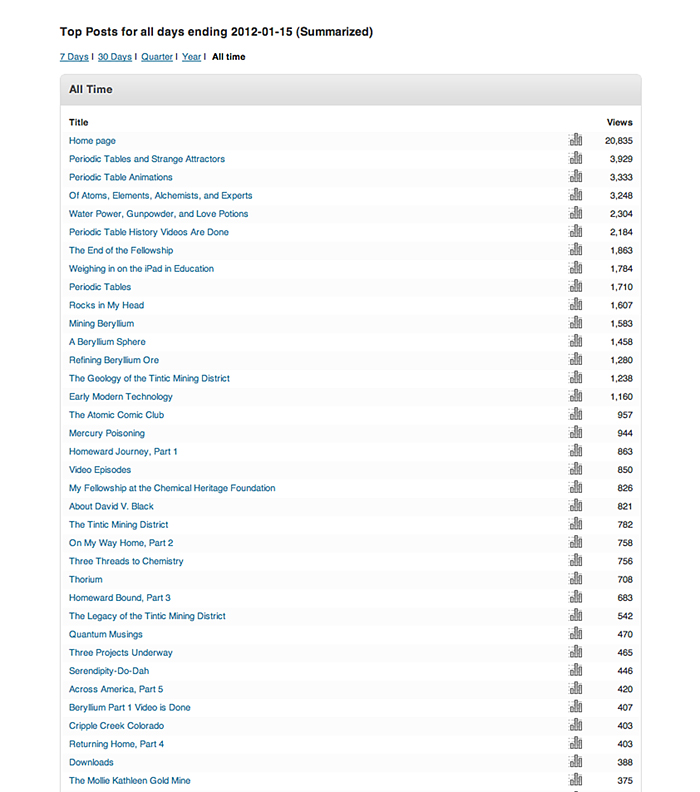
Although there are always some unrelated search terms that somehow reach my blog (the biggest ones are “Ocean City, New Jersey” and “Punxsatawney Phil” because I visited both places in 2009 and showed some pictures), by far the majority of search terms are related to chemistry and its history or to science education in general. I’ve gone through the search terms and compiled them into categories, mostly so that I can make plans for the future. Here are the top searches that reach this blog: (1) Greek Matter Theories (3473 searches) with Aristotle, Democritus, and Thales being the biggest ones; (2) the Periodic Table of elements (2288); (3) beryllium (1600); (4) Alexandre Beguyer de Chancourtois (1397) – this is a bit surprising, but apparently my animation of his telluric screw periodic system and description of his work is one of the few sites out there about him; (5) the Tintic Mining District (1041); (6) the history of the periodic table (868); (7) science education (862), especially using iPads in science classes; (8) early modern chemistry (822), including Lavoisier, Boyle, Priestley, Dalton, and Newton; (9) alchemy (732), with love potions, Khunrath, Basil Valentine, Zosimos, and Maier the highest; (10) water and wind turbines (618); (11) strange attractors (586) – this is another odd one, since I only mentioned it once, but it was in my most popular post; (12) mercury (554); (13) early technology (514), such as Roman glass, Pliny the Elder, Agricola, Neri, and others; (14) mining in general (455) – such terms as overburden, open pit mine, ball mill, and headframe; and (15) Cripple Creek, Colorado (315).

Top Posts for this blog

Top Posts for the Elements Unearthed Blog

The videos that I have created for this project are posted on this blog (under the video tab) and on YouTube. The History of the Periodic Table, featuring Dr. Eric Scerri of UCLA, is my biggest hit so far. All parts of this video have been watched a total of 11,474 times as of 1/7/2012. There are even a few derivative works on YouTube that take parts of my video – a section on Henry Moseley, for example – and combine it with parts of other videos with Bill Nye, etc. I’ve had quite a few comments on how useful this video has been for chemistry teachers out there, and I am very pleased with the results so far. There is also a version with Portuguese subtitles done by a professor in Brazil; I’m not sure how many times that has been seen. My separate video that showed only some animations of the periodic table has been watched 416 times.

The second most popular videos have been the two parts on beryllium – its properties and uses, and how it is mined and refined. It has been watched a total of 3219 times, with the separate video on the geology of beryllium watched itself an additional 153 times. The Discovery of Synthetic Diamonds has been watched 745 times and the demonstration of Glass Blowing 754 times. These have been the most popular videos related to this project.

In conclusion, the most important question is: Have I succeeded in my attempt to bring the history of chemistry and chemistry education to the general public, and specifically to teachers and students? All indications, based on these statistics, are that I am succeeding and that that success is continuing to grow.

The last several posts have been about astronomy and space science education, and although some search terms have reached these posts, not many have. For various reasons, not the least of which is that I want to keep this blog focused on my original intent, I am starting a new blog which should be up and running by Wednesday night on space science education and resources for teachers to use now that we are in the golden age of astronomy. I will be doing quite a bit of education outreach on these topics over the next few years, if all goes well, and they deserve to have their own blog. I will include links here once that is ready to visit. I will post to this new blog once per week on Wednesdays.

The statistics also point out which topics have been most popular, and give me direction on what to post about in the future. In my next post, I will give you a schedule of what I intend to discuss over the next year and a half and when I will have the related videos completed. I will try to post once per week, probably on weekends. I have much more material from my fellowship at the Chemical Heritage Foundation that I haven’t shown or discussed here yet, and I look forward to digging into it all. I have also visited many sites related to mining and refining of the elements which I have only mentioned in passing. It’s time to edit all that footage and photos into videos for this site and YouTube. I expect the next few years to be busy, productive, and rewarding and to reach even more people than I already have.

Read Full Post »

« Newer Posts - Older Posts »