Feeds:
Posts
Comments

Archive for the ‘Weekly Post’ Category

by Tanner Sorensen

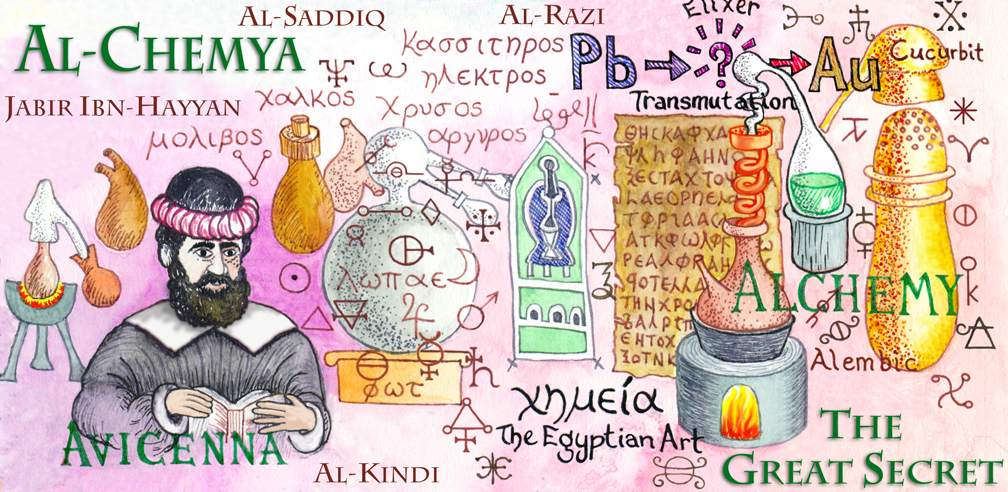
A big part of the development of Alchemy originated in Islam. The word alchemy came from the Arabic word al-kimia, which came from the Persian word kimia. Will Durrant quotes in his book The Story of Civilization IV: The Age of Faith,

“Chemistry as a science was almost created by the Moslems; for in this field, where the Greeks (so far as we know) were confined to industrial experience and vague hypothesis, the Saracens introduced precise observation, controlled experiment, and careful records. They invented and named the alembic (al-anbiq), chemically analyzed innumerable substances, composed lapidaries, distinguished alkalis and acids, investigated their affinities, studied and manufactured hundreds of drugs. Alchemy, which the Moslems inherited from Egypt, contributed to chemistry by a thousand incidental discoveries, and by its method, which was the most scientific of all medieval operations.”

Alchemy poster

Alchemy Section from the Elusive Atom poster

There are many Islamic figures in chemistry, and they often aren’t as acknowledged as they should be. Early Islamic chemists such as Jabir ibn Hayyan, Al-Kindi and Al-Razi made important chemical breakthroughs such as perfumery; distillation apparatus; muriatic, nitric, acetic and sulfuric acids; purified distilled alcohol, soda and potash; and filtration.

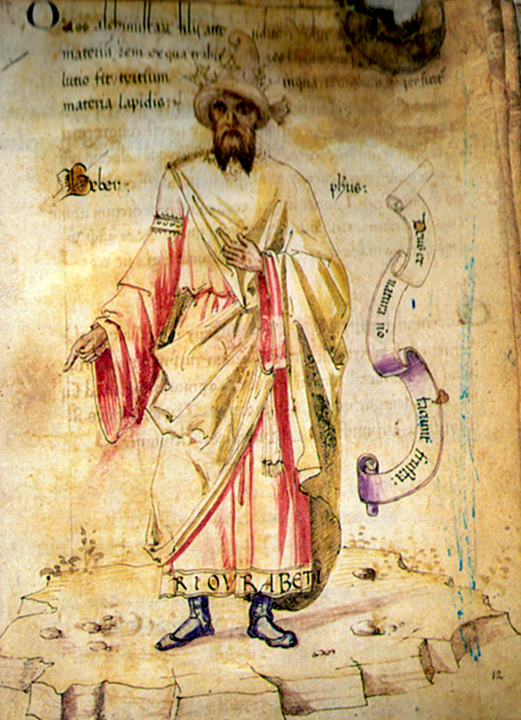
Jabir understood the importance of experimentation. Jabir created the alembic when he discovered how to complete the process of distillation. Jabir’s teacher, Ja’far al-Sadiq, refuted Aristotle’s theory of four elements by saying “I wonder how a man like Aristotle could say that in the world there are only four elements – Earth, Water, Fire, and Air. The Earth is not an element. It contains many elements. Each metal, which is in the earth, is an element.”

Drawing of Geber

Jabir ibn-Hayyan, known in the West as Geber

Another influential Muslim chemist was al-Razi. Al-Razi was the first to distill petroleum, invent kerosene and lamps for it, invent soap bars and recipes for soap, make antiseptics, and developed many chemical processes like sublimation.

In addition to all other contributions, Muslim alchemists developed theories on the possibility of the transmutation of metals, the philosopher’s stone, and creating artificial life in laboratories, as in later medieval European alchemy, though these theories were eventually discredited and rejected by practical Muslim chemists from the 9th century thereon. Therefore, medieval Arabic alchemy was the biggest contributor to Alchemy and Chemistry as we know it today.

Read Full Post »

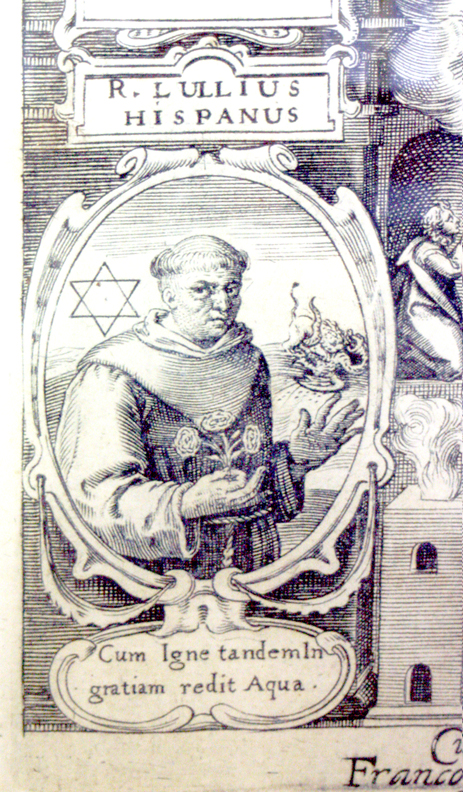
Ramon Llull portrait

Portrait of Ramon Llull

As we have studied the history of chemistry for our recent unit in Honors Chemistry, I’ve had my students do a bit of research on what is known and supposed about various alchemists. For example, a student in each of my sections was assigned to research Ramon Llull, the Majorcan alchemist. We started by finding out what is known about the real person. He was born in Palma in 1232 AD, and was a courtier, poet, and womanizer at the court of King James of Aragon, then had a religious epiphany that converted him into a fervent missionary for Catholicism. After a nine-year hermitage and writing many religious tracts, he set off on a series of missionary journeys to North Africa. He was fluent in Arabic and was unusual for his time in that he believed in converting the Muslims through reasoned argument instead of Crusades and the sword. He wrote some of the first works in Catalan, his native language, and died after being stoned in Tunis.

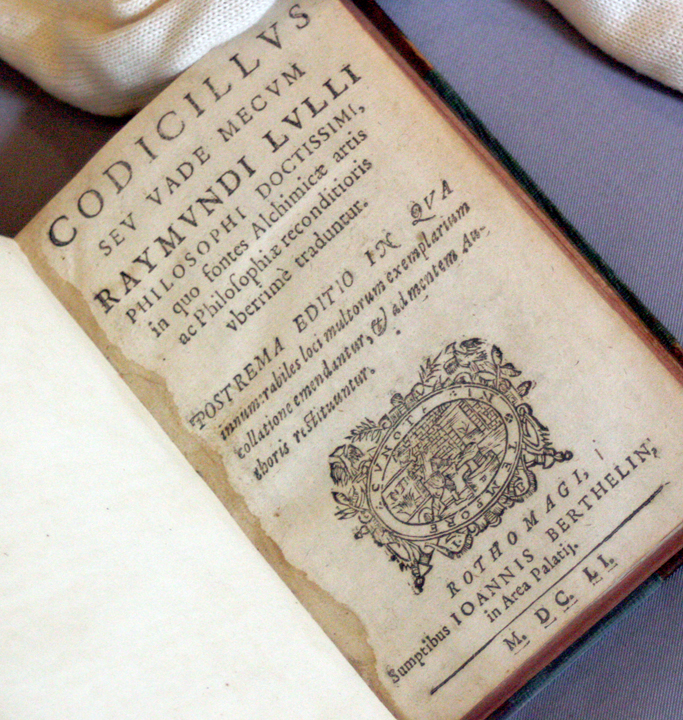
Ramon Llull title page

Ramon Llull title pagae

I also had the students research what is attributed or credited to the person in tradition and later writings, such as Ramon Llull’s alchemical works and his having created the Philosopher’s Stone.

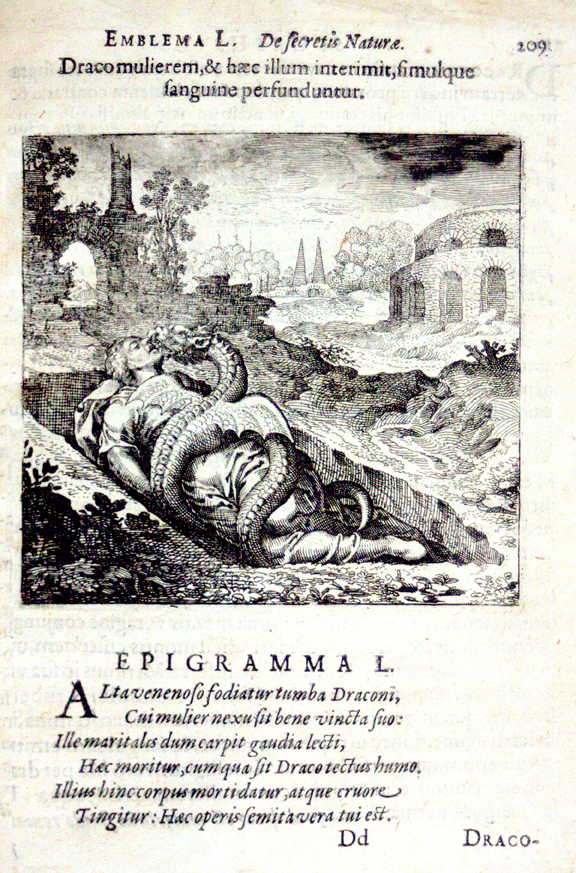
Uroboros from Michael Maier

Uroboros from Atalanta Fugiens

Each student also had to find an image of the person and include it, then take their short report and convert it to simple bullet points to summarize their findings. I’ve now taken those bullet points and turned them into a Keynote/Powerpoint slide show and added their images as well as photos I took last year at the Chemical Heritage Foundation as part of my fellowship sponsored by the Société de Chimie Industrielle (American Section). This is the first time, except for a few progress report blog posts, where I have started to use all the materials I assembled. I am attaching it here, and hope you enjoy going through it and using it in your own classes.

Alchemy_History (Powerpoint)

Alchemy_History (PDF)

Sorcerers Apprentice

A Sorcerer’s Apprentice Masters the Transmutation of Copper into Gold

It was my privilege last summer to dig into the very books these alchemists wrote, and I’m still digesting what I discovered. One result has been my own creation of the White and Red Elixirs and the formation of the Stone itself; in fact, I demonstrated my alchemical prowess for my students by converting copper into silver and then into gold. Several of my students had achieved the inner transmutation sufficiently to successfully direct the Stone’s powers as well, as shown in the photo. (Of course, we really aren’t making gold. This is the old “Alchemists Dream” activity where copper pennies are coated with sodium zincate [using a combination of 6.0 M sodium hydroxide and zinc powder], then heated gently in a Bunsen burner flame to alloy the zinc with the copper to form brass, which looks like gold).

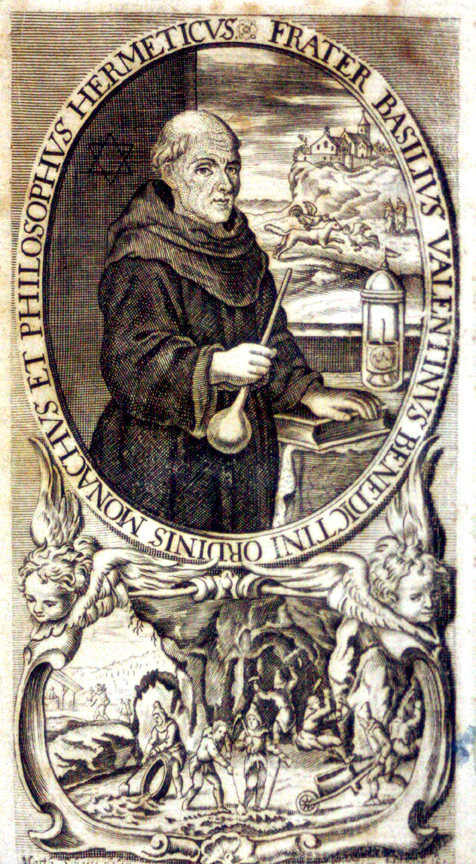
Basil Valentine

Portrait of Basil Valentine

These student-created projects are part of my overall philosophy of science education and the main rational of this Elements Unearthed project: that students learn best when they are actively involved in sharing their knowledge with others. With modern tools for publishing on the Internet through blogs and PDF files, Powerpoints and videos, students now have an audience for their work that is much greater than simply their peers and teachers in class. Tomorrow is the unit test; we’ll see if my theory holds water then!

Read Full Post »

by Eli West

Guest Host

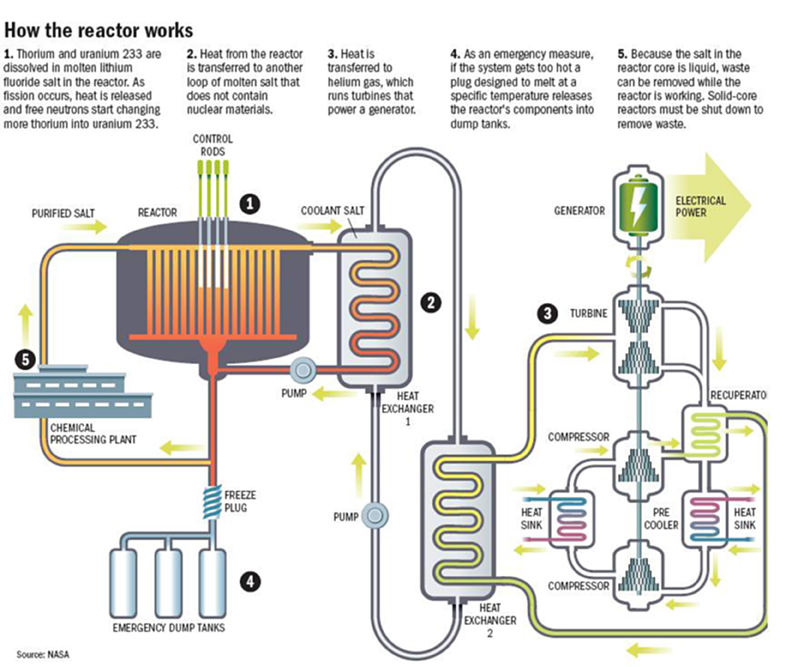
Thorium reactor

Liquid Thorium Reactor

The word “nuclear” means a lot to us today. When we hear it we think of many things: bombs, reactors, uranium, “nuculur,” and radioactive; all of these are connotations of the word nuclear. Let’s explain what each of them means.

We’ll begin with bombs. The common link between nuclear and bombs, is obviously, nuclear bombs; otherwise known as atom bombs. In essence, you have a collection of uranium atoms; specifically Uranium-235, which is very fissile.  In a bomb, a lone neutron is shot at a uranium-235 atom to create uranium-236. Since uranium-236 is too unstable, the isotope breaks apart very violently, shooting neutrons everywhere, and these reactionary neutrons in turn smash into other uranium-235 atoms, and those atoms break apart and smash OTHER atoms. Which is what makes atomic bombs so explosive.

Another think we link to nuclear is uranium. Uranium is a very heavy atom. With a standard atomic weight of 238.03 g/mole, it’s on the heavy side. However, you’re probably used to hearing terms like uranium-238 or uranium-235. What do the numbers mean? Why are they different? What does it change? The number with uranium is indicating the isotope number, which simply means that there are more or less neutrons with the same number of protons. The 238 number gives you the atomic weight of the atom. In order to find out how many neutrons there are, you simply take the atomic number (which is 92, the number of protons in all uranium atoms, regardless of isotope), then take the atomic weight minus the atomic number to find the number of neutrons. In this case it is 238-92=146. So we know that there are 146 neutrons in each atom of uranium 238. Compared to hydrogen, that’s heavy.

Nuculur. I’m not even going to go into that, except to say that the correct pronunciation, by the way, is “new-clear.”

Radioactivity: it’s a word with a history. It’s a word that’s gotten a pretty bad rep over the years, through romanticizing, myths, and fiction. Everyone has heard the stories of people getting hit with gamma radiation and gaining super powers! Or of radiation being like the Black Death, destroying any who get near. The truth is, EVERYTHING is radioactive. Now don’t get scared! That term isn’t quite as bad as believed! Let’s get a few things straight, what exactly does, radiation mean? Well, everything radiates. EVERYTHING. Radiation is just the constant output of energy. We radiate heat, and light, just like the sun; food radiates heat! Some things just radiate such high-energy waves that they become dangerous. THAT is radioactivity.

“Radioactivity refers to the particles which are emitted from nuclei as a result of nuclear instability.”

http://hyperphysics.phy-astr.gsu.edu/hbase/nuclear/radact.html

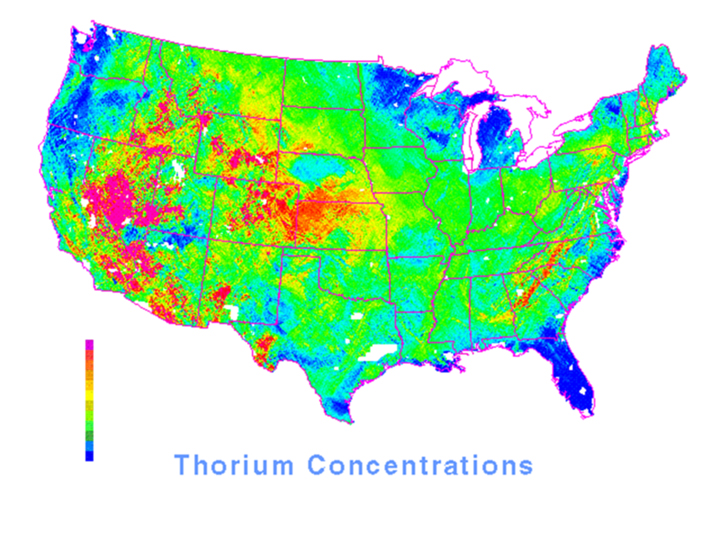
Thorium in USA

Thorium concentrations in the USA

Now, where I am going with all this is thorium. What is thorium? It’s an incredibly heavy atom, much like uranium. It has large isotopes, much like uranium. Both of them have a huge half-life, and are highly radioactive; the differences between them are: (1) uranium, when used in nuclear reactors, produces a new isotope of uranium, which can be weaponized in the form of depleted uranium. It can be formed into what are essentially large bullets crafted out of the depleted uranium isotope. The bullet is incredibly dense, and when shot at high enough velocities, can pierce tank armor. It doesn’t explode in a nuclear bomb, but it does spray radioactive uranium all over the inside of the target tank. Thorium, on the other hand, when used in a nuclear reaction will not produce a weaponizable material. Thorium and uranium are both naturally occurring materials.

Thorium is abundant compared to uranium. So as a fuel source it would be cheaper, MUCH cheaper. Thorium is not fissile itself, which means it cannot sustain a low energy chain nuclear reaction, which means that it is not actually usable in nuclear reactors by itself. However, it is fertile, which means slow neutrons can be added to it to change it into U-233 (or uranium-233), which is fissile. That’s why we can’t just start mining thorium and tossing it in nuclear reactors all over the world. First we need to create reactors that can change it into U-233, which would then be fissile.

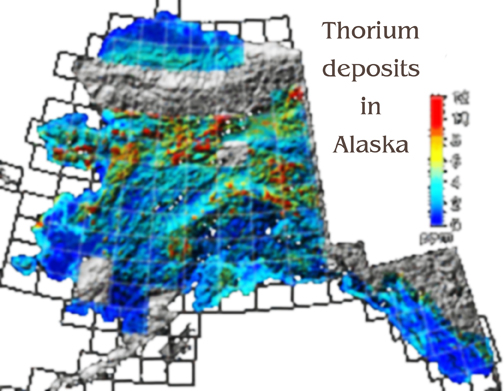
Thorium deposits in Alaska

Thorium deposits in Alaska

The word thorium has a very simple background. The man who discovered thorium simply decided that Thor was a pretty cool guy, and that maybe he should call this thing thorium!

As of right now there are a few companies around the world that are developing thorium reactors. Their projections for finishing the project are around 2015. That’s five years. Not to mention the actual two or three years it would take to build each reactor. So, the technology is coming, but is a ways off. Some believe that once they get the reactors running, that we could wean the world off oil in as little as five years, or by 2020. However, that’s probably a bit optimistic, and there still is a lot of work before we reach that point.

Read Full Post »

The Five Elements

The Five Elements

As I teach chemistry and astronomy again for the first time in several years, I’m having a lot of fun getting back into the physical sciences with all of the lab experiences I’d collected and developed over the years before I started teaching multimedia exclusively. I’ve also added a number of excellent activities that I picked up from my experiences with NASA and from various conferences and presentations. It’s also a lot of fun to start incorporating my expertise in media design and technology in ways I never could before, as well as the materials I collected at Chemical Heritage Foundation in 2009. For example, I just finished teaching a Keynote presentation on Greek matter theories that I put together myself using photos, drawings, illustrations, and 3D animations (mostly my own) and information collected at CHF. I have all the files stored on various hard drives that all hook into my Mac Powerbook (about four terabytes total). Some of the images I pulled off the Internet at school using our wireless router and Airport technology, and once the Keynote was finished, all I had to do was hook my laptop up to a projector and give the presentation (complete with animations and audio clips) using an infrared remote. Here’s the presentation, in Powerpoint format. If you want to use it, be my guest:

Greek_Matter_Theories

To me, all of this seems remarkable, even miraculous. And here I am writing about it on a Blog, publishing my experiences instantaneously where anyone in the world can read them, and even sharing the presentation itself. Yet I feel as if I’m only just scratching the surface of what these new technologies can do. That’s part of why I’ve been working on this Elements Unearthed project for the past several years; there are so many connections between science practitioners and students that can still be made and which I hope to develop, so many innovative methods of teaching that no one’s thought of yet. I’m a digital immigrant; my students are natives. I’m always playing catch up to what they’re already using daily.

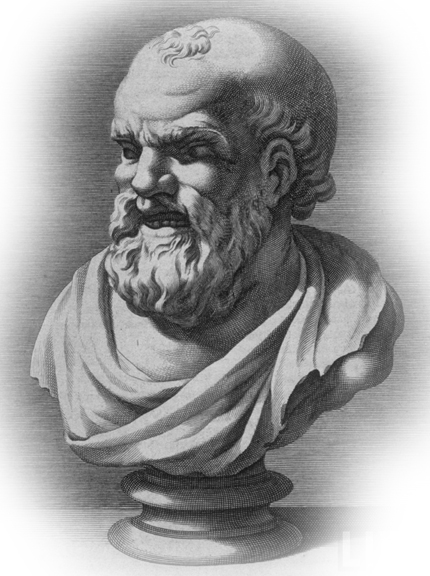
Engraving of Democritus

Engraving of Democritus

So far this blog has been written entirely by me (David Black) since it debuted in Oct., 2008. Now that I’m teaching chemistry again I am turning over much of the posting to my students, who will be taking turns once per week adding information about the research project they are pursuing. They have chosen between an element (such as copper), a material (such as cement), a method of generating energy (such as solar power), or a time period from the history of chemistry (such as medieval European alchemy) and are compiling notes into an MS Word document with references.

With each post, they are to include about 500-800 words of writing in their own words culled from all of their research notes and include relevant images or diagrams. They are also producing a nicely laid out document such as a newsletter, poster, or brochure that will be converted to PDF format and linked to this blog for download. It may take a week or two for the first few student posts to contain these linked files, but they will come. My hope is that any chemistry teachers or students out there who are reading this blog will be able to download these linked files and use them in your own classrooms.

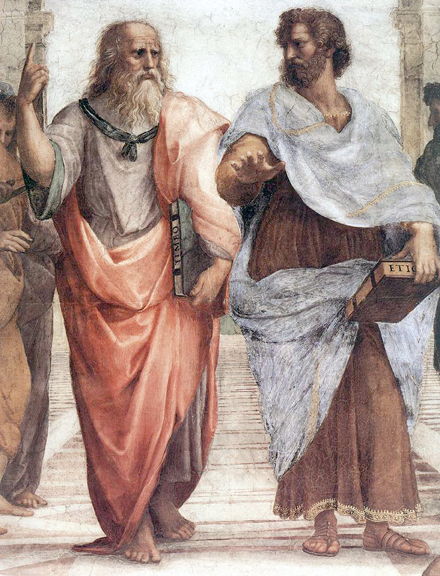
Plato and Aristotle

Plato and Aristotle, Detail from The School of Athens by Raphael

During second term, the students will be developing and practicing a hands-on demonstration that involves some property or aspect of their topic. We’ll present these demonstrations to the elementary classes at Walden (I’ve already met with the teachers to plan this out) and the students will also present them to each other for feedback. During third term, we’ll create a more extensive project from their topic: a detailed Powerpoint or Keynote presentation or a three-minute video or a computer game. They’ll present these in class again, then fourth term put all of this together for a back-to-school science night for the public and their parents and siblings. We’ll videotape these presentations and share them with you as well.

I’ve done all of these things before in various multimedia or chemistry classes, but this is the first time that technology and opportunity have combined to allow me to put it all together. I am still looking to build partnerships with local organizations (museums, mining associations, etc.) that will combine my students’ media skills with their content. I’ll still visit mining towns, take tours of museums, and continue to post about how technology can be used in the science classroom. I also plan on writing more grants and professional articles. I’ll continue to create longer format videos to go with the student short videos (the Tintic Mining District is up next after I make some changes to the beryllium videos).

This blog has certainly been successful in what I’ve intended it to be. Last month (September) was the best month so far with over 2700 visitors to the site. I’ve had over 23,500 visitors total, most of them this year. I would love to hear from any science teachers or students that have found this site useful.

I look forward to seeing what my students come up with as they post about their topics. I’m encouraging them to do more than just a list of properties, to dig deeper and talk about the unusual stories and histories of each element or material. And now, I am pleased to introduce my chemistry students’ blog posts . . . .

Read Full Post »

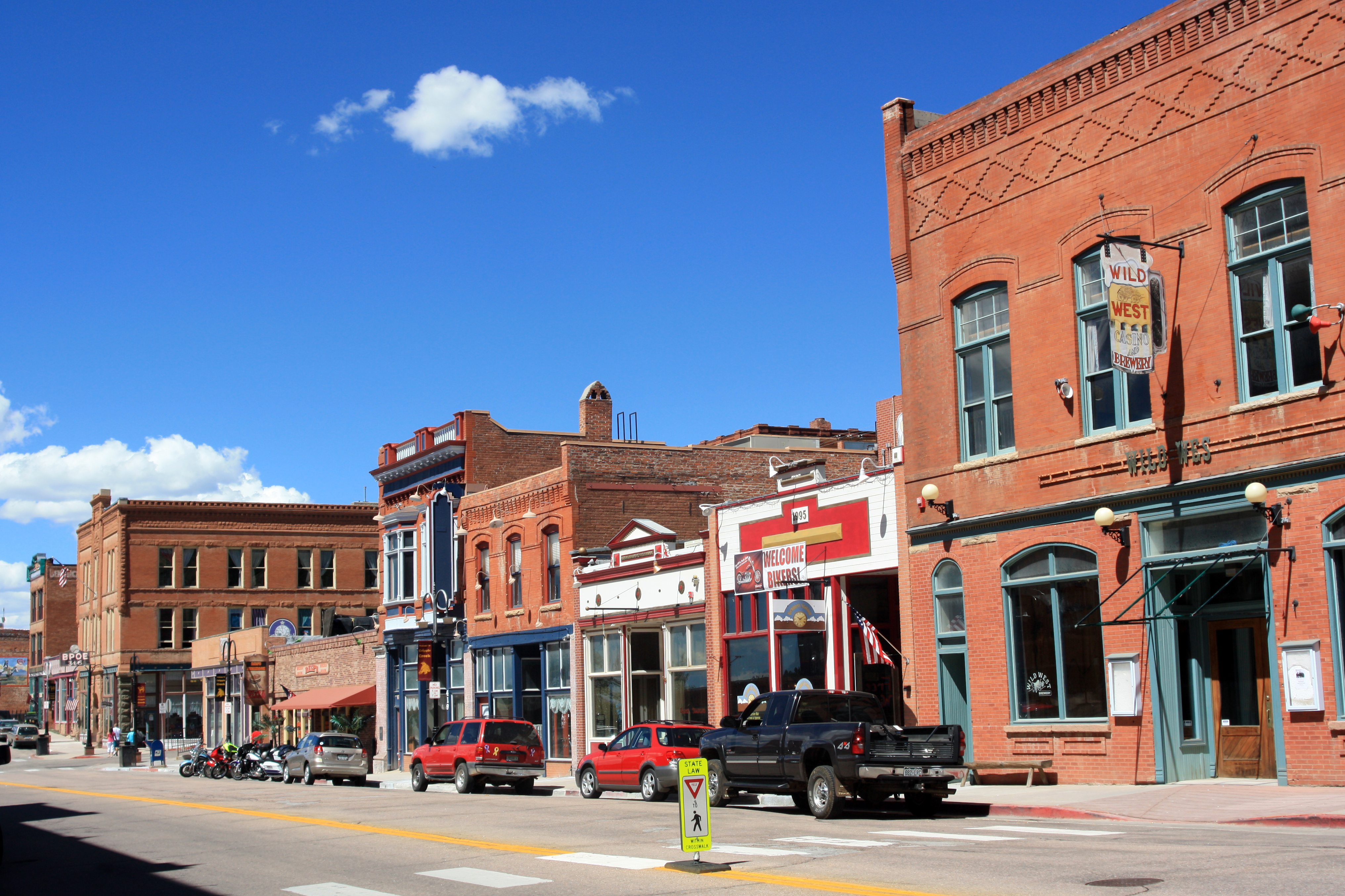
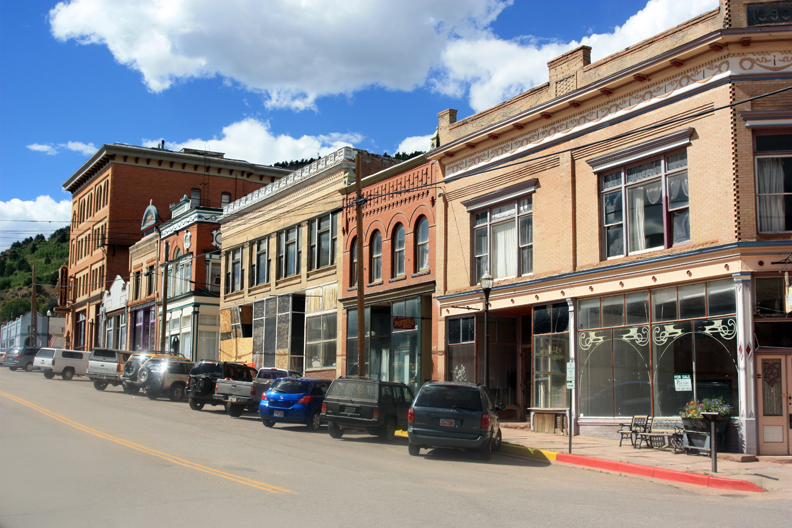
Cripple Creek downtown

Downtown Cripple Creek Colorado

This is the second half of my trip to Cripple Creek, Colorado, over the Labor Day weekend. As I described in my last post, we traveled to Cripple Creek on Friday, Sept. 4, 2010 and arrived late at night. The next day, I started out by taking a guided tour of the Mollie Kathleen gold mine, then visited the Cripple Creek Heritage Center right across the road, taking photos of all the displays. They even had a scale model of the Mollie Kathleen.

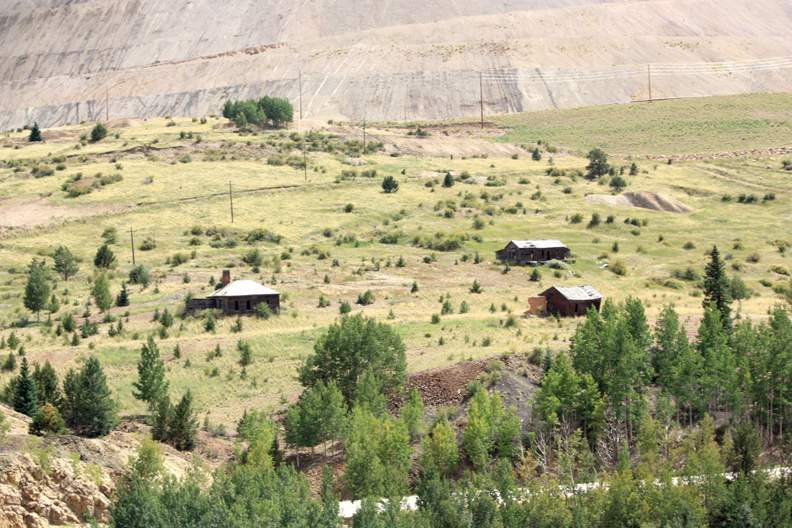
Anaconda mines

Anaconda mine sites with Cripple Creek and Victor Gold Mine

Now for the rest of our visit: After taking some panoramic video shots of the town from the mine dump behind the heritage center, I drove back down Hwy 67 to the town. I was to meet my wife, ‘Becca, and our two children at 12:30 at the Cripple Creek District Historic Center at the east end of Bennett Ave. (the main street of town). I was a bit early, so I wandered around and took some photos and video of downtown, then ate lunch with my family. I had wanted to visit the Historic Center (a man at the mine told me it was worth visiting both museums) but didn’t want my family having to wait for me, so we decided instead to take the narrow gauge railroad tour. We were almost late for the train, and in the hurry my son William fell down and skinned his knee in the parking lot, so we were trying to get him bandaged up (fortunately we brought a first aid kit in the diaper bag) while the train pulled away. The loud train whistle frightened William some more, and I’m afraid the whole experience wasn’t very great for him or my wife, who had to hold him most of the way. My other son, Jonathan, was having the time of his life, pointing out all the rocks to me (at three he’s already a budding geologist). I tried to videotape the whole thing and take a few photos as well.

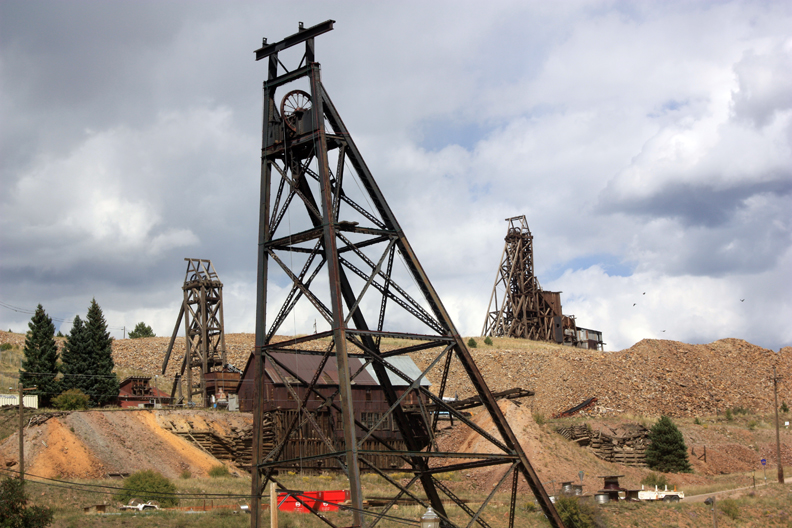
Headframes in Victor

Headframes in Victor, Colorado

The train headed south along the mountain grade, over some old tressles and fills, past many old mine workings, to a point about half way to Victor at the abandoned town of Anaconda. It was quite interesting to see the old mine shacks lower on the hillside and the new terraces and trucks working the higher hillsides for the Cripple Creek and Victor gold mine. On the way back we paused on a siding to let the next train pass, and the engineer pointed out the remains of Crazy Bob Womack’s cabin in Poverty Gulch, who was the first to discover gold in the district in 1890. We had a good view of Cripple Creek and Myer Ave., which was the notorious part of town.

WInfield Scott Stratton and I

Winfield Scott Stratton and I

We had to leave for Denver by 3:00, so we had just enough time to drive out to Victor and snap a few photos. There are many headframes on the hillsides around town, including those of Stratton’s Independence Mine and the Portland, which he had a share of. As we left, I had to take one more photo of myself seated on this bench with Stratton himself (well, at least a bronze replica of him).

Winfield Scott Stratton was the first big millionaire of the district, discovering his gold telluride deposit on July 4th, 1891. He had searched unsuccessfully for silver and gold for the previous 17 years, working as a carpenter during the winters to finance his summer prospecting expeditions. He had even built a sign for H. A W. Tabor in Leadville for his opera house while he was prospecting there. He finally decided he needed more education and took courses in mineralogy at the new Colorado School of Mines. In 1891, he scoured much of the Cripple Creek area and found nothing. On the evening of July 3, 1891, he had a dream in which he imagined going back to a granite ledge he had already passed over. The next day, upon revisiting the site, he noticed signs of gold telluride ore, and discovered rich veins in some boulders that had fallen off the main face of the ledge. He staked a claim and named it the Independence, which he eventually sold for $11 million to a group of British businessmen, the highest amount paid to date for any mine, and a large fortune at the time. But Stratton wasn’t one to blow all of his money; he’d learned from the example of Tabor, who was now ruined because of the Silver Panic of 1893. Eventually Tabor came to Stratton looking to sell some mine stock to help pay his debts. Stratton paid him $50,000 for the stock, but never bothered to record the sale at the mine office. Stratton eventually bought a house in Colorado Springs that he himself had built years before and lived there the rest of his life. I had read a biography about him a couple of years ago called Midas of the Rockies by Frank Waters (1937) and now I’ve finally visited the sites he helped to make famous.

Victor Colorado

Downtown Victor Colorado

There is still much I would like to do and see here. I would like to hike some of the paths in Victor, take the tour of the open pit mine, and view the whole valley from the Eagles overlook. But that will have to wait for another trip. At least I have gathered enough footage and photos to make a great video of the Cripple Creek mining district.

Read Full Post »

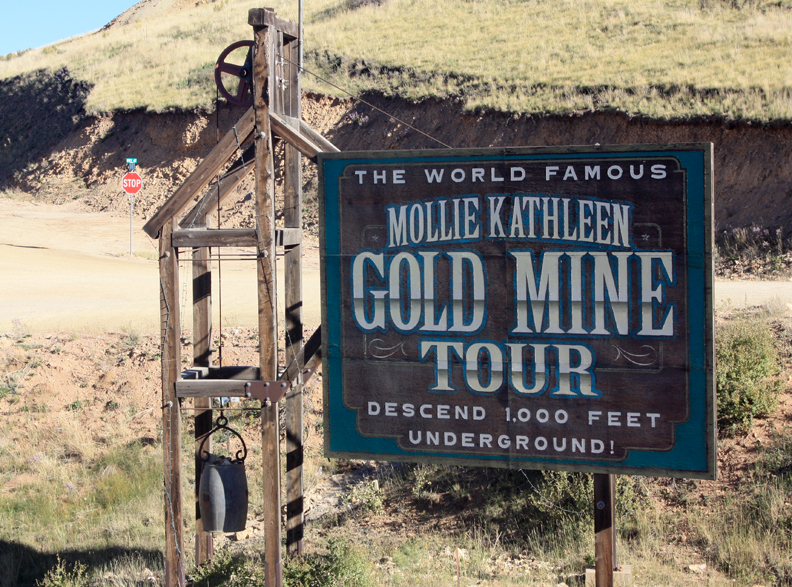
Mollie Kathleen sign

Sign for the Mollie Kathleen gold mine

Over Labor Day weekend I traveled with my family to Denver to visit my brother-in-law’s family. On the way, we stopped off at Cripple Creek, Colorado, to tour the gold mining district. I’ve been near there twice before but never took the chance to stop and visit, so this time I determined to get there no matter what. Since we left after my classes were over on Friday at 2:45 p.m., with occasional stops for food and stretching, we didn’t get into our motel until 2:30 a.m.

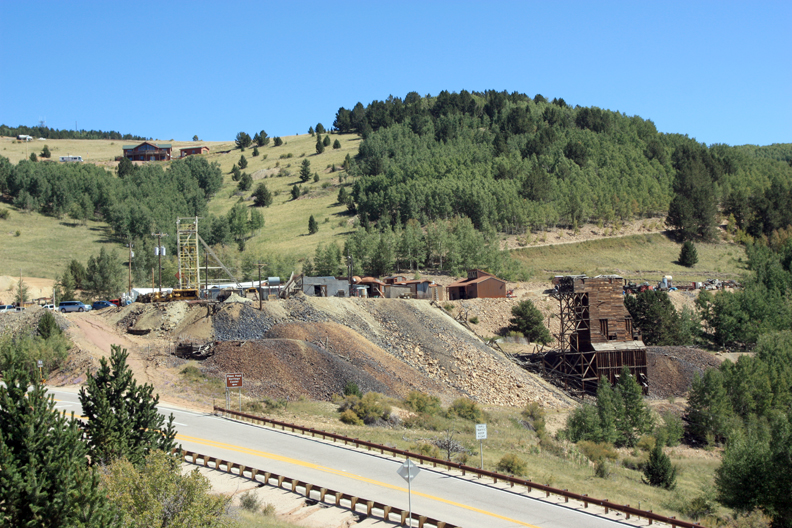
Mollie Kathleen mine

Mollie Kathleen gold mine

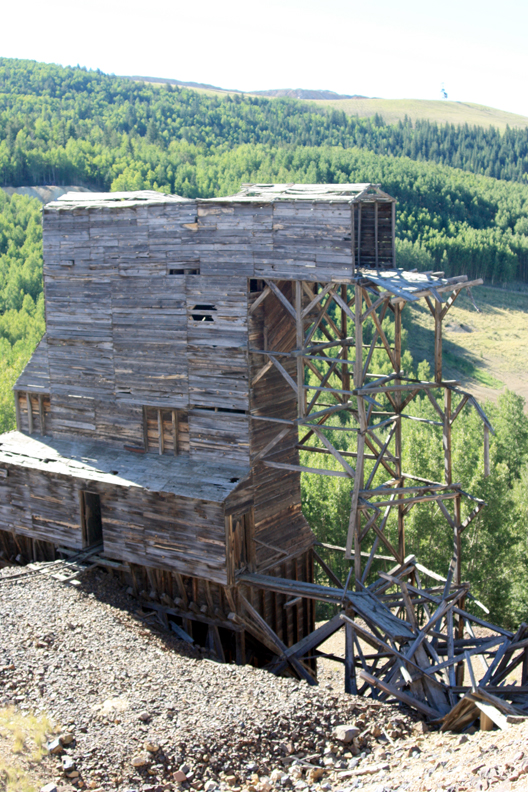
On Saturday I got up early and drove a couple of miles out of town on Highway 67 to the Mollie Kathleen gold mine. I arrived about 8:50 and the first tour was at 9:30, so I took the time to take photos around the mine site of the old equipment and original headframes. One person there told me a bear had walked through the site just ten minutes before I arrived.

Old headframe at Mollie Kathleen mine

Old Headframe at Mollie Kathleen Gold Mine

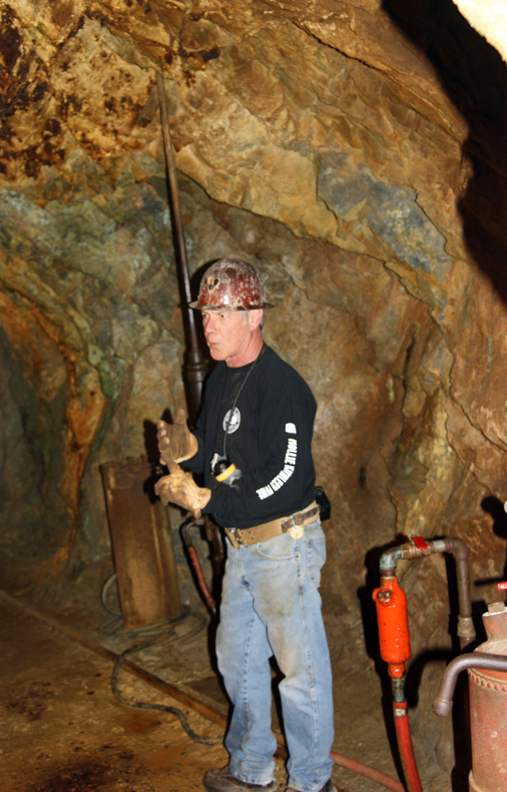
At 9:30 we donned hard hats and were loaded tightly into the double-decker man skip to travel 1000 feet down to the bottom level of the mine. Jim Smith was our tour guide, and of all the tours I’ve taken of mines around the country, this was one of the best. Not only did he explain how the equipment was used, he actually demonstrated it (it is still in working order). We saw how hydraulic drills, stope drills, muckers, bucket dumps, and other types of equipment were used by the miners. The tour lasted about an hour. I videotaped the whole thing, but wasn’t able to take many photos because we moved through the tour fast enough that I couldn’t use both cameras at once.

Mucker model

Scale model of a mucker, Cripple Creek Heritage Center

Mollie Kathleen mine tour

Jim Smith explains stoping drill, Mollie Kathleen mine tour

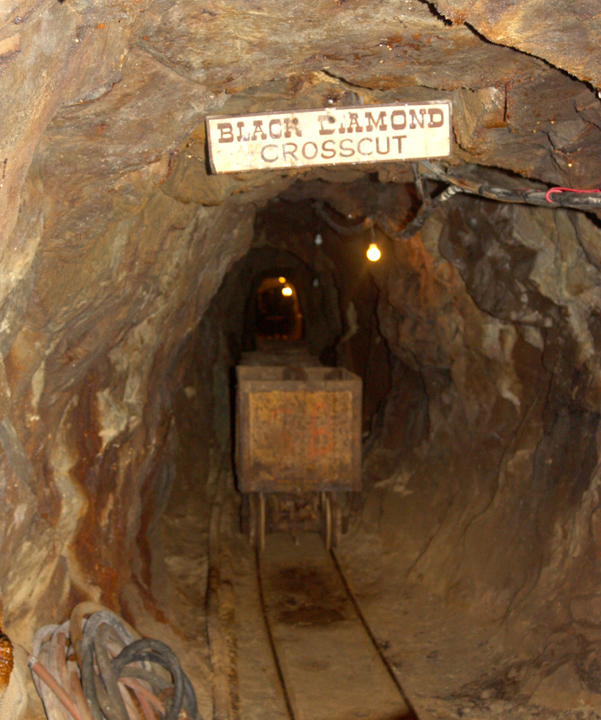
Jim described how miners would discover a gold vein or deposit, and shafts and crosscuts would be dug into the bottom of the deposit so that it could be stoped upward (following the deposit as it twists through the rock), standing on planks using a stoping drill that could jam and flip you off the plank at any time. Some deposits were found filling cavities called vugs, where the gold would replace the granite rock and form rich veins. The normal grade of ore assayed at about $2 of gold per ore car; some of these vug deposits, such as the one in the Cresson Mine, assayed out at over $4000 per car. Miners were paid $3 per day at that time (the same as miners in the Tintic District in Utah) and it was common for miners to “high grade,” or smuggle rich ore samples out in the false bottoms of their lunch pails.

Crosscut tunnel and ore car

Crosscut and Ore Car, Mollie Kathleen mine

Mary Catherine (Mollie Kathleen) Gortner discovered the mine in 1891 shortly after Bob Womack and Winfield Scott Stratton had discovered their gold lodes. She was visiting her son, who was prospecting in the camp, and walked up Poverty Gulch to where he was working. As she sat down to rest, her foot kicked a rock that looked like promising gold float, and she followed the rock to its source (which had already been missed by numerous miners) and memorized its location – she was too afraid of someone jumping her claim to even mark it. When the rocks she hid in her dress assayed out as rich gold ore, she returned and staked a claim as one of the few women mine owners in the district. Since then, the Mollie Kathleen has been in more-or-less continuous operation as a producing gold mine; the Lanning family that owns it now still goes in during the winter to mine out veins. They can make a small profit, with gold at over $1200 per ounce now (the main problem for the gold mines in the district isn’t the lack of gold, but the lack of a local mill to process it). But the main source of income now is from the mine tours.

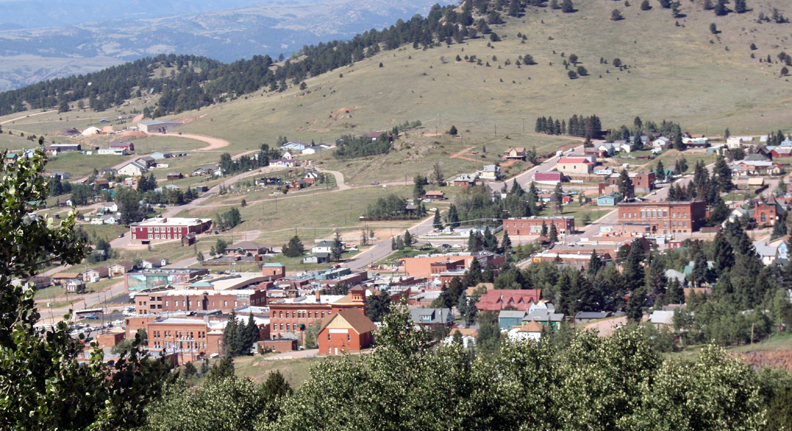
Cripple Creek Colorado

Cripple Creek, Colorado from Heritage Center

After the tour I visited the Cripple Creek Heritage Center across the street and took some panoramic videos of the town, as the view was great. There were headframes on most every hill and holes everywhere where prospectors had tried and failed to find gold. At the top of the major hills was a huge continuous tailings pile from the Cripple Creek and Victor Gold Mine, a large open pit/surface mining operation that is still operating. They are concentrating the ore through leaching the tailings piles, and it is interesting to see this modern mining operation superimposed on the older, historic mines.

Next post, I’ll describe the towns of Cripple Creek and Victor and some of the mines in the area.

Read Full Post »

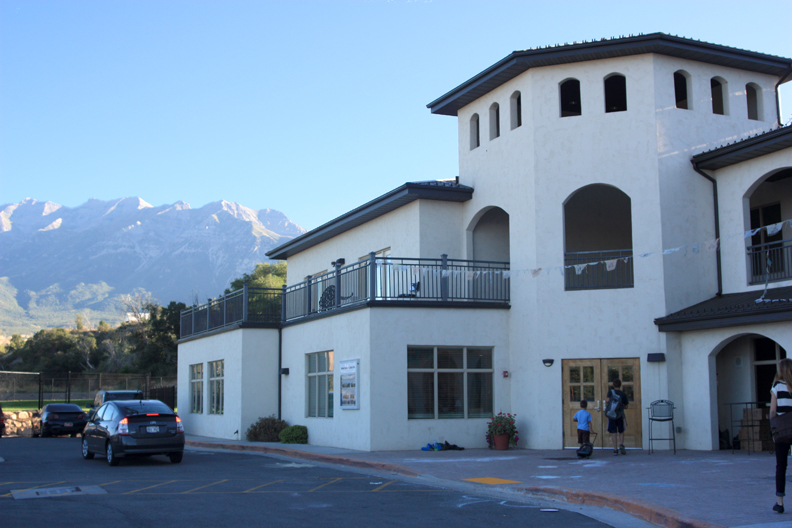
Walden School

Walden School of Liberal Arts in Provo, Utah

The past month has been crazy busy as I’ve prepared for my new teaching job at Walden School of Liberal Arts in Provo, Utah. I had intended on writing at least six blog posts in August and interviewing at least one person, but didn’t do any of it; instead, I’ve been writing curricula, lesson plans, preparing my classroom, and going on a four-day backpacking trip with my students to the high Uintah Mountains, up past Mirror Lake to Naturalist Basin. My legs are still recovering. Now this week has begun our first week of classes: I am teaching two sections of Honors Chemistry and one section of Astronomy on Mondays, Wednesday, and Fridays and one section of Computer Technology and one of Multimedia on Tuesdays and Thursdays. I’ll probably also pick up a Video Production class afterschool as well on those days. So far we are three days into the school year and things are going well.

My chemistry and multimedia students will be helping with the Elements Unearthed project in much the same way as my Media Design students did at MATC, except I am now at a school that actually believes in expeditionary learning (field trips) and project-based learning (PBL). Plus having dedicated chemistry students will help improve the accuracy and relevance of the student videos. Here’s what they are going to do:

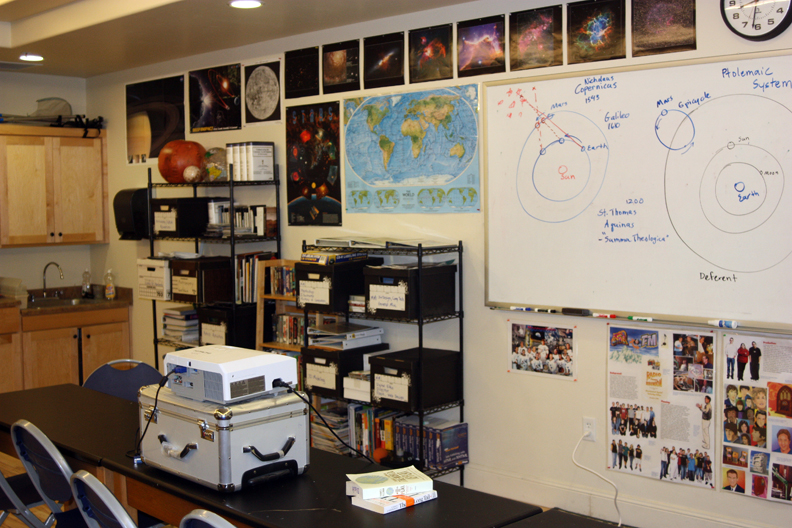
David Black classroom

My classroom at Walden School

During the first term, each student will select a topic from one of four categories: elements, materials, energy processes, or the history of chemistry. They will conduct background research and develop an extensive set of notes with references, which they will condense into some form of print media, such as a poster, newsletter, brochure, etc. which they will convert to .pdf format. They will act as guest hosts of this blog, each one taking a turn to write a post entry about their topic and attaching their .pdf file to it for all to see.

During second term, they will come up with some sort of demonstration that relates in some way to their chosen topic, and practice it in class, then on a Friday in November we’ll take the whole class downstairs to the elementary classrooms (Walden School is a K-12 Montessori school) and present their demonstrations to the students, as well as handing out a simple worksheet or activity the students can take home. The chemistry students will also present their demonstrations to each other just before winter break and receive feedback.

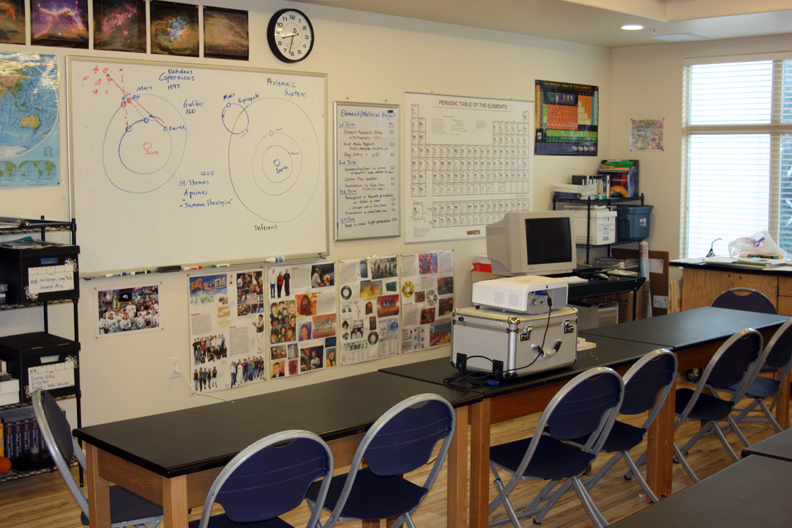
David Black's Classroom

My classroom again

During third term, the chemistry students will add a Powerpoint or Keynote presentation or a video to their topic, which will be presented to their peers and added to this blog site. They will also present again to a different elementary class.

During fourth term, they will present their demonstration, Powerpoint, video, etc. to the public and their parents at a Back-to-School Science Night at the end of April or start of May. We’ll videotape the proceedings and add the videos to this blog as well.

This may seem like a huge project (and it is) but I’ve done all of this before when I’ve taught chemistry at Juab High School in Nephi (except for the media elements – that comes from MATC). Those students who wish can utilize the footage and photos I’ve already gotten for the Elements Unearthed project to do their element or material reports. They can also compete in the Chemical Heritage Foundation’s “It’s Elemental” video competition. My multimedia students will help on the longer videos I’m creating for this blog, YouTube, and iTunes (we’ll set up the iTunes account in our Computer Tech. course).

So you see, I have landed in an ideal situation for classes that I love to teach coupled with a great group of students and an environment that works perfectly for this project. I’m very excited to see what will come out of it. At the very least, this blog should be quite a lively place.

Read Full Post »

The last two weeks I’ve been busy preparing my chemistry and astronomy curricula for school this fall and writing a Preliminary Proposal for the National Science Foundation’s Informal Science Education grant. That was submitted last Thursday, and then I’ve been gone to a family reunion over this last weekend at Bear Lake in northern Utah.

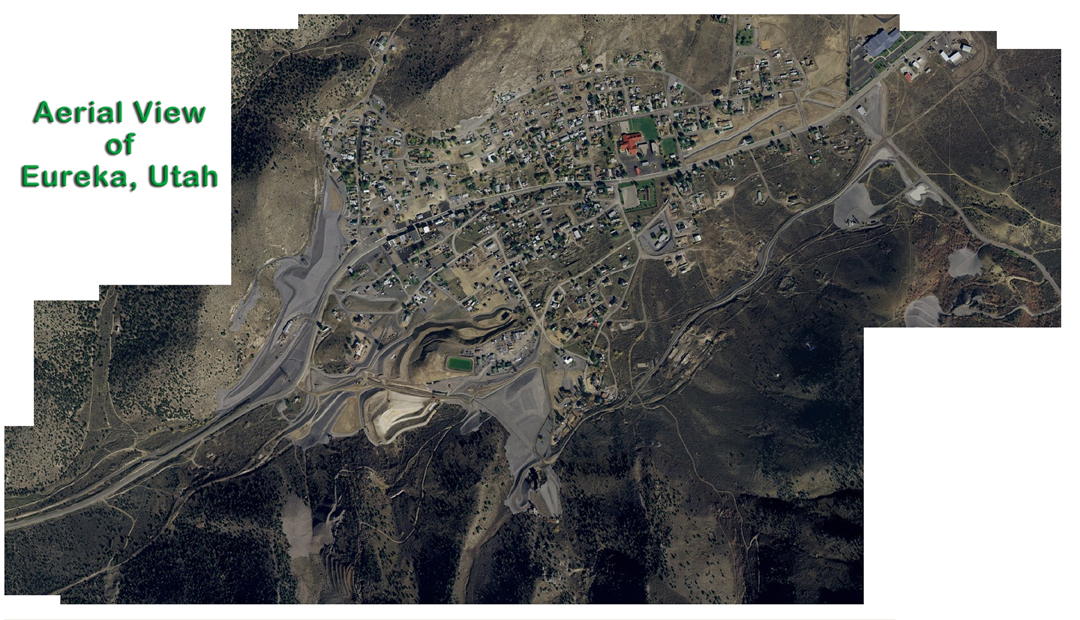
Aerial view of Eureka

Aerial View of Eureka, UT

My proposal has some changes from what I wrote last year; the core of having high school students work with historians, engineers, and other experts to document the history and uses of the chemical elements is still the mainstay of the Elements Unearthed project, but student-created videos aren’t as unique as they were two years ago when I first proposed this project. The NSF program is also more for informal science education: afterschool, public television, or museum programs outside the regular formal education system. Now that I am back teaching chemistry and multimedia in a high school setting, I have a group of students under my direction that can do much of the video editing and research themselves as part of my classes in a formal setting. What I am proposing for NSF to fund is the museum aspect of the project, thereby simplifying my proposal and making it more palatable. I am attaching the six-page project description here:

Small_Museum_Enhancement_Program

Based on what I’ve seen visiting museums across the country that have mining exhibits is that most mining towns are rural and don’t have the wherewithal to host a museum that can really stand on its own. Most small town museums are drastically underfunded and staffed with volunteers; the museums usually have poor Internet presence – if they have a website, it was probably created by somebody’s nephew ten years ago and is usually out of date and ineffective and doesn’t take advantage of Internet video, Web 2.0 technologies, or social networking links. The staff at these museums consists of elderly docents with a passion for local history and a great deal of personal knowledge that has never been recorded; the exhibits usually have faded labels and inadequate signage. So my proposal has three parts to it, all based on enhancing the quality of exhibits and the number of visitors to small town museums with mining exhibits, and all centered around what the museums need instead of what I want my project to do.

The first aspect of this Small Museum Enhancement Program is to meet with museum staff and determine what the museum most needs in terms of exhibit improvements or new exhibits, then provide the funds so that carpenters, electricians, and other contractors can fix up and rebuild the exhibits, such as providing better lighting to displays, building risers inside glass display cases to better display artifacts, cleaning and repairing the artifacts themselves, and in general digitizing and cataloging all the collections.

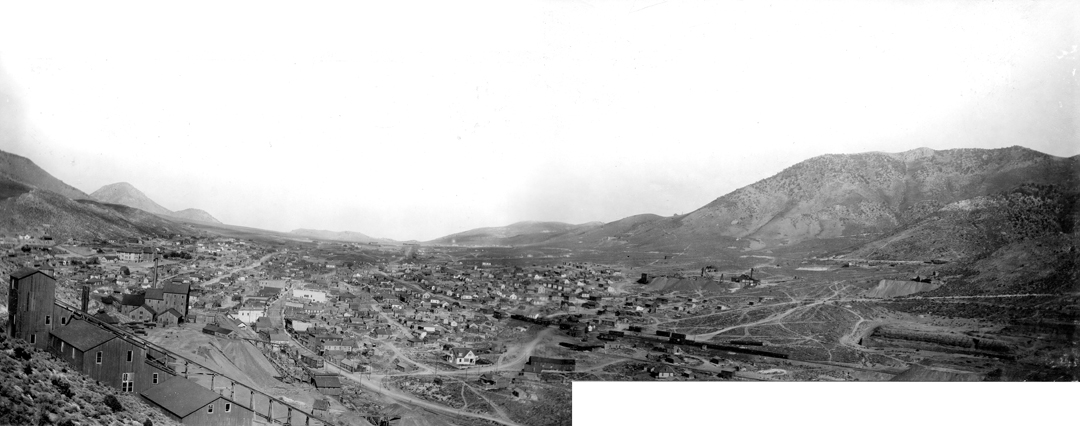
Eureka, Utah in 1911

Panorama of Eureka, Utah in 1911

The second aspect is to improve the museum’s online presence through redesigning the museum’s website and linking it to social networking sites, such as Facebook, Twitter, Scribd, GoogleEarth, etc. None of these small museums make use of blogs as a way of promoting the museum and keeping the public’s interest up, so I’m proposing that the staff be trained on how to set up and maintain a blog, including how to convert their photos and documents to be uploaded and linked as .pdf files to their blogs and to Scribd and other sites.

The third aspect of the proposal is what the Elements Unearthed project has always been about: adding to the museum’s collections by interviewing the staff, videotaping their tours of the museums, and collecting photos and oral histories from the community. Teams of local high school students will work with my students at Walden school to set up community nights where local townspeople bring in photos, documents, and other artifacts and allow us to scan or photograph them, then tell us their stories of the town and the mines on camera. We’ll edit all of this into the podcast/YouTube videos as we already have been doing. One addition is that we’ll also create “point-to-point” video segments based on specific locations in the museum corresponding to particular displays and create short videos that describe the display, show the docent explaining it, and add community and other resources beyond what the display can hold. These videos will be placed on iPads and used by visitors as they tour the museum, playing the videos as they reach each stop on the tour.

These are the three main points of the NSF-ISE proposal. Assuming this proposal receives encouragement to proceed, the final proposal must be submitted by early December. Based on my feedback from last year, I need to develop a stronger collaborative team instead of trying to do all of it myself (thereby increasing the probability of success) and I need a stronger evaluation plan, which means actually having a third party firm involved to plan the experimental design. NSF doesn’t want just projects that are worthwhile, they wan them to also enhance the field of informal science education through fundamental scientific investigation of what types of programs are effective for science education in informal settings. These strategic impacts mean a carefully considered methodology, and my attempts to set up a plan last year weren’t seen as strong enough strategically.

Toward that end, if anyone out there would like to comment on my proposal (if you think it is worthwhile, and if you have suggestions for improving it, etc.) then please take a look at the Preliminary Proposal and give me some feedback, either as a comment to this blog or to my e-mail at: elementsunearthed@gmail.com.

Thanks!

David Black

Read Full Post »

For the last week, I’ve been busy preparing for my classes at Walden School, including inventorying the science lab room (which is also my classroom) and planning out my course schedules. I’ll be teaching two sections of Chemistry, one of Astronomy, one of Computer Technology (a basic computer literacy course required in Utah), a section of Media Design, and a section of Video Production. This is, for me, a perfect schedule. In the meantime I’ve also been preparing a series of maps and 3D images of the Tintic Mining District, focusing on the ore deposits and the various mines located there. I’ve also prepared the script for this section of the video, which I have pasted below:
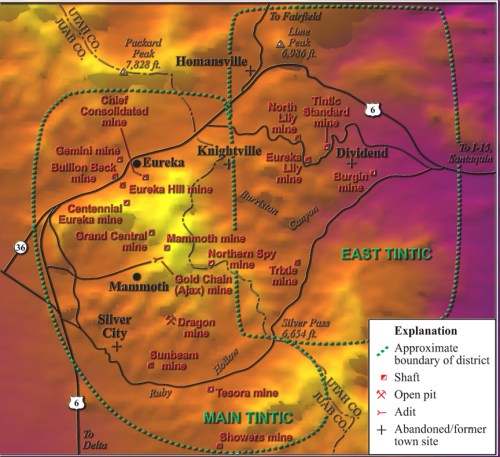
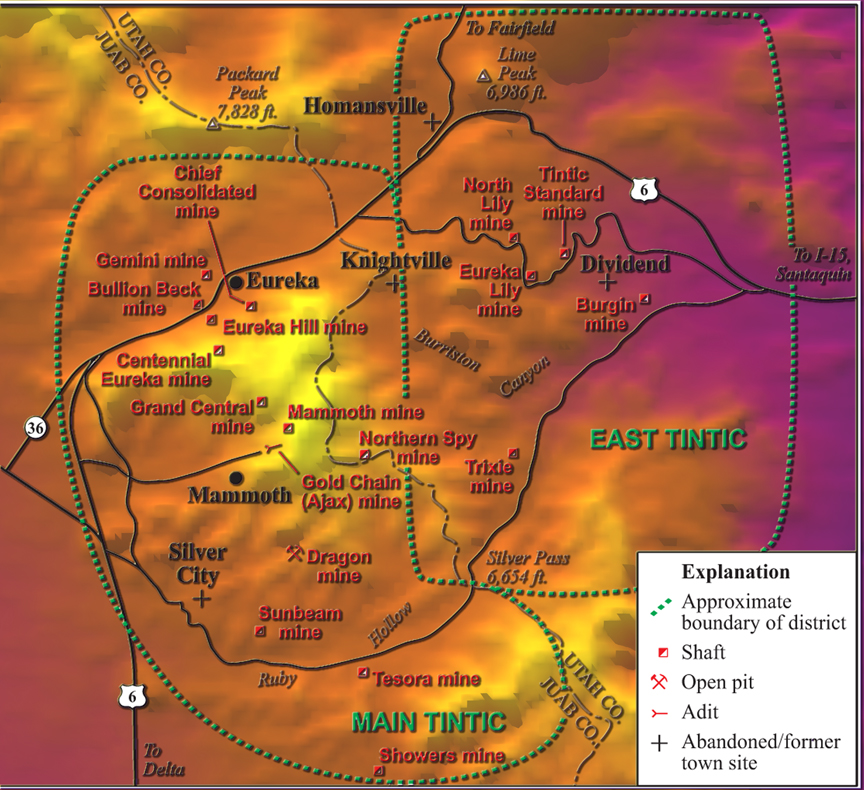
Mines in the East Tintic Mts

MInes and Roads in the East Tintic Mtns.

Tintic Geology

To understand how the ore bodies in the Tintic District were deposited, we have to start about 800 million years ago in the Precambrian Period when the western portion of the North American craton rifted away from the rest of the continent along a line where the Wasatch Front now lies – this Wasatch Line has been an important hinge line in Utah’s geology ever since. For the next 600 million years, a sequence of ocean sediments including dolomite, limestone, shale, and sandstone were deposited off the coast in the geosyncline that would become western Utah. Beginning 150 million years ago, Nevada and then western Utah were uplifted as the Farallon tectonic plate was pushed under North America. Like a throw rug being wrinkled up as it’s pushed over a hardwood floor, western Utah was folded by thrust faults into a large mountain range during the Sevier orogeny about 70 million years ago. This thrusting continued across eastern Utah and into Colorado and Wyoming during the Laramide orogeny, building up the Uintah and Rocky Mountains.
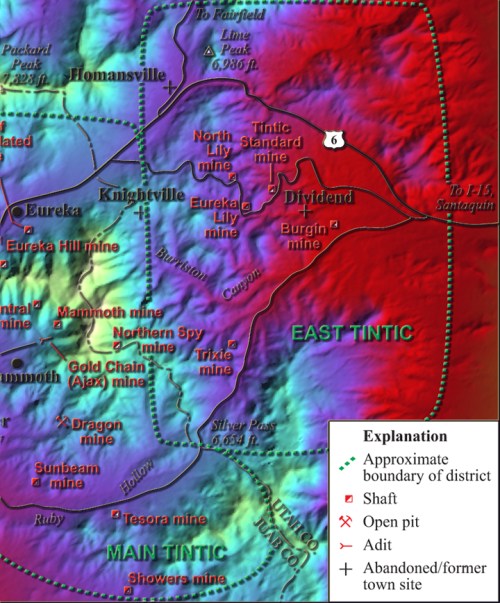
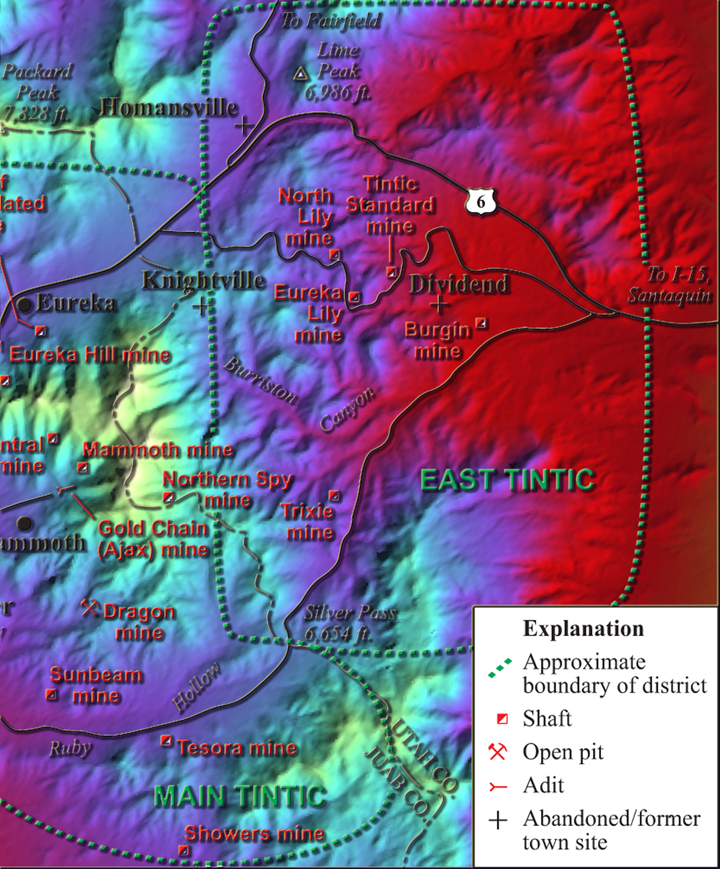
East Tintic Mines

Mines in the eastern portion of the Tintic Mining District

Then, about 50 million years ago, the Farallon plate began to collapse from underneath the continent. As it peeled away, a wave of volcanism moved from east to west across Colorado and Utah. Intrusive laccoliths rose to the surface, bulging up the LaSal and Henry Mountains in eastern Utah and forming explosive calderas in several places in western Utah. About 35 million years ago, a series of calderas formed in the area that would become the Tintic Mountains. A large andesitic volcano rose up from eruptions of ash and tuft.
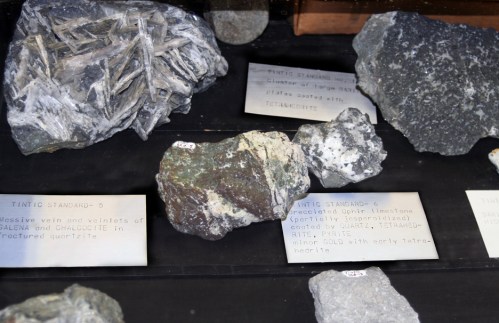
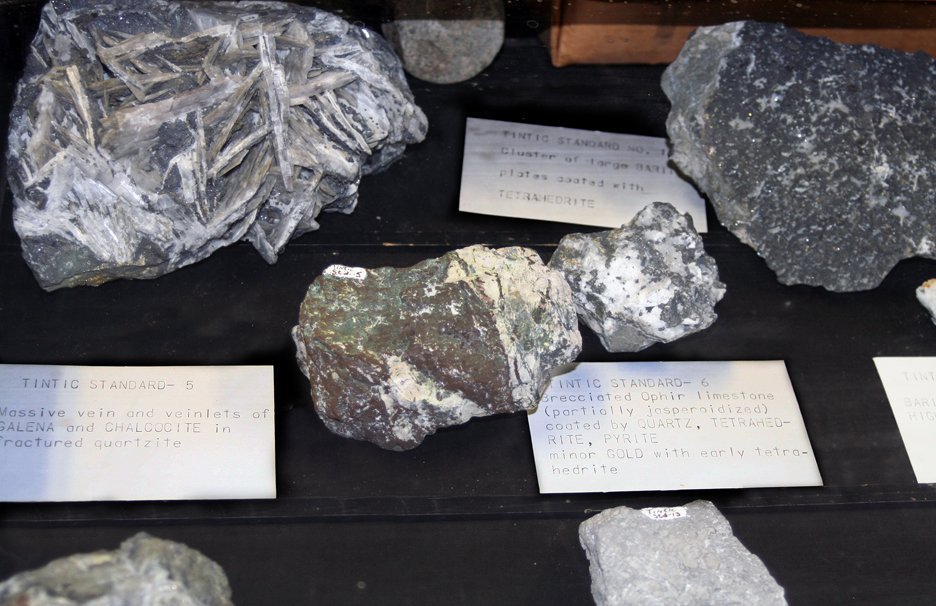
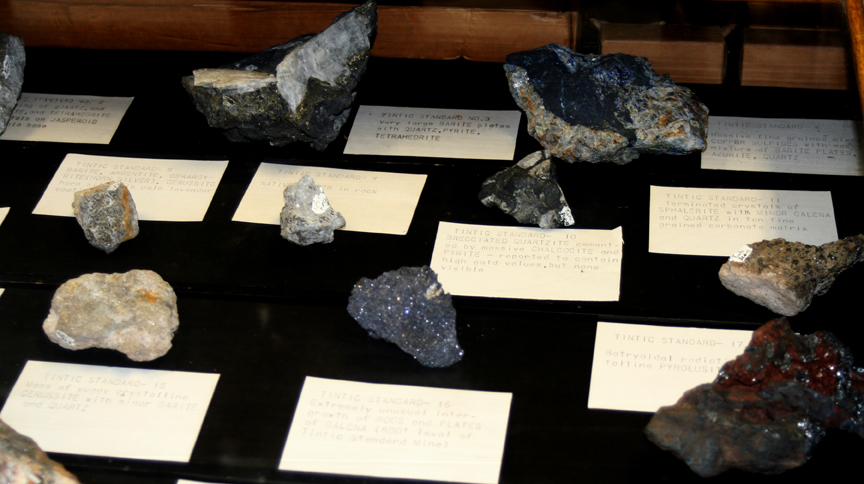
Tintic Standard ore samples

Ore samples from the Tintic Standard Mine, eastern district.

About 31.5 million years ago, the volcano collapsed as the intrusive magma began to cool. Mineral rich fluids were injected into the surrounding limestone, quartzite, and dolomite as replacement beds. The hot magma caused the carbonate rocks to decompose; for example, limestone turns into lime or calcium oxide and carbon dioxide gas when heated. This left large cavities that then filled up with the mineral-laden magmas. These deposits are called stopes, such as the famous Oklahoma stope of the Chief Consolidated mine. The carbon dioxide released from the decomposing limestone and dolomite in turn dissolved into the hot magma, making it a kind of lava champagne, and reacting with it to form various exotic minerals, some of which are found nowhere else.
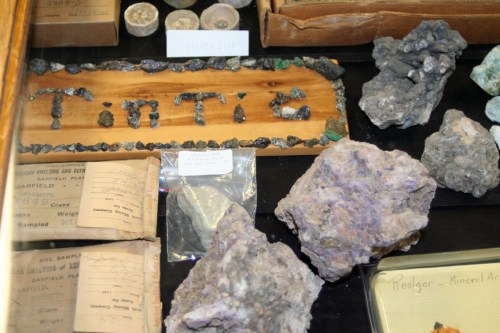
More Tintic ore samples

More ore samples from the Tintic District

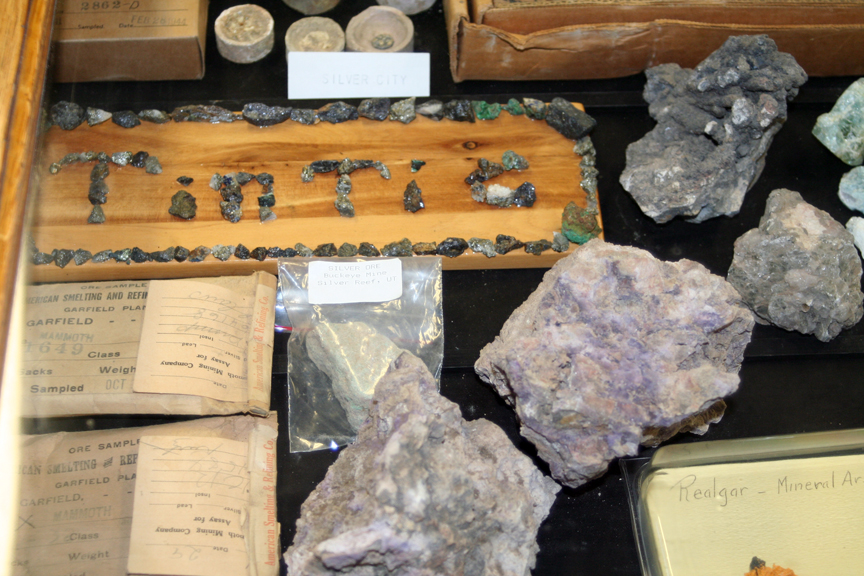
The primary ore-bearing minerals in the Tintic District are enargite, tetrahedrite, galena, sphalerite, pyrite, marcasite, and native gold, silver, and copper. But many more minerals are present, including unusual minerals that blend copper, silver, tellurium, arsenic, sulfur, carbonates, hydrodixes, etc. At the Centennial Eureka mine, over 85 different minerals have been identified, ranging from common pyrite, malachite, and azurite to minerals found only here. It is the type locality (where the mineral was first identified) for leisingite, frankhawthorneite, jensenite, juabite, utahite, and eurekadumpite. Other rare minerals include xocomecatlite, carmenite, adamite, duftite, and mcalpineite.

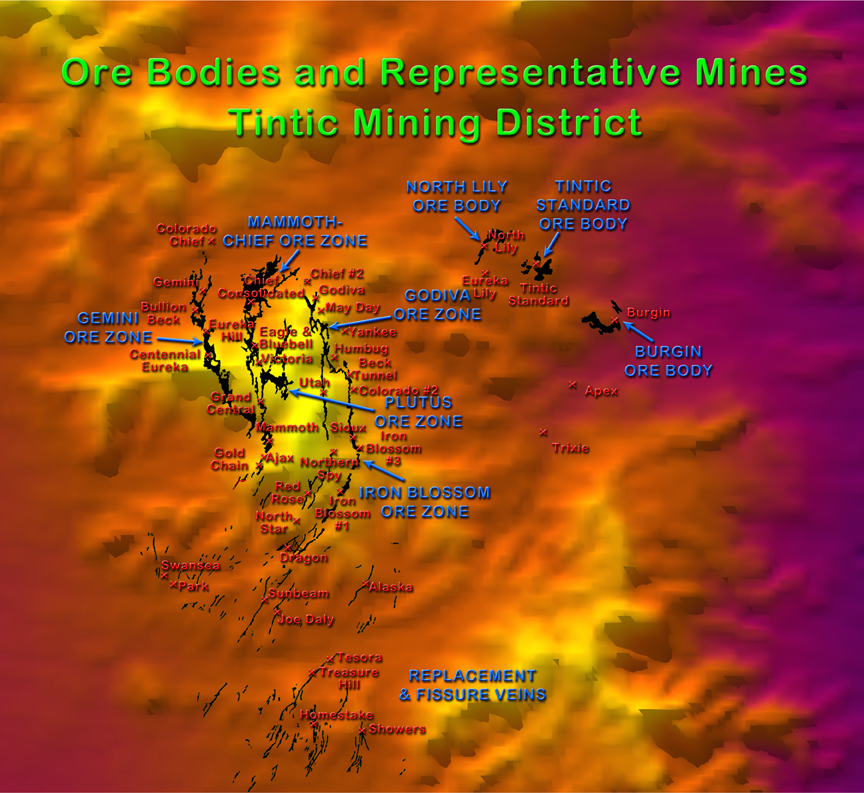
These mineral deposits occurred around the edges of the caldera and formed the five large ore zones of the main Tintic District. The Gemini Ore Zone runs to the west of Eureka south to the north edge of Mammoth Gulch. The Gemini, the Bullion Beck and Champion, the Eureka Hill, and the Centennial Eureka mines (known collectively as the Big Four) are located on this zone.

The Chief-Mammoth Ore Zone begins under the center of Eureka and extends due south across the mountain to the east end of Mammoth Gulch. The Chief Consolidated mine is located on the richest ore body, which is right under the center of Eureka city; up the hill is the Eagle and Blue Bell mine, named for the beautiful deposits of azurite found inside. Further south over the top of Eureka Peak lie the Grand Central, Mammoth, Apex, and Gold Chain mines that are also part of this deposit.
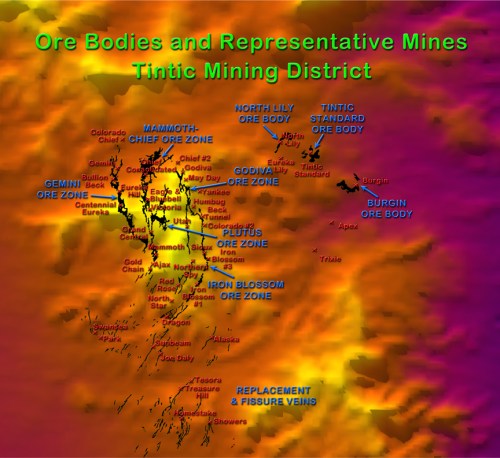
Ore zones in the Tintic District

Ore Zones and Major Mines of the Tintic Mining District

The Plutus Zone branches off of the Chief-Mammoth Zone high up in the Tintic Mountains. The Godiva Zone starts just east of Eureka and runs southeast in a curve where it joins the Iron Blossom Zone, which continues in a curve south and then southwest. Some mines in these zones include the Godiva, May Day, Humbug, Beck Tunnel, Sioux, and Iron Blossom mines.

In the eastern section of the Tintic District, several zones of minerals were deposited and were among the last to be discovered because they are overlain by 400 feet of igneous rock. These bodies include the Burgin ore body, the Tintic Standard, and the North Lily bodies. Other bodies are located at the Apex and Trixie mines.

In the southern section of the Tintic District, the large replacement bodies give way to smaller fissure veins that are only two feet wide on average but can be up to 4000 feet long. Here, the mineral-bearing magma was injected into cracks and fault lines already existing in the host rocks. The Dragon mine is the only true open pit mine in the area; it sits on top of a network of fissure veins at the south end of the Iron Blossom Zone. Other mines in the area include the Swansea and Sunbeam mines at Silver City, the Tesora and Treasure Hill mines at Ruby Gulch, and the Showers mine at Diamond Gulch.
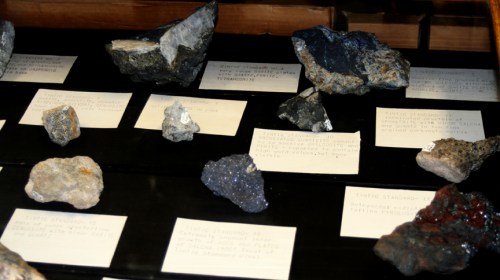
More ore samples from the Tintic Standard Mine

More ore samples from the Tintic Standard Mine

The final chapter in the area’s geomorphology began about 17 million years ago when normal faulting created the Basin and Range province, lifting up blocks to form the mountain ranges of Utah and Nevada, including the East Tintic Mountains. Other blocks sank to form the valleys, such as the Tintic Valley. Erosion has exposed the ore bodies in many places, including the outcropping that George Rust stumbled over in 1869. It was to become the Sunbeam Mine.

Read Full Post »
This morning I accepted a job offer to teach full-time at Walden School in Provo, Utah. (here is their website: Walden School Website). I will be teaching a combination of chemistry, earth science, and multimedia courses at the high school level. Walden is a small charter school that follows the Montessori philosophy of providing a rich learning environment and letting students have a large say in the direction and content of their education. This happens to coincide very well with my own philosophy, which I have stated here before, that science classrooms need to go beyond hands-on learning and teach students how to be creative contributors to their own education, through building their own science content or conducting their own experiments.

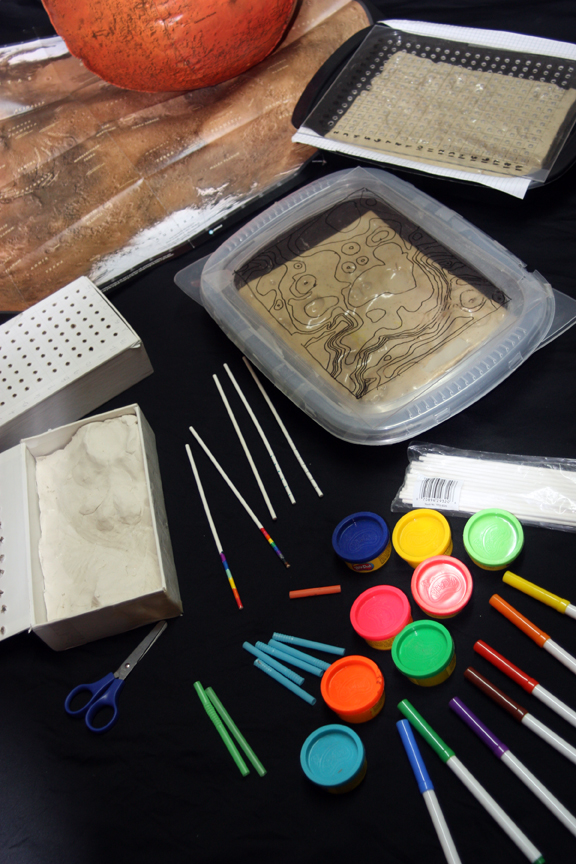
Materials for Mars 3D activity

Materials for the Mars 3D activity

In fact, the fit for me is so good that if I had sat down and designed the perfect situation for what and how I like to teach, it would be very similar to what Walden School has to offer. And it will be ideal for The Elements Unearthed Project. It will provide a base of operations, so to speak, from which to apply for grants and gain support as well as a group of dedicated, creative students to work with. Teaching chemistry and earth science in addition to the multimedia I’ve taught for the last ten years will also allow me to cross-pollinate the classes so that students can do diagrams, animations, and videos for their multimedia class but also get credit in chemistry or earth science. This is the way project-based-learning (CBL) can be more efficient as well as more effective.

I’ve struggled this last year since returning from my fellowship at the Chemical Heritage Foundation to make financial ends meet by creating Business Profile Videos for clients. The economy being the way it is, all the businesses we’ve contacted love the idea of a YouTube video advertising their products or ideas, but hardly anyone can afford to pay what the videos are actually worth. So for the last two months I’ve been searching for full-time and part-time jobs; it takes a great load off my mind to know I will have a regular income. Although my days will now be spent teaching, I think the overall pacing of the project can increase; I no longer will have to spend all my evenings working on business videos and can devote almost as much time as now to the video episodes I’ve already filmed.

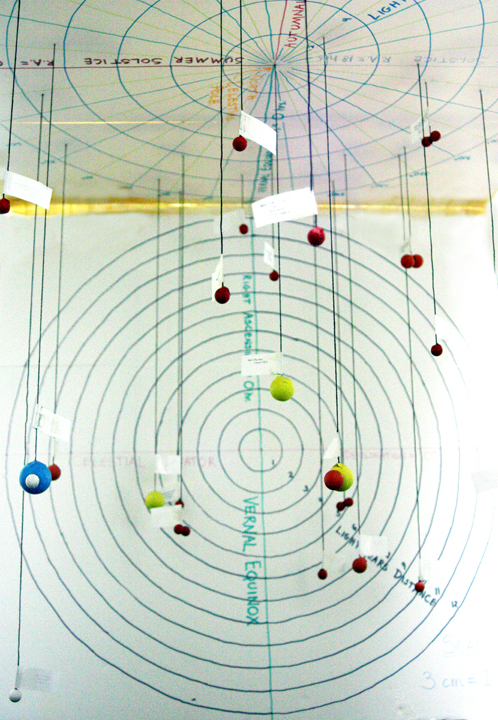
It will also be great to get back to science teaching. I’ve missed it, and I’m looking forward to dusting off and updating some of the great lesson ideas and activities I’ve learned from NASA and elsewhere. I can bring back the Elementary Science Tutorial Program I began at Juab High School so many years ago. Now my students can build the 3D model of the nearby stars I developed for my astronomy classes at Provo Canyon School. Now the Mars 3D project I developed at MATC can be shared between multimedia and earth science classes. Now The Elements Unearthed Project will be able to draw on students from multiple disciplines in a school that believes in student creativity, project-based teaching, and expeditionary learning.

Table top star model

Table-top 3D model of the nearby stars.

Instead of the factory model, one-size-fits-all style that is killing our public high schools, where subjects are fragmented and divorced from each other, I believe in teaching holistically and individually and expecting students to achieve highly creative work. Now I’m going to put this philosophy to the test.

Read Full Post »

« Newer Posts - Older Posts »