Feeds:
Posts
Comments

Archive for the ‘Weekly Post’ Category

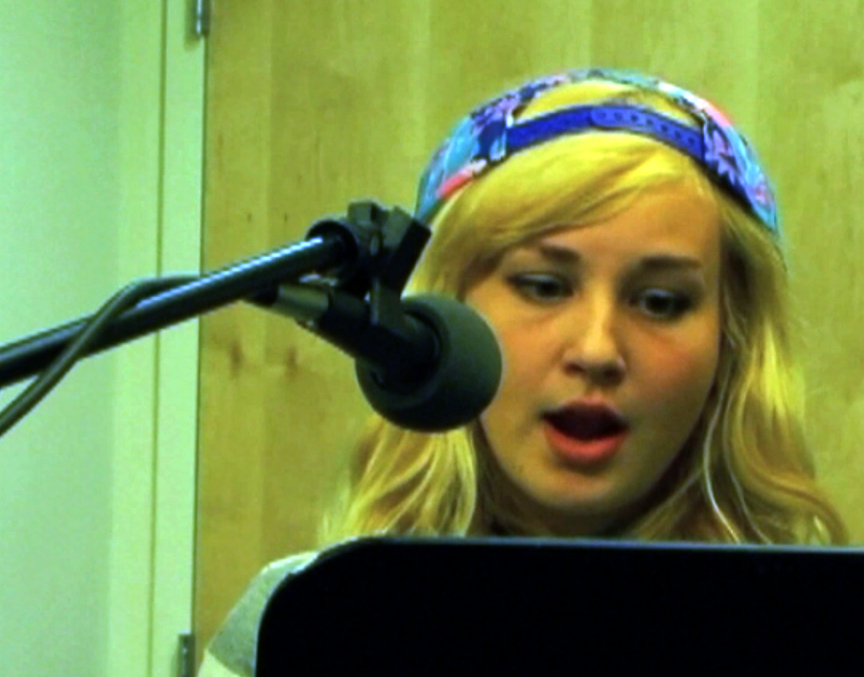
Recording a podcast

Mazie recording her paragraphs for the podcast

I realize the last three blogs I’ve posted here have been about astronomy instead of the elements (although the elements are mentioned here and there). I tend to write about what’s been on my mind, and since I’m not teaching chemistry this year, but I am teaching astrobiology, you’ve been getting quite a bit about the Moon and now about Mars and the stars. I hope you don’t mind.

My astrobiology students are now hard at work creating podcasts for the 365 Days of Astronomy website. The first episode was uploaded this evening and is scheduled to “air” on Friday, Dec. 2. Three other episodes will follow, on Dec. 8, 14, and 19. Here’s a link to the website: http://365daysofastronomy.org/

Recording podcast audio

Cali records her portion of the podcast

This first episode was researched and recorded by Mazie, Cali, and Tia and is about how stars are named. They describe the four most common methods: Common names (such as Bellatrix or Rigel or Sirius), the Bayer naming system (such as Alpha Centauri), the Flamsteed System (such as 61 Cygni), and various star catalogs such as the various Durchmusterungs, the Henry Draper, Hipparcos, etc.

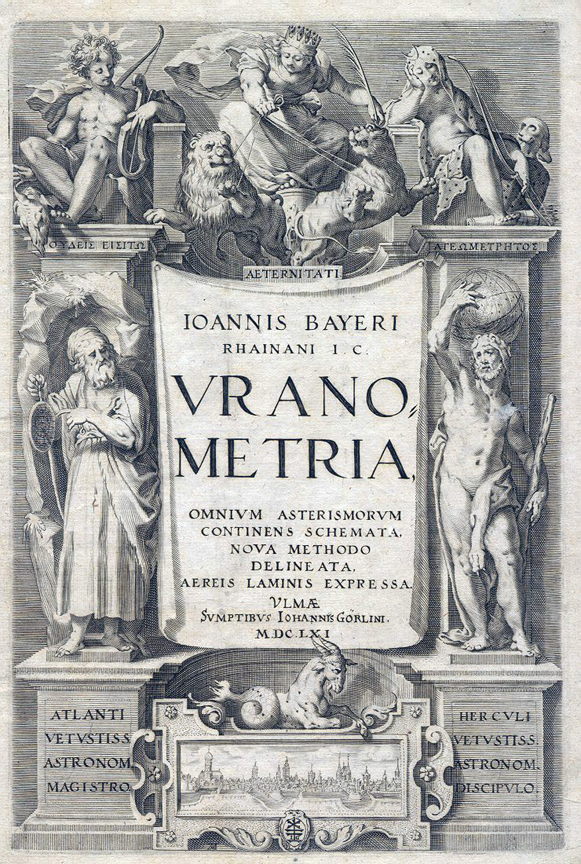
Title page of Uranometria

Title page for Uranometria by Johann Bayer

Rather than steal their thunder, I am attaching the audio file here:

Naming_Stars_Podcast

And here is the transcript of their presentation:

Naming_Stars_transcript

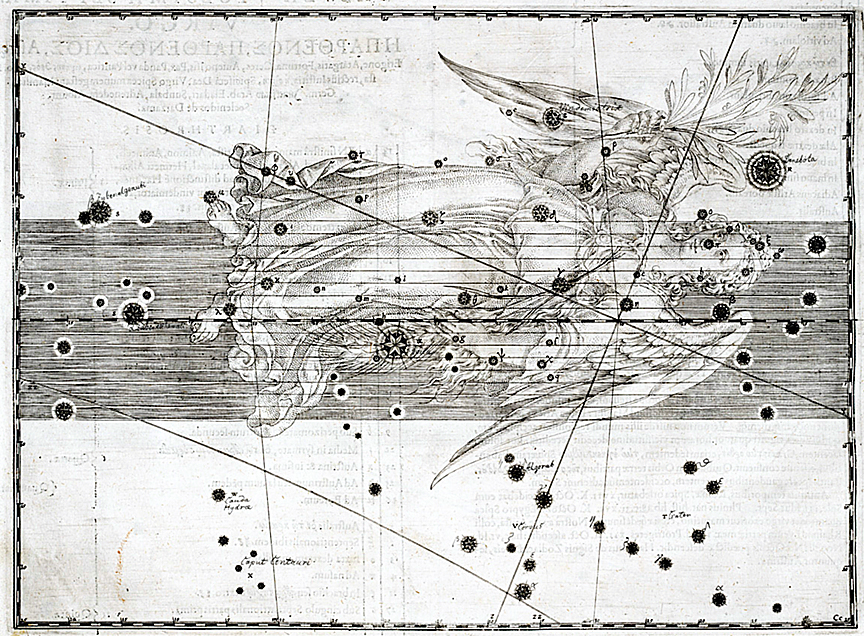
Unfortunately, as I was preparing this post and gathering images (such as this one of Virgo taken from Johann Bayer’s Uranometria) I discovered that we made one mistake. We had listed the star Zuben Eschamali as being in Libra when it is really in Virgo. This was my mistake, and one I should have caught before now.

Virgo constellation

Virgo as drawn in Uranometria. The bright stars on the left are Zuben Elgenubi and Zuben Eschamali. The very bright star is Spica.

Hopefully that is the only mistake we’ve made. The students did the research, with notations and edits by me, developed it into a script, and recorded their parts this last week. We went through each paragraph (and sometimes each sentence) several times to get good takes. I also recorded myself at home doing the second episode, which is on my own take on the Drake Equation. I’ll have that one edited and transcribed by tomorrow evening.

I’ve also ran into a major difficulty in that my laptop’s hard drive died last week and I’ve been trying to recover files and software ever since. The Mac store I went to would only install the system software that originally came on my computer, even though I had upgraded to Snow Leopard. So now much of my software that I’ve reinstalled doesn’t work because I have to wait for the Snow Leopard disk to arrive in the mail to get my OS up to speed. Then there is the whole fiasco with buying Final Cut Studio off of e-Bay only to have it arrive without the installation disks. So I got a refund and have to mail it back tomorrow and wait for my new purchase (hopefully complete this time) to arrive. In the meantime, I’ve been editing these podcasts using iMovie and Audacity – not my first choice, but it is working.

The worst part of losing the hard drive is that I had literally thousands of photos on it from my research at the Chemical Heritage Foundation and from visits I’ve made to mine sites since then that I don’t want to lose, so I will need to pay an extra amount to get the data recovered. Hopefully it can be. Now I know to back up all my photos as well as the video projects I had already backed up.

I hope you enjoy the podcasts. I’ll let you know how the data recovery goes.

Read Full Post »

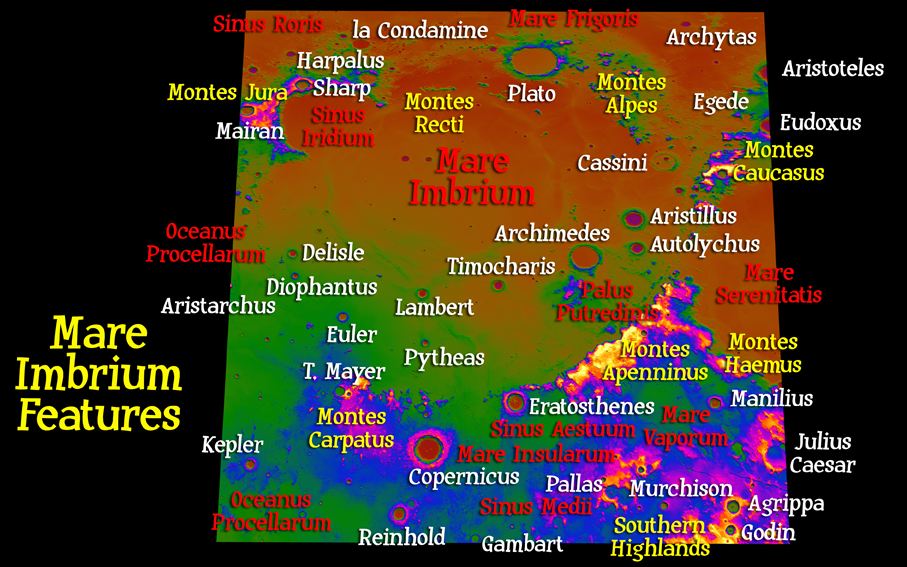
Mare Imbrium features

Mare Imbrium features, created using LOLA data in Daz3D Bryce

We’ve made it to the end of first term and are starting in to second term at Walden School. In our astrobiology class, the students have studied in detail the formation and evolution of the Moon according to best evidence as well as the history of lunar exploration and the Apollo program.

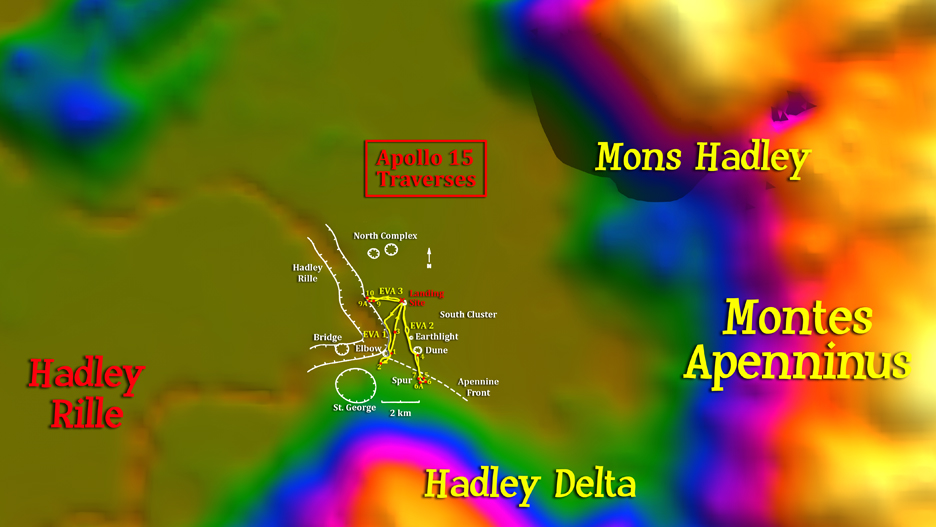
Apollo 15 landing site

Apollo 15 landing site at Hadley-Apennine

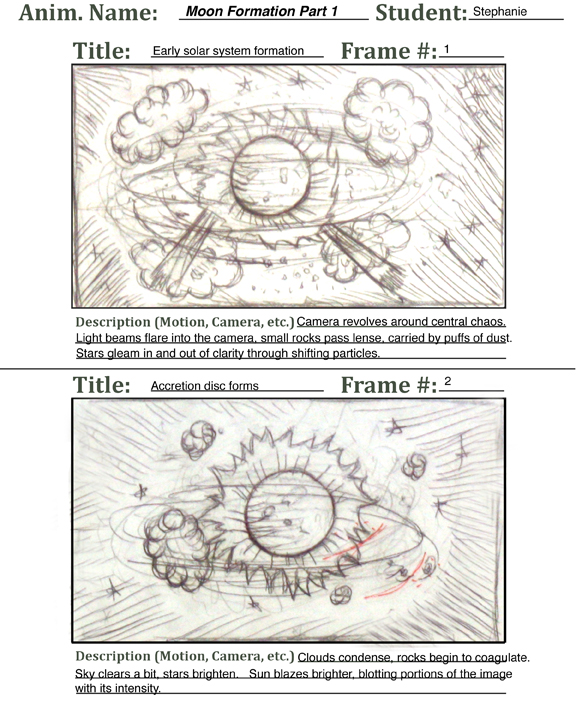
The students have drawn up storyboards of the animation we’re developing for the Center for Lunar Origin and Evolution. One of these storyboard frames is shown below. We will now pass these over to my 3D modeling class, who will soon start the process of planning and developing the models and scenes necessary to make the animations work. The multimedia students will then do the final assembly and special effects/post production work.

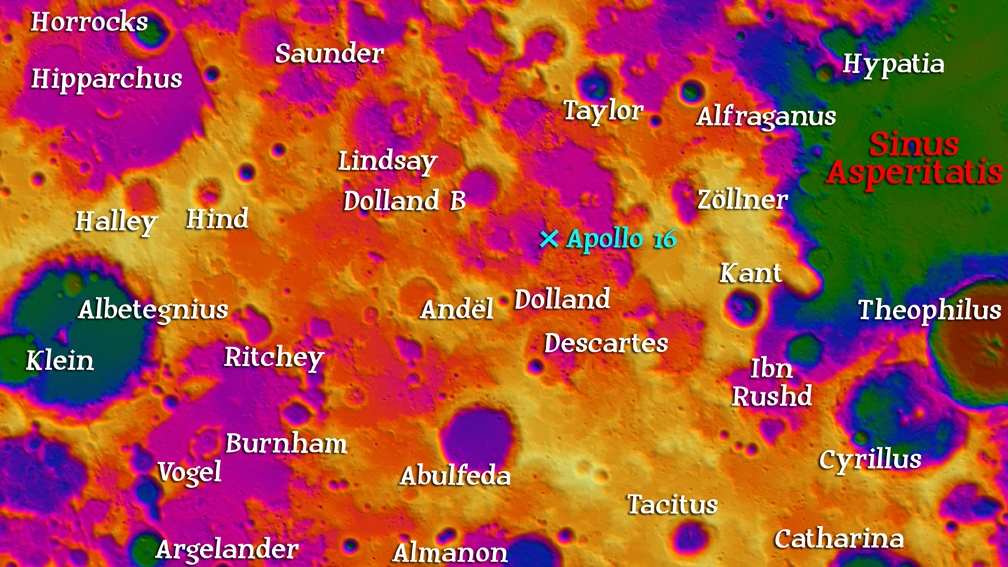
Southern Lunar Highlands

Southern Lunar Highlands around Apollo 16 landing site

In the meantime, I have been working on ways to get the Moon and Mars 3D elevation data to work in my favorite 3D modeling program (Daz 3D Bryce). If I can get the data into a grayscale image, then I can turn it into a 3D terrain in Bryce. I’ve discovered that the LOLA (Lunar Orbiter Laser Altimeter) data from the Lunar Reconnaissance Orbiter and the MOLA (Mars Orbiter Laser Altimeter) data from Mars Global Surveyor can be imported directly into Adobe Photoshop using the Photoshop Raw format (as long as I know the exact size of the .img file). But I’ve encountered a problem: Photoshop has problems with the positive and negative altitude data, as there isn’t any such thing as a negative color. So the high areas are showing up as dark colors and the low areas as high colors, with the Lunar and Martian mean elevation (like sea level on Earth) represents the breaking point between.

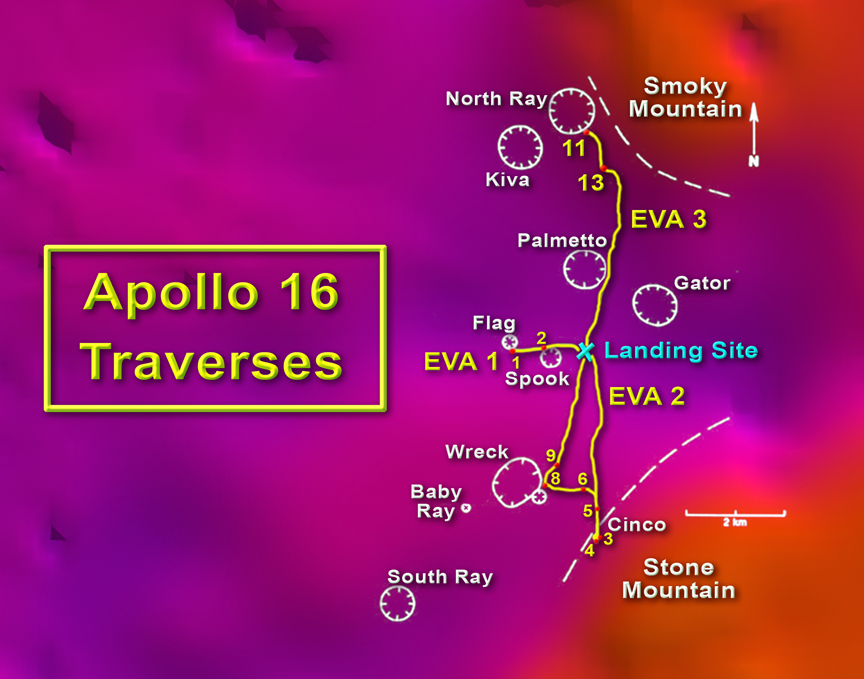
Apollo 16 landing site

Apollo 16 landing site: Descartes Highlands

I’ve tried using the Exposure setting in Photoshop, with some success, but it always creates a border between the two areas that requires blurring and loss of detail no matter how careful I am. If anyone out there knows of a solution using Photoshop, such as how to automatically add a certain number to each color value in a selected area, then I’d appreciate you letting me know! I’m having one of my students, who is also in the 3D class and good at computer programming, develop a python script that can do this for us. I don’t want to use the automatic software on the data website, because it digests the data too much and won’t allow us to create our own textures and animations. Regardless, I have managed to do test animations in Bryce zooming in on the six Apollo landing sites, along with text showing the geographical surroundings. I’m including some images here.  My astrobiology class will create 3D images for Mars sections tomorrow and my 3D class will create animations flying around the Moon in the next week. I’ll be able to show these to the CLOE people as a progress report.

Storyboard on Solar System Formation

Storyboard for Solar System Formation

Now we’re beginning to study Mars and its potential as a source of life. We’re working through the Mars lesson plans I developed earlier this year for the Mars Education Challenge sponsored by Explore Mars and the National Science Teachers Association. On Monday, October 24th, I had the opportunity to share my lesson plans with other teachers through an online webinar hosted by Chris Carberry and Artemis Westenberg of Explore Mars. Howard Lineberger, the first place winner, shared his lessons this last Wednesday, and Andrew Hilt, the second place winner, shared his in September. The whole Mars Education Challenge has been a wonderful opportunity, not only to go to the NSTA conference in San Francisco this last March, but also to be a part of a larger community of educators interested in teaching Mars exploration in the classroom. I’m also not done with the opportunities this program has provided; I’ve been invited to the launch of the Mars Science Lab, but I don’t have the funds to go (and I have a large video project to finish). This coming March, we will have the chance to spend several days in the Mojave Desert with Chris McKay doing field research. Chris has confirmed the dates, and I look forward to the experience, even if it is somewhere out beyond Zzyzyx Road at the end of the Earth.

Physical model compared with terrain

Physical model compared with actual terrain

Making the clay model

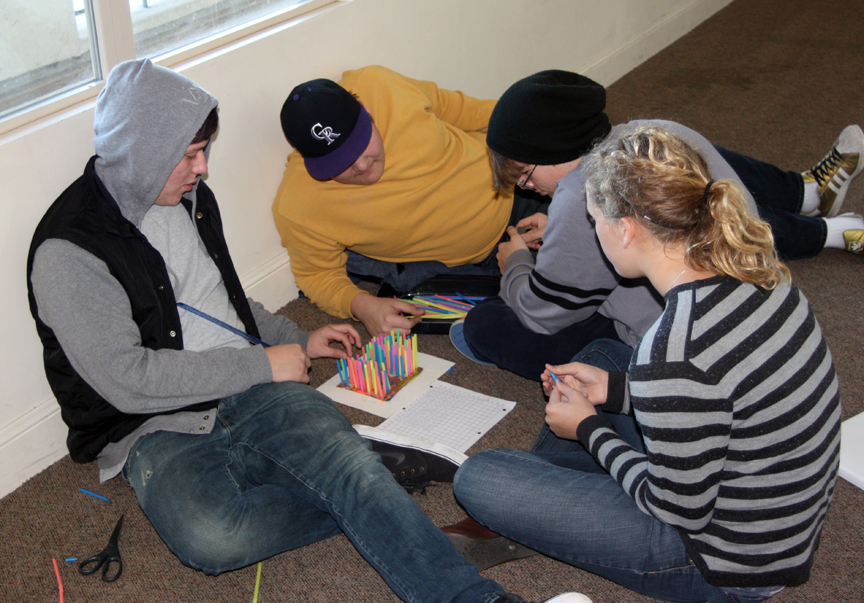
Students in astrobiology making a physical model of a hidden terrain

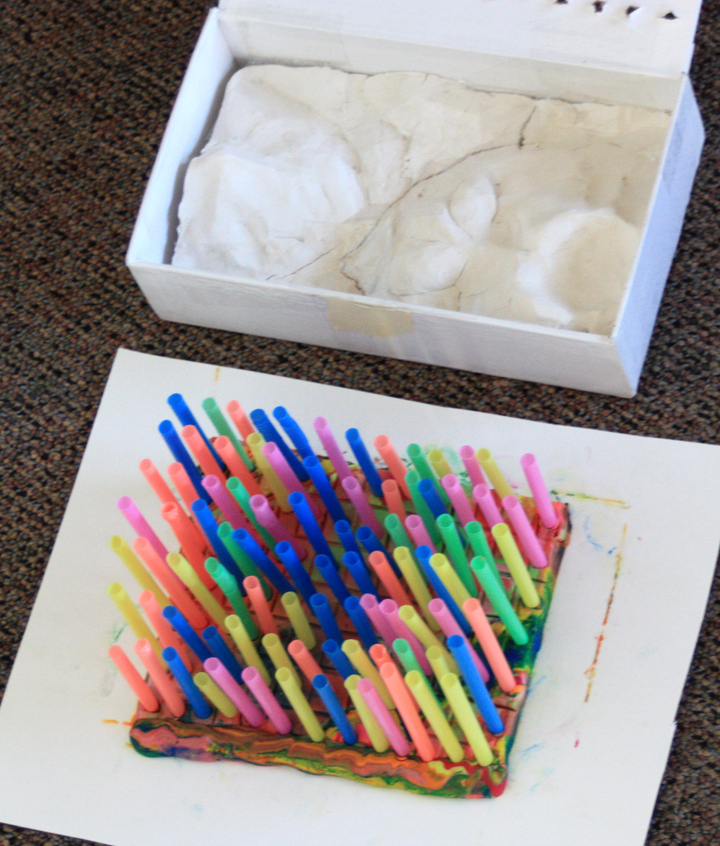
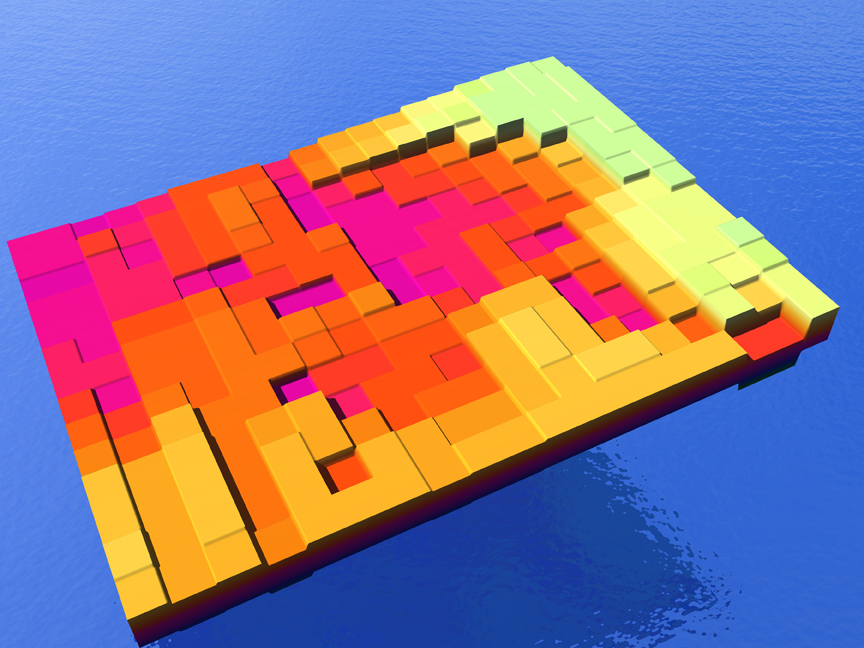
As part of the Mars lessons, my students have used a graduated lollipop stick to measure the height of locations in a hidden terrain box (modeling clay in a pencil box with holes drilled in the lid in a grid pattern). The measurements were written down and typed into a word processing program separated by commas. This data was saved as a .txt file and imported into ImageJ, a program developed by the National Institutes of Health to analyze biological images. ImageJ can turn the numbers directly into a grayscale image. One group used the numbers to cut drinking straws to the right length and imbed them into a layer of modeling clay to make a physical model of the terrain. They did quite well. The grayscale image was imported into Daz3D Bryce and turned into a virtual model, as seen here. Now we move on to actual data of Mars instead of simulated data only.

Gusev terrain virtual model

A virtual model of the Gusev Crater clay terrain

Read Full Post »

Big splash

An artist's concept of a large impact hitting Earth during the period of heavy bombardment

Last week I wrote about the leading theories for how our moon formed. This week, I’d like to write about what’s happened to the Moon since then and what lunar rocks and element isotopes tell us about the Moon’s evolution.

You would expect that once most of the material in Earth orbit was swept up into the new moon (a process that took only about 10-100 years), the debris that remained would have gradually continued to collide, adding to the Moon’s mass, but slowly tapering off. The leftover planetesimals in the solar system would have occasionally collided, but that should taper off as well to a point almost, but not quite, equal to zero today. However, the rocks brought back by Apollo tell a different story.

Apollo 8 photo

The Earth rising over the Moon as seen from Apollo 8

The original surface of the Moon was crystallized out of a magma ocean (the formation of the Moon within less than 100 years would have created sufficient heat to melt the crust). We know this from the pieces of anorthosite brought back, especially the famous Genesis rock found by Dave Scott and Jim Irwin on Apollo 15. These rocks date back to 4.5 billion years. Yet by far the most common type of rock brought back from the six landing sites and the several Luna sample return missions and by lunar meteorites found on Earth are lunar brecchias: small, angular pebbles and regolith (lunar soil) fused together from the heat of lunar impacts. And they’re all the same age; a narrow window between 3.85 and 3.95 billion years ago.

Potassium-40 is fairly common in lunar rocks (in the form of feldspar) and once it breaks down to Argon-40, the argon atoms are too big to escape the rock if it has crystallized, so determining the amount of Argon-40 in a rock gives a very accurate age of crystallization. We hardly find any rocks on the Moon (at least we haven’t found many yet) that date to the time between 3.9 and 4.5 billion years. It’s as if some event occurred that reset the isotope clocks at 3.9 billion years in most of the lunar rocks.

When we look at the lunar highlands, which are the oldest surfaces on the Moon, we see only craters. It’s as if the surface of the Moon has been pounded and pounded repeatedly, so that no area is without craters. Craters lie on top of craters, from the very large basins all the way down to the microscopic level. The pounding has thrown up pulverized rock and fragments that has formed a powdery layer the consistency of flour called regolith that is very deep in some places (it can’t properly be called soil because it wasn’t formed by erosion). The large basins themselves are from big impacts that occurred around 3.9 billion years as well, with the Imbrium basin among the most recent (it overlaps the others).

Moon cross section

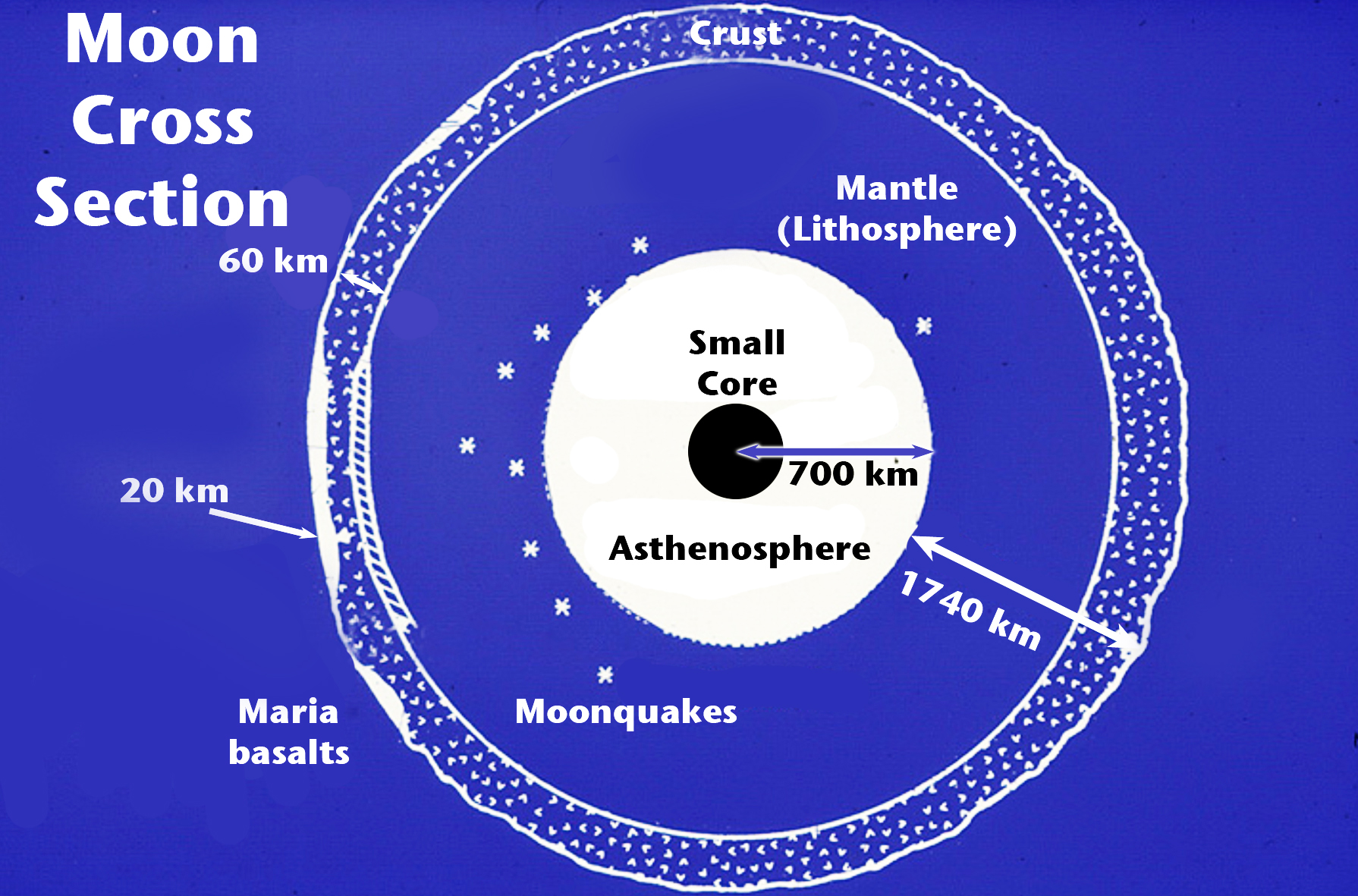
Cross sectional diagram of the Moon

There are other oddities as well. The lunar maria (what ancient people thought were seas) are large areas of basaltic lava that have filled in the huge impact basins, such as Mare Serenitatis and Mare Nectaris. These lava flows, accompanied by rivers of lava, volcanic domes, lava tubes, and other features, occurred between 3.8 and 3.2 billion years ago. Of the 50 some odd basins, by far the majority are on the near side of the Moon (maria basalts cover about 37% of the near side and only 2% of the far side). Data from the Apollo seismic monitors show that the far side of the Moon has a thicker crust and therefore fewer maria; lava had further to go to reach the surface. How could this be?

At the same time period (3.9 billion years ago), Mars and Mercury also show evidence of heavy bombardment. This is called the Noachis Period on Mars. Until recently, we had only seen 1/3 of the surface of Mercury in detail. Now, with the Messenger probe orbiting Mercury, we see craters on top of craters as well. The solar system at that time was a violent, dangerous place as large planetesimals roamed through the inner solar system and pummeled the planets. Earth would have been hit as well, maybe ten times as often as the Moon. It would have been difficult for any life that developed prior to that point to survive, except a few extremophilic bacteria similar to those living in hot springs today. Interestingly, life on Earth seems to date from about 3.8 billion years, just as soon as this heavy bombardment settled down. Perhaps it was already here but all evidence before that was blasted away. Or maybe life gets going quickly where conditions are favorable.

The heavy bombardment could not have been just a regular trail-off of impacts left over from the formation of the solar system. Something extraordinary happened that dramatically increased the numbers of planetesimals reaching the inner solar system. There are several theories for this increase. One is that a large asteroid or small planet was broken up by Jupiter’s gravity. Contrary to what we might like to think, the solar system hasn’t always been a fixed and stable configuration of planets in nice, regular orbits. At present, 4.5 billion years later, it mostly is, but not back then. The regular pattern of planetary orbits first noticed by Kepler (who thought he’d found the music of the spheres) isn’t an accident or coincidence. The masses and orbits of the planets created resonances that pulled and pushed the planets and other objects around as the solar system settled down. These resonances could have broken up a planet trying to form where the asteroid belt is now and sent pieces flying around to smash into the young inner planets.

Another theory is that Jupiter migrated around in an unstable orbit as it grew larger; Saturn also wobbled around, and when these two planets reached a 2:1 resonance, the combined gravity of Saturn and Jupiter sent Uranus and Neptune spiraling outward, which in turn scattered the large number of planestimals and Kuiper Belt Objects. Many objects were spun outward and escaped the solar system. Some were tossed inward. Computer models show this possibility and agree that about 500 million years after the formation of the solar system would have been a likely time for such a resonance to occur. It was like a cosmic shooting gallery. These icy bodies could have provided much of Earth’s water supply, and caused the blasting of medium and large craters seen on the Moon, Mars, and Mercury.

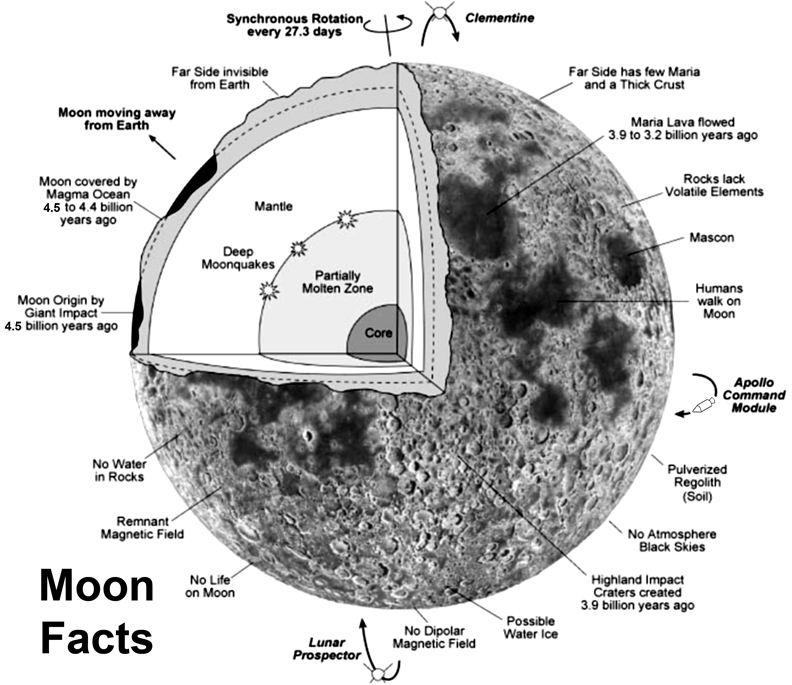
Facts about the moon

Cut away diagram of the Moon, with known facts

Since the maria basalts stopped erupting about 3.1 billion years ago, the Moon settled down into a basically steady state. Occasional moonquakes occur deep in the mantle near the boundary with the Moon’s asthenosphere. These are weak and long lasting (several minutes) and help reveal the Moon’s interior. Now and then meteorites still hit the Moon, splashing bright rays over the dark maria (such as those of Tycho, Copernicus, and Kepler craters). But that’s about all.

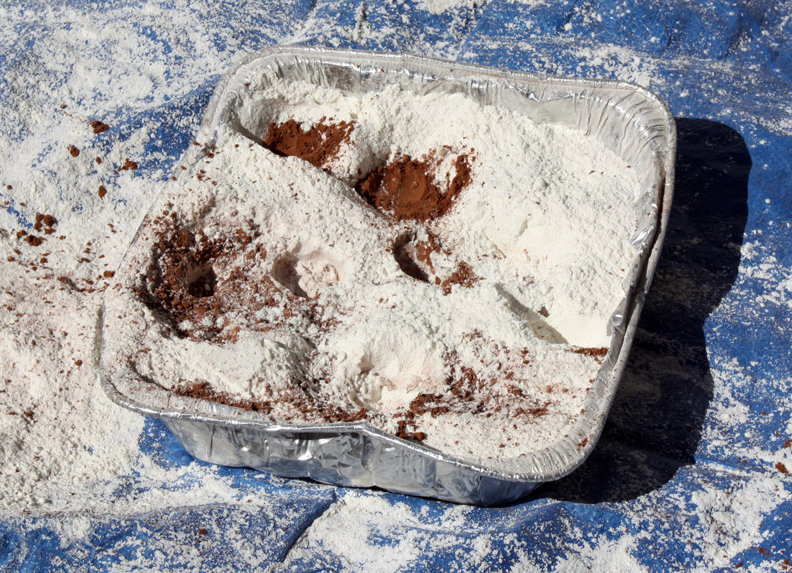
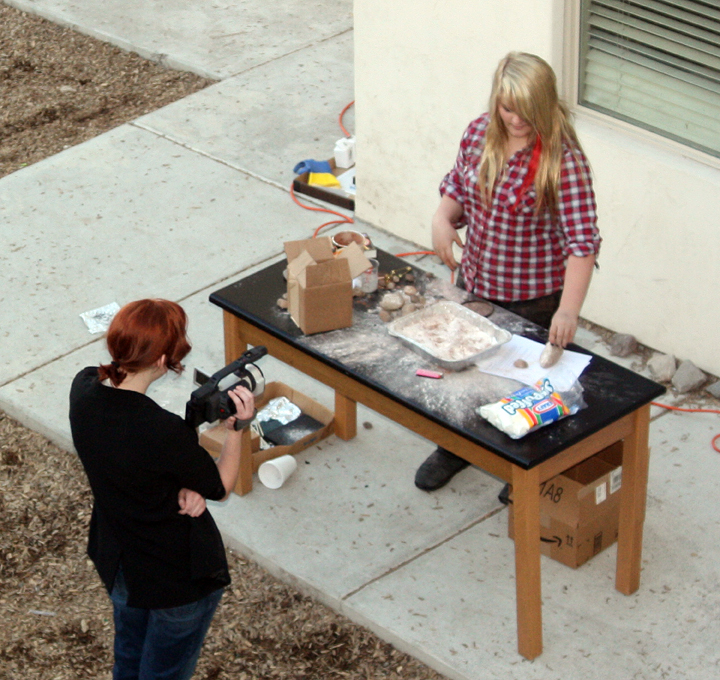
There’s a great activity done in many Earth Science classrooms to demonstrate the sequence of events that shaped the Moon’s surface. Start with a cake pan about ½ full of flour and sit it on a tarp or drop cloth. Take a number of small and medium  sized rocks and drop them from various heights and angles into the flour, carefully removing the rocks each time so as not to disturb the craters made in the flour. After a while, the craters start overlapping, with younger craters showing sharp and clean and older craters getting obliterated. This is the lunar highlands. Then drop in larger rocks to make deep basins. Take cocoa powder and sprinkle it carefully in a thin layer in the deepest holes. This is the maria basalts. Then take small rocks and drop them into the maria. The white flour underneath will splash out over the top of the dark maria, making rayed craters. When you’re done, you have a very convincing model of the Moon’s surface.

Moon crater activity

Moon crater simulation activity

Read Full Post »

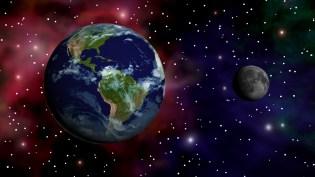
Earth-Moon

Earth and Moon today

We’re back in session at Walden School of Liberal Arts and this year I’m teaching courses in astrobiology, forensic science, multimedia, 3D animation, and computer literacy. We alternate chemistry every other year, since we are a small school, and therefore I’m able to teach some unusual science classes. Because my focus is on astrobiology this semester, the blog posts for this Elements Unearthed website will have a decidedly planetary science flavor for the next few months. As much as possible, I’ll try to weave the stories of the elements into our quest for life elsewhere in the universe.

I’ve spent much of the summer trying to arrange authentic learning experiences using real data for my students and for the students in the physics classes. I still get e-mails from NASA programs that I’ve participated in, and these often contain some wonderful student opportunities. I’ve been pretty successful finding some fun and meaningful projects.
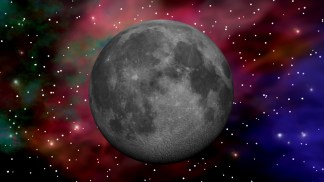
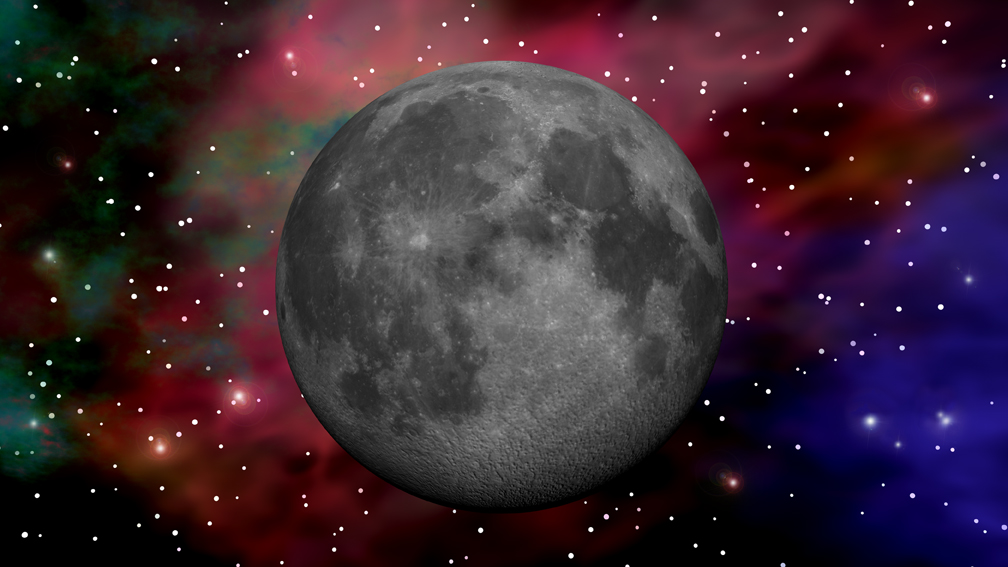
Moon

Our Moon today

Our first is to create a realistic animation of how the moon formed for the Center for Lunar Origin and Evolution (CLOE) in Boulder, Colorado. Here is a link to their website: CLOE Homepage. They are part of the NASA Lunar Science Institute and study the evidence brought back by the Apollo astronauts, trying to determine how our moon first formed and how it evolved over time. This has important implications for astrobiology because it gives us clues to the early solar system and how planets form in general and how some planets (such as Earth) develop life and others (such as the Moon) don’t.

A successful theory of the Moon’s formation has to explain some strange, anomalous facts about the Moon and its rocks. First, the Earth-Moon system has too much angular momentum compared to other planetary-moon systems. No other planet (unless you count Pluto) has a moon so massive compared to the planet, and adding up the total mass and rotational and orbital speeds gives too much energy for a stable system. In fact, the Moon is slowly spiraling away from the Earth.

Second, the rocks brought back show that at one point about 4.5 billion years ago the entire surface of the Moon was molten, a magma ocean, at a time when the Earth already had a solid crust. If the moon formed slowly, by accretion, then there wouldn’t have been enough energy to totally melt the surface. The moon must have formed quite quickly (in a period of only a few years) for there to have been enough heat. Also, since the Moon is smaller than the Earth, one would expect it to have cooled down sooner, not later.

Third, the elemental composition of the Moon’s crust very closely matches Earth, especially Earth’s mantle, right down to the precise isotopes of elements. Fourth, the Moon has a smaller iron core than it should have for an object its size (Earth, for example, has an iron/nickel core that takes up 1/3 of its mass, the Moon’s iron core is less than 5%). If it formed on its own either in Earth obit as a twin planet or was captured later, it should have different isotopes and a larger iron core than it does.

Fifth, the Earth’s axis is tilted about 23.5° from the plane of the solar system (the ecliptic) and the Moon’s orbital path is closer to Earth’s tilt than it is to the ecliptical plane (only about 5° off). Otherwise, we would have lunar and solar eclipses each month.

Sixth, the moon’s elements are different than one would expect for an object that size compared to other similar objects in the solar system. It has more titanium and aluminum but much fewer volatiles – that is, chemicals like water, methane, and ammonia that evaporate easily. Even the rocks are extremely dry, without any hydrates to speak of except small deposits in shadowed craters near the lunar poles. So the Moon is both very similar and somewhat different than the Earth.

How do you account for these facts? The theories of lunar formation prior to Apollo were: 1.) The Moon formed at the same time as the Earth, both accreting from the same cloud of planetesimals, with the Moon already in orbit around the Earth as it formed. 2.) The Earth started out rotating very fast and spun the Moon off. 3.) The Moon formed elsewhere and was captured into Earth’s orbit.

A careful look at each theory shows facts that contradict it. Theory 1 (co-formation) is negated by the high angular momentum of the Earth-Moon system. Theory 2 (spin-off) is contradicted by the magma ocean early in the Moon’s history and by the fact that the Earth couldn’t have ever spun fast enough for this to happen. Theory 3 was the leading contender for years, despite the Moon’s large size, but the identical isotopes show that the Moon must have come from the Earth, not elsewhere. None of these theories can account for the unusually small iron core and lack of volatiles.
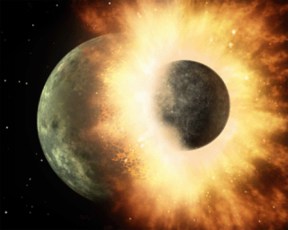
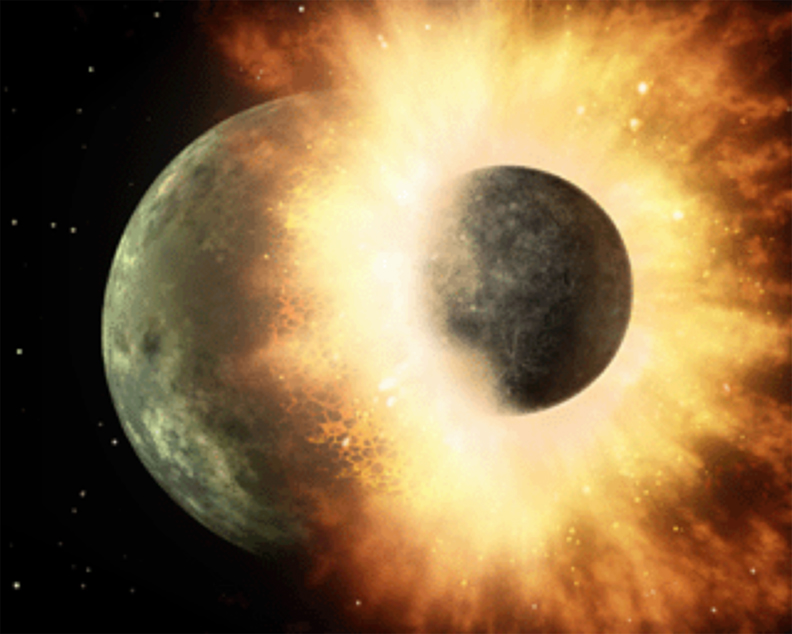
Giant impact

Giant impact of a Mars-sized object 4.5 billion years ago

Gradually, during the 1970s and 1980s, a new theory emerged and gained acceptance in planetary science circles. It is called the Giant Impactor theory. If true, then about 50-100 million years after the Earth formed (4.5 billion years ago), a large object about the size of Mars collided with Earth. It wasn’t a head-on collision, more of a glancing blow, and it knocked off a goodly amount of the Earth’s mantle into space and knocked Earth partially on its side while leaving Earth’s core intact. This planetesimal, called Theia, would have formed nearly in the same orbit as Earth and the closing speed was slow – only about 5 km per second. The impactor was demolished after the first collision – most of its iron core spiraled in and joined with Earth, the rest of it joined the splashed mantle material to form a ring around the Earth. The lighter volatile materials escaped from Earth’s gravity entirely. Within a fairly short time (maybe only ten years or so) most of the ring coalesced into the Moon. The heat of this rapid formation caused the Moon’s surface to melt and crystallize. The final lunar surface was therefore a mix of the Earth’s mantle (similar isotopes of oxygen and other elements) and impactor material (different aluminum and titanium). Here is a poster from CLOE that summarizes this theory: Moon formation poster

I find it really fascinating from both a chemical and a planetary science standpoint that by analyzing a few hundred kilograms of moon rocks brought back by the Apollo astronauts, we can tell so much about events 4.5 billion years ago and answer age-old questions. This is why we must eventually send humans to many locations on Mars – even with sample return robotic missions, the chances of answering the riddles of the Red Planet are small unless we have people with trained minds and eyes on the surface to put it all in context and find the right specimens to study back on Earth.

Our job will be to take this theory and turn it into a believable animation. My astrobiology students will research the details and evidence, create the storyboards, and ensure the accuracy of the animation while my 3D modeling students create the actual objects, textures, scenes, and animations. It will be challenging, involving particle effects, physics, and some very sophisticated compositing techniques, but I think we’re up to it. I look forward to the challenge! Meanwhile, I continue to apply to programs that we can participate in where our unique capabilities will be put to good use.

If you’d like a more detailed description of the giant impactor theory, check out this link: http://www.psrd.hawaii.edu/Dec98/OriginEarthMoon.html

Read Full Post »
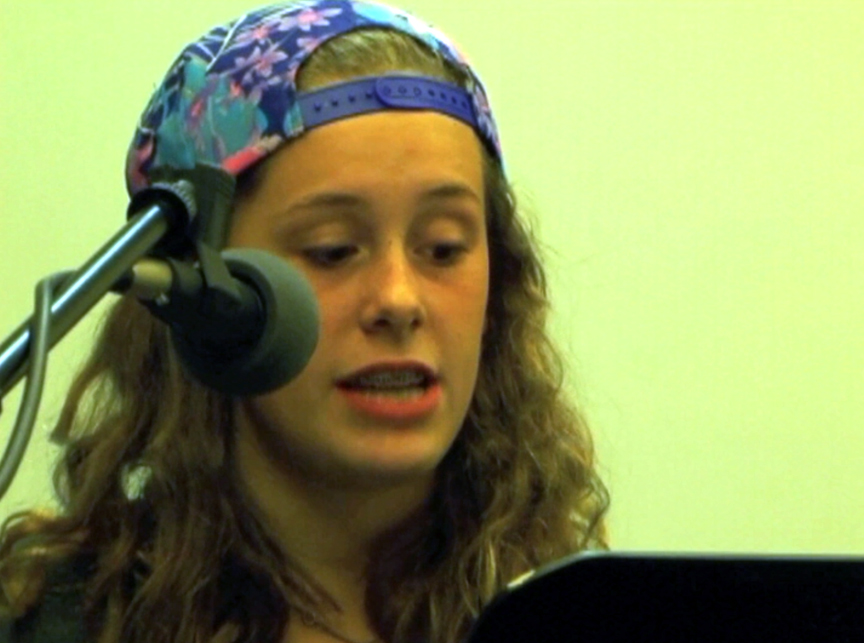
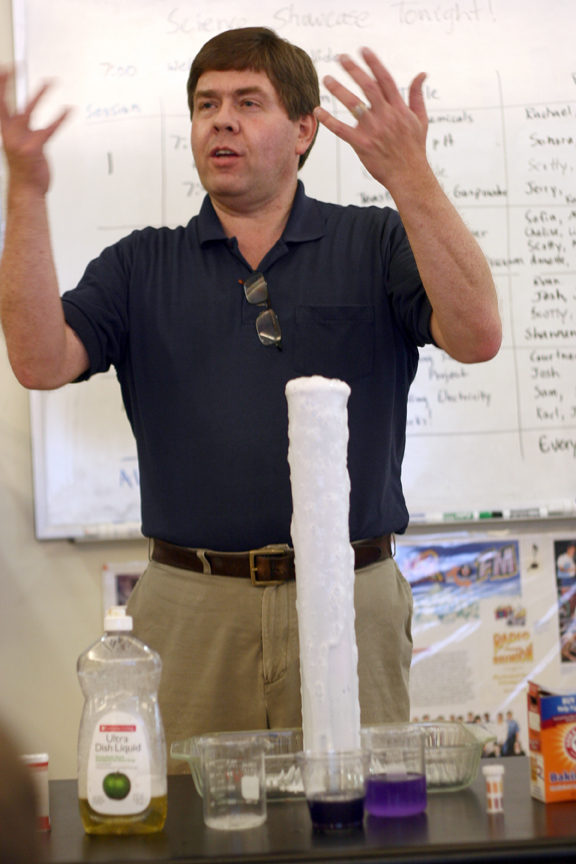
Foam demonstration

David Black presenting foam demonstration

Yes, I know this is late. The new school year is about to start and I am only just finishing up the last school year. This post will describe the Grand Finale of the school year for my science classes, which was our First Annual Science Showcase at Walden School.

We had been working toward this all year, as you have seen from previous posts. Students in my astronomy and chemistry classes joined into small groups (2-3 students) and chose topics based on what interested them and what materials and equipment I had available. Then during first term, they conducted background research. My chemistry students created posters and several of them contributed posts to this blog. During second term, the teams condensed their research into a script for a presentation or mini-lesson on their topic which was to include explanation, background, and some type of demonstration or hands-on activity. The teams practiced and refined their scripts, then I divided the teams in half. Half of each class presented their demonstrations/lessons to their peers in class, and I had their fellow classmates fill out an evaluation form with Likert-style point scales and room for comments. The other half presented to our elementary classes and wrote evaluations on themselves. In astronomy, the students merely presented for the elementary classes once.

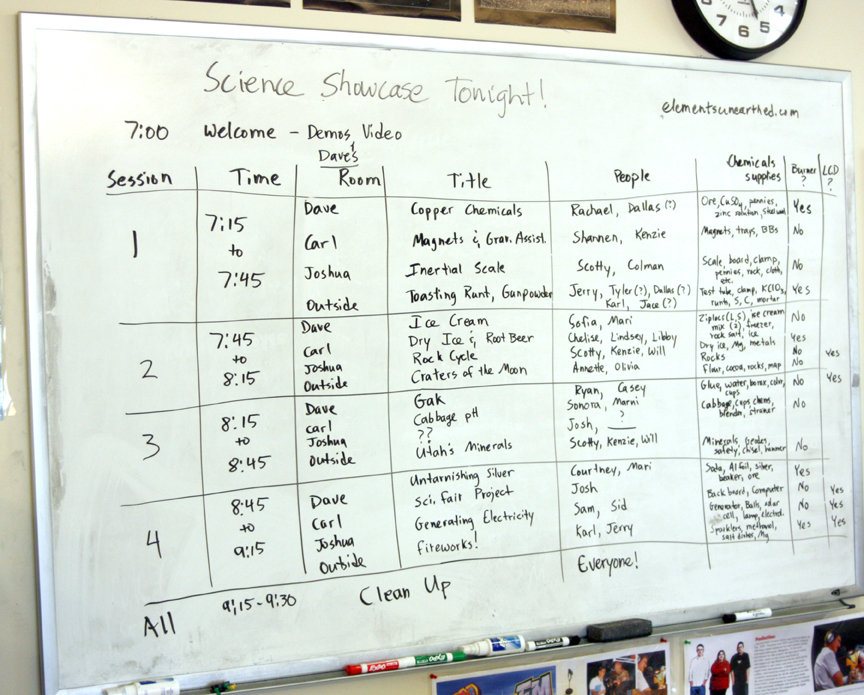
science night assignments

Assignments for Science Showcase

During third term in chemistry, the teams went over their evaluations and improved their scripts. I had them start to create Powerpoint slide shows or add YouTube videos to increase the depth of their presentations. Then the teams presented again – those that presented to their peers now presented to the elementary classes and vice versa. Evaluations were again filled out, with even more detail. I also wrote up my own detailed suggestions for each team.

copper group presenting

Copper group presenting at Science Showcase

Finally, fourth term, we made our final preparations and practiced and set up our Science Showcase on May 16. I also asked the astronomy students to return and reprise their presentations, and had my geology students help out. Since our school is small, many students presented twice (and got extra credit for it). We set up an invitation for the parents and had it e-mailed out to the whole school mailing list. It took a lot of preparation, and wouldn’t have been possible without the support of the Air Force Association Educator Grant, which helped to pay for materials and supplies that were used up each time we presented (like plastic cups, red cabbage, white glue, etc.).

Schedule for science night

Schedule for Science Showcase

We set up the evening to be in three classrooms and outside on the school’s back patio (for the dangerous or messy presentations). The teams were assigned carefully so that those who were doing more than one session could make it to each one. Some students also got credit for helping film the sessions, making sure the refreshments were done (homemade root beer and ice cream, which were actually presented at two sessions), acting as hosts for each room, etc. For four sessions we had four presentations going at the same time, or about 16 topics altogether.

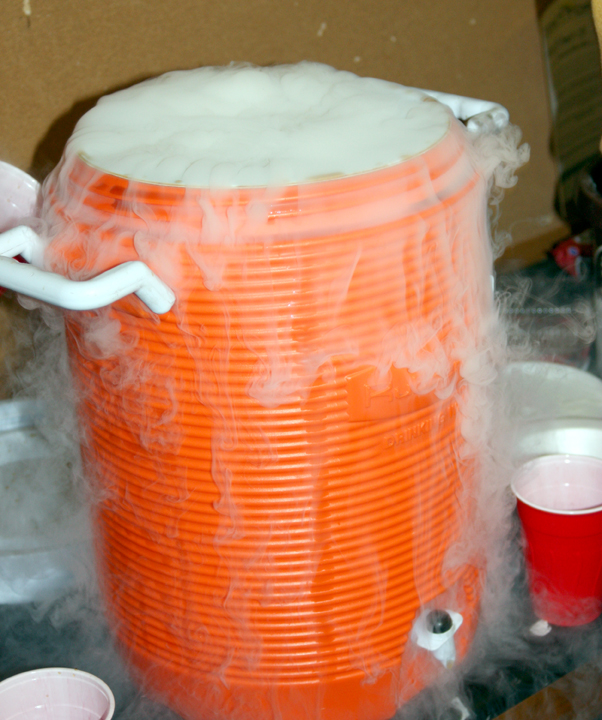
Dry ice group

Dry ice group presenting at Science Showcase

It was a bit frustrating to get the students all there on time (an hour early) and a few things I wanted to do didn’t get done, but overall the night was a huge success. I had about 30 students involved, and there were about 40-50 other people who attended, some other students, some parents, some siblings. A few of the sessions were too short, and the student hosts in each room didn’t watch the clock well enough, so the schedule got a bit messed up by the end, and we had to take a break for refreshments. The homemade root beer (we already had dry ice) and ice cream (another presentation) went over well. Some of the sessions only had a few in the audience, others were packed.

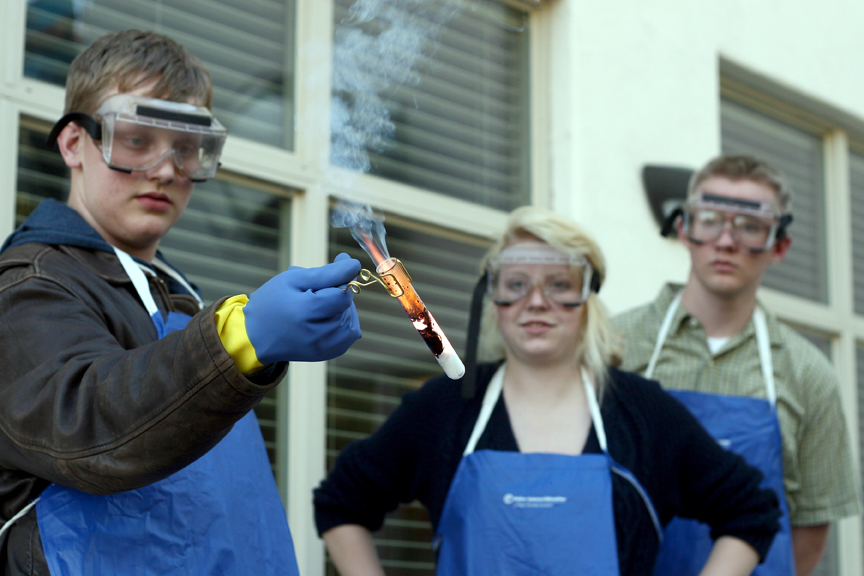
Flame test abstract

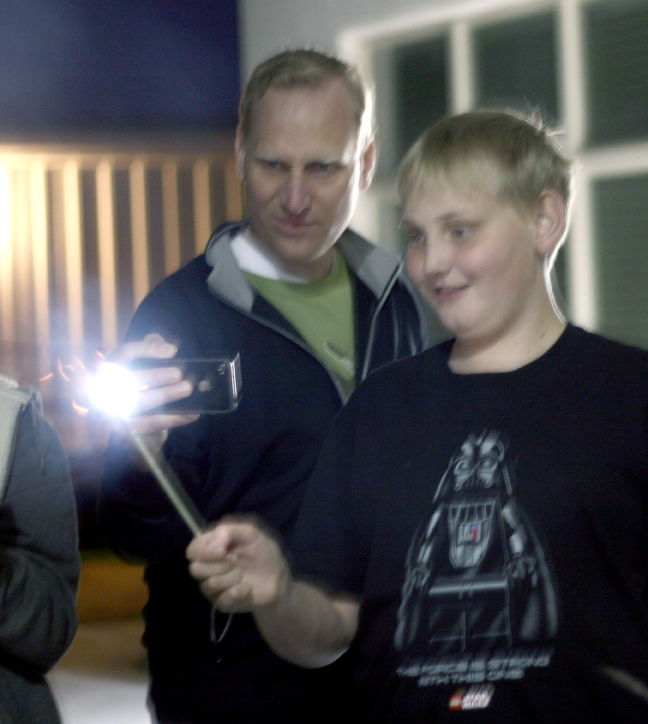
The last session was done by Jerry and Karl on properties of the elements and how fireworks are made, and in addition to the methanol flame test, Karl had made his own sparklers. He’d looked up a recipe online, but I didn’t have all the exact ingredients, so we substituted and experimented for a few days and came up with a viable recipe, one that actually works better than commercial sparklers. It was nice to have a grand finale, so to speak.

Homemade sparkler

Homemade sparkler demonstrated at Science Showcase

We videotaped and photographed everything, and I am still trying to capture and compile the video. I have only two weeks left until school starts, and my goal is to put together a final 15 minute video of all our presentations for the year before school begins so that I can show it to my next classes and post it here.

Solid rocket booster

Toasting the Runt: A solid rocket booster

As an assessment of the evening, I didn’t have any kind of feedback forms, but based on overheard comments, feedback from parents and other teachers, and general excitement of my students, I’d say the evening was a great success. Everyone had fun, most of the presentations worked well, the students came through very well, and I saw some genuine learning and expertise displayed by my students. Certainly they have come to feel comfortable using lab equipment and presenting to their peers and others. What they presented they have now learned deeply and will never forget, long after stoichiometry and thermochemistry have faded away. For our first year doing this, we have set up a good foundation. There are things that can be improved, of course, and I hope to get the other science teachers involved this coming year. At least now my students know what to expect.

Homemade root beer

Homemade root beer

I hope to have several students display their science experiments, where they designed, observed, and analyzed their own data for science fairs. My one science fair student displayed his computer game project and it was well attended and received. Next year, as we are involved in authentic NASA research, we’ll have more students doing the real thing. But more on that next post.

Moon craters

Moon formation and evolution demonstration

Josh shows game

Demonstrating the "Salt the Slug" game

Silver group presenting

Read Full Post »
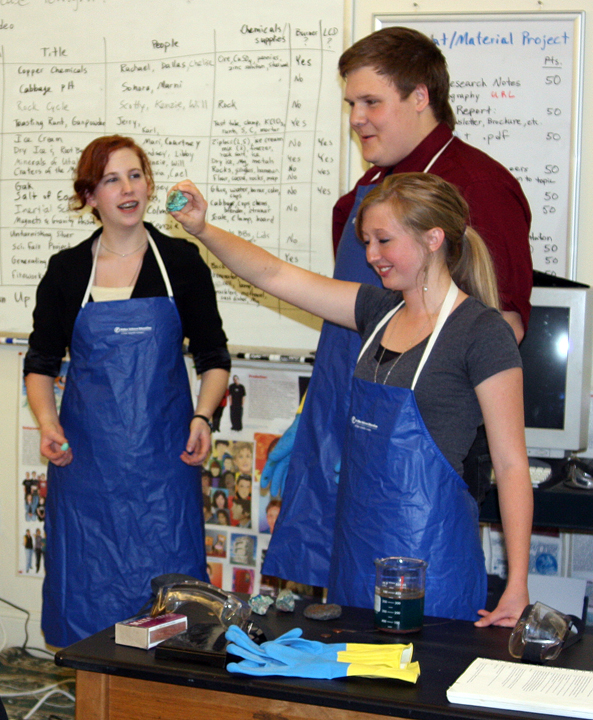
titration

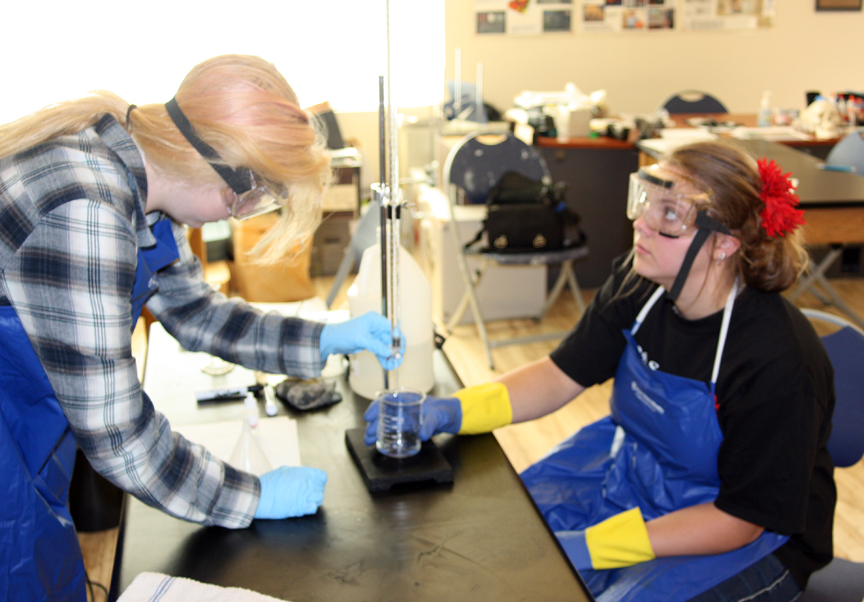
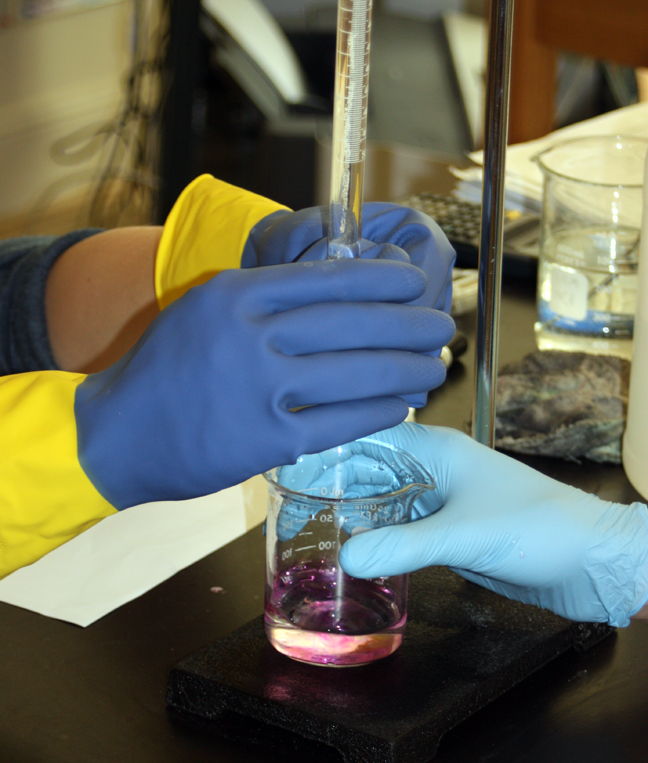
Students preparing for an acid-base titration

My last post told about our school’s trip to Moab in March and about the discovery of uranium in that area by Charlie Steen. Since then I have not been as active on this blog because I have been spending much of my spare time finding and applying for grants and now preparing for my fall classes. The last term in chemistry was also fairly hectic as we went through several units, including acids/bases, electrochemistry, and thermochemistry.

Titration equivalence point

Finding the equivalence point in an acid-base titration

The grant game isn’t a very fun one to play. There are many losers and only a few winners, and a great deal of effort is required for what is often no reward at all. Unfortunately, as science teachers, we know that to do the engaging, exciting hands-on activities that are the hallmark of good teaching, we often need funds well beyond what our school districts can provide. During difficult financial times, when district budgets and state tax revenues are shrinking, more and more of us are applying for ever scarcer opportunities. So it becomes a numbers game; the more grants you apply to, the more your odds of success for a few of them. Sometimes you luck out.

During the period between March and May, when classes ended for the year, I applied to three grants. Two I haven’t heard back from yet (the Dreyfus grant program and the Presidential Award for Excellence in Math and Science Teaching [PAEMST]) but one, the McCartney-Dressman Grant, sent me a form e-mail last week saying we had not been selected. There were over 400 applications. In many cases, including this one, grant monies have stipulations such as requiring the schools to have a high number of underrepresented students, which means having a certain percentage of students with minority status, or classified as poor by the percentage applying for free or reduced lunches, or by being in an urban or rural geographical area. Walden School is located in Provo, Utah, which is not rural or urban, and although some of our students are on free or reduced lunches, the percentage isn’t particularly high. In other words, we’re not considered underrepresented. I knew that going in, but decided to try anyway.

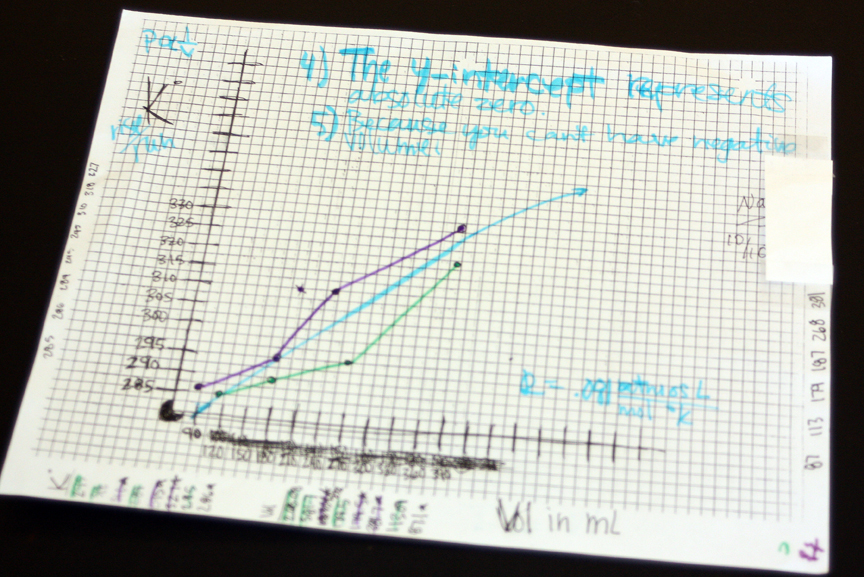
For the PAEMST program, this is the first year in 15 that I have qualified. To apply, one has to be a science or math teacher (at least 50% load) in a public or private school and the application process is pretty intimidating. I went to a presentation at the Utah Science Teachers Association conference this last February, and found that in addition to a lengthy essay with supplemental exhibits, one has to also provide a 45 minute video of teaching that has no breaks in it – just one continuous lesson. This is harder than you might think, even for a video professional like myself (maybe especially for me) because I want good quality video as well as good quality teaching. I filmed my chemistry classes on two different days doing activities – one was testing Charles Law that gases expand when heated by having them measure the diameter of balloons as they were dipped in water of different temperatures. That video looked good and had some good comments by the students, but as I moved the camera the video started and stopped on its own, so I couldn’t use it.

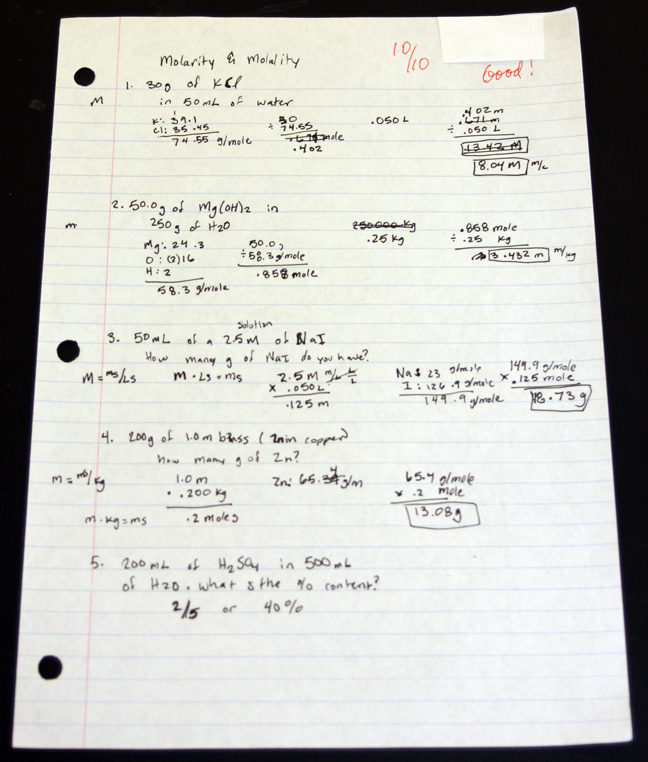
Molarity problems

One of the requirements of the PAEMST application: Provide proof of student learning

Then I videotaped my students doing a lab testing the voltages between different metal electrodes. Not as interesting, perhaps, but it went well enough. I got some nice letters of recommendation from a student, a fellow teacher, and my school’s director, wrote up the essay, created a ten-page supplement document, and sent all of this off by the deadline in May. Now the people in Utah have to decide which applications to send on to the national selection committee, and we won’t find out if we’ve won until next May (a whole year). Then in December, 2012, if I’m selected, I get a trip to Washington, D.C. to meet President Obama (maybe – sometimes the president doesn’t show up to present the award named after him) and receive a check for $10,000. Yes, it’s quite a process and if I don’t make it (I don’t know how many actually finished applications – probably ten or so) then I have to wait for two years (2013) before I can apply again as they alternate high school and elementary teachers. Each state gets one math teacher and one science teacher per year (although sometimes the national committee doesn’t select anyone from a state if they feel none qualify).

Charles law lab

Results of the Charles Law lab

As I was looking over the list of previous Utah awardees, I came across the name of a teacher I used to teach with at Juab High School. Janet Sutorius is an excellent math teacher who has also participated in the NASA Educator Workshop program at Dreyden Field Research Center at Edwards Airforce Base. Even after I left Juab HS, I did a workshop presentation with Janet on NASA educational programs at a state conference. Here is a nice article about Janet as an alumnus of Brigham Young University: Janet Sutorius Presidential Award. Other past awardees I know include Duane Merrill (I learned how to teach conceptual physics from him), Ron Cefalo, and others. These are all excellent teachers and role models for me.

The fact that I’ve been out in the wilderness teaching multimedia for ten years means I haven’t been in the spotlight for science teaching (even though I was doing all the NASA stuff). I was actually better known outside of Utah than inside. I did present at the USTA conference frequently, including this year. Many of the people I worked with as a NASA/JPL Solar System Educator had been Presidential Awardees, and when I asked about the program they all said I should apply. But I had to be an official science teacher before that could happen, and this year is the first time since Juab High School. I think I have a strong application – I’ve certainly done more on the national level for teacher professional development that anyone else I know in Utah, but that is just one dimension they look at. I think my content knowledge is excellent, and I’m strong on the other dimensions as well. Anyway, win or lose, I have tried. There have been many times in the past when I have applied for similar programs and thought I could never be selected but was. Maybe this will be one of those times. I just wish I didn’t have to wait so long to find out!

Read Full Post »

Walden students in Moab

Walden students at the Arches National Park visitor center

Between third and fourth terms, Walden School holds a two-week Intersession that includes high interest classes (such as the CSI class I reported on last post) and often also includes a field trip. This year we traveled to Moab, Utah which is the gateway for some of the most incredible scenery, geology, and adventure activities you can find anywhere. The town is situated in a valley between two national parks (Arches and Canyonlands), a mountain range (the La Sals), and next to the Colorado River.

Moab is the last place on the river that is easily accessible for putting boats in and out until you get all the way down to Lake Powell and Bullfrog Marina. If you want boating, kayaking, bicycling, hiking, slick rock four-wheeling, camping, or just photo opps, this is the place. It’s also an interesting place for unearthing the elements.

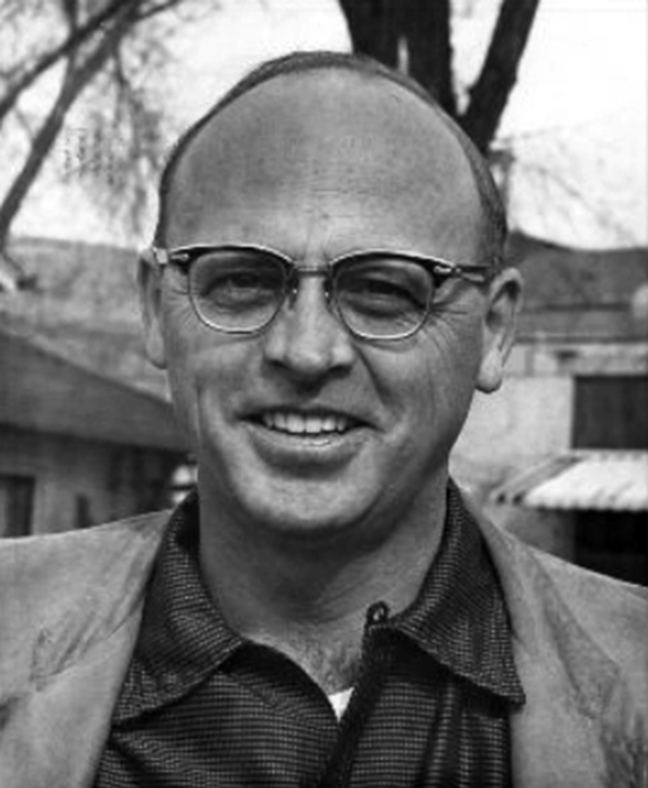
Charlie Steen

Charlie Steen in 1961

Moab was a sleepy town in the early 1950s when an unlikely discovery changed everything. Charlie Steen was a geologist and prospector who had heard that uranium was a byproduct of the vanadium mines scattered around the American southwest. The Atomic Energy Commission needed domestic sources of uranium and set an artificially high price for it as an incentive for prospectors and miners to discovery new sources, and Steen headed to Utah to seek his fortune.

Steen had a theory that uranium might accumulate in an anticlinal structure just as oil does, and the area around Moab consists of underground salt domes deposited about 350 million years ago when a mountain range known as the Uncompaghre Uplift covered what is now the border between Utah and Colorado. A large syncline called the Paradox Basin formed just west of this mountain range, and during the Pennsylvanian and Permian periods it was filled with a shallow ocean. This sea frequently dried up, leaving huge layers of salt, which were eventually covered with sand dunes (now the Navajo and Entrada sandstones) and the Mancos shale layer during the Mesozoic Era. The weight of these overlying layers caused the salt layers to shift and bulge in places and form depressions in others. The Moab Valley is one of these depressions, and Arches National Park is one of the domed up areas. As the salt bulged up, it cracked the sandstone layers into a series of parallel cracks. Water got into the cracks and created fins, or thin ridges which eventually eroded further into the arches that the area is famous for. But underneath it all lies the salt. Steen felt that any uranium that eroded off of the ancient Uncompaghre Mountains would accumulate in the Paradox Basin and be deposited in the sandstone found there, now pushed up into an anticline.

Rock fins

Eroded remnants of rock fins in Entrada Sandstone at Arches National Park

Everyone else thought this theory was ridiculous. Uranium in sandstone? Impossible! Steen spent two years prospecting through the area living in a tarpaper shack, feeding his family on poached venison. He didn’t even have enough money to buy a Geiger counter to check samples for radioactivity. Then, in 1952, he struck a deposit of high-grade pitchblende ore in the Lisbon Valley southeast of Moab and named it the Mi Vida (“My Life”) mine. Suddenly rich, he invested in various other mines and uranium mills, built a large house on the edge of the cliff overlooking Moab, and made sizable donations to build the local hospital and to improve the airport, and even flew in a private plane to Salt Lake City once a week for dance lessons.

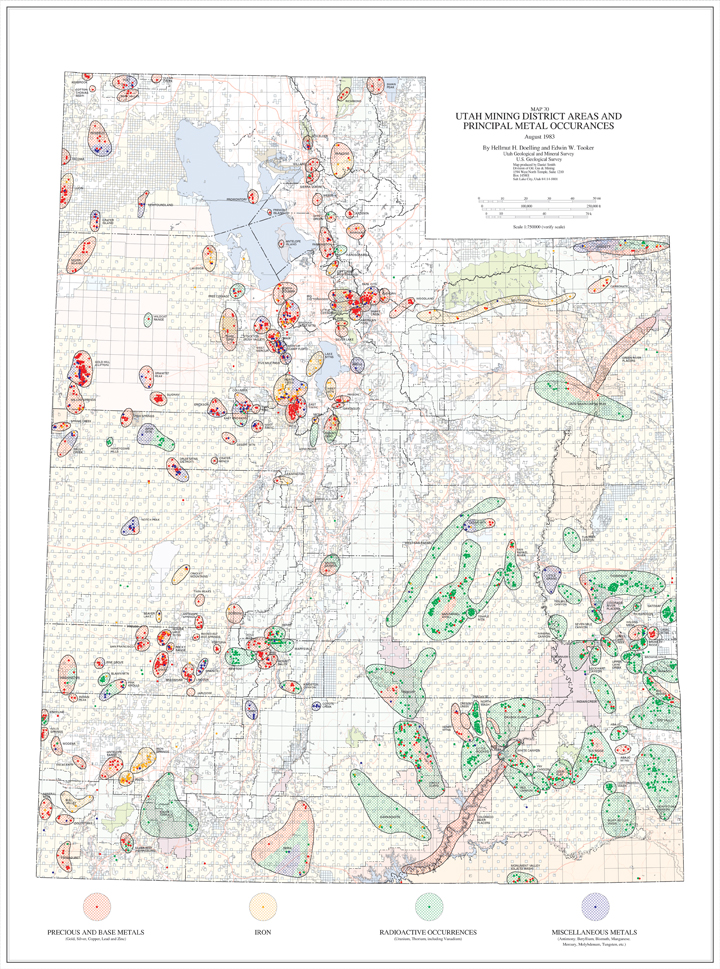
Mining Districts of Utah

Mining Districts of Utah. Uranium/Vanadium deposits are shown in green.

Steen’s success started a uranium boom in southeast Utah, and other deposits were soon discovered. They were mostly located in three major areas (as shown by this map of Utah’s mining districts – the green areas are uranium/vanadium mines). The first area centered around Moab and the Paradox Basin. A second major area was around the edges of the San Rafael Swell. The third was along White Wash, a remote area east of present-day Lake Powell. Uranium processing mills were built at Moab and Monticello, and the area prospered as money and jobs poured in.

By the mid-1960s the U. S. Government decided it had enough uranium stockpiled and stopped purchasing it. The price fell, and the boom days were over. Unfortunately, radiation from the tailings piles at the mills had so contaminated the two towns that the incidence of cancer is greatly increased compared to similar populations elsewhere. Both tailings piles are being removed and reprocessed to make them safe.

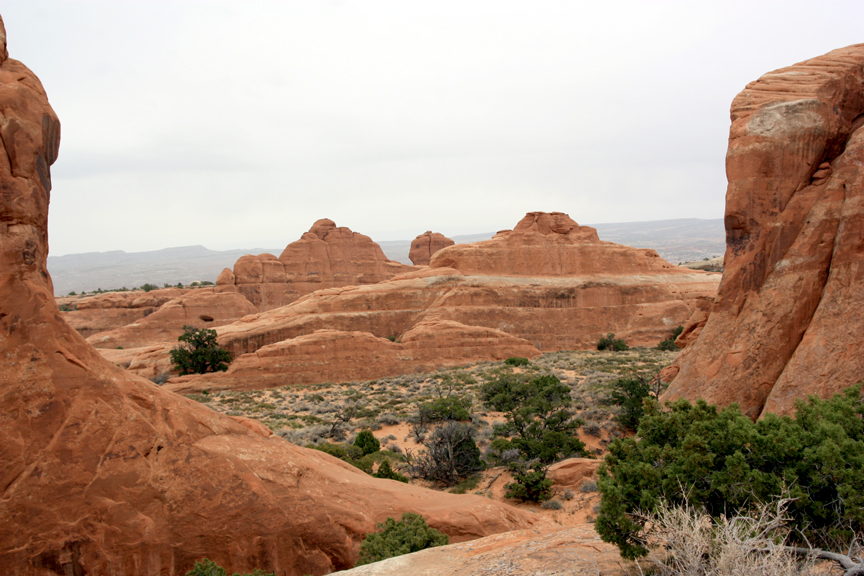
Double Arch

Double Arch at the Windows Section, Arches National Park

For our trip to Moab, we stayed in small cabins at an RV park at the north end of town. The weather, being March, was windy with a storm front moving in slowly from the northwest as we left Provo, but traveling east we got ahead of the storm and found the weather nice when we arrived around noon on Wednesday. The group split into two parties, one going to the Fiery Furnace in Arches NP and the rest going to the Windows Section (my favorite area). I took some photos and video of Double Arch, Balanced Rock, the La Sal Mountains, and other areas between the Park entrance and Windows Section.

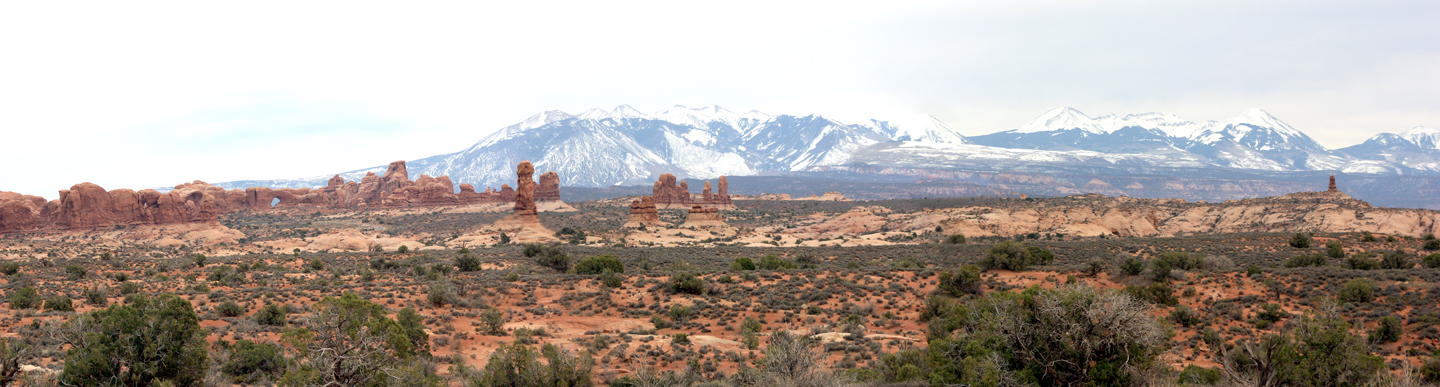
The La Sal Mountains

The La Sal Mountains and Windows Section, Arches National Park

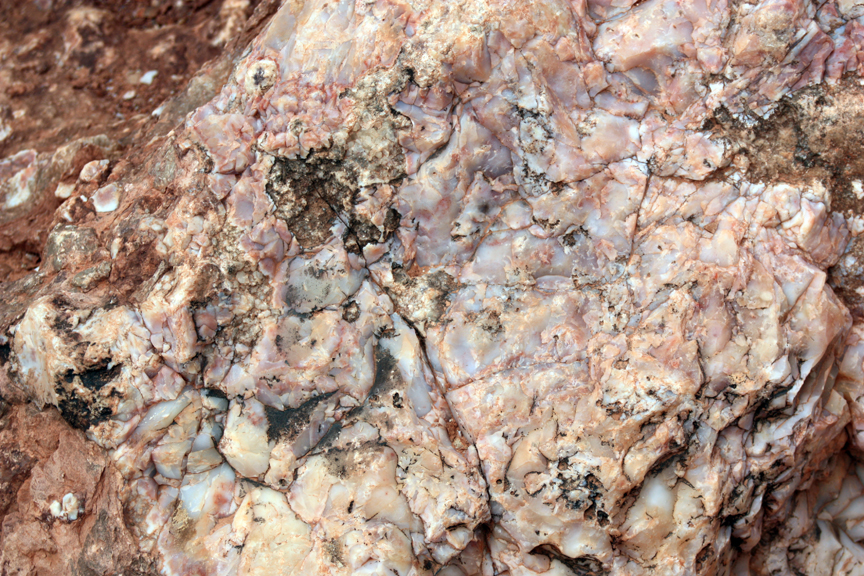
On Thursday, most of the group hiked in to Delicate Arch. The weather had turned colder and more threatening as the front slowly approached, but it was a nice hike to the arch (about 1.5 miles). Along the way, at the backside of the first hill, is an unusual rock formation of purplish chert. It was formed from the same red sandstone all around us, but here there was a fault line caused by the buckling of the underlying salt domes. As the two sides of the fault moved against each other,  contact metamorphism converted the sandstone to chert, the red iron oxide turning purplish as it often does when metamorphosed.

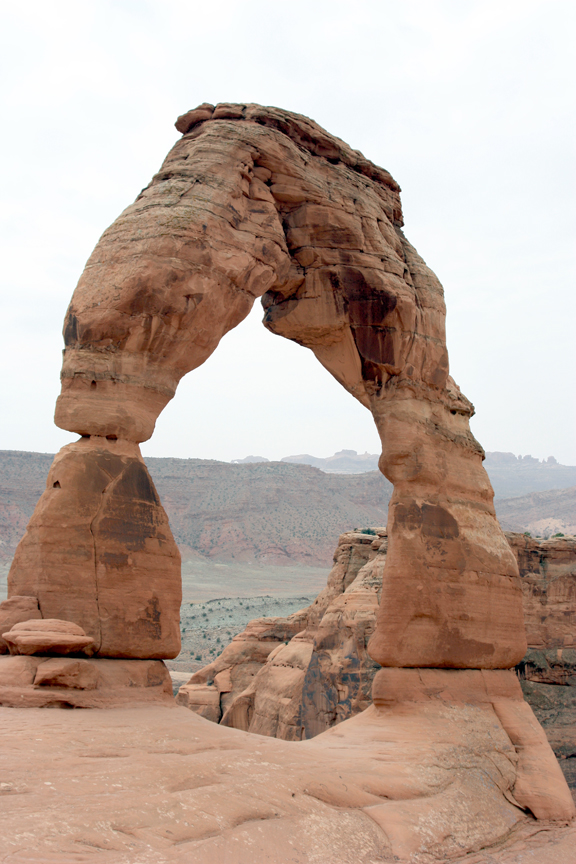
Delicate Arch

Delicate Arch in Arches National Park, Utah

Chert boulder on trail to Delicate Arch

Chert boulder on the trail to Delicate Arch

After Delicate Arch we hiking into Landscape Arch, then returned to camp as the day turned colder. We ate dinner in Moab as a faculty at a decent pizza place as it finally started to rain, and enjoyed the hot tub that evening. On Friday we packed up and headed back to Provo.  I was able to get some great photos of the geologic features of Arches National Park.

Landscape Arch

Landscape Arch in Arches National Park

Read Full Post »

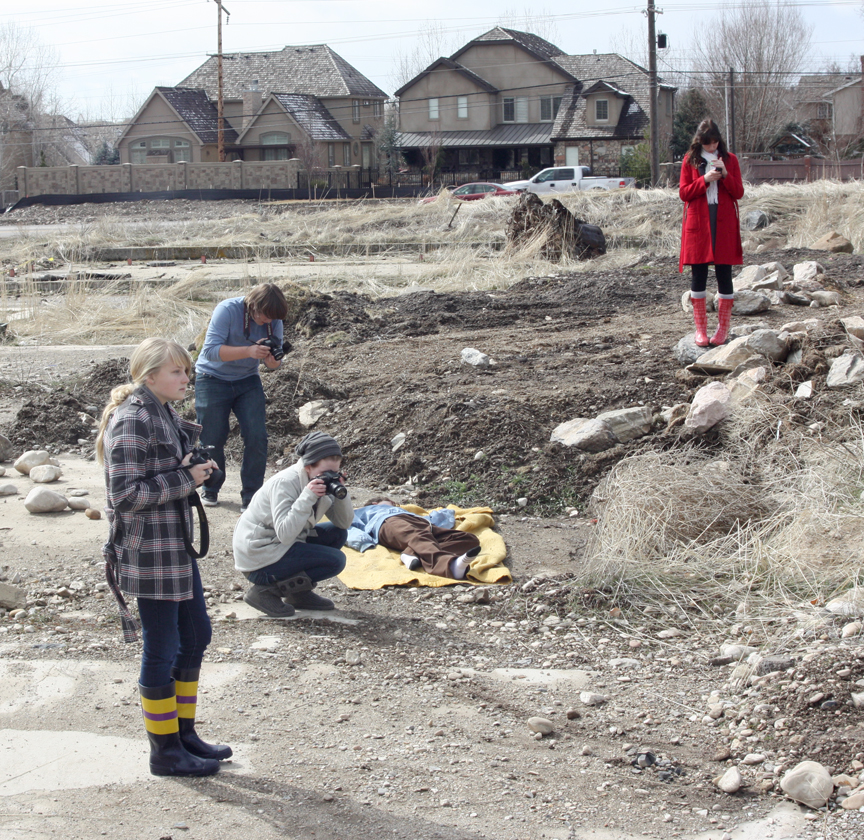
Dead body

Our First Dead Body for the CSI Class

My trip to the NSTA conference in San Francisco came right in the middle of our Intersession period at Walden School of Liberal Arts. The most difficult time of the school year is the stretch from Presidents’ Day through Spring Break. The weather is still too nasty in Utah to do very much outside, and so most students (and teachers) get a little stir crazy with cabin fever. I call this period of time “The Doldrums.”

At Walden School, we break out of the doldrums by putting a two-week Intersession period at the end of the third term, with specialty classes that are high-interest and out of the ordinary. I teamed up with Eric Beecroft, our social science teacher, to create a Crime Scene Investigation (CSI) class that combined parts forensic science, criminology, psychology, and electronic data collection.

Photographing the scene

Photographing the crime scene

We started on Monday, March 7 with a general class meeting to go over the requirements, set up teams, and train them in group communication skills. I used an exercise I had written up years ago while a master’s student in organizational behavior at Brigham Young University (I’ve been through a few career changes). It has groups of six students solve a murder mystery aboard the Carob Bean Queen. Each student receives a sheet of paper that has a description of the crime and suspects, but what they don’t know is that each paper is slightly different and has information that will clear one suspect. The only way to solve the crime is to cooperate and communicate as a group to pool their information.

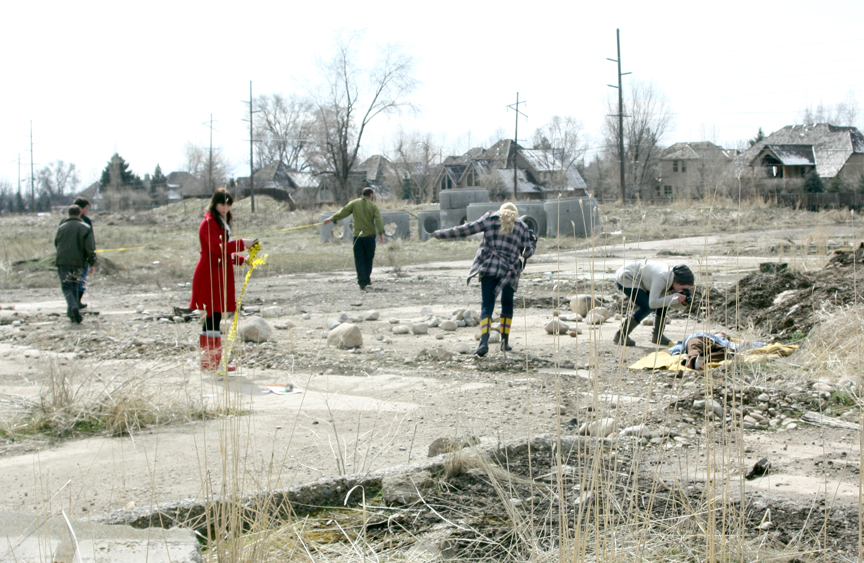
On the second day, we had a volunteer made up to look like a dead body and I planted evidence in a field just south of our school. It had snowed the night before, but this day the sun came out and melted the snow, leaving ideal conditions for footprints. I carefully set up the evidence, with various shoes used to represent the  suspects. I had another student dress up as a homeless person pulling a cart through the field (to leave some unusual tracks). We planted fake ID cards, bullet casings, hair and fiber samples, and I even had the butcher at a local supermarket same me some beef blood which I splashed liberally around the scene (so we could test for blood using hydrogen peroxide).

Taping the scene

Taping off the crime scene

While I was planting the evidence, the students were watching a presentation by the medical examiner’s office. She brought slides. After she was done, the students came out in groups (the lead detectives and photographers first) to document, collect, and catalog the evidence. We even did plaster casts of some of the footprints, although a batch of plaster was ruined because the students let it set up too much before trying to pour it into the footprints. Despite our warning to watch where they walked, most of my carefully laid footprints were trampled by the investigators. They could have solved the crime just by carefully looking at the footprints and drag marks, but fortunately we had other lines of evidence. As it was, it took them a couple of days to realize that there was a missing person in addition to the dead body. The second victim was finally “found” some distance away on Friday.

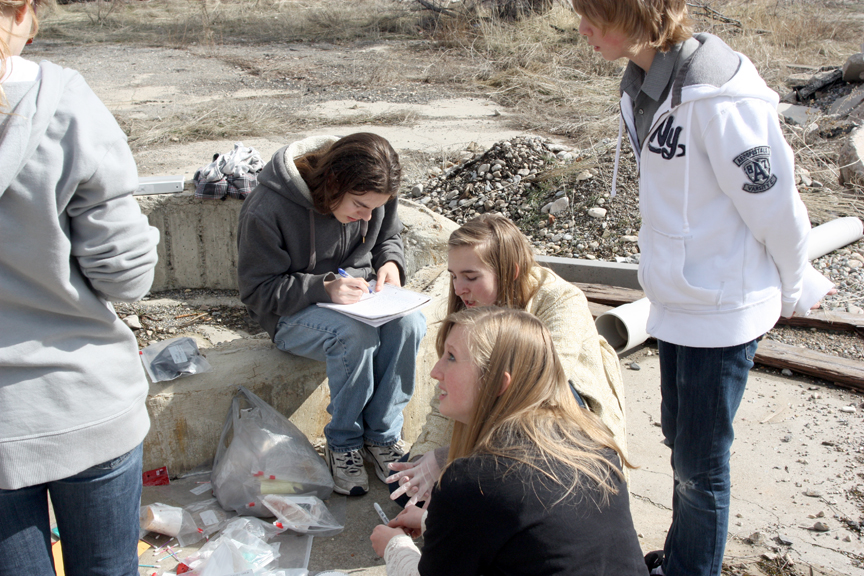
Cataloging evidence

Cataloging the evidence

On Wednesday, the analysis of the evidence began as they looked at hair and fibers under the microscopes and started testing for blood, checking fingerprints and lip prints, and trying to put it all together. Meanwhile, other teams were looking at paper evidence (ID cards and documents) and electronic evidence. We had even created fake Facebook accounts, travel tickets, bank records, etc. Most of this was to point to various suspects and leave some red herrings to confuse the issue. Those suspects were brought in on Wednesday and Thursday for interviews and fingerprinting. I had to leave after an hour on Wednesday because I had to get to the airport for the NSTA conference.

On Monday, once I returned to Utah, we finished analyzing the evidence and I made sure the students understood the ideas of criminology and burden of proof, such as motive, means, and opportunity as well as keeping a tight chain of custody of evidence. Some evidence had to be thrown out because it had not been put away properly while I was gone. On Tuesday we summarized our findings, recommended a suspect be arrested, held a mock arraignment for that suspect, and tested the students on their participation.

Analyzing the evidence

Analyzing the evidence

If I were to rate this, my first attempt to teach a forensic science class, I would have to say it went well. Some of the students weren’t as helpful or worked as hard as they could have (they had to be told what to do and where to go instead of taking initiative). We had less of this than I feared we would, due mostly to setting up careful roles and team memberships at the beginning and choosing some responsible students as Lead Detectives, who could then keep the other students focused. Our greatest problem was that the students worked out the culprit too quickly and we had to throw out some additional evidence to keep them guessing. The comments I’ve heard since are that the students had fun and enjoyed the activity. We had a fairly large group for Walden (about 22 students in both junior high and high school) so it was a challenge to have meaningful tasks for all of them all of the time.

I think this went well enough, and there was enough science and analysis involved, that I might try to teach a whole semester course in forensic science at some future time.

Read Full Post »
On the final day of the NSTA conference in San Francisco, I woke early and packed up, then went to find breakfast. I ran into Julie and Gary Taylor at the Hilton and we ate together at Mel’s Diner. Nancy Takashima (also of SSEP) joined us later. I then went to the last two sessions. All of today’s sessions were at the Moscone Center since the conference was winding down and only a few sessions were left. I wondered how many people would be left and felt a bit sorry for those sessions who’s fortune it was to be selected for Sunday morning, but actually the attendance was fairly good, since these sessions were the only thing going on (the dealer’s hall had closed the night before).

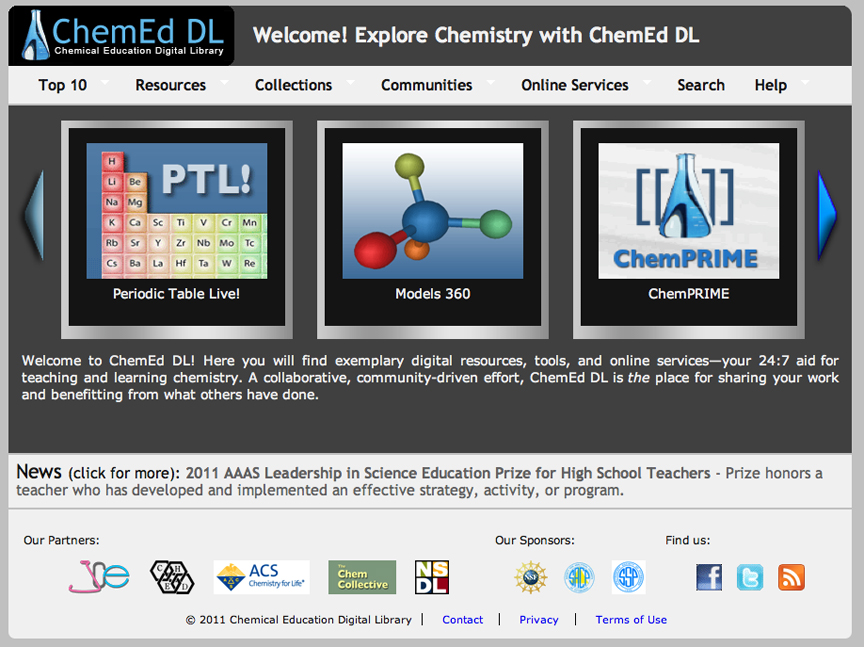
Chemistry Education Digital Library

Chemistry Education Digital Library website

The first session I attended was on the Chemical Education Digital Library, a series of chemistry resources available for educators online, with everything from the American Chemical Society to 360 ° models of molecules to living textbooks. It looks like a great resource, and when I have the time I plan on exploring it more thoroughly and perhaps submitting some of our videos and materials. Here’s the link: http://www.chemeddl.org/

The final session I attended was on digital storytelling through student video projects. The presenter (Roger Pence) gave some great rationale for using student-created video projects and also showed some of the handouts and other resources he uses with his students. He does this with sixth graders, and so the level of sophistication is lower, but they do research, write a script, record narration, and then chain images and videos into a final short project. Many of his tips will be useful for me as my students get deeper into creating their own videos next year.

I returned to my hotel and finished packing and checked out. The shuttle van picked me up and after we collected a few more passengers, we drove out to San Francisco International Airport. As I was waiting in line, I saw Martin Horejsi in line ahead of me, and we discovered we were on the same flight to Salt Lake. He would then connect with his flight to Missoula. We arranged seats next to each other and waited to board. Martin writes a column for The Science Teacher along with Eric Brunsell on Web 2.0 technologies in the classroom, and Martin was finishing a blog post for the NSTA site that included video clips he’d taken with his iPad of the dealer floor, including the robotic arm that was solving a Rubik’s Cube. It was fun to see him applying the very technologies he was writing about to create the blog. You can check out his post at: http://nstacommunities.org/blog/2011/03/13/high-tech-highlights-nsta-2011/

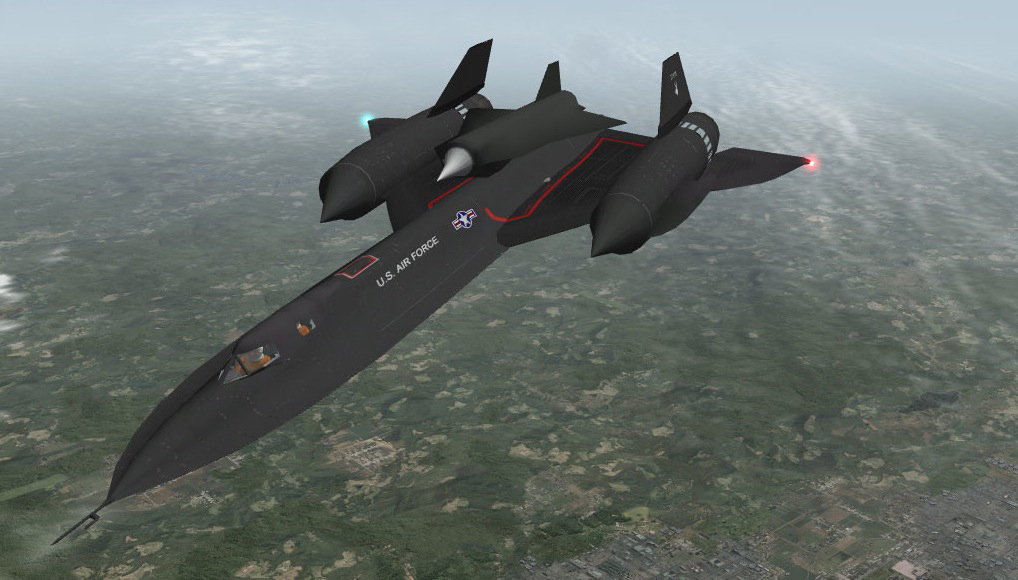
Screenshot from X-Plane

SR-71 from X-Plane's flight simulator game for the iPad

On the flight, I used Martin’s iPad to play a flight simulator game, but had to stop because I was getting a bit motion sick. Apparently trying to fly an SR-71 while flying on a commercial jet is just too much for my inner ear. Now that I have the award money from Explore Mars, I plan on using part of it to purchase an iPad 2 over the summer and use it to both explore and create apps and eBooks. One course I hope to teach next year is on game development using the Apple SDK and have students create small games for the iPad that would be useful for chemistry teachers to use for review of units.

I said goodbye to Martin at Salt Lake and my wife and kids picked me up. While waiting, I watched an episode of Star Trek: Enterprise on my MacBook Pro, which I had downloaded from iTunes. I remember a time when I taught with Mac Classics with 9 inch black and white monitors and dot matrix printers, and I was the only teacher at my school with any experience on computers. Times have changed – now we all must teach to digital natives who grew up with these tools. I am still amazed that I can sit in my classroom or a hotel room without any physical connections or books and find almost any information I need (including the two screen shots I’ve used in this post). I am literally pulling data and images out of thin air. It seems like magic to me.

If I were to summarize my visit to San Francisco and what I got from it, I would have to say that I especially focused on programs to get my students involved in authentic science projects (such as MESDT, GAVRT, and the Mt. Pisgah stellar spectra project) and project-based learning; on new technologies such as the iPad and how it can be used in science education; and on ways of teaching chemistry and doing demonstrations and science night activities. I made good contacts, met interesting people, saw some old friends, and came home re-charged and excited to continue teaching.

Read Full Post »
My presentation

My Presentation at NSTA

On Saturday, March 12, I attended a presentation by Howard Lineberger on the Mars Exploration Student Data team program his students have participated in. It was at the Hilton Hotel, so I hopped the conference shuttle bus over. My students at Mountainland Applied Technology College had participated in this program during its first year in 2003-2004. We used dust opacity measurements from the Mars Global Surveyor probe to predict Martian dust storms. Now the program measures the geochemistry of Martian rocks using the CRISM instrument on the Mars Reconnaissance Orbiter. I’m glad to see that the program is still going, and I hope to get my students from Walden School involved next year for an astrobiology course I plan on teaching.

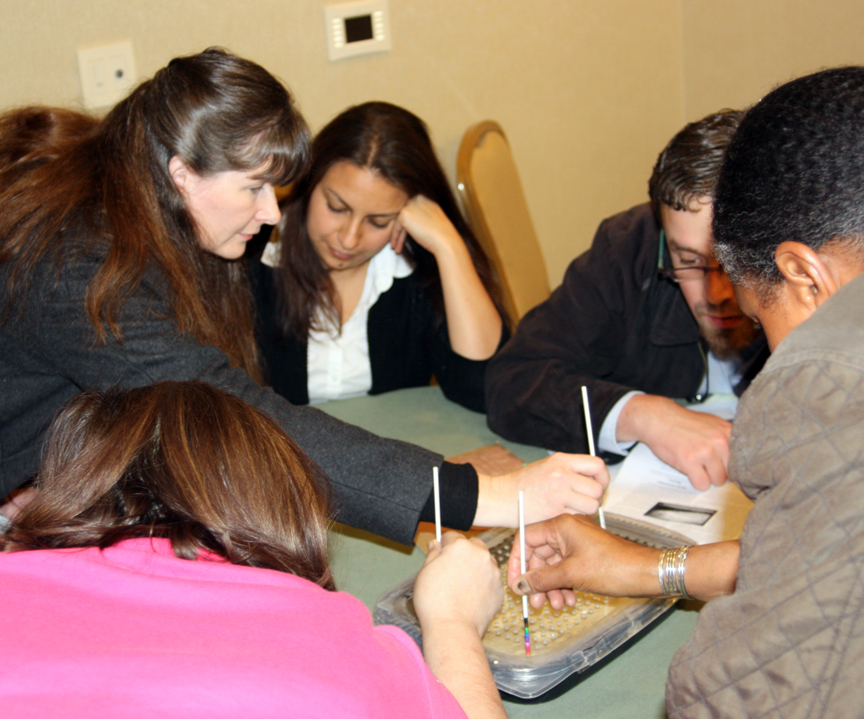
Measuring Mars

Teachers measuring the Mars model during my presentation

After the session, I rode the shuttle back to my hotel and prepared for my own session. I was in the Marriott hotel in the same room where many of the space science workshops were being held (and where I attended the Mt. Pisgah Observatory session the day before). The session before mine was by Pamela Wheffen, a Solar System Embassador who’s name I’d heard before. I didn’t get to hear her session because I didn’t want to interrupt, so I was pacing outside in the hall with my box of Mars stuff.

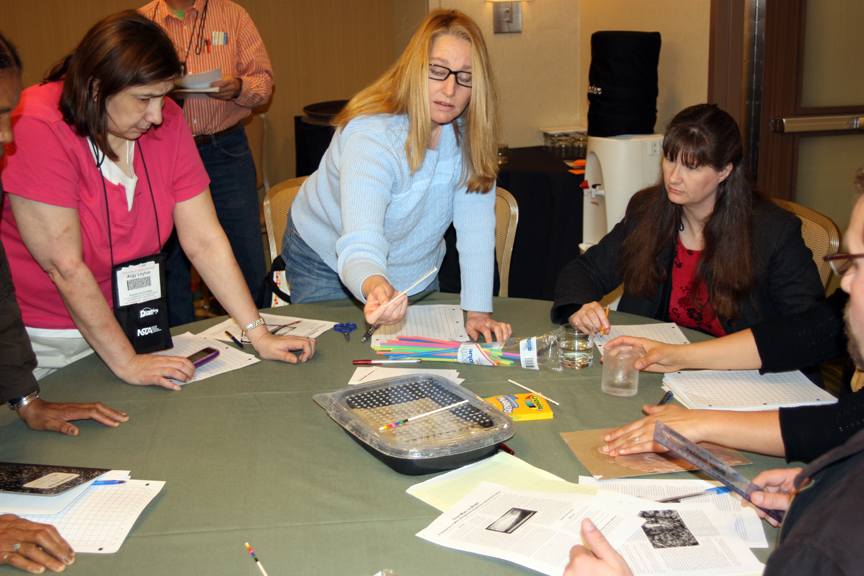
I was hoping to improve on the number of participants compared to my session on Thursday, and I was pleased to have about 15 people come and participate. I got all of my materials ready and walked through the Keynote presentation, then we tried out the three methods of measuring and recording the altitude data. This presentation is on my Mars to Model lesson that was submitted to Explore Mars’ competition (although I had submitted the proposal long before I heard of the competition).  A terrain made of clay or paper mache is placed in a box with holes drilled in the lid in a grid pattern (and it was a real pain to drill all the holes the other day). Using a lollipop stick, the height of the terrain is measured from the lid down using three techniques.

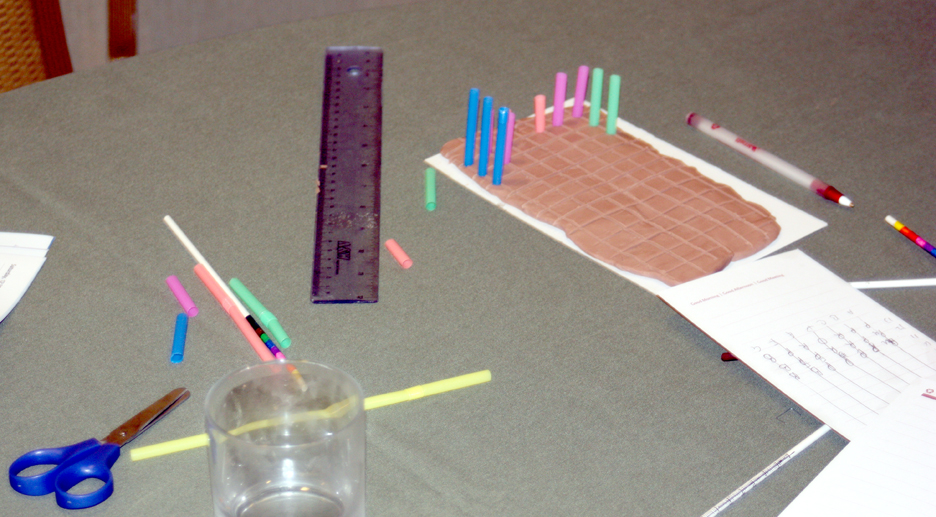
Clay model

A physical model of the Mars terrain

The first method uses color bars at intervals on the lollipop stick, and whatever color it comes to, the students record using colored markers on a graph paper sheet. This creates a color-coded topographic map of the terrain, and is appropriate for younger students. The second method uses a lollipop stick with marks in millimeters and numbers are recorded on a graph paper. Modeling clay is rolled out onto a piece of cardboard and drinking straws are cut to the same lengths as the terrain measurements, then stuck in the clay, thus creating a physical model of the terrain. This is appropriate for middle grades. The third method is for high school students. Using the same millimeter stick, the numbers are recorded into a .txt file, then converted to a grayscale image using the Image-J software from the National Institutes of Health. I then use GIMP or Photoshop to clean up the image, then move it into Daz3D Bryce to convert it into a virtual 3D model of the terrain.

This was quite a bit to demonstrate in one hour, but I had already given this presentation at the Utah Science Teachers Association conference in February, so my timing came out just right. It went very well, over all.

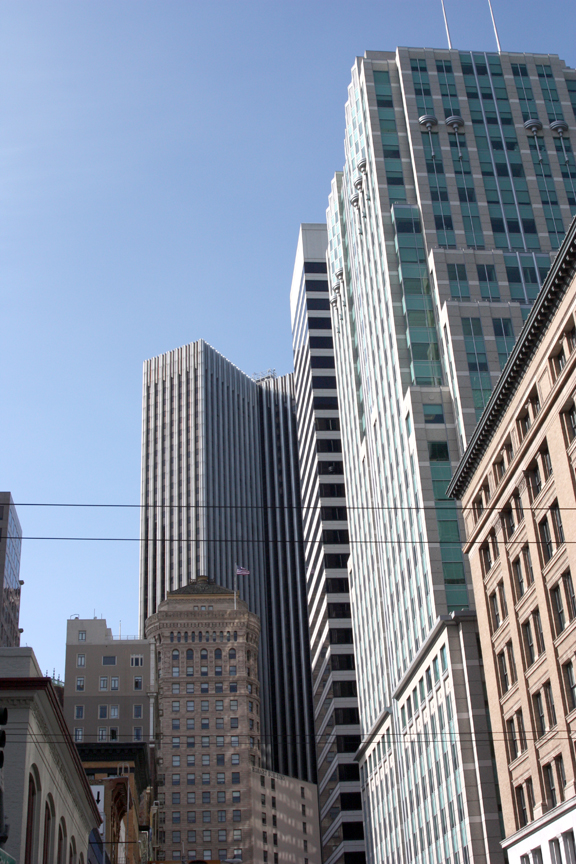
Financial District

Skyscrapers in the financial district, San Francisco

After my presentation I cleaned up my materials while the next group prepared. It was a duo from Texas presenting on lesson plans and activities (which they provide on a CD) on cosmology, which was quite cool and very useful for me in my astronomy courses. I then returned my stuff to my hotel and went and got some lunch of a meat pie and soup, which I ate in a small park between the Hilton and the Moscone Center. It felt nice to be outside in warm sunshine. I decided to skip the next session and went for a walk around the financial district of San Francisco. When I got to Market St., a St. Patrick’s Day parade had just ended and there were costumed dancers walking around, and a group of bike riders who weren’t costumed at all . . . and people taking photos of them. I’m definitely not in Utah anymore!

I walked back to the Hilton and attended the last part of the afternoon session, just more or less picking a session at random because I wanted to see the next session that would be in that room. After the session, I called my wife and found all was well at home, then went back in for the last session on creating hands-on activities for rural students in Vermont. I was just getting settled when someone walked in that I hadn’t seen in six years: Dave Seidel from JPL. I had worked with Dave for several years as part of the Solar System Educators Program and the NASA Explorer Schools program. He has been moved up to Assistant Director for Education Programs at JPL, which doesn’t surprise me at all. There are some great memories of those years and my involvement in NASA’s educational programs, and Dave was at the heart of it all. I remember at the educator conference at Cape Canaveral for the launch of the Mars 2001 Odyssey space probe that Dave set up a conference call with Arthur C. Clarke in Sri Lanka, since this probe was named after his book. Dave was the person who called Sir Arthur, and he read out the questions we had submitted the night before, including one of mine. I also remember at the NES workshop in 2004 on robotics how he set up a movie evening in the Space Flight Operations Center. We sat in the visitors’ gallery and he played “Angry Red Planet” on the center screen while telemetry from various probes was coming in on the other two screens. It was the perfect setting for such a movie, and we all laughed our heads off at the appearance of the Bat-Rat-Spider-Crab and the female astronaut walking around Mars in high heels. I recall the puzzled expressions of the controllers in the ops center as they tried to figure out what this movie was all about. Yes, Mars is Red. And its Angry . . . It was great to see him again. He showed me some incredible online programs and data sets JPL has been posting, and some layers for Google Earth that can track satellites in real time, etc.

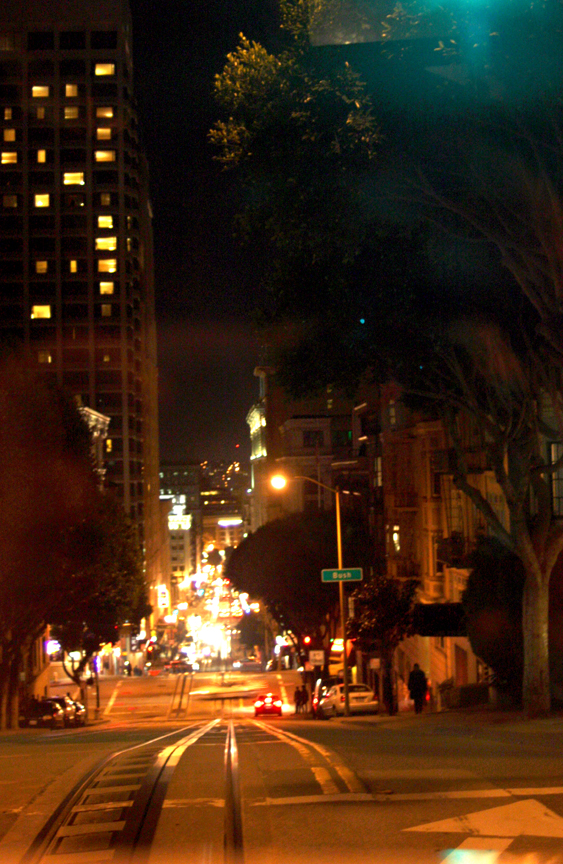
Downhill on Cable Car

Riding the Cable Car down from Nob Hill

After the sessions, I decided to take the cable cars over the top of the hill to fisherman’s wharf and Pier 39. I ate at the wharf (clam chowder) and walked around Pier 39, buying some kooshy caterpillars that light up when shaken for my sons. It was chilly but not cold, and fun to ride the cable cars again. I had forgotten just how steep some of these hills are.

Read Full Post »
« Newer Posts - Older Posts »