Feeds:
Posts
Comments

Archive for the ‘Weekly Post’ Category

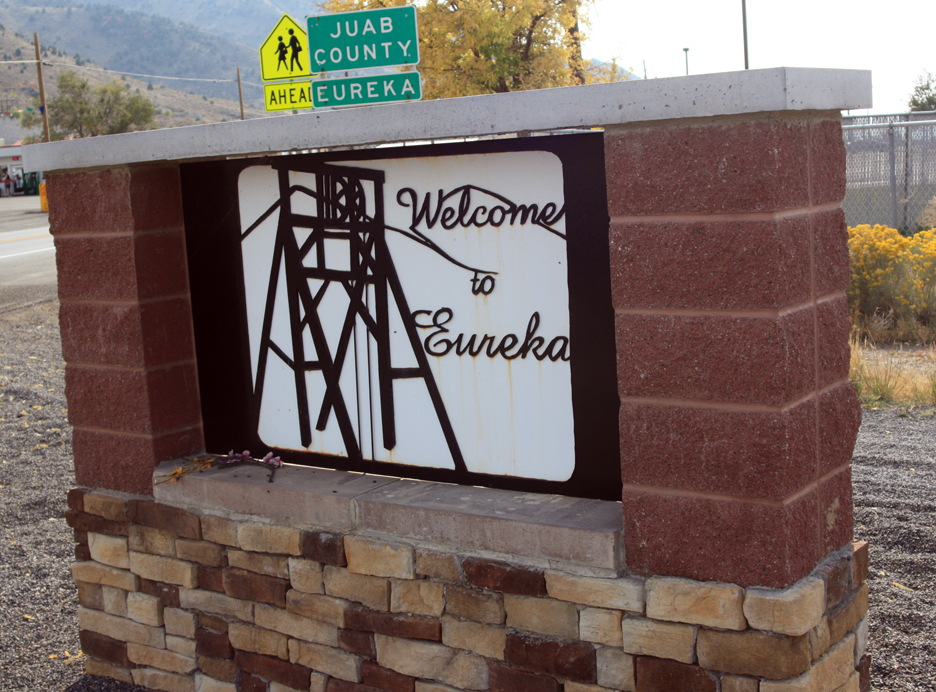
Welcome to Eureka sign on U.S. 6

Welcome to Eureka sign on U.S. 6

It’s time to take a break from recounting my tour through Colorado’s mining towns last summer and catch you up on what we’ve been doing this year at Walden School of Liberal Arts.

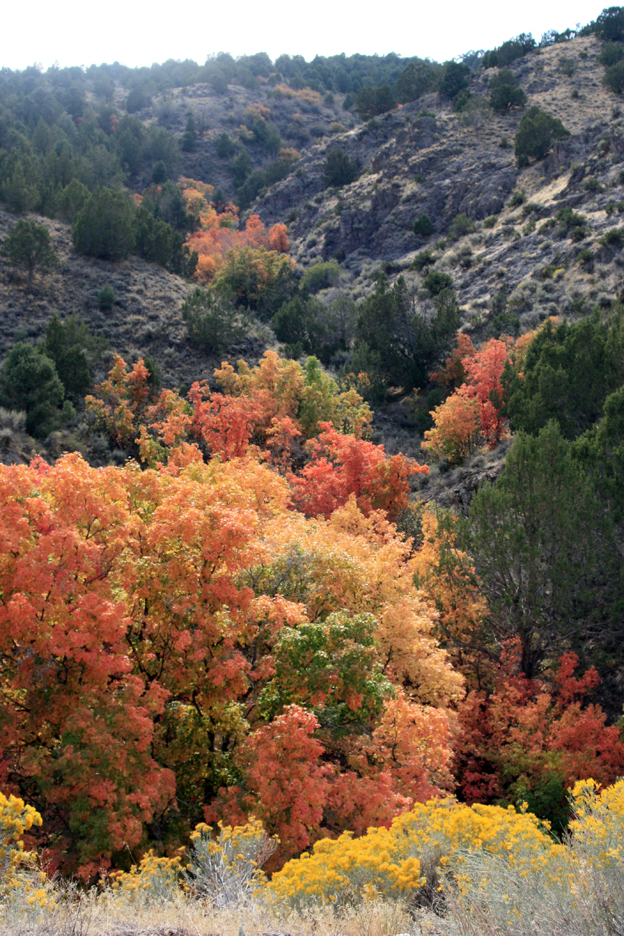
Maples in the fall near Eureka, Utah - with junipers and rabbit brush.

Maples in the fall near Eureka, Utah – with junipers and rabbit brush.

As mentioned earlier, we received a grant from the American Chemical Society to study lead contamination in the soils in Eureka, Utah and the surrounding area. The grant provided funds for travel, equipment, chemicals, and supplies. It took until early October to receive the money, so our first trip down had to wait until mid-October. It meant we wouldn’t have much daylight, but we’d have to do our best.

Canyon of Fire: Maples in the East Tintic Mountains

Canyon of Fire: Maples in the East Tintic Mountains

I’ve been gradually documenting the history of the area, collecting historical photos, taking photos around the town myself, etc. Back in 2009, I took a group of students with me to interview June McNulty, President of the Tintic Historical Society. He showed us through the museum and we videotaped the tour. Now, with this grant, we can tell the story of recent events in Eureka, especially the history of the EPA superfund project over the last ten years that cleaned up or covered up contaminated soils in the town.

TIntic HIgh School from the Godiva Mine site

TIntic HIgh School from the Godiva Mine site

My science research class researched the history of the area during first term while we were waiting for the grant funds. They identified 20 collection sites outside town using GoogleEarth. Some of these are old mine waste dumps, some are around smelter or concentration plants or leeching piles. Others are control sites outside the district. We were going to collaborate with students at Tintic High School, who were to collect from sites in town. Unfortunately, our collaboration fell through, so my students eventually collected from sites inside the town as well.

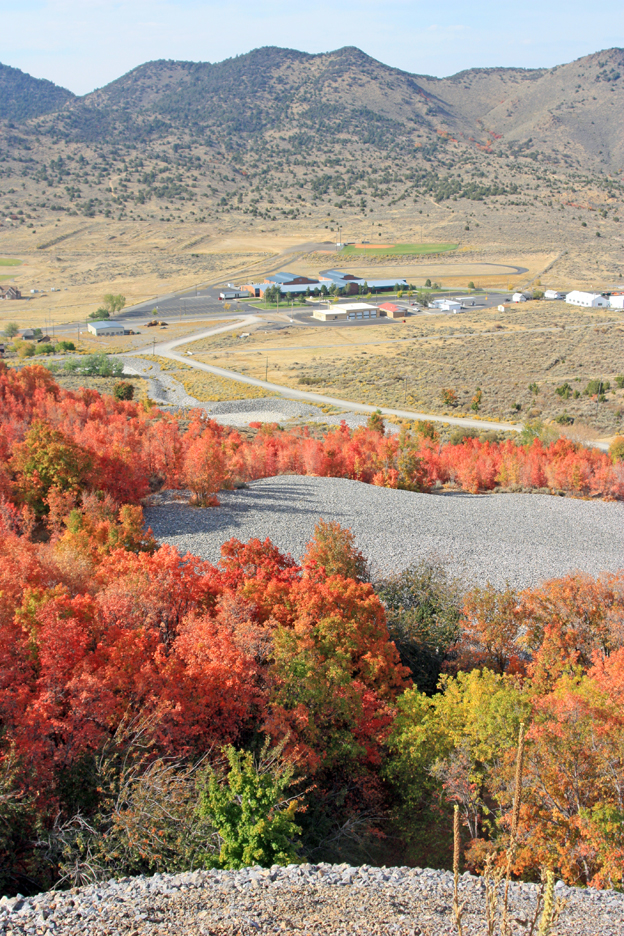
Valley of maple trees from a mine dump in the East Tintic Mountains

Valley of maple trees from a mine dump in the East Tintic Mountains

In preparation for our sample collection trips, I traveled down to the area to get some photos of fall foliage on Saturday, Sept. 22. I got there just at the right time, when the maples in the canyons were at their brightest. I photographed some areas along Highway 6 leading into town and filmed the maples in the canyons along the road leading over the top to Dividend. I then took videos around town by attaching a Flip camera to my left rearview mirror with a small claw-style tripod. I drove up to the Godiva mine site and took photos down toward the high school, then drove further up the canyon past the Knightsville site and hiked around some mine dumps further up. I had seen that there was a valley nestled inside the East Tintic Mountains from GoogleEarth and my 3D models of the area. There was a road leading along the edge of the hills, and I walked around as far as the site of the Iron Blossom #2 mine. The headframe there has recently collapsed. It was a nice trip and the photos turned out well. I also saw and photographed several deer.

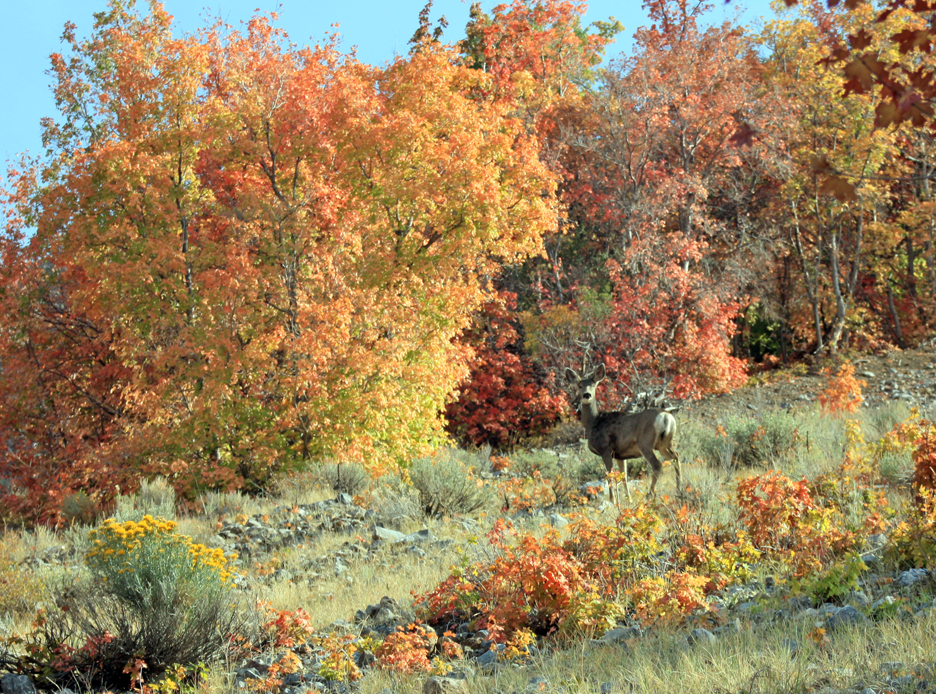
Doe a Deer: A mule deer  doe in the East Tintic Mountains

Doe a Deer: A mule deer doe in the East Tintic Mountains

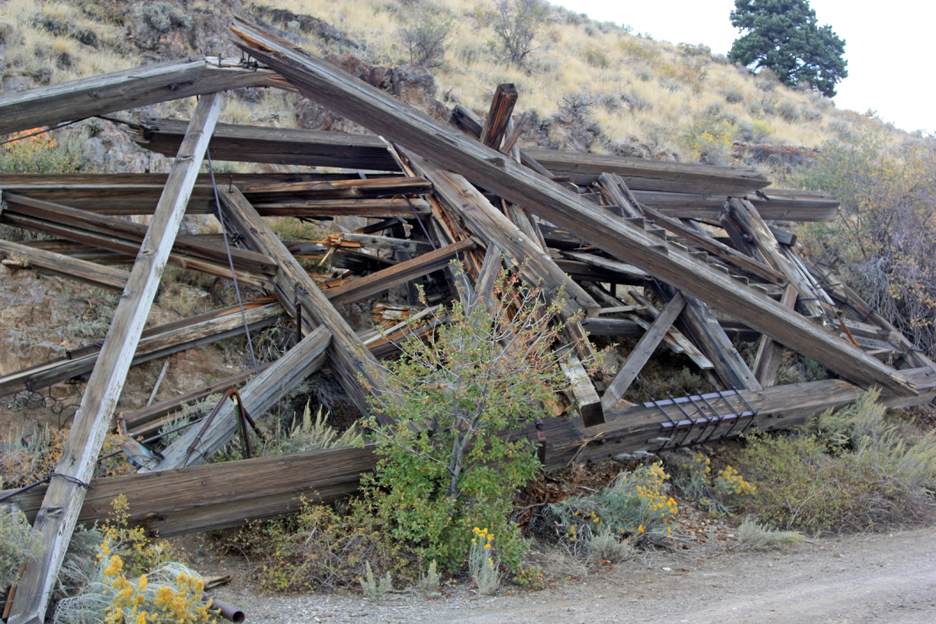
Ruins of the Irom Blossom #2 Headframe

Ruins of the Irom Blossom #2 Headframe

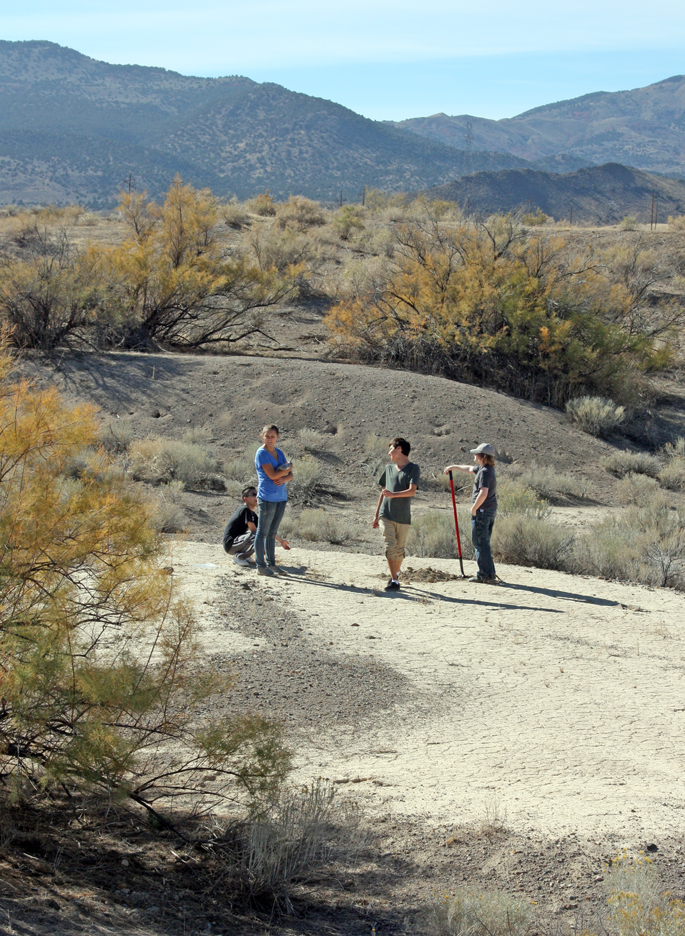
I took four students to the area on Oct. 19 and we collected samples and explored the area, including the road over Silver Pass. We first collected from some old evaporation ponds near Elberta where hot water pumped out from the Burgin mines was allowed to cool and settle before discharging it into Utah Lake. During the early 1980s, as I drove home from college to my hometown of Deseret, I would pass through this area and see the water steaming as it passed down the gulley to the ponds. This was the last time they had attempted to open the mines at Burgin. We sampled from two locations inside the old ponds, which can be reached by a short walk from Highway 6.

Collecting samples at the settling ponds near Elberta

Collecting samples at the settling ponds near Elberta

We then collected from the bottom of the wash at the mouth of the canyon leading up to Burgin. The soil here looked healthy and contained a combination of sand and humus. We then stopped at the old Burgin concentrator and took some pictures. I talked with the men at the main office of the Chief Consolidated Mine operations there about getting some samples from the tailings piles (they corrected me when I mentioned “tailings piles” around the headframes themselves and said those rocks were more properly called mine dumps or waste rock; tailings are the actual ore that has been processed).

Silver ore concentration plant at the Burgin mine

Silver ore concentration plant at the Burgin mine

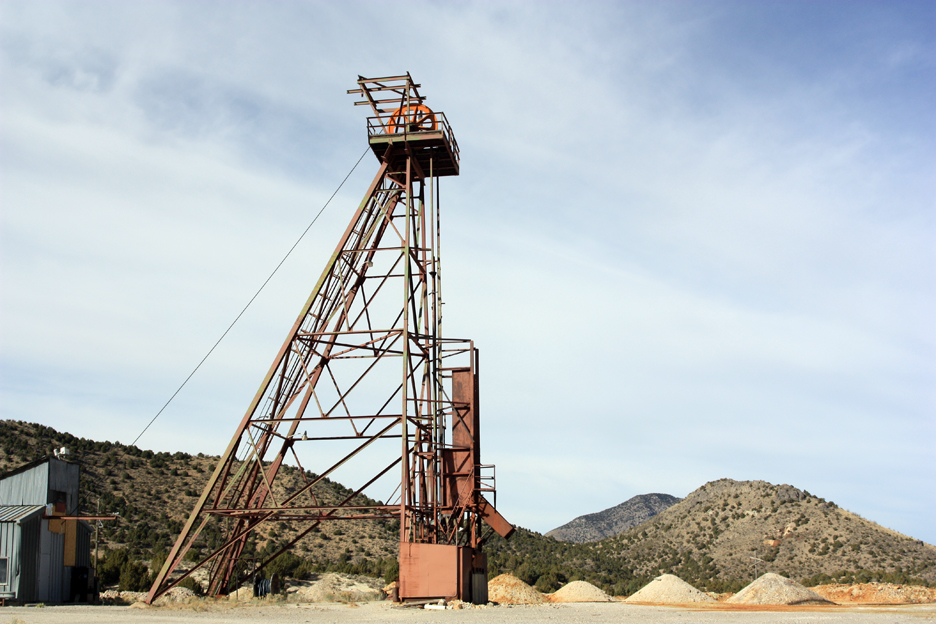
We took photos around the Trixie headframe, then drove on up the canyon over the top of Silver Pass, which I had not done before. This was the opening of the deer hunt, so I didn’t want to venture too far from the road without orange clothing.

Headframe at the Trixie Mine above Burgin.

Headframe at the Trixie Mine above Burgin.

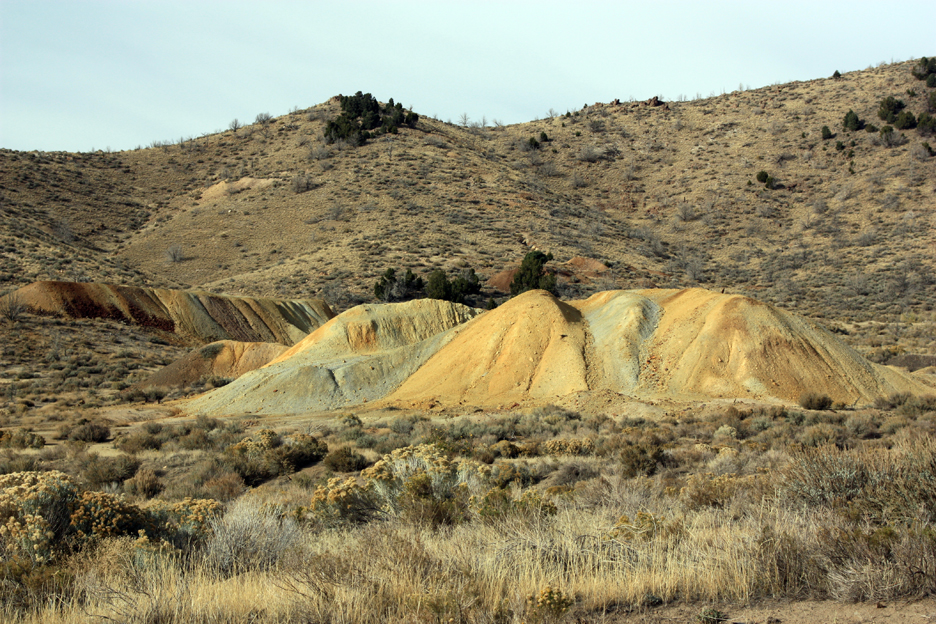
We also collected at a mine dump next to the road in Ruby Hollow, which I later identified as the Tesora Mine. The soil there had a bright yellow color and contained obvious sulfides. Part of the shaft is still there without much protection around it.

Collecting samples at the Tesora Mine dump in Ruby Gulch

Collecting samples at the Tesora Mine dump in Ruby Gulch

I also showed the students Silver City, the leeching pile from the 1980s when much of the waste rock and tailings were heaped up and cyanide solution was sprayed onto it, chelating the silver and gold out of the rocks. We stopped at the Bullion Beck headframe for photos and walked around the Tintic Mining Museum. It was late afternoon by then and time to get the students back.

Waste rock pile at the Swansea Consolidated Mine near Silver City

Waste rock pile at the Swansea Consolidated Mine near Silver City

Altogether we collected six samples from three sites and the students had a chance to get to know the area. I knew that we would have to be more productive on our next trips. Back at school, we did some simple pH tests and found the first two sites (Elberta Ponds and Burgin Wash) were near neutral pH, but the Tesora Mine samples were quite acidic, at a pH of about 3.5. Other tests would have to wait until we ordered the testing supplies.

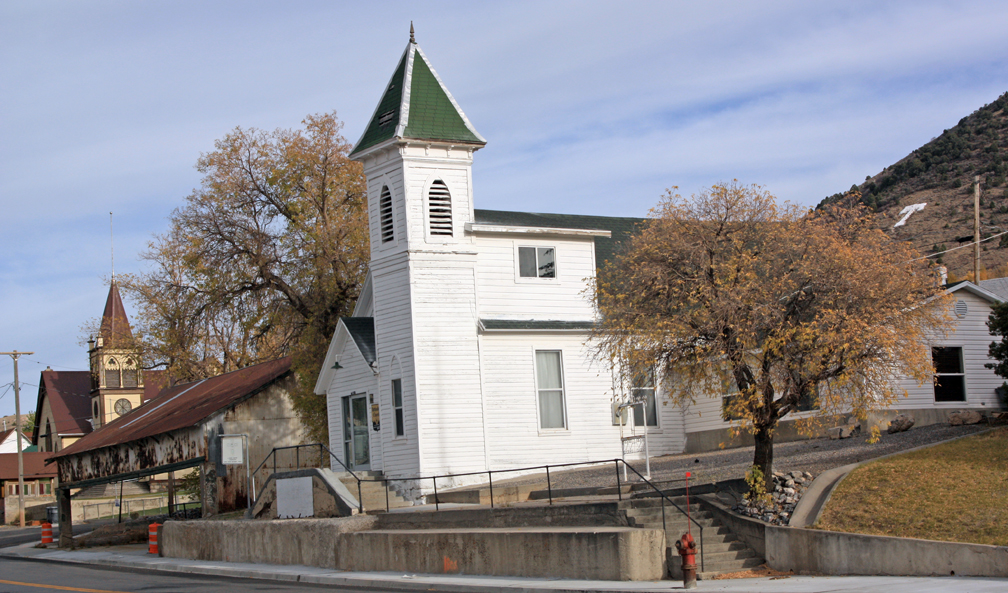
Historic churches in Eureka, Utah.

Historic churches in Eureka, Utah.

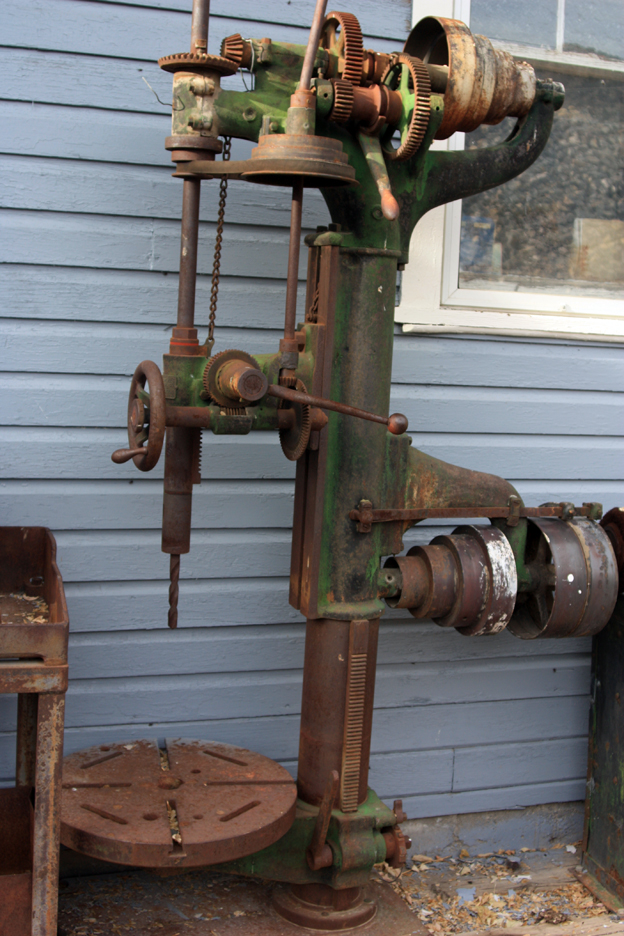
Belt-driven drill press at the Tintic Mining Museum

Belt-driven drill press at the Tintic Mining Museum

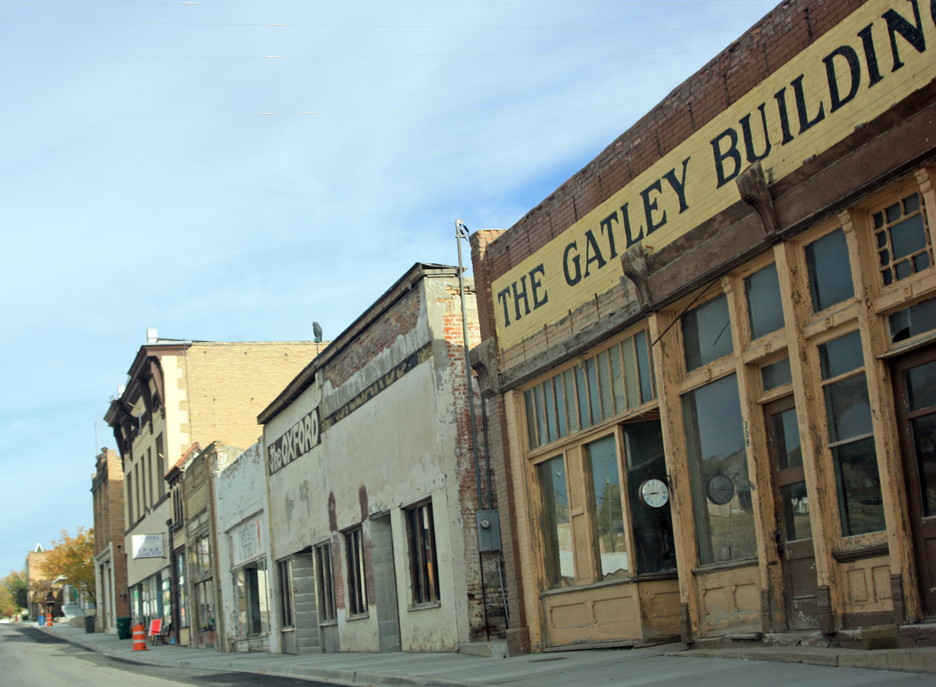
Downtown Eureka, Utah: 2012Belt-driven drill press at the Tintic Mining Museum

Read Full Post »

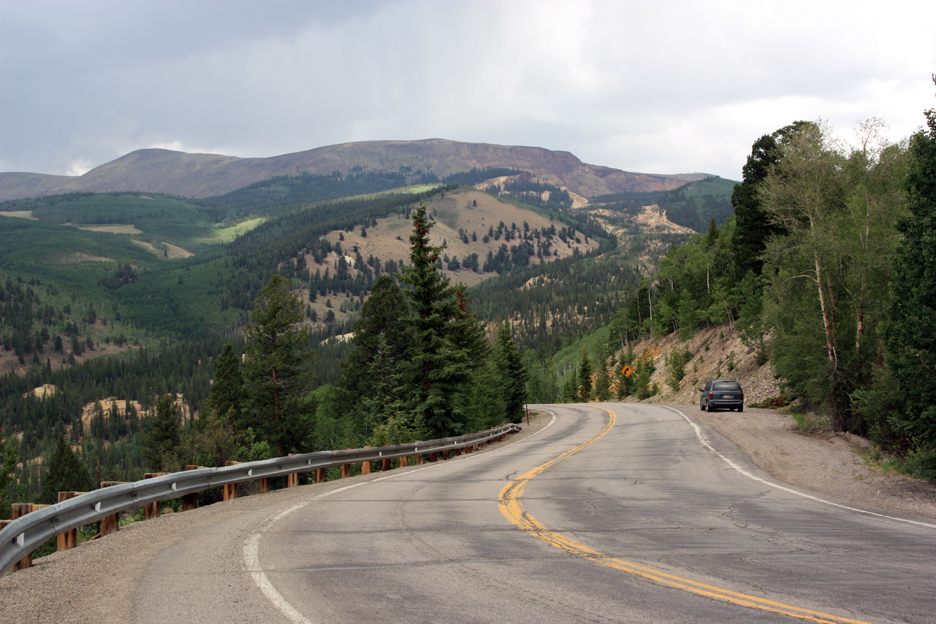
Parked along the switchbacks from Slumgullion Pass

Parked along the switchbacks from Slumgullion Pass

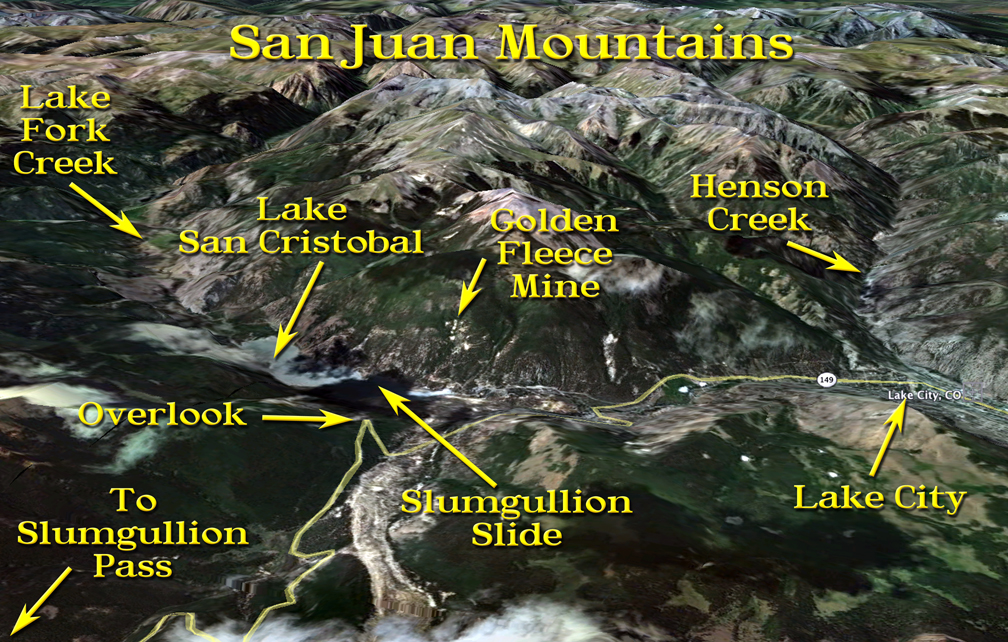
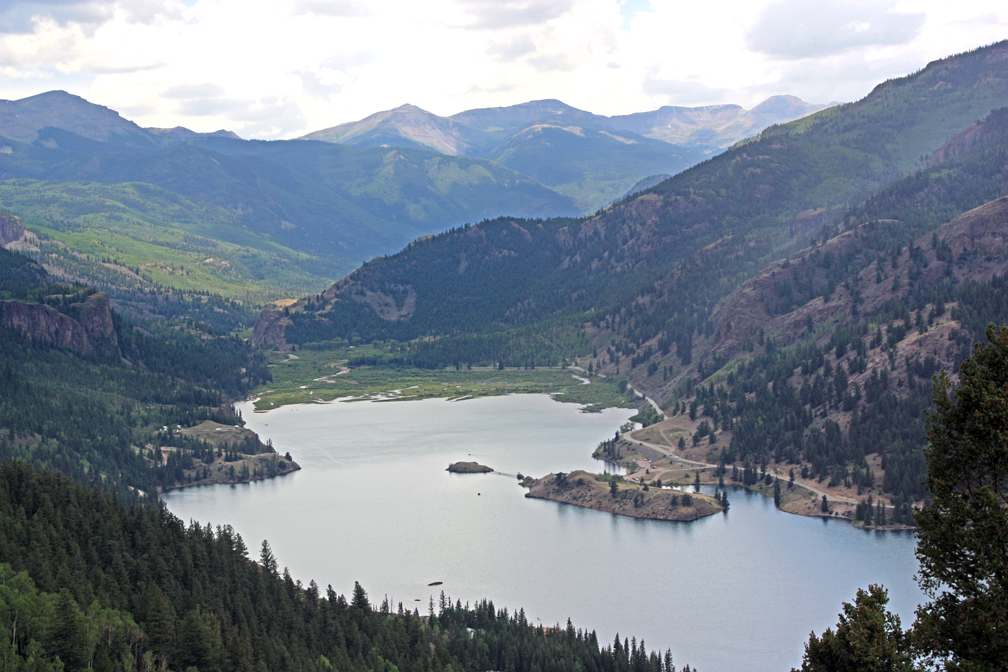
I came to Lake City from the south along Highway 149, driving from Creede along the headwaters of the Rio Grande River over the Continental Divide at Spring Creek Pass (10,901 feet). After staying on the high plateau, the road climbs again to Slumgullion Pass at 11,361 feet. It then descends toward Lake City, taking a series of dramatic switchbacks. At one hairpin turn, there is a nice overlook of Lake San Cristobal and Lake City. I stopped to look at the interpretive signs and take a few photos.
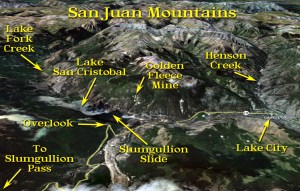
The San Juan Mountains of Southwestern Colorado

The San Juan Mountains of Southwestern Colorado

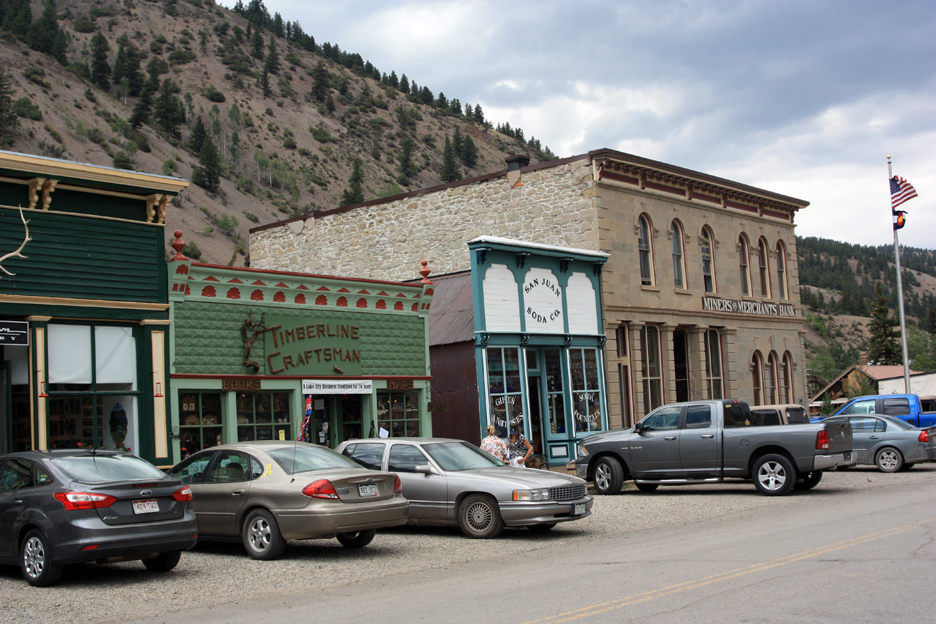
I parked along the old main street of town and found a nice old-fashioned soda fountain, the San Juan Soda Company, in a store next to the historic Miners and Merchants Bank. I had a tasty mint chocolate chip shake, which really hit the spot. I asked for directions and drove northeast out of town up Henson Canyon about two miles in a slight drizzling rain for the Hard Tack Mine.
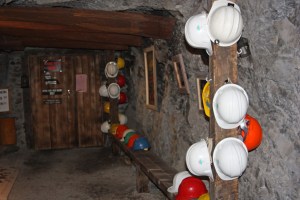
Entrance to the Hard Tack Mine near Lake City, Colorado

Entrance to the Hard Tack Mine near Lake City, Colorado

As I always do, I asked the tour guide if I could videotape the tour, and he told me to check with the owner, who was in the main office next to the mine entrance. She was afraid that I would show their tour to “the competition” and refused to let me videotape it, although she said that photographs were allowed. I tried to assure her that my reporting should help business, but she wasn’t convinced. At least this would give me a chance to take more photographs. As things turned out, I’m glad I didn’t tape the tour. The guide was fairly new, having only done this about two months. He was from out of state, and was unable to answer questions about the types of minerals found here or how mining began around Lake City (which you would think would be standard background any guide would know). Hopefully he’s done more homework since.
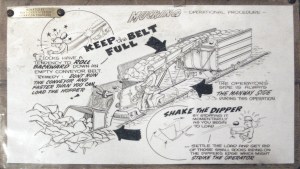
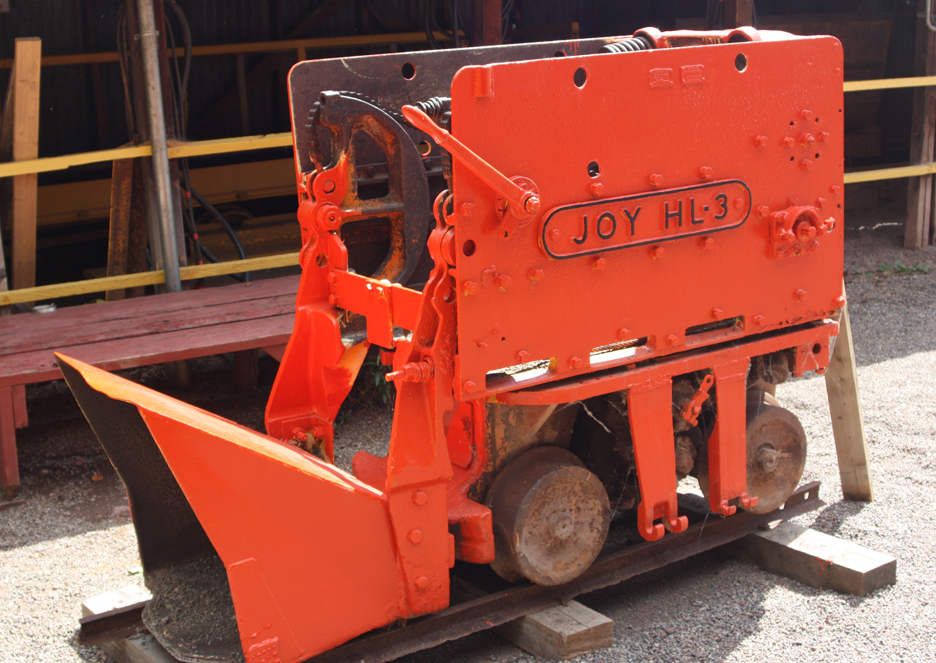
Mucking Machine Diagram in the Hard Tack Mine

Mucking Machine Diagram in the Hard Tack Mine

The tour itself was disappointing compared with other tours I’ve taken on my trip through Colorado. To begin with, the Hard Tack Mine wasn’t a mine at all; it was originally blasted as an adit to reach other mines further up the mountain but was abandoned after reaching only 350 feet. No ore was ever struck. The current owners came in, cleaned out the old works, blasted a few way stations to hold exhibits, brought equipment in from other places, and called it a “mine tour.” Now, if I had never been on any other mine tours (such as the one in Creede just this morning, which was far superior) then I might have learned some interesting things about hard rock mining. But the other tours at least had tour guides who had been miners and knew their stuff, and their displays were better designed and more detailed. And their mannequins were less cheesy.
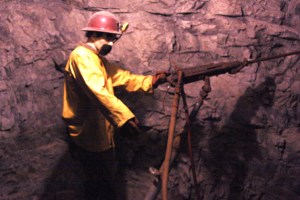
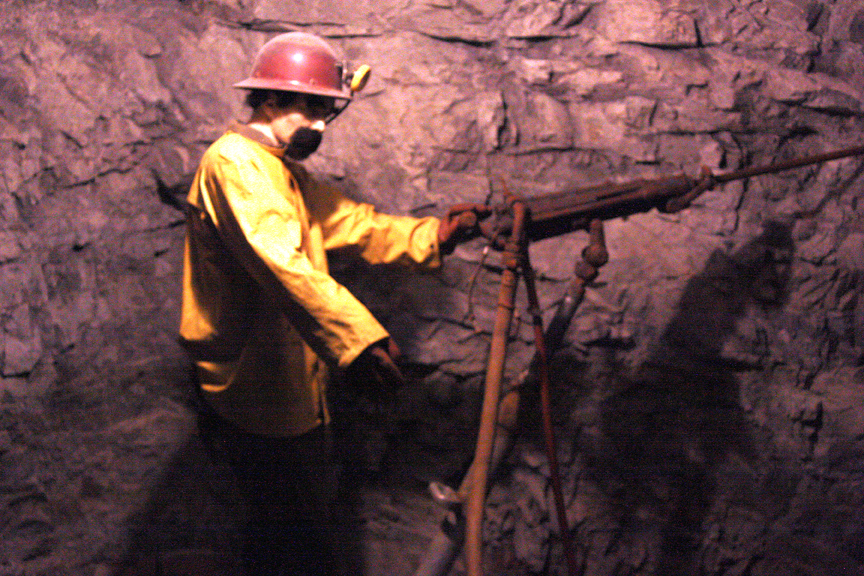
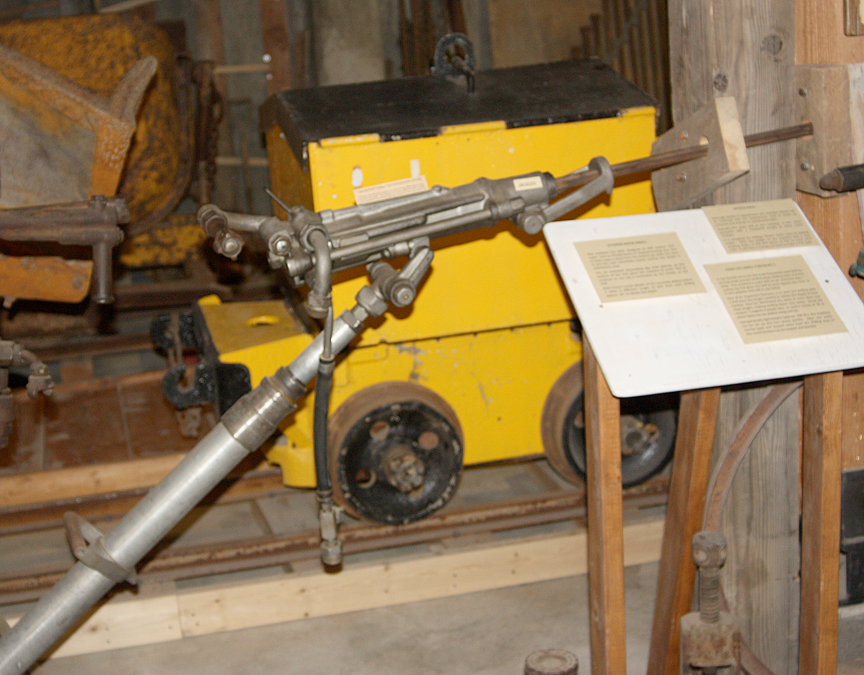
Jack leg drill display in the Hard Tack Mine

Jack leg drill display in the Hard Tack Mine

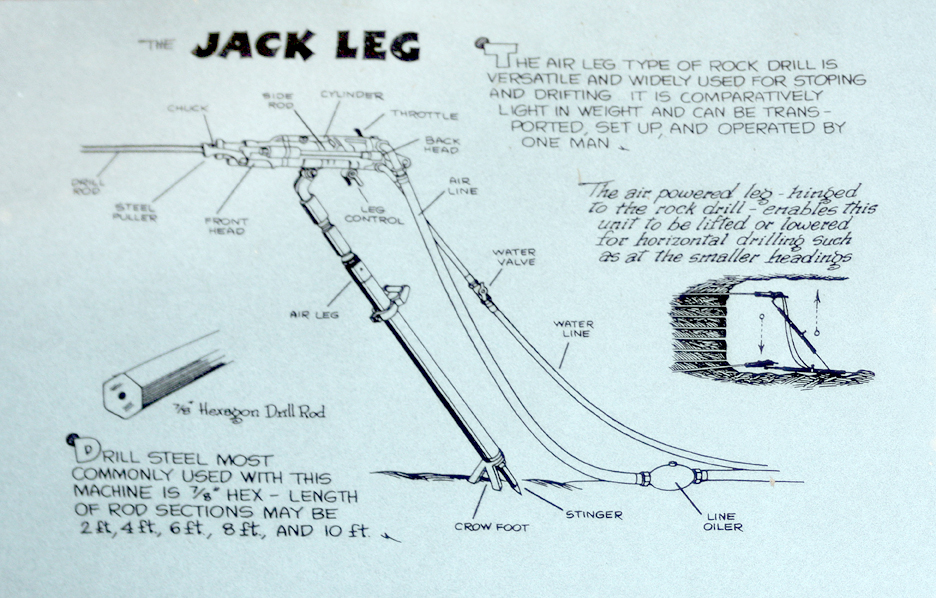
There were a few good things about this tour. The displays had some illustrated signs that did a good job explaining how the drills and other equipment worked. The signs were on paper inside plastic sleeves and were hard to photograph because they didn’t lie flat, but I did the best I could. There was also a good mineral exhibit and some photographs of the mining in the area. But the tour didn’t last very long nor was it very informative. There is a museum in town that no doubt gives more details about the history of the area, but my time was short – I wanted to get to Victor before nightfall. I’ve had to do some further research on my own.
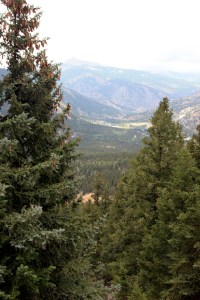
Lake City Colorado from Highway 149

Lake City Colorado from Highway 149

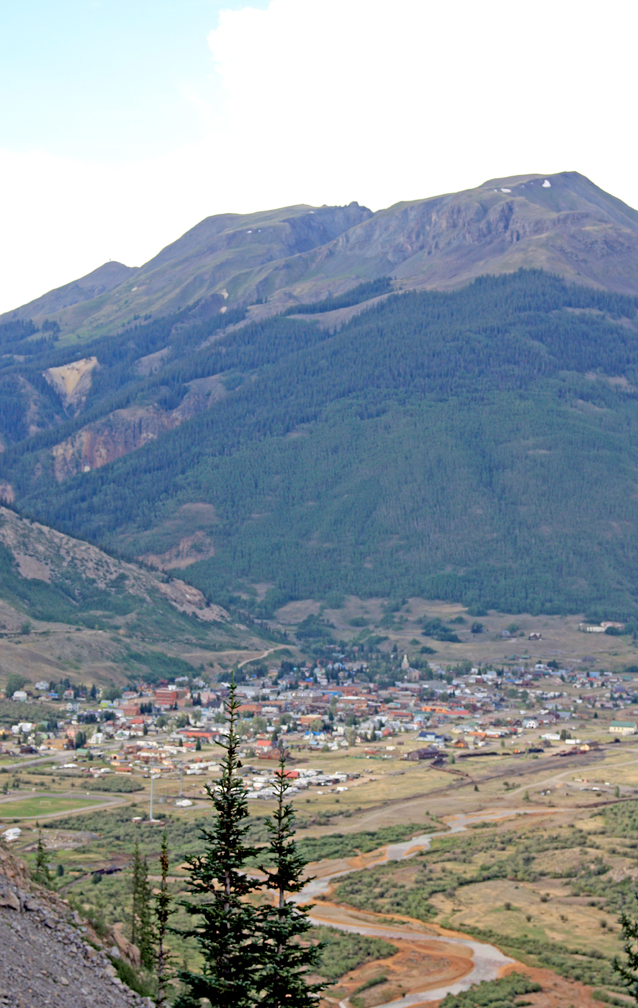
Lake City, Colorado is the county seat of Hinsdale County and the only incorporated town in the county, which is the most sparsely populated county in Colorado. This should tell you something about how remote the town is from just about anywhere else; although it is not very far as the eagle flies from Lake City to Ouray or Silverton, you need a good four-wheel drive vehicle to make it over Engineer or Cinnamon Pass. This silver camp is located on the west slope of the continental divide along Colorado Highway 149, northwest of Creede and southwest of Gunnison.
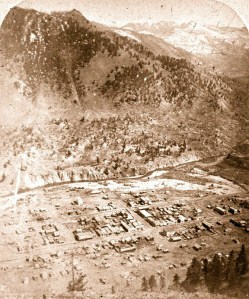
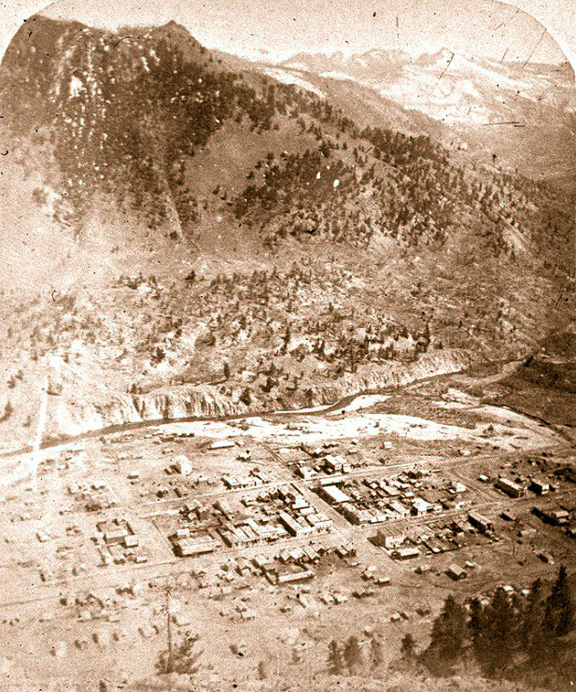
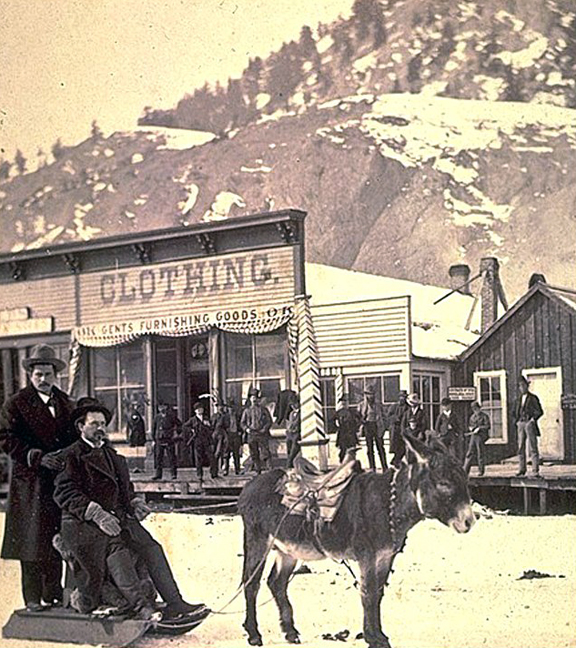
Lake City in 1881

Lake City in 1881

The same caldera eruptions that brought veins of silver, gold, lead, zinc, and copper to the San Juan Mountains also placed veins in this area, cut into by glaciers to form the rugged peaks and ridges of the San Juans. About 800 years ago, a large earthflow filled the canyon and damned off the Lake Fork of the Gunnison River, creating Lake San Cristobal, the second largest natural lake in Colorado. Lake City is located in a dell about three miles below this natural dam. The slide itself is called the Slumgullion Slide, because its brownish-orange color studded with boulders reminded the early miners of slumgullion stew, a beef stew with onions, carrots, and potatoes.
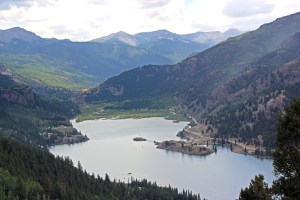
Lake San Cristobal above Lake City, Colorado

Lake San Cristobal above Lake City, Colorado

This area was home to various Ute tribes, especially the Tabeguache Tribe led by Chief Ouray. They originally ranged from the San Luis Valley through the San Juans. But their range was reduced through several treaties, ending with the Brunot Treaty of 1873, which moved the Utes to the Uintah-Ouray Reservation in Eastern Utah.
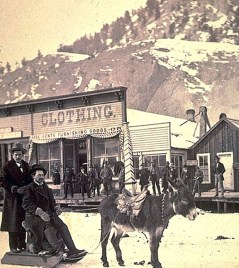
Lake City winter

Lake City winter

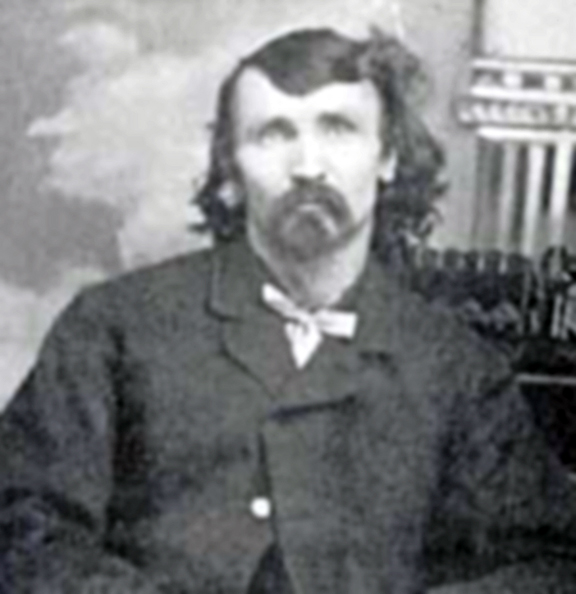
Even before the treaty was ratified, prospectors were heading into the San Juans, pressing south along Lake Fork to the area around Lake San Cristobal. One party of six men, led by Alferd Packer, got caught in deep snows as they tried to hike to the Los Pinos Indian Agency near Saguache. They ran out of food and even ate their shoe leather to try to stay alive. Only Packer made it to the station.
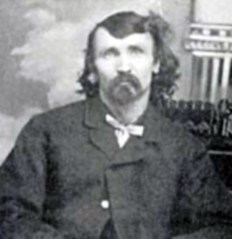
Alferd Packer. You would not want to hire this man as a tour guide . . .

Alferd Packer. You would not want to hire this man as a tour guide . . .

Later that year, the bodies of the other five men were found dead at the base of Slumgullion Pass and showed signs of foul play and cannibalism. Packer had seemed well enough fed, and was spending money from several different wallets. He was arrested and charged with murder, escaped, was captured seven years later and convicted of murder in the Hinsdale County Courthouse. He was retried in Gunnison and found guilty again, then sentenced to 40 years. He was later pardoned by the Governor of Colorado. He always claimed he had killed one of the men in self-defense, and that another man, the oldest of their party, had died of natural causes and was probably eaten by the others.
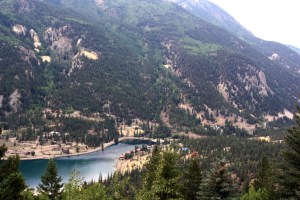
The Golden Fleece mines above the Slumgullion Slide.

The Golden Fleece mines above the Slumgullion Slide.

Other prospectors discovered claims, which were staked out and filed just as soon as the treaty was complete. The first big strike was the Golden Fleece claim discovered by Enos Hotchkiss (who also built the first cabin in the area of what is now Lake City). He and Henry Finley and D. P. Church were building a toll road between Silverton and Saguache in 1874 when he located rich gold ore by the lake. By 1875, Lake City was incorporated as a town, and became the county seat. Within a few years over 500 structures had been built and mining had extended all the way into the valleys and passes above Lake San Cristobal. The town itself became an important jumping off, resupply, and smelting point.
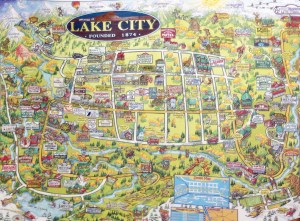
Illustrated map of Lake City, Colorado

Illustrated map of Lake City, Colorado

In 1889 the Denver and Rio Grande Railroad built a narrow gauge line in from the north and the ores could now be transported much more cheaply. Otto Mears built toll roads over the passes from Silverton and Ouray to Lake City and charged $2.25 per passenger for the daily stagecoach runs. It would take two days to make the bone-jarring ride, and the stages would stop over at Rose’s Cabin, originally built in 1874 by Corydon Rose as a one-story log cabin. It eventually grew into a saloon and hotel, stable, store, post office, and cultural center for the mining claims in the area.
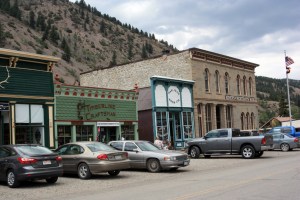
Downtown Lake City, Colorado

Downtown Lake City, Colorado

Lake City reached its peak population of about 6000 around 1900, but the writing was already on the wall. The Silver Panic of 1893 cut the price of silver so much that it doomed much of the mining in the San Juan Mountains and elsewhere in Colorado and throughout the West. Only those mines that contained enough gold and other ores to ride out the downturn were able to survive. Now maybe 500 people live there year-round.
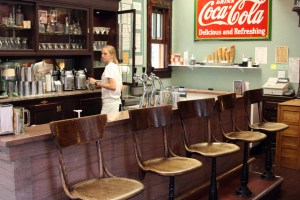
Soda fountain in Lake City, Colorado

Soda fountain in Lake City, Colorado

The last train out of Lake City left on May 25, 1933. After the railway was abandoned, Mike Burke, owner of the Ute-Ulay Mine, had a 1928 Pierce Arrow automobile remodeled with train wheels so it could run on the tracks. It was called the Galloping Goose because of its tendency to weave back and forth on the rails.
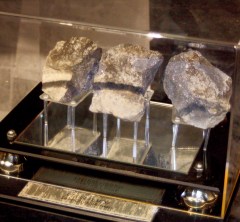
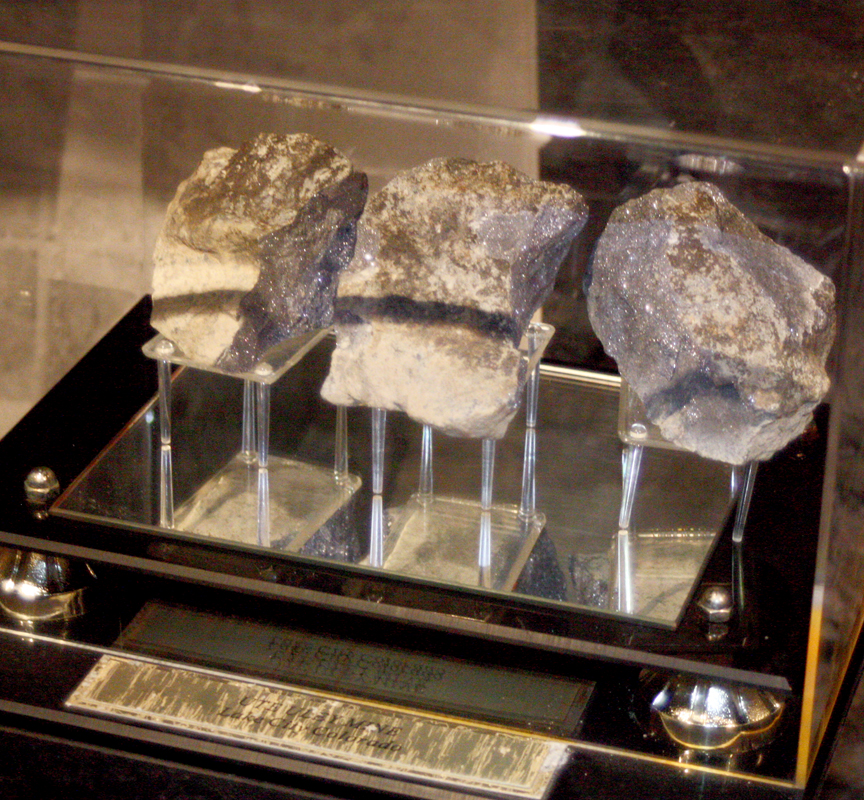
Silver ore from the Ute-Ulay Mine near Lake City, Colorado

Silver ore from the Ute-Ulay Mine near Lake City, Colorado

The Ute-Ulay (or Ule) Mine is one of the more famous in the area, with over $10 million worth of silver and lead extracted. Its mill was used as late as 1983, but now the buildings, mill site, boarding house, tram line, etc. are decaying and in danger of collapsing under heavy winter snows. The current owners, LKA International, have donated the land to Hinsdale County and options are being looked at to renovate the structures and remediate the tailings pile and pit near the mill.
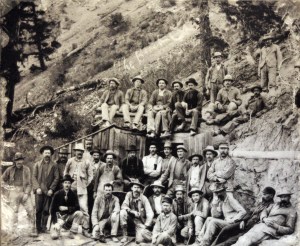
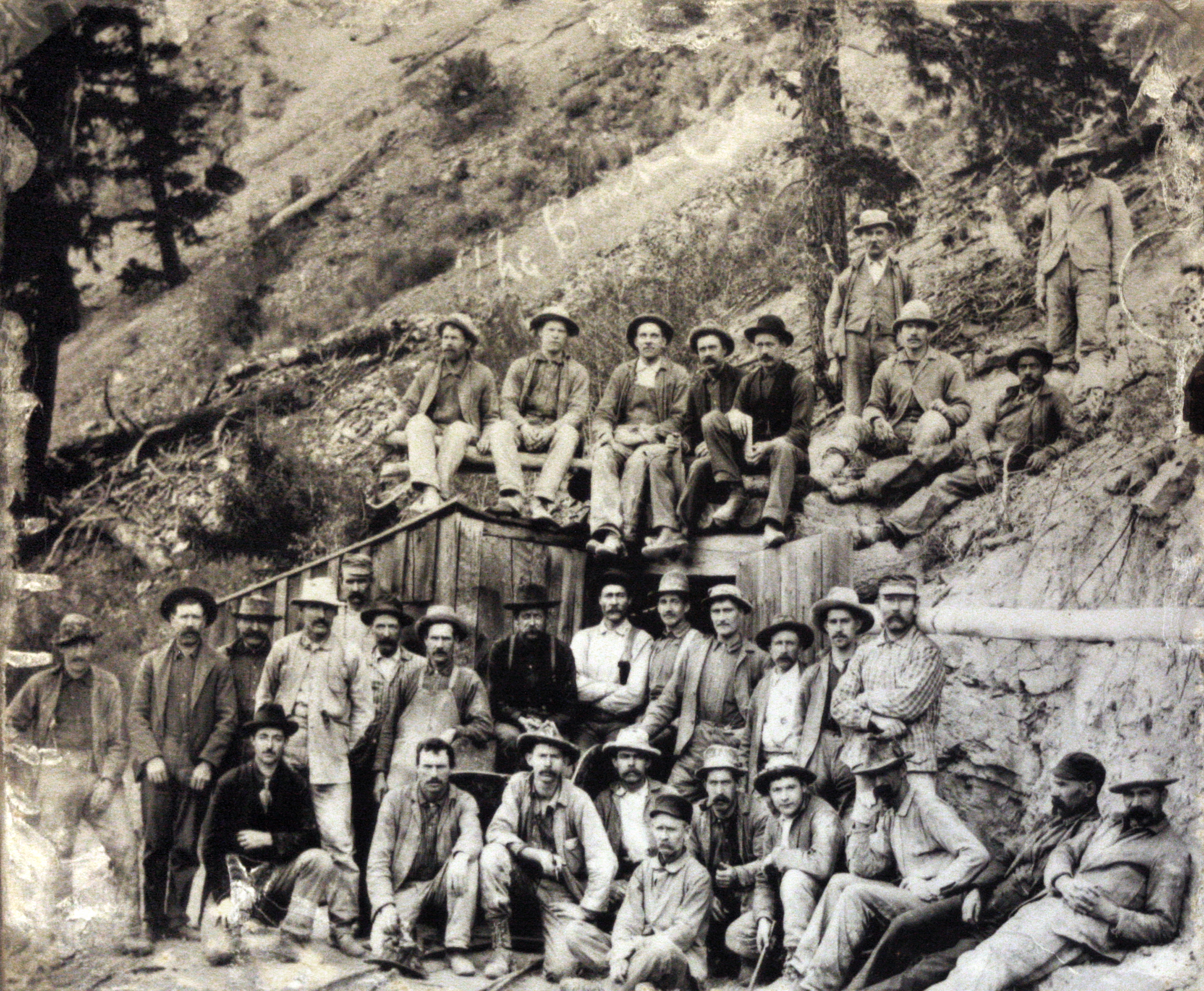
Miners at the Black Creek Mine near Lake City, Colorado.

Miners at the Black Creek Mine near Lake City, Colorado.

The county invited in the nonprofit Colorado Art Ranch to put together the Hardrock Revision Team, a group of seven artists to find creative ways to utilize the property while maintaining its historic appeal. Some ideas include turning the over 100 miles of tunnels into a large Aeolian harp, converting the water tank into a camera obscura, covering the roofs of the buildings with protective tarps painted with mining scenes, and turning the tailings pit into an ice skating rink once it has been remediated. This is not a bunch of outsiders coming in to tell the community what to do – it was initiated by Lake City citizens. It will be interesting to see what happens, and perhaps I’ll have to stop when I come this way again. Here is a link to the article I found on this project: http://www.hcn.org/issues/43.20/can-an-old-mine-become-a-work-of-art/article_view?b_start:int=0. I just wish similar efforts could happen in Utah before the state shuts all our mining history down or all the old structures collapse into oblivion.
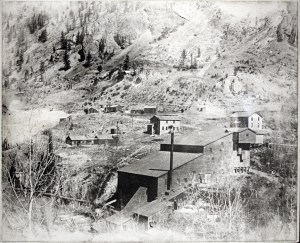
Mining structures in the Lake City area

Mining structures in the Lake City area

As I left the Hardtack Mine, I drove north out of Lake City on Highway 149 and left the San Juan Mountains behind. North of Lake City, large basalt flows continue all the way to the Black Canyon of the Gunnison. I joined U.S. 50 nine miles west of Gunnison and stopped to gas up. Now I was on a familiar road – I’ve traveled most of the length of U. S. 50 at one time or another. I’ve been on this section with my children 10 years ago when I was last in the San Juans.
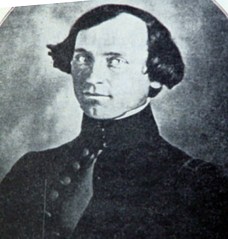
Captain John W. Gunnison, for whom many towns and places are named in Colorado and Utah. His 1853 survey expedition was attacked by a Pahvant war party in Oct., 1853 west of Deseret, Utah.

Captain John W. Gunnison, for whom many towns and places are named in Colorado and Utah. His 1853 survey expedition was attacked by a Pahvant war party in Oct., 1853 west of Deseret, Utah.

Captain John William Gunnison left his name all over Colorado and into central and western Utah, but not in Nevada. He never made it that far. As a Captain of the Army Corps of Topographical Engineers, he was commissioned in 1853 to survey a route for the transcontinental railroad between the 38th and 39th parallels. U.S. 50 and parts of the Denver and Rio Grande Railroad follow the route his team surveyed. They discovered the gorge of black basalt and the river that bears his name. Once they reached Utah, they surveyed along the Sevier River near the site of Gunnison, Utah and passed through Leamington Canyon into the Pahvant Valley. Fearing the approach of winter, he sped up the work by splitting his team into two groups. His half of the party surveyed a large meander in the Sevier River where the Gunnison Bend Reservoir is now located. Several miles further down the river, west of what is now Deseret (my hometown), they were attacked by Pahvant Utes on the warpath. Of eleven men in the group, only three survived. Gunnison was killed. I travelled east on U. S. 50, thinking about how Deseret would be different if Gunnison had finished his survey and the transcontinental railroad had followed that route instead of the more northern route it took.
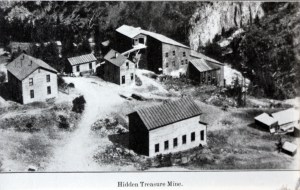
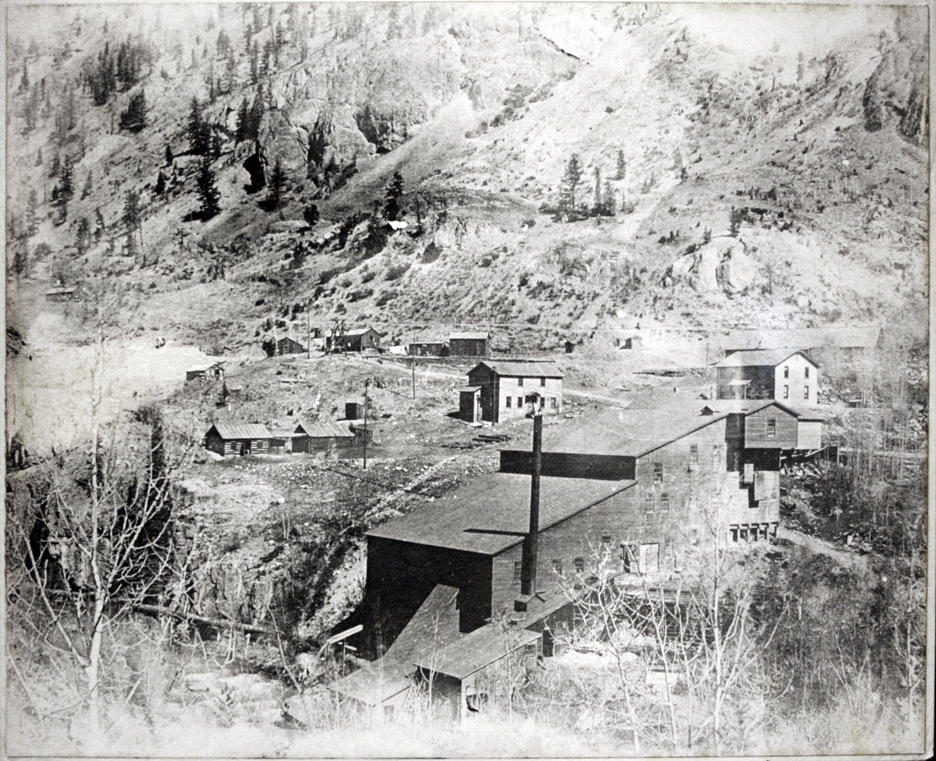
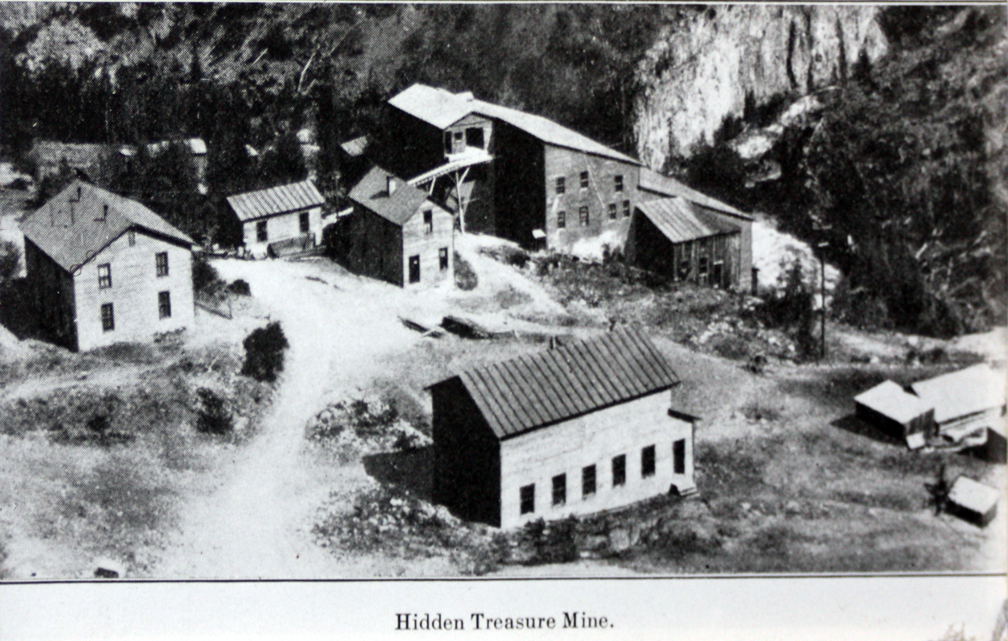
Hidden Treasure Mine near Lake City, Colorado

Hidden Treasure Mine near Lake City, Colorado

I became so sleepy that I had to pull over and take a nap for an hour, then press on. Clouds gathered as I drove up into the Sawatch Range and it began to drizzle. I had intended to take the tramway to the top of Monarch Pass, but I was behind schedule and it wouldn’t have been much of a view in the rain, so I pressed on. I drove into Buena Vista and ate supper at a burger place, then tried to get the phone number for the KOA campground outside of Victor that I was going to stay at. It was getting dark and I wanted to let them know I was going to be late coming in. My wife looked up the number for me (somehow I had forgotten to write it down with all my other contact information when planning this trip) as I drove east on U.S. 24. I had to double back to find a spot with cell tower reception in order to get the number, but was not able to get through to the campground. They must have already closed the office.
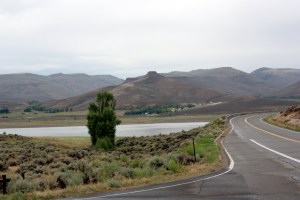
The Road to Gunnison

The Road to Gunnison

By now it was completely dark, so once again I travelled this highway in the night, the last time being in 2010 when we drove out to Denver, stopping in Cripple Creek. Now I was returning to complete the visit I made then. At least I had driven this route once in the daytime, back in September, 2009 on my way back from Philadelphia, and had good photos of the scenery.
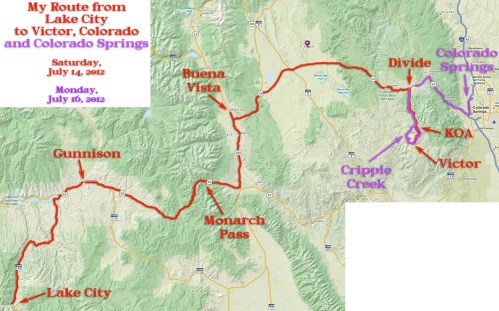
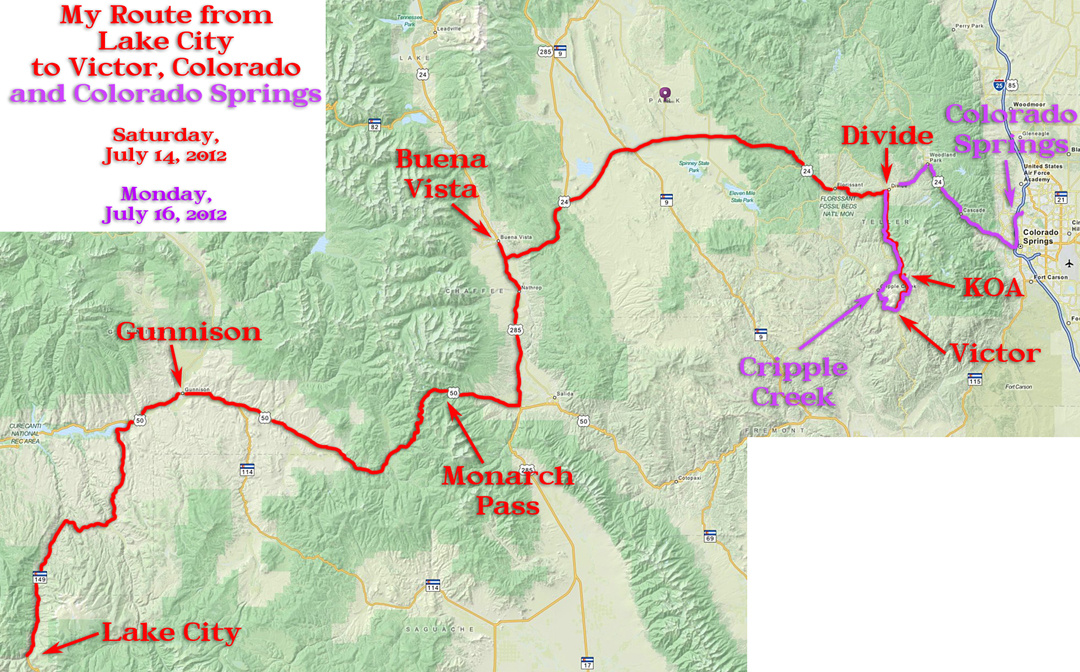
My route from Lake City to Victor, Colorado on July 14, 2012.

My route from Lake City to Victor, Colorado on July 14, 2012.

I was getting very tired by the time I got to Divide and turned south. I took the turn toward Victor, but somehow missed the KOA in the dark and wound up driving all the way into town. I turned around and headed back. I almost missed the sign again. The KOA is located just south of the turnoff to Victor, and I arrived about 11:00. The manager had left a map for me in the entranceway to the office with my site circled, a tent site on the outer edge of the camp. It took a couple of drives around the camp before I found the right trail leading off to the tent sites. Mine was Site 1, nestled back in the aspens with good privacy. I was too tired to make camp, so I just rearranged my gear, setting stuff outside like the tent that I knew bears wouldn’t get in to, and made a fairly good bed in the back of my minivan.

Read Full Post »
Rio Grande River Valley, on the way to Creede, Colorado.

Rio Grande River Valley, on the way to Creede, Colorado.

Saturday, July 14, 2012 was the sixth day of my trip through Colorado’s mining history. I started in South Fork and travelled through Creede, Lake City, Gunnison, Buena Vista, and finally wound up near Victor. It was a long drive, but I stopped for some interesting tours and explorations along the way.

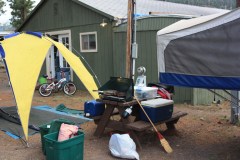
Campsite at South Fork. There wasn't much privacy.

Campsite at South Fork. There wasn’t much privacy.

My campsite in South Fork was very tiny and right next to the community center and I was trying to cook breakfast and break camp as people literally walked through my camp to set up a bake sell in the common room. Here’s a photo to show it. The tent trailer next to me almost hung over my picnic table. But despite the lack of privacy, I did manage to get packed up and ready to go at a reasonable time.

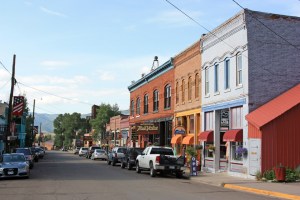
Main Street in Creede, Colorado.

Main Street in Creede, Colorado.

I drove north on Highway 149 toward Creede, following the Rio Grande River. The valley here is wide and flat, the obvious result of valley glaciers during the last ice age. Going back much further than that, about 60 million years ago, the Farallon tectonic plate was pushing under the North American Plate at a faster rate than normal, wrinkling up the western part of the continent like a rug on a wooden floor. The last great orogeny (mountain building episode) pushed up the Rocky Mountains and was called the Laramide Orogeny. The San Juan Mountains, which I have been exploring all week, were the final uplift and are the youngest mountains in Colorado. Eventually, the North American Plate slowed down and the Farallon Plate finally subducted beneath. As it pealed away, a wave of volcanic activity followed it as the melting plate became magma that rose to the surface.

Volcanic Activity in the San Juan Mountains.

Volcanic Activity in the San Juan Mountains.

In the newly formed San Juans, the rising magma created a system of andesitic volcanoes that exploded and spewed ash and tuft throughout the region. The empty magma chambers collapsed to form calderas, and around their rims veins of ore-bearing igneous rocks were injected into fault lines and cracks. These veins became the great silver and gold mining districts I’ve visited all week.

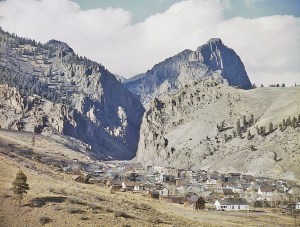
Creede, Colorado in 1942.

Creede, Colorado in 1942.

In the area of Creede, about five overlapping calderas exploded and collapsed; silver-bearing ore was injected into fractured rock at the edge of the caldera. In 1889, these silver deposits were discovered and began the final great silver mining camp in Colorado. It was the fastest, wildest, and richest of the boomtowns and the population reached 10,000 by 1891.

Creede Main Street looking north into Willow Creek Canyon.

Creede Main Street looking north into Willow Creek Canyon.

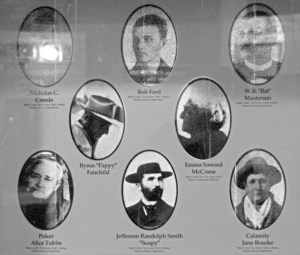
Denver went through a wave of gambling and saloon reforms in the early 1890s, and many of the most famous casino owners and con men moved here to set up shop, including Jefferson Randolph “Soapy” Smith II. He sold his Tivoli Club in Denver and moved to Creede. He swindled local property owners out of their deeds and took over a large section of Creede’s business district, setting up his gang in various fronts for his confidence schemes. He soon announced himself as camp boss, and controlled all of the gambling and organized crime in the district. He appointed his brother in law as deputy sheriff, and the two of them established some order to the rough and tumble town, throwing out troublemakers. Soapy opened up a gambling hall called the Orleans Club in 1892. He purchased a “petrified man” nicknamed McGinty and had him placed on display.

Cast of Characters in Creede, Colorado.

Cast of Characters in Creede, Colorado.

Later in 1892 he got word that the reforms in Denver were coming to an end, so he returned to Denver. Shortly after, a large part of Main Street burned down in a fire, including the Orleans Club.

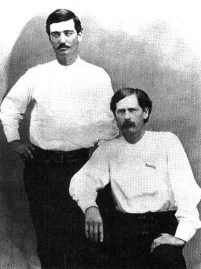
Bat Masterson (standing) and Wyatt Earp in 1876, when they were deputies in Dodge City, Kansas.

Bat Masterson (standing) and Wyatt Earp in 1876, when they were deputies in Dodge City, Kansas.

Another well-known figure that came to Creede was Robert Ford, the man that shot Jesse James. He arrived in early 1892 and set up a dance hall, but after a drunken night spent shooting windows out along Main Street, he was about to be driven out of town when the Soapy Smith gang insisted that he stay. Ford’s dance hall was burnt down in the fire on June 5, 1892 and he set up a temporary saloon in a tent until he could rebuild. Three days after the fire, on June 8, Edward O’Kelley walked into the saloon, called Ford by name, then shot him twice in the chest with a shotgun. Ford died instantly.

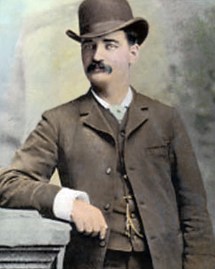
Bat Masterson

Bat Masterson

Another famous Old West character that found his way to Creede was William Barclay “Bat” Masterson. In his early days, he was a deputy sheriff in Dodge City, Kansas, along with Wyatt Earp. Bat eventually became county sheriff, at the same time that his brother, Ed, was town marshal. When Ed was killed by a cowboy named Jack Wagner, Bat avenged his death and had to leave town. He went to work for Wyatt Earp in Tombstone, Arizona running the faro tables at the Oriental Saloon.

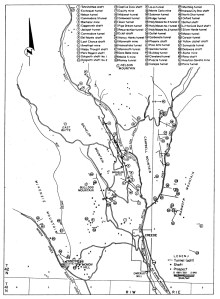
Map of mines in the Creede Mining District.

Map of mines in the Creede Mining District.

When Bat’s other brother, Jim, was threatened by men in Dodge City, Bat returned and engaged in a shootout in the town plaza where one man was wounded. Bat was fined $8 and asked to leave town again. He moved to Denver where he dealt faro at a gambling house and became friends with Soapy Smith. He moved with Soapy to Creede in 1892 and managed the Denver Exchange Club until it, too, burned down in the fire. Bat was known for being a dapper man who enjoyed wearing a bowler hat. He was also known as an irrepressible practical joker.

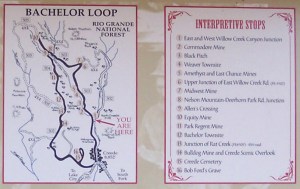
Map of the Bachelor Loop scenic trail north of Creede.

Map of the Bachelor Loop scenic trail north of Creede.

Other characters that stopped by Creede during its boom years were “Poker” Alice Tubbs and Martha “Calamity Jane” Burke.

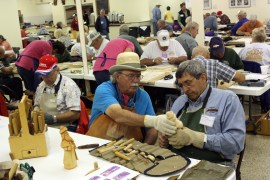
Woodcarving lessons in the Creede Community Center.

Woodcarving lessons in the Creede Community Center.

As if the 1892 fire wasn’t bad enough, in 1893 the Sherman Act was repealed by congress and the Silver Panic began, with prices for silver dropping from $1.29 to about $.50 per ounce. Almost as soon as it began, the boom was over and Creede began to die. Most mines closed, but a few kept working and others consolidated until 1930, when all mining ceased. Some additional mining occurred in the late 1930s by the Emperius Mining Company, and the Bulldog Mountain vein system was discovered in the 1960s, with mining along the vein conducted by the Homestake Mining Company until 1985. Overall, nearly 5 million tons of ore have produced over 84 million ounces of silver and substantial amounts of lead, zinc, copper, and gold (the big five).

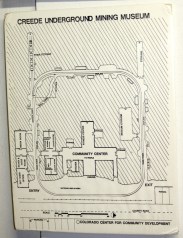
Creede Underground Mining Museum map. The mine tour and community center were blasted out of the side of Willow Creek Canyon.

Creede Underground Mining Museum map. The mine tour and community center were blasted out of the side of Willow Creek Canyon.
Some of the leading mines were the Bachelor Mine high up in a notch in West Willow Creek Canyon, the Commodore Mine lower down the same vein, the Amethyst Mine further up the canyon, the Last Chance high on the hill above the Amethyst, and the Bulldog complex to the west of Willow Creek. A large mill, called the Humphreys Mill, was located at the junction of East and West Willow Creek Canyons. The mill’s foundations can still be seen. The earliest mines in the district were discovered west of town around the Sunnyside area, such as the Solomon and Holy Moses mines. The town cemetery is located there now.

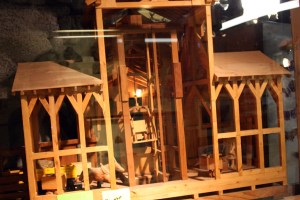
Model of the Bulldog Mine.

Model of the Bulldog Mine.

After looking around Main Street, I drove further up the canyon to where the Creede Undergound Mining Museum and community center are located. I was surprised to see a lot of cars filling up the parking lot, and was lucky to find a place to park. A large woodcarver’s convention was being held in the community center, and I enjoyed watching the vendors teaching classes. I think I have a hobby decided on for when I retire, if ever; I’d like to do a combination of wood burning and painting, perhaps of some of the mining towns and scenery I’ve seen on this trip.
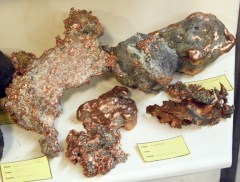
Native copper in the Creede Underground Mining Museum.

Native copper in the Creede Underground Mining Museum.

I joined a tour of the Underground Mining Museum, which was built partially from an old tunnel that has been enlarged into a loop tour, with the community center blasted out in the middle. It had a good display of minerals and posters of mining terms, with some illustrations. After videotaping the tour itself, I backtracked around the loop with my camera and took photos, so this tour is better documented than some of the others I took where I couldn’t take still photos very well while running my video camera.

Mucker machine as it was found in the Big Six Mine.

Mucker machine as it was found in the Big Six Mine.

Some of the unusual aspects of this tour (which was a very thorough overview of hard rock mining) included a slusher, which is a type of dragline used to pull blasted rock fragments away from the face, a description of how fuses were measured (the person cutting fuses would wind them around wooden pegs set one foot apart), a honey car (an outhouse on wheels), an accurate recreation of a stope, a good assayer’s office, a hoist and skip station, and a description of the local geology.

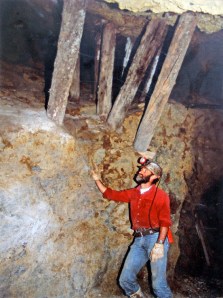
Open stope in the Big Six Mine.

Open stope in the Big Six Mine.

After the tour I drove further up East Willow Creek Canyon and saw the remains of the Humphreys Mill, then drove up West Willow Creek. High on the hill was the Bachelor Mine, and lower down the Commodore, with its large ore house. The slope is so steep that extensive cribbing is needed. I drove a little further up, but the gravel road became too steep and too rough for my minivan. Perhaps some other time I can come this way with a 4-wheel drive. Further up the canyon are the Amethyst and Last Chance, and I’ve found some photos of them taken by the Mining History Association.

Measuring fuses. The fuses would be wound around the peg to get precise lengths.

Measuring fuses. The fuses would be wound around the peg to get precise lengths.

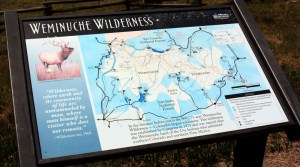
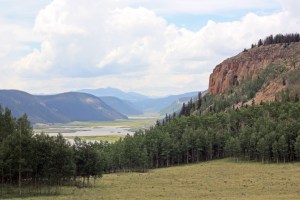
I drove out of town around noon and headed west and north on Highway 149. I came over a small pass with displays and beautiful views of the Weminuche Wilderness and the headwaters of the Rio Grande River. It was a nice chance to see both ends of the river. I have been down near the mouth of the Rio Grande in Laredo, Texas and now I’ve seen the other end.

Assayer's office, with balance, crushers, and bone crucibles. To the left is the furnace for fire assaying.

Assayer’s office, with balance, crushers, and bone crucibles. To the left is the furnace for fire assaying.

Honey car in the Creede Underground Mining Museum. OK, I'll say it: whoever had to clean this out each day had a really crappy job. . .

Honey car in the Creede Underground Mining Museum. OK, I’ll say it: whoever had to clean this out each day had a really crappy job. . .

Humphreys Mill in East Willow Creek Canyon.

Humphreys Mill in East Willow Creek Canyon.

Site of Humphreys Mill today.

Site of Humphreys Mill today.

Ruins of mines in West Willow Creek Canyon. The Bachelor Mine is high up on the hillside and the Commodore Mine at the bottom.

Ruins of mines in West Willow Creek Canyon. The Bachelor Mine is high up on the hillside and the Commodore Mine at the bottom.

The Bachelor Mine.

The Bachelor Mine.

The Commodore Mine #5 Level adit.

The Commodore Mine #5 Level adit.

Commodore Mine ore house and chutes. Ore was hauled from the adit across a bridge to the top of the tipple.

Commodore Mine ore house and chutes. Ore was hauled from the adit across a bridge to the top of the tipple.

Amethyst Mine

Amethyst Mine

Last Chance Mine (photo by the Mining History Association).

Last Chance Mine (photo by the Mining History Association).

Weminuche Wilderness sign and road map.

Weminuche Wilderness sign and road map.

Headwaters of the Rio Grande River in Colorado.

Headwaters of the Rio Grande River in Colorado.

Read Full Post »

Mine near Silverton, Coloado

Mine near Silverton, Coloado

My exploration of the Mayflower Mill took quite a bit of time, but it was worth detouring back to Silverton just to see it. I was quite hungry by the time I finished, but I stopped at some interpretive signs along the road back to town, including a road map of the area showing the roads over Cinnamon and Engineer Passes to Lake City. I would like to explore these routes, but knew my minivan was no match for those passes. I’ll take the long way round.

History of mining around Silverton, Colorado.

History of mining around Silverton, Colorado.

Closer to Silverton was a display on the tailings from the Mayflower Mill and a description of the Silver Lake Mill across the valley, as well as the mansion called Waldheim that was built by Edward and Lena Stoiber, who also built the mill. It was eventually sold to the Guggenheims and demolished for salvage in the 1940s.

Mayflower Mill and tailings pile. The Silver Lake Mill was across the Animas River from the Mayflower.

Mayflower Mill and tailings pile. The Silver Lake Mill was across the Animas River from the Mayflower.

Back in Silverton, I found a promising place to eat and had a tasty lunch of buffalo chicken wings at Handlebar’s Restaurant and Saloon. Certainly much better than the place I ate at on Tuesday. The train crowd was leaving by the time I finished and the town was more relaxed.

Main Street in Silverton, Colorado.

Main Street in Silverton, Colorado.

I had one more attraction to see on my Silverton Heritage Pass, and that was the San Juan County Historical Society Mining Heritage Center housed in the old Silverton jail. Downstairs was an excellent exhibit of local minerals, and the jail itself was interesting. From the jail, you pass through a tunnel and connect with another building to see the Heritage Museum. It had good displays of mining equipment and how it was used, including engineer’s transits, safety equipment, and general artifacts from the town itself.

Gold ore from the San Juan Mountains on display in the Silverton museum.

Gold ore from the San Juan Mountains on display in the San Juan County Historical Society Mining Heritage Center in Silverton.

More gold ore in the Silverton museum.

More gold ore in the Silverton museum.

Silverton got its start after the Brunot Treaty of 1873 opened the area to settlement and pushed the Ute Indians out. Almost immediately mining began in the area and continued until 1991 when the last mine shut down. At its height in the 1880s, Silverton’s population reached 3000, with many coming from European countries. The mines advertized in foreign newspapers and promised land and wealth. Usually the younger male members of families came first, hoping to save enough money to send for the rest of their families.

Silver ore from the San Juan Mtns., on display in the Silverton museum.

Silver ore from the San Juan Mtns., on display in the Silverton museum.

Silverton was a rough town, with gambling, saloons, and other forms of recreation that led to the need for a good jail. Built in 1902, the jail was rarely empty. The jailer’s family lived on the main floor and the cells were on the top floors, with storage in the basement. Eventually, as mining dwindled and the population decreased, the jail was shut down and used to store artifacts for a proposed museum, which finally opened in 1965. Now, a large addition has become the Mining Heritage Center.

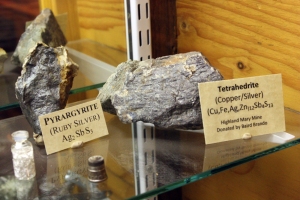
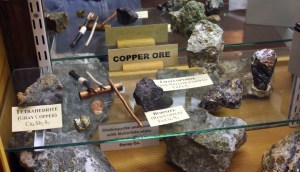
Copper ore on display in the Silverton, Co. museum.

Copper ore on display in the Silverton museum.

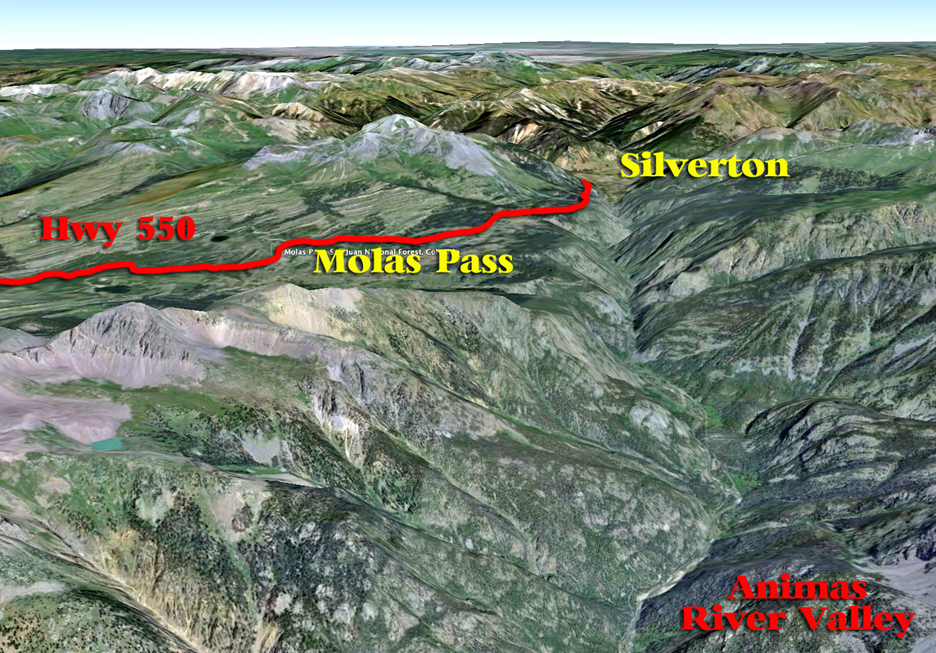
After completing my tour, I drove out of town on Highway 550 and crossed over Molas Pass again, returning to Durango for the third time in five days. I did stop at the train station one last time, but they still had not seen my hat. Oh well! I drove on out of town on Highway 160 toward Pagosa Springs.

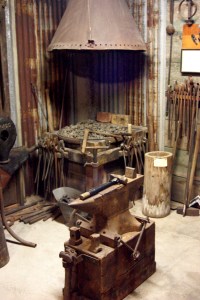
Typical mine blacksmith shop, recreated in the Silverton Heritage Museum.

Typical mine blacksmith shop, recreated in the Silverton museum.

It was a pleasant drive, threatening rain but never more than a light drizzle. It’s about 60 miles from Durango around to Pagosa Springs, which surprised me for being such a large town. I didn’t stop to explore, as I was already behind schedule to get to my camp for the night. It must have a fairly large airport judging from the midsized jet I saw taking off.

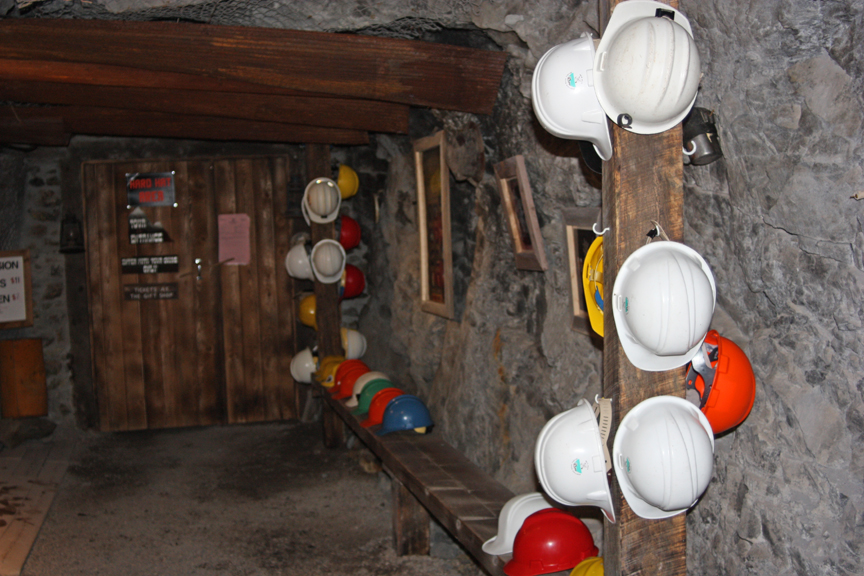
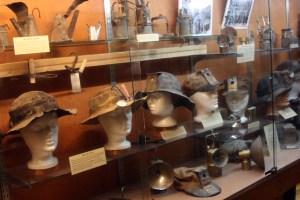
Progression of miner's hats and lamps.

Progression of miner’s hats and lamps.

Highway 160 continued on to Wolf Creek Pass. I stopped at a scenic pullout along the switchbacks leading up to the pass and could see a long way down a glacial valley to the west. This is the site of one of the old songs by C. W. McCall, called “Wolf Creek Pass.” The song follows the misadventures of truck driver Earl and his companion, whose 1948 Peterbilt 18-wheeler goes out of control driving down Wolf Creek Pass, until they crash into a feed store in Pagosa Springs, losing most of their cargo of chickens along the way.

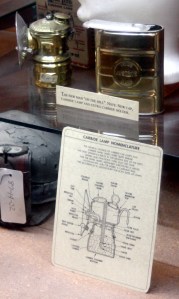
Miner's carbide lamp and cross-section diagram.

Miner’s carbide lamp and cross-section diagram.

I looked at Earl and his eyes was wide

His lip was curled, and his leg was fried.

And his hand was froze to the wheel like a tongue to a sled in the middle of a blizzard.

I says, “Earl, I’m not the type to complain

But the time has come for me to explain

That if you don’t apply some brake real soon, they’re gonna have to pick us up with a stick and a spoon…”

(“Wolf Creek Pass” written by Bill Fries and Chip Davis, sung by C.W. McCall)

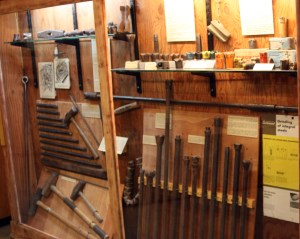
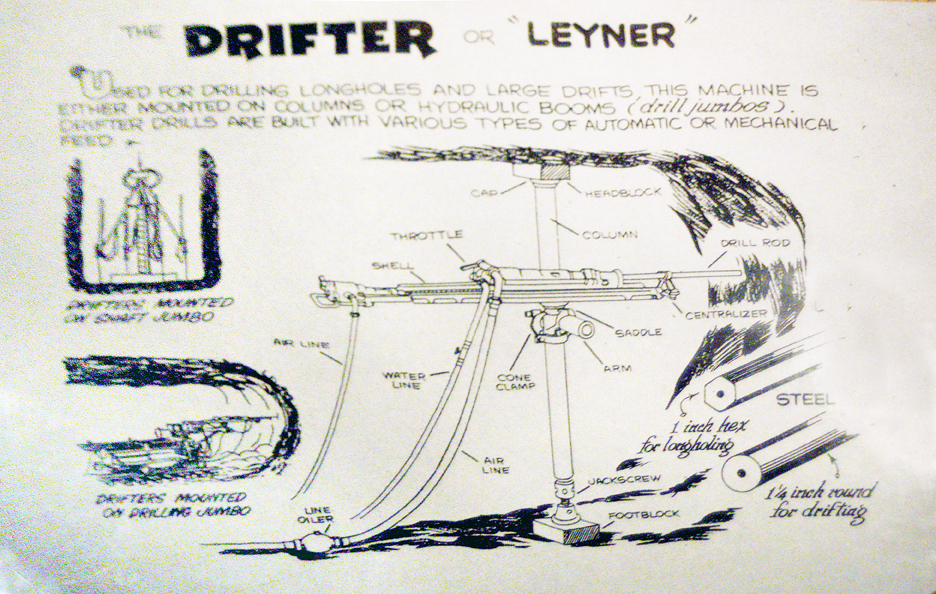
Drill steals, including single and double jacks and Leyner drill bits.

Drill steals, including single and double jacks and Leyner drill bits.

Interestingly enough, another song by C. W. McCall is entitled “Black Bear Road” and talks of the legendary jeep route between Telluride and Ouray. Since I started out in Ouray this morning, I’ve definitely been in C. W. McCall country.

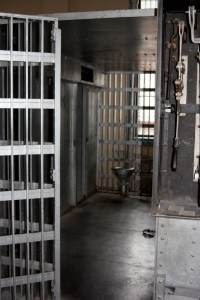
Jail cell in the old Silverton, Colorado jail.

Jail cell in the old Silverton, Colorado jail.

But the funny thing is, C. W. McCall never existed. It was a pseudonym of songwriter Bill Fries who, along with Chip Davis, worked for an advertising company in Omaha. They were hired to do a marketing campaign for the Metz Baking Company, which made Old Home Bread. They came up with a trucker named C. W. McCall who delivered Old Home Bread to the Old Home Filler-Up and Keep On a Truckin’ Café, where he meets with waitress Mavis Davis. The commercials were a big hit and won the Clio Award. Bill and Chip decided to take the C. W. McCall persona on the road, and released several “outlaw country” albums. In 1976 they ignited the citizen band radio craze with the song “Convoy,” which earned them a gold record.

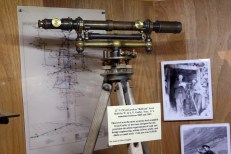
Mine engineer's surveying transit.

Mine engineer’s surveying transit.

While on the road, Chip began experimenting with a fusion of medieval music with modern instruments and synthesizers and created the group called Mannheim Steamroller. The first album was rejected by all the major record labels, so Chip set up his own record label called American Gramaphone. Their Fresh Aire albums, especially the Christmas albums, are still among my favorite.

1930s photo of Silverton, Colorado with a large mill complex in the background.

1930s photo of Silverton, Colorado with a large mill complex in the background.

Bill Fries eventually moved to Ouray, Colorado and was elected mayor there in 1986.

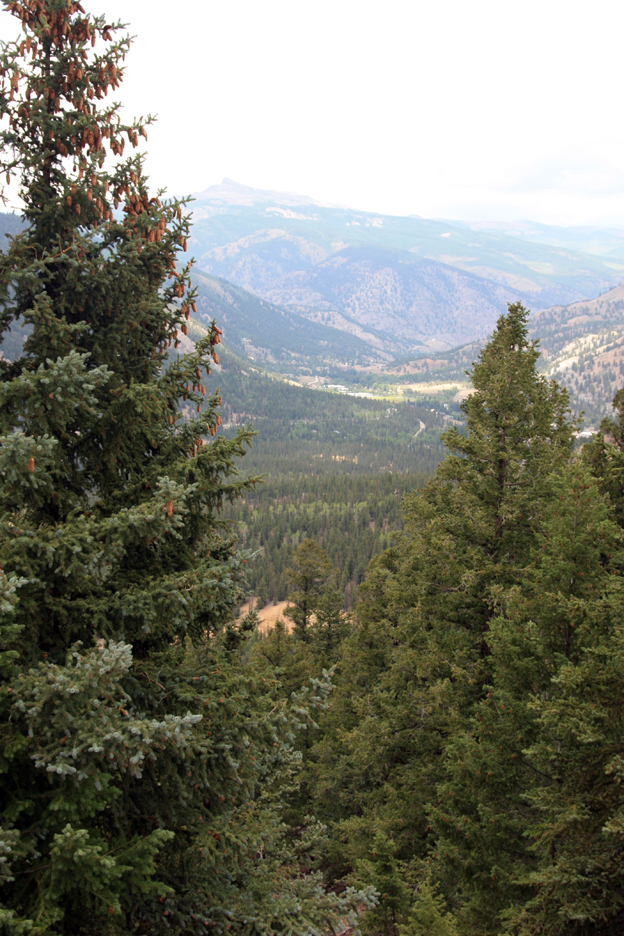
View from Wolf Creek Pass toward Pagosa Springs.

View from Wolf Creek Pass toward Pagosa Springs.

It was raining a bit more heavily as I crossed over Wolf Creek Pass but lightened up as I headed down into South Fork. I had a reservation at a large RV park a short distance up Highway 149. I had set up the reservation long before I had the trouble with my tire and had to modify my itinerary; originally, I was going to come in from the north on Highway 149. Fortunately, even though I was late, the manager was still in the office making bread for a bake sale in the commons room. My camping spot was right next to this room and the spot was so narrow my tent was literally wedged between the building and my neighbor’s pop-up tent. I covered my tent with a tarp in case of rain and to keep out the bright light on the side of the building. I ate supper, got my electronics charged up, uploaded my photos, and slept well despite the light.

Sign near the Silverton Museum detailing the history of the area.
Sign near the Silverto museum detailing the history of the area.
Read Full Post »

Howardsville

Howardsville, Colorado on the Animas River.

So far on my tour through Colorado’s mining history, I have reported on how the ore was mined. Today, I got the chance to see how the ore was transported and processed at a mill. After completing my tour of the Old Hundred Mine near Silverton, I drove back down Stony Creek to where it joins the Animas River at a place called Howardsville, where some mining operations were still evident.

Arrastra Gulch

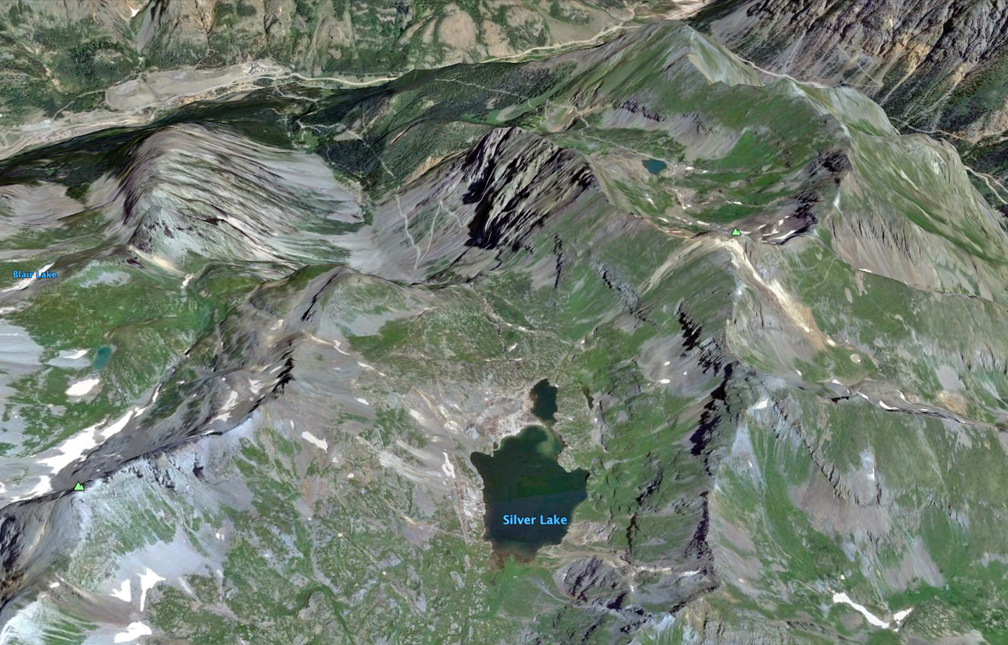
Google Earth view of Arrastra Gulch and Silver Lake. The Mayflower Mill is located at the bottom of the gulch in the upper left corner.

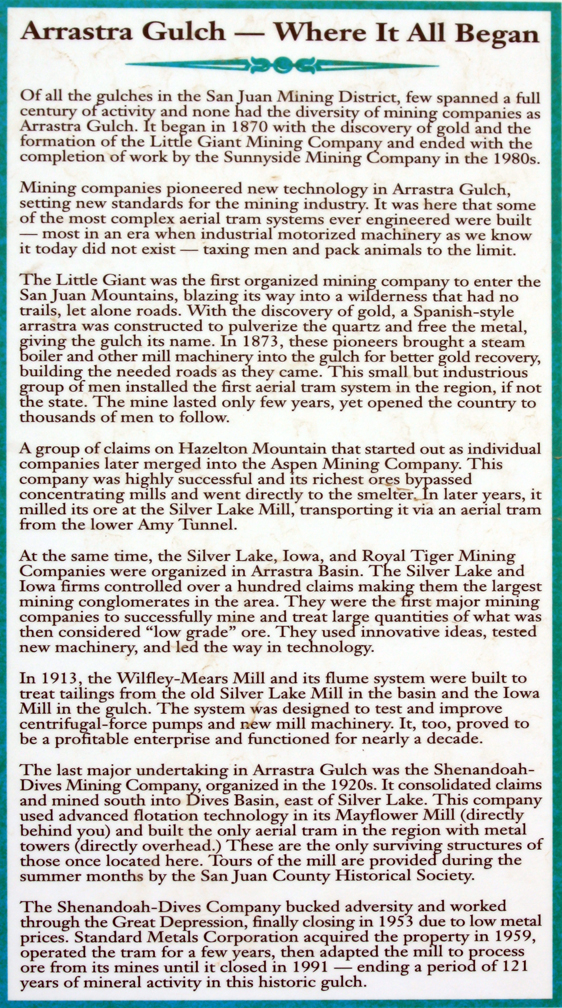
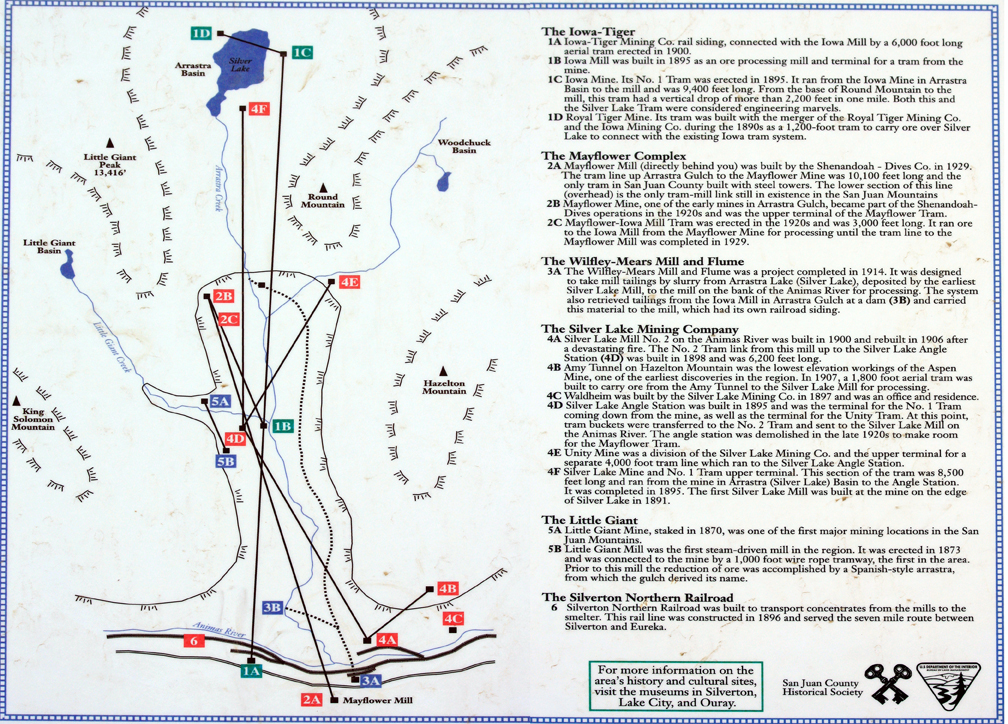
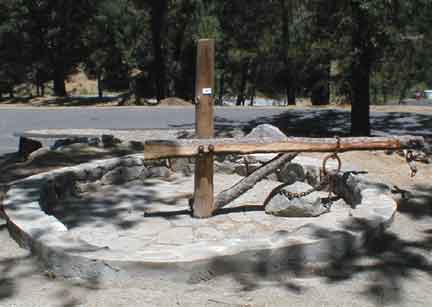
I stopped along the way toward Silverton at the base of Arrastra Gulch. This is the location of the main mining area around Silverton and one of the richest deposits in all of the San Juan Mountains. Before a proper mill could be built to process the ores, a Spanish-style arrastra was built here, which is a circular area with a flat stone floor and a central post with arms coming out. Each arm had a heavy stone or iron weight that hung from it and which would drag over the ore and crush it. Mules, donkeys, or even humans would be used to push the arms around in a circle. Once mills were built, the ore was transported to them from Arrastra Gulch and the high glacial circque above it (around Silver Lake) by tramlines or flumes. At one point as many as four separate overlapping trams were operating.

Arrastra Gulch marker panel a

Arrastra Gulch marker Part 1

The largest mill in the area was the Mayflower Mill (also known as the Shenandoah-Dives Mill) about two miles northeast of town. It was built in 1929 to process gold, silver, zinc, lead, and copper ores. Another large mill nearby was the Silver Lake Mill on the Animas River.

arrastra trams

Map of aerial trams in Arrastra Gulch near Silverton, Colorado.

Built of pre-framed Oregon fir and completed in six months for $373,000, the Mayflower Mill began processing ore in Feb., 1930 and continued in operation for 49 of the next 61 years, finally closing down in 1991. It is in fact still capable of operation, and all the original equipment is intact. The historical society allows self-guided tours that start in the machine shop, then move to the tram station, ore storage bins, ball mills, flotation cells, recovery system, assay office, etc.

Arrastra

A restored arrastra in Groveland, California. Heavy rocks were dragged around in a circle to crush ore.

It was an extensive operation, the biggest in the San Juan Mountains, and employed the latest technologies available in 1929, including the new techniques of ball mill crushers, froth flotation of sulfide ores, and recovery of base metals as well as gold and silver. These techniques are still used today in such places as the concentration plant at Utah’s Rio Tinto/Kennecott Copper operation, although the scale there is enormous.

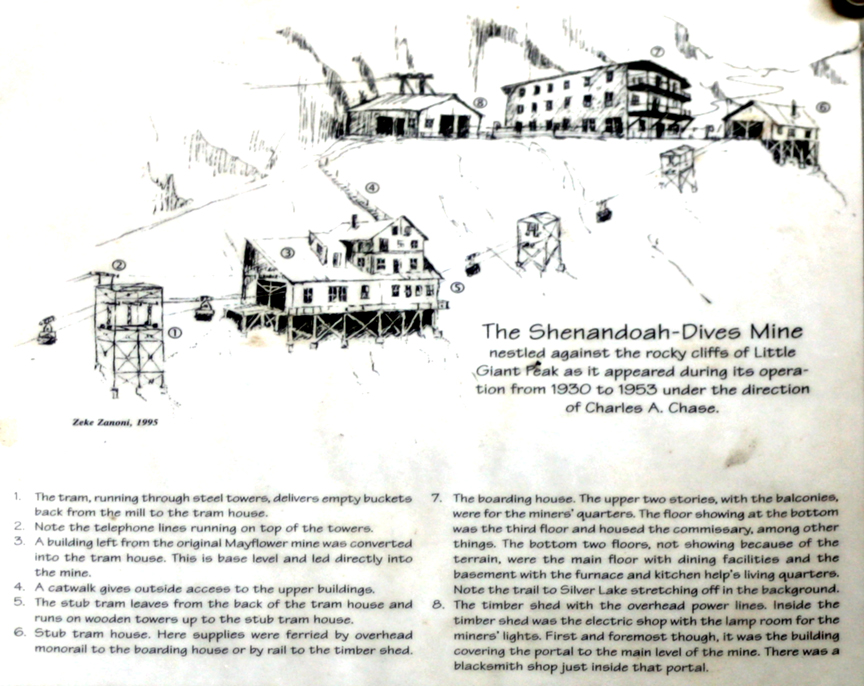
Shenandoah-Dives mine

A sketch showing what the Shenandoah-Dives mine looked like during the 1930s. The aerial tramline connected with the Mayflower Mill.

For its 61 years of operation, it processed over 9,700,500 tons of ore to produce 1,940,100 ounces of gold, 30,000,000 ounces of silver, and over 1,000,000 tons of base metals.

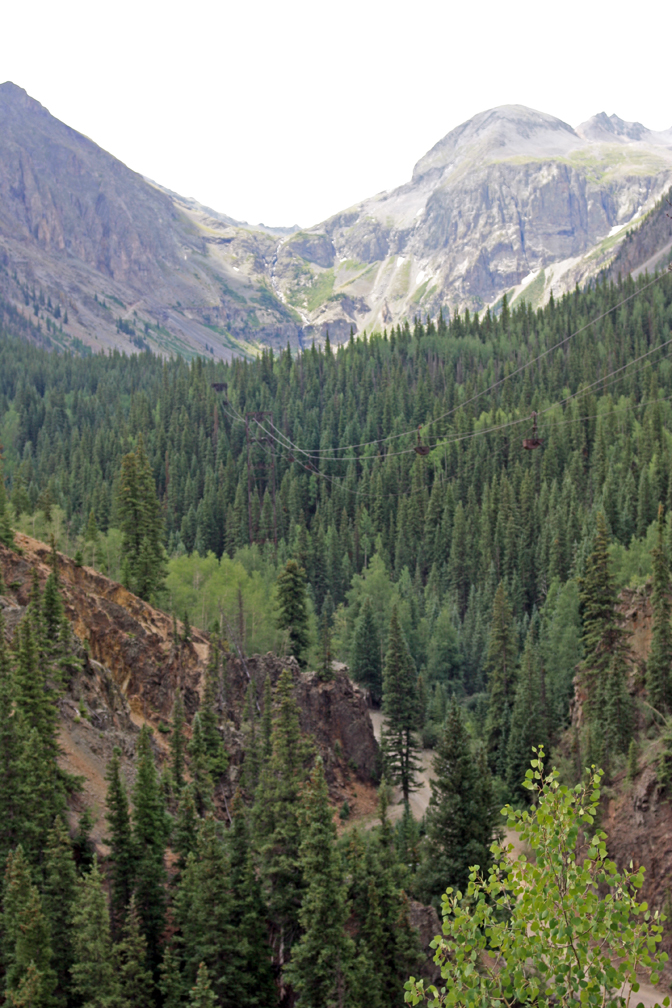
Tramway in Arrastra Gulch

The aerial tramline connecting the Shenandoah-Dives Mine above Arrastra Gulch with the Mayflower Mill. The gulch is the canyon in the foreground, and the high circque is the basin around Silver Lake.

I used my camcorder to create a complete walkthrough of the mill, going in order from start to finish. At each stop I would stop the tape and take photos as well, and took my time to document everything. There were interpretive signs at each stop explaining what each piece of equipment did. Here is a rundown:

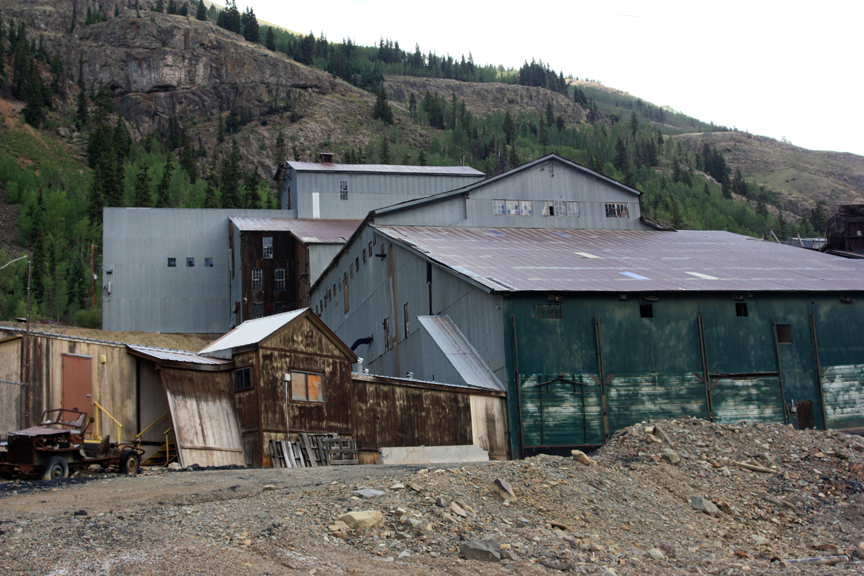
Mayflower Mill

The Mayflower Mill near Silverton, Colorado. A self-guided tour is available during the summer.

Processing Ore

The ore coming from the mines was about 5% metals and 95% waste rock (tailings). The metals have to be separated out, and this is done in stages so that all the metals (gold, silver, copper, lead, and zinc – the big five) could be individually removed and purified. This is done in three main steps: crushing, separation or reduction, and purification. The final step was done by a smelter off-site, but the first two steps were done at the mill.

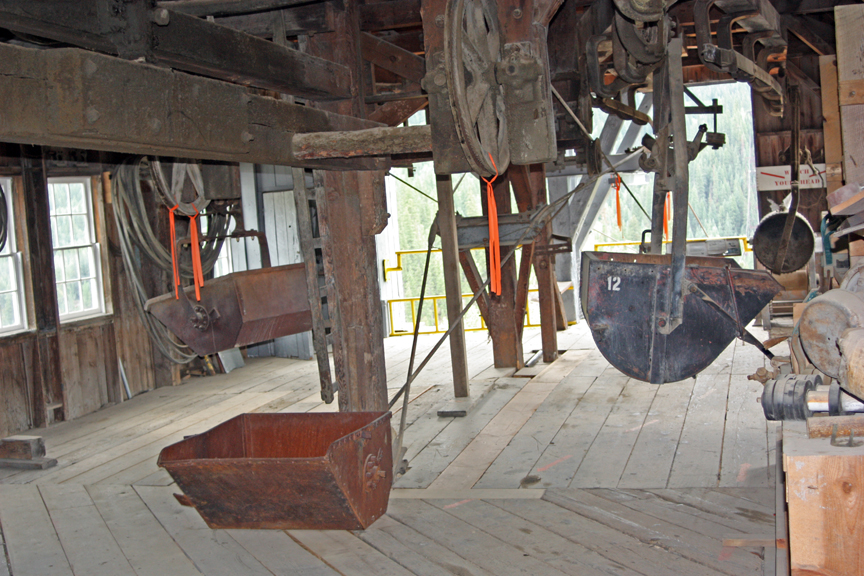
tram station

Tram station at the Mayflower Mill. Full buckets descended from the mine by gravity, which also pulled the empty buckets back up.

The ore arrived in large open buckets by tramline. Gravity brought the ore down and allowed the empty buckets to move back up the loop. The ore was brought into the mill at the tram station and dumped, then transported by conveyor belt to the cone crushers. It was screened for size, and if too big would be returned to the crushers.

cone crusher

Cone crusher at the Mayflower Mill. It would crush the ore between rotating cones until it was pebble sized.

Once it was pebble sized, it would be transported to the Fine Ore Bin, which would hold 1200 tons of ore, enough for one full day of operation. The ore was then transported out of the bottom of the bin and mixed with water to form a slurry, then passed through a rod mill (which used long iron rods rolling around) where the ore was further crushed to a fine powder and sorted by a spiral classifier, an auger-like device that pushed the ore upward. If the ore was fine enough, it was pushed all the way to the top – if not, it would fall back down and be returned to the rod mill for further crushing.

rod mill

Rod mill at Mayflower Mill. Iron rods were fed into the mill, then allowed to roll around inside to crush the ore to the size of sand grains.

The powder, now the consistency of sand, was passed through a ball mill, with 2-3 inch diameter iron balls rolling around to crush the ore even finer. These balls were added frequently during the day through pipes from a ball bin. Now the ore was now the consistency of talc and fine enough to start to separate.

Spiral classifier

Spiral classifier at the Mayflower Mill. Ore slurry from the rod mill would be pushed up the spiral. If it was fine enough, it would be pushed over the top. If not, it would return to the rod mill.

The first metal to be separated was gold, using a system of settling jigs that pumped the ore through, allowing the heavier gold particles to settle out through vibration and suction. The lighter remaining material was passed on to flotation cells, where reagents and flocculents were added that would float the desired metals to the top of the tank solution while depressing or sinking the other metals. Lead was removed first, then copper, and finally silver and zinc removed in large tanks. The soapy bubbles would simply be skimmed off the top of the cells.

Ball mill

Ball mill at the Mayflower Mill. Ore crushed to the size of sand grains would enter the rotating drum and be crushed to powder by 2-3 inch iron balls.

The flotation cell solutions were then passed through filters with pumps that pushed the water through, drying out the solution to a damp cake-like material that was then shipped to a smelter for final refining, where it would be heated to drive off the sulfides. Each day, samples were removed and filtered through a squeeze press, then sent away to an assayer to determine the percentage of metals in each day’s run.

gold jigs

Gold jigs at the Mayflower Mill. Using air pressure, the lighter ore powder was suctioned away from the heavier gold particles.

Meanwhile, the gold filtered out by the jigs was sent through a concentration process. It would be passed over a shaking Deister table where the gold would be caught by riffles and formed a streak to be collected. It was mixed or amalgamated with mercury to remove the gold from the remaining waste ore. The amalgam was then formed into rounded boats or cakes and heated in a retort at 1200 ° F for 12 hours to evaporate the mercury, which was bubbled through water to condense it for reuse. The remaining gold was now called “sponge” and was about 80% pure. It would be sent off to a foundery for final purification. Four to five sponges would be produced each week. Each sponge weighed about 22 pounds. During the last year of the  mill’s operation (1991), a new process was developed that eliminated the need for mercury (which was highly toxic).

Lead cleaner cells

Lead flotation tanks at the Mayflower Mill. Reagents were added that would float the various metals, such as copper or lead, to the top of the liquid on soap bubbles which were skimmed off into the trough in front. The remaining metals were depressed to the bottom. Impellers would keep the solution agitated while blowing air through it.

Once processed, the waste material is called tailings and was made up of water and sandy ground rock. It was pumped down to settling ponds, where the solid tailings would settle out. This was an innovation of the Mayflower Mill, as previously the tailings would simply be allowed to flow into the Animas River. The high sulfur and iron content in the tailings would travel down the river and created the reddish stains on the rocks that I noted on my train trip up the gorge several days ago. At the Mayflower Mill, the ponds were shifted so that the solid tailings would build up a series of mounds downhill from the mill. These have now been collected into a large tailings pile near the mill.

Deister table

Deister table at the Mayflower Mill. It would shake, causing the gold particles to separate out against the riffles.

I found this self-guided tour to be fascinating from a chemistry perspective. The mill used a system of physical separations to crush, concentrate, and amalgamate the ore. The final smelting used a system of chemical separations. It is a perfect example of a chemical engineering process, and was continually upgraded and improved during its 61 years in operation. The mill could be run, during the night shift, with only three people. During the day there were additional people to do repairs and take samples, to run the gold process, and to run the machine shop. Shift supervisors oversaw the operation from the dog house, one man ran the crusher facility, and one man ran the flotation cells. This was the biggest operation of its kind in southwest Colorado and processed more ore than any other mill in the area.

gold sponge

A model of what gold sponge looked like after being removed from the retort furnace. The holes in it are caused by mercury vapor bubbling out.

Retort furnace

Retort furnace and gold button mold at the Mayflower Mill. The gold particles would be amalgamated with mercury, then heated in this retort furnace to drive the mercury off.

Read Full Post »

red mountain reflection

The Red Mountains near Ouray, Colorado.

My original plans for this fifth day in Colorado’s mining towns was to drive north on Highway 550 to Montrose, then east on U. S. 50 and south on Highway 149 to Lake City and eventually Creede. But having to detour two days ago to Farmington, New Mexico to pick up a used rim for my minivan made it necessary to drive through Silverton without stopping. I did some quick calculating and found an alternate route that would allow me to hit all three places (but it would mean missing Alamosa and Great Sand Dunes National Park and having a very long day tomorrow). Since my trip is mostly about the history of mining in Colorado, I chose to take the alternate route. Alamosa will have to wait for another trip.

I packed up and ate some doughnuts and other supplies I had that were still good. The ice in my coolers had long since melted and things were beginning to go bad. I videotaped some panoramic shots along Ouray’s main street and talked for a few minutes with a Native American wearing a veteran’s hat, whom I had seen around town. He had been to Provo and enjoyed visiting the national parks in Utah.

Mining at Red Mountain 2

Mining ruins near Red Mountain #2, near Ouray, Colorado.

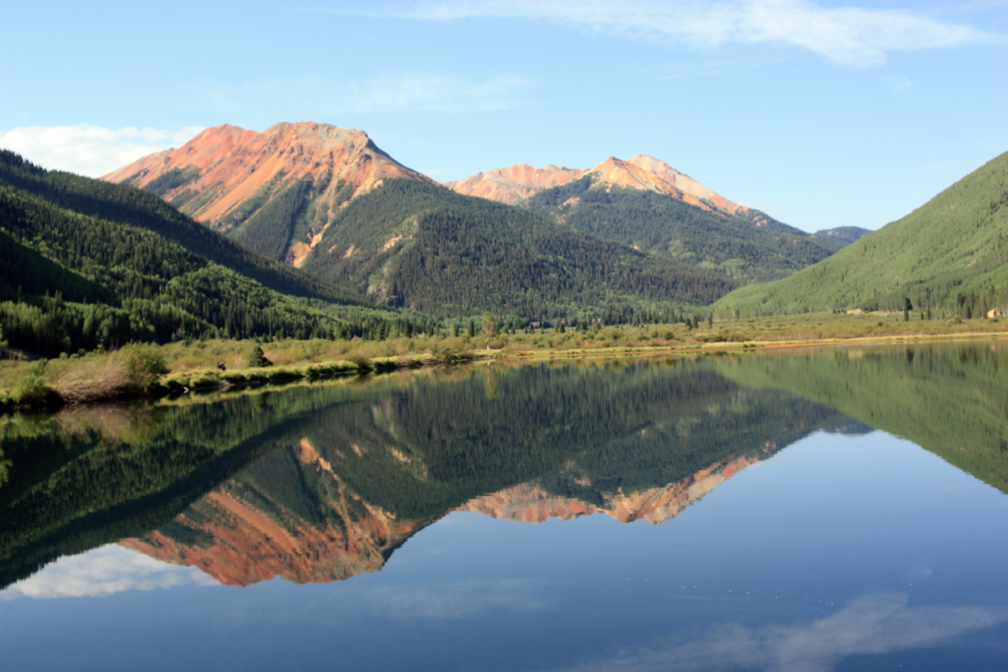
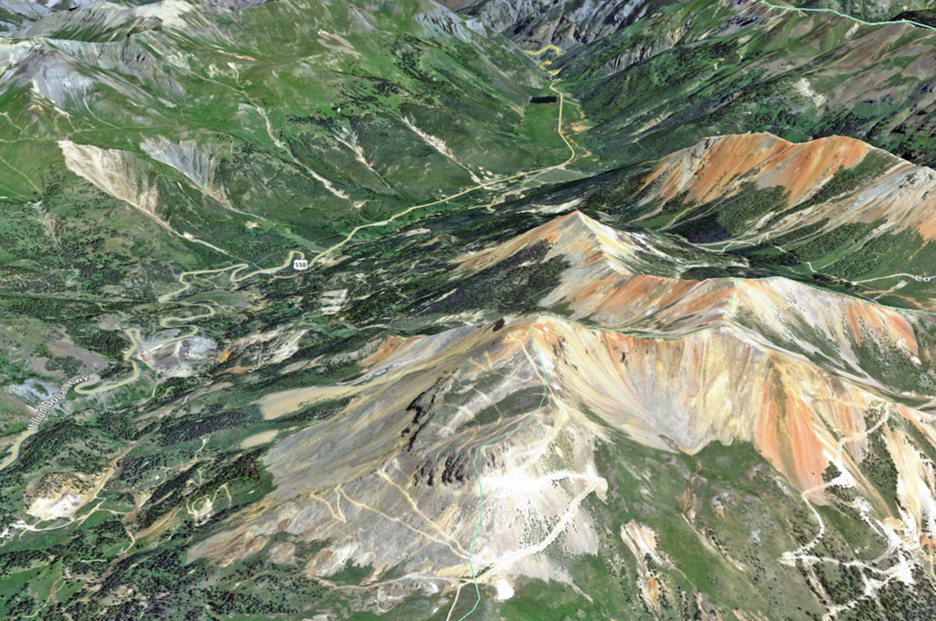
I drove out of town south on Highway 550, stopping to take photos of the Red Mountain peaks reflected in a small lake, as well as some mine structures I’d missed on my way in two days ago. Once over the top of the pass, I pressed on through Silverton, talking a gravel road out of town to the northeast toward Engineer Pass and Lake City, then southeast through a narrow river valley (Cunningham Gulch) to the Old Hundred Mine at the base of Galena Mountain. I arrived just at 10:00 in time to take the first tour.

Old Hundred mine location

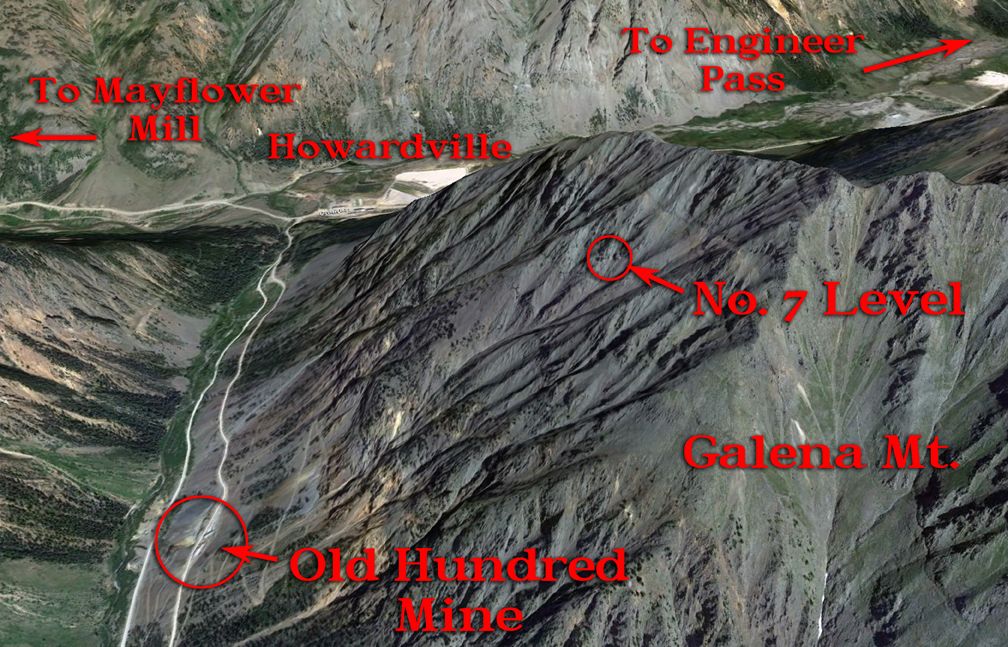
Location of the Old Hundred Mine on Google Earth.

The Old Hundred Mine

This mine was named after the 100th Psalm, where it says: “Make a joyful noise unto the Lord, all ye lands.” No doubt the prospectors who found this deposit made a very joyful noise! Galena Mountain was laced with veins of rich silver-lead-gold ore, and the Niegold brothers (Reinhard, Gustave, and Otto) staked claims on some of the richer veins in 1872. About 300 feet from the top of the mountain, they located the best vein of all at what came to be called the Number Seven Level. Other veins were located further down. The mountain was so steep that mining the higher levels was very difficult – supplies and equipment had to be lowered from the top of the mountain and ore removed on ropes to the bottom level. A small town grew up at the bottom with a hotel, a saloon, a post office, and cabins for the miners. It was called Niegoldstown. Well-educated and classically trained, the Neigold brothers would entertain the miners during the long winter months with music, operas, and plays.

Change room of Old 100

In the change room of the Old Hundred Mine.

In 1904 additional investment built a trail that winds its way around and up to the Number Seven Level, where a boardinghouse with bunks and a tram station were built perched on the side of the cliff and anchored by cables to the cliff face. A tram station was also built at the bottom of the mountain, and massive foundations poured for a stamp mill to process ore. A long adit was blasted into the mountain just above the mill level with hopes of reaching deeper veins inside the mountain.

Entering the Old Hundred Mine

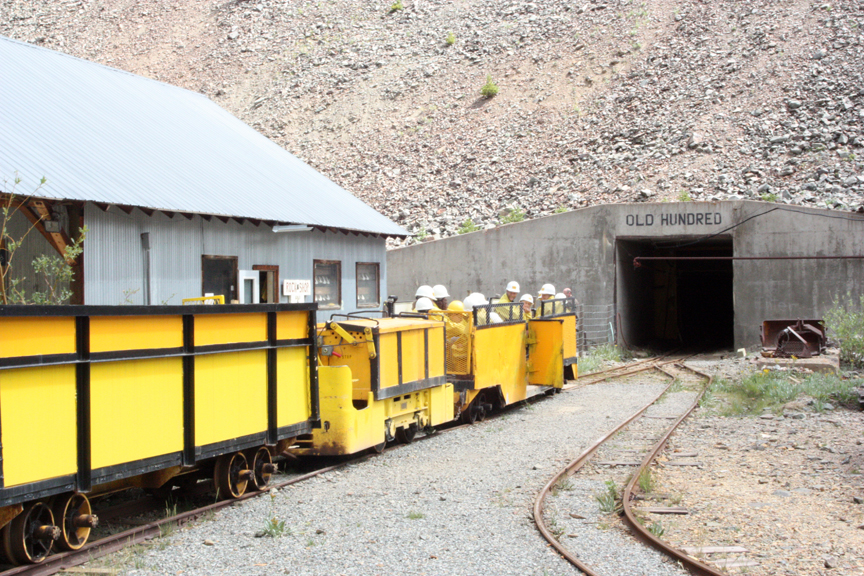
Entering the Old Hundred Mine on an electric tram.

The boarding house still stands on the side of the mountain. Damaged by deep snows in the winter of 1983-84, the roof has been repaired and the boardinghouse and tram station stabilized by some very brave carpenters and helicopter pilots.

Inside the old hundred mine

Inside the Old Hundred Mine; near Silverton, CO.

The bunkhouse was built to house 40 miners and a cook. Miners would stay there for two weeks at a time, with two shifts rotating through the bunks. When they got their pay after two weeks, they would either take a slow mule down the steep trail (just wide enough for two mules to pass each other and much narrower than that now) or ride the tram buckets down. In Silverton, they would spend their money on gambling, whiskey, and women and head back to the mine after the weekend dead broke. Some miners had better sense, saving up money to send for their families in Cornwall or Ireland or elsewhere.

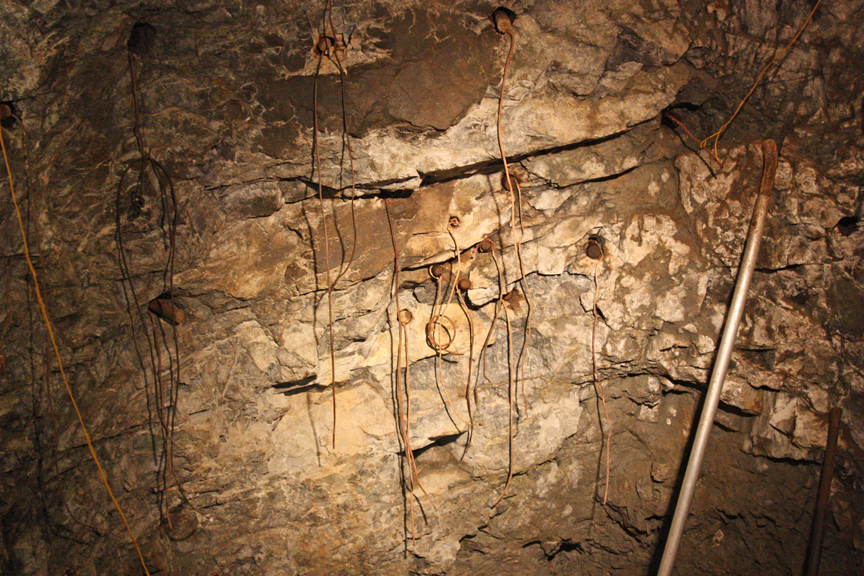
Charges on the face

Charges set to blast the face at the Old Hundred Mine.

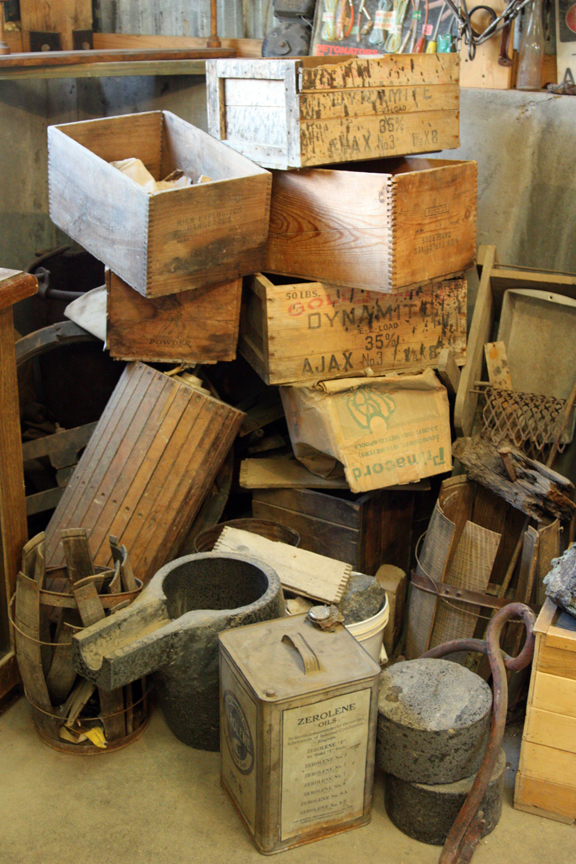
Dynamite in Old Hundred Mine

Dynamite boxes at the Old Hundred Mine

With the improvements made, mining continued in earnest. Over 16,000 ounces of gold was removed from the mountain by 1908, but then the veins dried up. The panic of 1907 also dried up the money for further investment, and the property defaulted back to the Neigold brothers. Eventually the mine was lost to back taxes, and the last of the brothers died in 1927.

Old Hundred mucker

A working mucker inside the Old Hundred Mine.

Other owners worked the mine sporadically until 1967, when the Dixilyn Corporation brought new investment. The Mill Level Tunnel was continued over 5000 feet into the mountain and other levels were also extended and connected. A modern mill was built with better techniques for processing the low-grade ore, but the mine remained unprofitable. By 1973 it was finally realized that the deeper veins just weren’t there. The buildings and mill were torn down and sold for scrap. To find out more about the history of the Old Hundred Mine, go to: http://www.minetour.com/history.php.

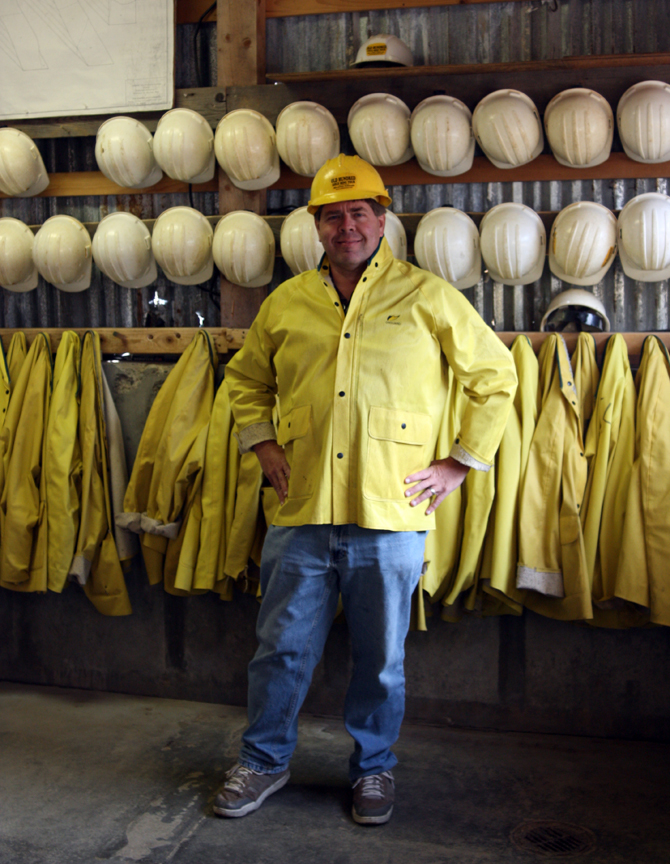
For our tour, we donned hard hats and slickers, then boarded an electric tram and travelled deeply into the Mill Level adit. There is something a bit spooky and exciting about zipping along a railroad line underground in an open car. Since this mine only closed in the 1970s, they have kept some equipment inside in working order. Our guide demonstrated a working drill and even a pneumatic mucker, which are not usually available. Lots of old muckers are found with the rust painted over as standing displays outside of the mines (including some at this mine), but this is one of the only times I’ve seen one actually working.

No 7 level painting

Painting of the No. 7 Level at the Old Hundred Mine.

No 7 level

Number 7 Level above the Old Hundred Mine.

The tour was truly enjoyable, and I would recommend it as one of the best in Colorado, along with the Mollie Kathleen Mine tour in Cripple Creek. Our guide was knowledgeable and he gave us a good explanation of the technologies and history of the mine. Running my HD camcorder to record all that the tour guide said meant I couldn’t take many photos during the tour itself and some were taken rather hastily and turned out blurry in the darkness. After the tour I took photos around the mine entrance and of the boardinghouse high above us on the cliff. I also bought a used hard hat in the gift shop to add to my collection.

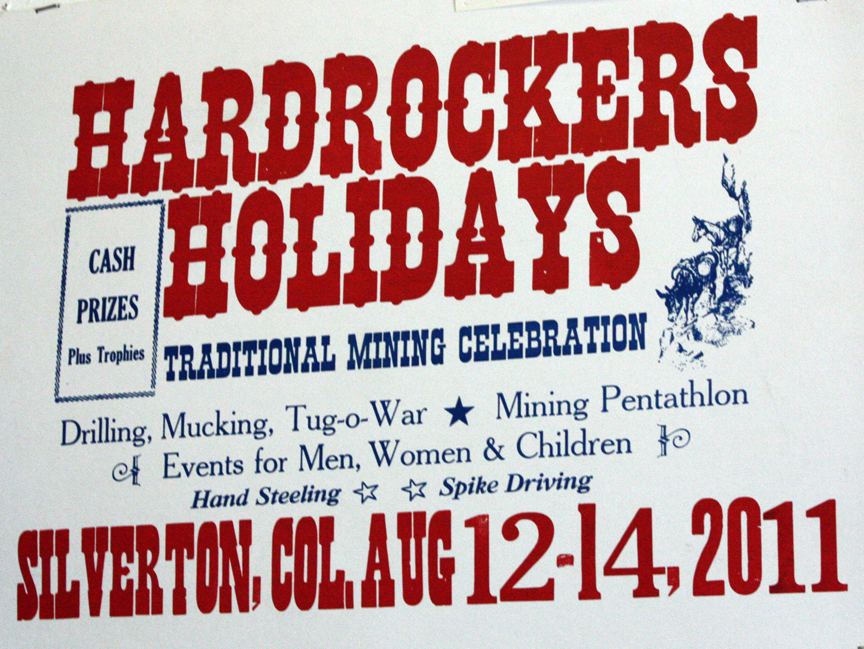
Hardrock holidays

Poster for the annual Hardrock Holidays celebration in Silverton, CO.

Read Full Post »

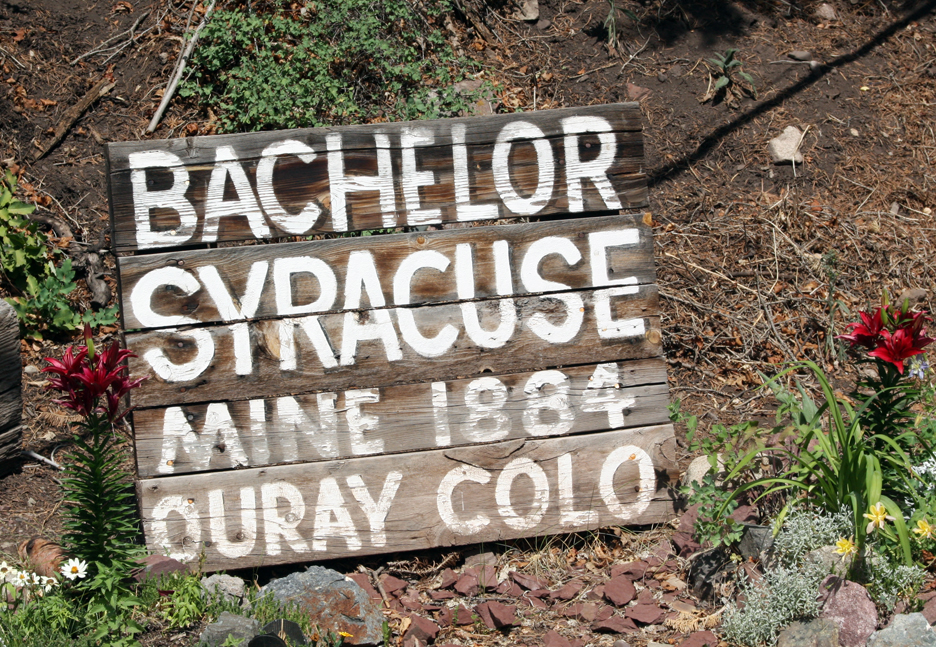
sign for bachelor mine

Sign for the Bachelor-Syracuse Mine in Ouray, Colorado.

Two posts ago I outlined my jeep tour up into the San Juan Mountains of Colorado around Ouray to visit Yankee Boy Basin and the Camp Bird Mine. Now, let’s move on to what I did during the afternoon on Day 4 (Thursday, July 12, 2012) of my journey through Colorado’s mining history.

The Bachelor-Syracuse Mine

Bachelor mine tour

Touring through the Syracuse adit.

I returned to my room after the jeep tour to recharge my electronics and to rest my spine. I then found a fun hamburger joint in town on Main Street for lunch, and drove north about a mile to the turnoff to Country Road 14 to Gold Hill and the Bachelor-Syracuse mine. This was the first actual mine tour on my trip.

change room at the bachelor mine

Change room at the Bachelor-Syracuse mine.

During the main silver rush in Ouray (1876 to 1893) most of the silver mines were located up Box Canyon, up Canyon Creek in Yankee Boy and Imogene Basins, and around Ironton and Gastun to the north of Ouray. One other area was north of Ouray around what became known as Gold Hill. There was enough gold at the site to survive the Silver Panic of 1893. The Bachelor mine was claimed in the early 1890s by three bachelors, C.A. Armstrong, Frank Sanders, and George R. Hurlburt. Seeing as how none of them were attached, they settled on the name Bachelor Mine. It was a high producer and eventually bought out other claims in the area. The main shaft drilled downward from the top of the hill and eventually reached over 2000 feet into the mountain. As the shaft got deeper, ground water began to flood the mine and it became increasingly expensive to haul every ore bucket up out of the mine through the shafts to the top of the hill. A drainage adit was drilled from the east, which allowed the mine to go even deeper. In the 1920s, another adit was needed to come in from the west into the bottom of the mountain to drain deeper water and allow the ore to be removed more easily. It was hoped that the adit would pay for itself by encountering new ore bodies along the way, and it was named the Syracuse Tunnel since the money to build it was raised mostly in Syracuse, New York.

portal of syracuse adit

Portal of the Syracuse adit and entrance to the Bachelor Mine.

Today, the mine tour goes in through that adit. The electric tram that used to carry in miners and then tourists has been shut down, so that we had to walk in about 1500 feet after donning hard hats. When the tram was running, the tour went in 3500 feet, but this deeper tour is no longer allowed for safety reasons. It had been a nice, warm day in Ouray with a few rain sprinkles, but it felt good to walk into the cool mine with temperatures in the 50s. It was fairly damp inside, with water dripping from the ceiling in places. Even now, a steady stream of water drains out of the mine in a ditch to the right of the tracks.

They showed us how the pneumatic drills were used to hammer out a series of holes in the face following a pattern of concentric circles. The guide actually turned on the drill for a few seconds, which was very loud in such a confined space. In addition to getting rocked up, old time miners often went deaf as there was no hearing protection used.

Mucker at the bachelor mine

Mucker at the Bachelor-Syracuse mine

Since I was recording the tour with my HD videocamera, it was difficult to take still photos at the same time. I will eventually capture still frames from the video and add to this post, but for now you’ll have to make do with photos from the outside. I found that the headlamp I had purchased to provide more light for my camera worked fairly well. Between trying to point my head in the right direction to provide light for my camera and looking through the LCD screen as I was trying to walk made for several bumps of my head on the ceiling (hanging wall), especially in the side drifts. I’m glad we wore hard hats.

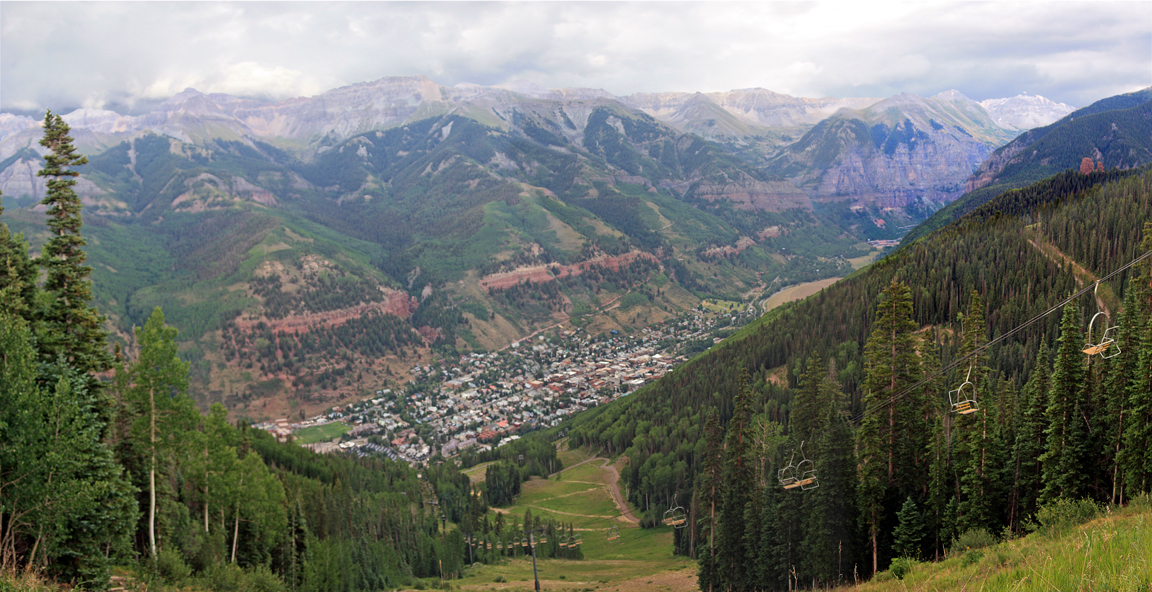
Telluride panorama

A panorama of Telluride taken from the top of the gondola lift.

Telluride

After the tour, I took a few photos outside, then drove on to the north on Highway 550 to Ridgway, then turned west and eventually south, then back east again on Highway 145 to reach Telluride. Although only about 10 miles from Ouray as the crow flies (right over the route I took this morning on the jeep tour), it takes about 50 miles to go around on passable roads. Imogene Pass can be taken in between, but only in a 4 x 4. Then there’s Black Bear Pass, the most dangerous pass in Colorado. Someday maybe I’ll be back and try it, but absolutely not in a minivan.

Water cannon

Water cannon nozzle used for hydraulic mining near Telluride, Colorado.

On the way into Telluride, I stopped at an overlook that described how mining was done in the lower parts of the San Miguel Valley. Gold was scattered here in the gravel bars along the river, and early panning was unable to reach the deeper grains. Hydraulic cannons were installed to wash the gold out of the gravel. Water from upstream was diverted into ditches that became progressively more narrow and steep, putting a great deal of pressure on the water. Finally, it would be directed through a moveable nozzle at the gravel beds to wash the gravel and gold away. This slurry was collected in sluice boxes and riffle beds where the gold particles would settle out. It was effective and cheap, but it left lasting scars all along the riverbed. Since all the topsoil was also washed away, the scars remain to this day since nothing can yet grow there. Hydraulic mining was also used in the California gold rush; It is especially bad along Highway 149 in Mariposa County.

Geology of Telluride area

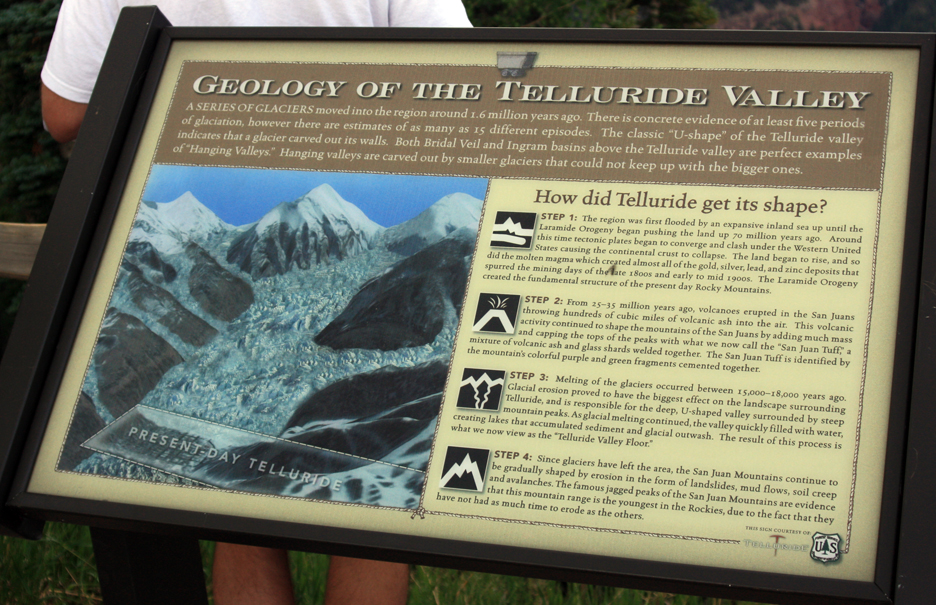
Geology of the Telluride, Colorado area.

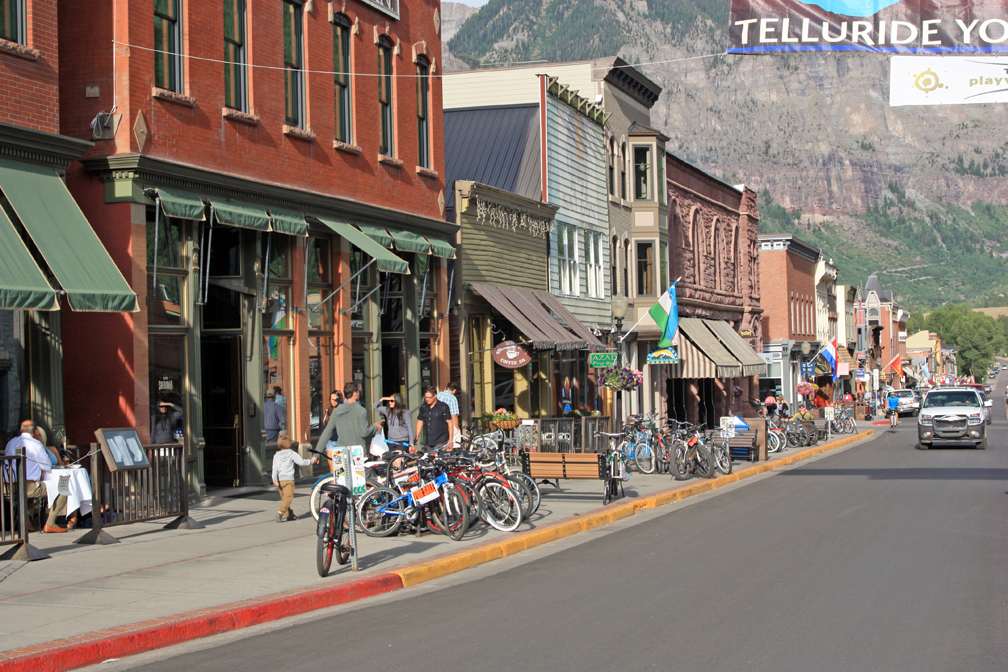
Telluride is a former mining town that has gotten developed into a ski resort and tourist attraction, which was good for business but not so good for history. Most of the mine dumps and infrastructure have gotten erased to make way for ski slopes. Some of the original buildings remain, but it is hard to tell which are which since modern buildings were designed to match the original 1890s style. Much of the main mines, such as the Pandora, were further up the box canyon from Telluride and the dumps and tailings piles can’t be seen from town.

telluride from gondola

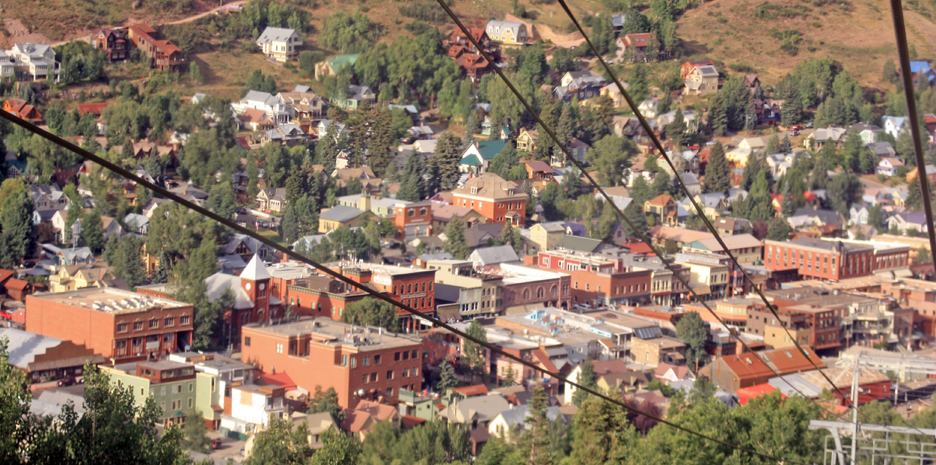
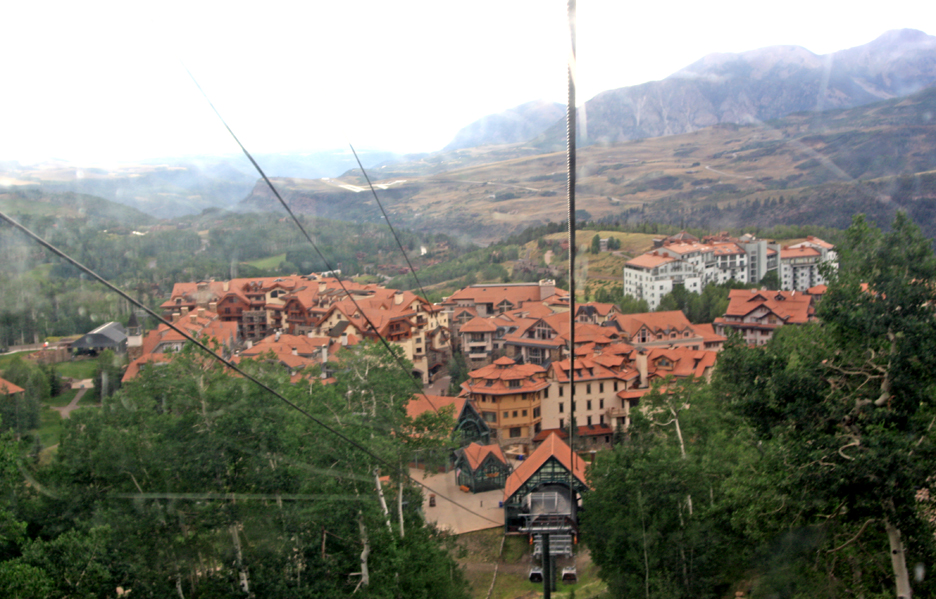
Telluride, Colorado from the gondola.

The first gold was discovered in 1858 in the Marshall Basin above Telluride. The first successful claim occurred in 1875 and the town of Columbia, later Telluride, was founded in 1878. Interestingly, the type of gold in Telluride was not telluride ore (as is found in Cripple Creek). In addition to gold, silver, zinc, lead, and copper were mined. Because of its extreme isolation, Telluride grew slowly until the railroad finally arrived in 1890 built by transportation entrepreneur Otto Mears. At its height in 1900, the population reached about 2500.

Telluride main street

Telluride, Colorado: July 12, 2012.

One of the most historic events in the town was the robbery of the San Miguel Valley Bank in 1889 by none other than Butch Cassidy, his first major heist. He got away with $24,580.

In canyons to the south are the ghost towns of Alta and Ophir. Ophir boasts the first alternating current hydroelectric plant in the world, the Ames Hydroelectric Generating Plant. The second plant in the world was in Telluride at Bridal Veil Falls and served the pumps at the Smuggler-Union Mine. The Ames plant was designed by Nicola Tesla and George Westinghouse and financed by Lucien Lucius Nunn, a prominent Telluride banker. Westinghouse was reputedly paid with a pouch containing $50,000 worth of gold. When first activated, the engineers realized they had a problem: they didn’t know how to switch it off safely. It could only be turned off when the power cycle reached zero or the switchman could get electrocuted. Finally, the power failed when a squirrel shorted out a transformer (which was unfortunate for the squirrel). With the power finally off, the Nunn brothers were able to install a safer switch. Eventually these two plants became the Telluride Power Company.

Mountain Village

The gondola ride continues over the top of the mountain to Mountain Village.

Interestingly enough, all this has a tie in to Orem and Provo, Utah, where I live. The mines in the Tintic Mining District around Eureka, Utah, about 40 miles away, were having a similar problem with water flooding the lower levels, and decided to install electric pumps. The closest reliable water supply was the Provo River where it exits the Wasatch Mountains (about a mile from Walden School of Liberal Arts, where I teach). So the mine owners contracted with the Nunn brothers to build a power plant in Provo Canyon, which was called the Olmsted Station. Not only did it provide power for about 3000 homes (and still does), it also housed an electric power education institute for about 40 students. So as a child growing up in southern Utah, the power company was Telluride Power. It eventually merged with Utah Power and Light. Today there is a park in Provo Canyon near Bridal Veil Falls (just like in Telluride) called Nunn Park.

By the 1930s the mines at Red Mountain Pass (such as the Idarado) had followed the veins toward Telluride and the Pandora, Tomboy, Smuggler-Union, Nellie, and Sheridan mines near Telluride had followed the veins in the other direction. Eventually they met up, and ore and men could be transported underground all the way from Red Mountain Pass to Telluride. The mines were consolidated by 1953. The mill at the Pandora portal continued to process ore until 1978. Fortunately, after mining closed down another business was available: skiing and tourism. With the addition of ski runs, a free gondola connecting Telluride with Mountain Village, and several music and film festivals during the year, Telluride is now flourishing even though it may not have much left of its historic mining flavor.

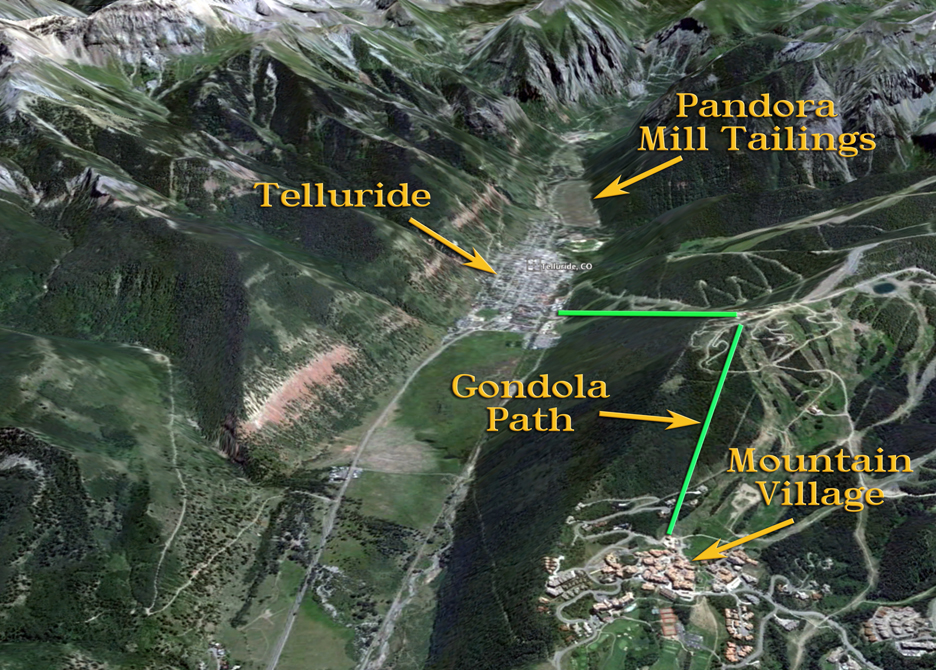
telluride from above

A Google Earth view of Telluride, showing the gondola run and Pandora Mill tailings pile.

I rode the gondola up the mountain and got some impressive views of the canyon below. I walked the streets for a while, then discovered I was starving and ate some excellent Chinese food at a restaurant in town. I tried to talk Chinese to the owners, but no one could understand me except their young daughter. I guess my Chinese is pretty rusty; thirty years ago I was fluent, but not anymore.

I drove back to Ouray and fell into bed after plugging in all my cameras to recharge. I had wanted to go swimming at the hot springs/pool complex north of town but was too tired to attempt it.

Read Full Post »

mucker

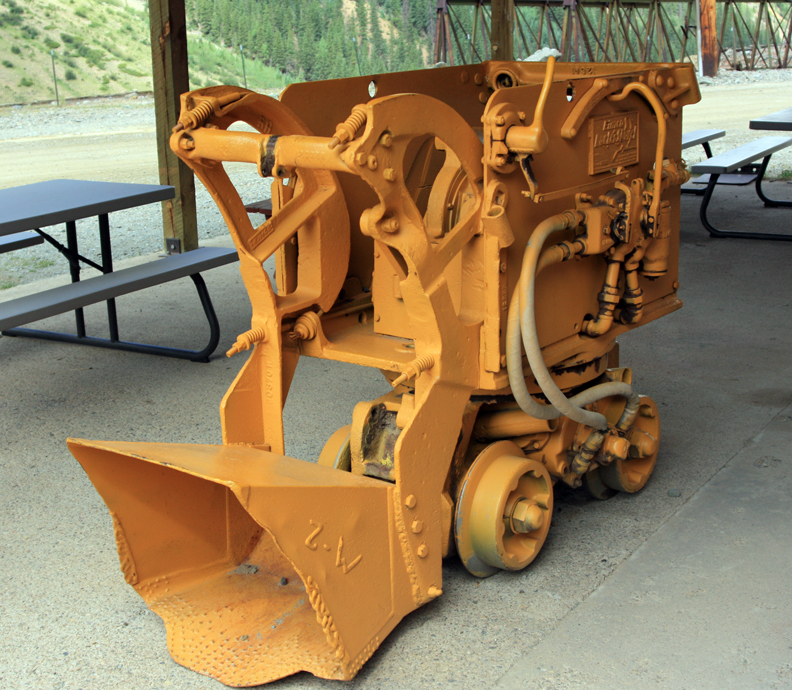
Mucker machine that runs on compressed air (Old Hundred Mine).

As my tour through Colorado’s mining towns has progressed, I’ve become much more knowledgeable about hard rock mining techniques. I created a post on basic terms of the parts of a hard rock mine and the phases of its development previously; now, it’s time to learn the terminology of the daily lives of the miners and their 12-hour shifts underground. Since these terms and techniques are common to all hard rock mines, I’ll explain them now before moving on to the second half of my day in Ouray and Telluride. That way, as I describe the specific mine tours, I’ll only have to mention those things that are unusual about each tour.

miners using a jackleg

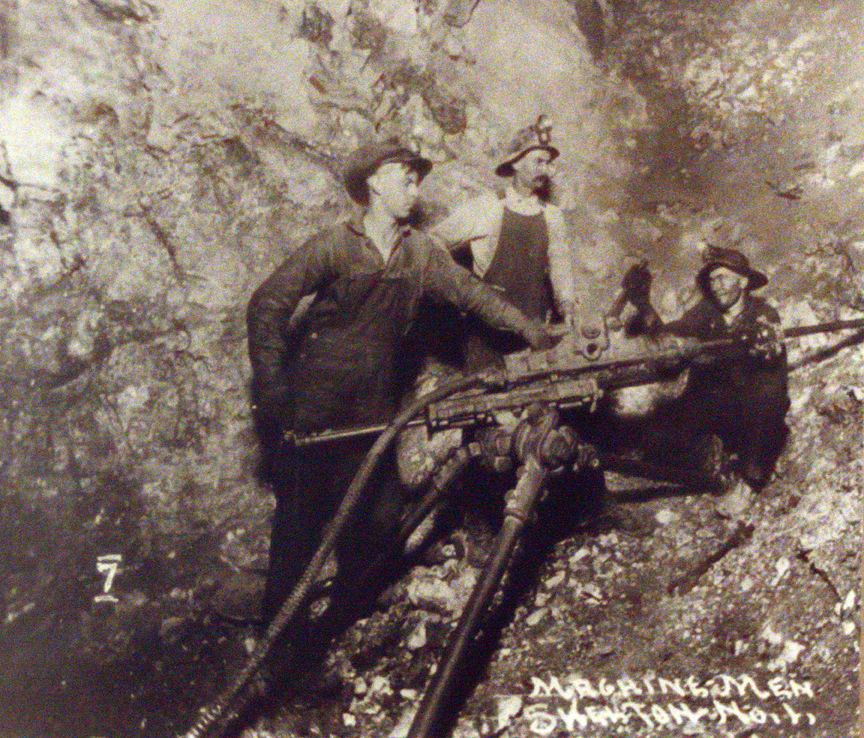
Miners using a jackleg drill.

Each mine generally had two shifts of 12 hours each. The miner’s shift would begin by reporting to the change room, where they would put on their miner’s helmet (at first a stiffened felt hat, later a helmet with a carbide lamp) and other gear, then they would line up for the hoist to lower them down into the mine shaft in the skip, or man cage. This process would take about an hour. Different miners had different jobs; newly hired men would work the face, more experienced men would run the hoist or set up the dynamite charges and fuses, or work inside the mine as blacksmiths to keep the tools sharp.

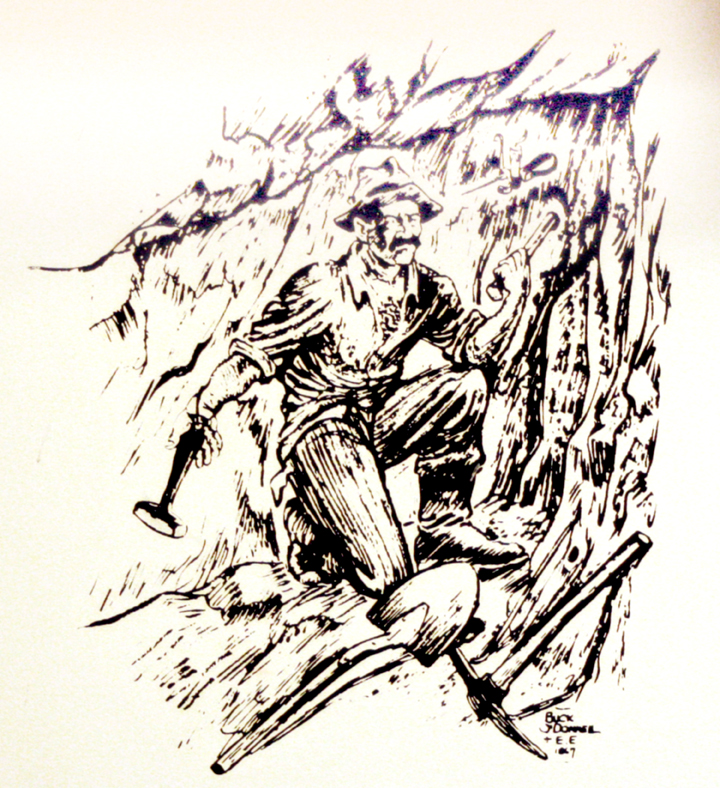
Single jacking

Single jacking. The miner would relax his grip at the end of each swing to prevent muscle fatigue, and the jack (chisel) was rotated 1/4 each hit to prevent binding.

Old time miners would single jack the face of the ore body using a chisel and an eight-pound hammer and just one candle. Teams of two men would double jack the face: one man would hold the jack and turn it a quarter turn as the second man would hit the jack with a sledge hammer. In the darkness of just one candle, all the hammer man had to see to aim at was the single slightly reflective spot of the smashed metal at the end of the jack.

jackleg drill

Jackleg Drill (San Juan County Museum).

Eventually pneumatic drills replaced the jacks and hammers, driven by a large air compressor just off the change room at the mine’s entrance. Hoses snaked into the mine to drive the drills. Some mines used tanks of compressed air that were filled up each shift and driven on the tram into the mine. These first drills were called jacklegs because they were set up on a portable leg that could be angled into the face. Instead of a rotary motion, the drills used a hammering motion to pound into the hole. They were also called widowmakers because they put out a lot of dust that got into the miners’ lungs and caused a disease called silicosis, similar to the black lung of coal miners. The silicon dioxide dust would act like glass fragments to cause scarring in the lungs, and after a year or two of mining with a widowmaker, a miner would be “rocked up” and unable to work. They usually died within six months or so.

jackleg instructions

Diagram of how a jackleg drill works (Hard Tack Mine).

Eventually someone thought of putting a hole through the center of the drill iron and pumping water through it to mix with the dust and make a slurry. This created quite a mess to transport out of the mine, but it did control the dust and extend the miners’ lives.

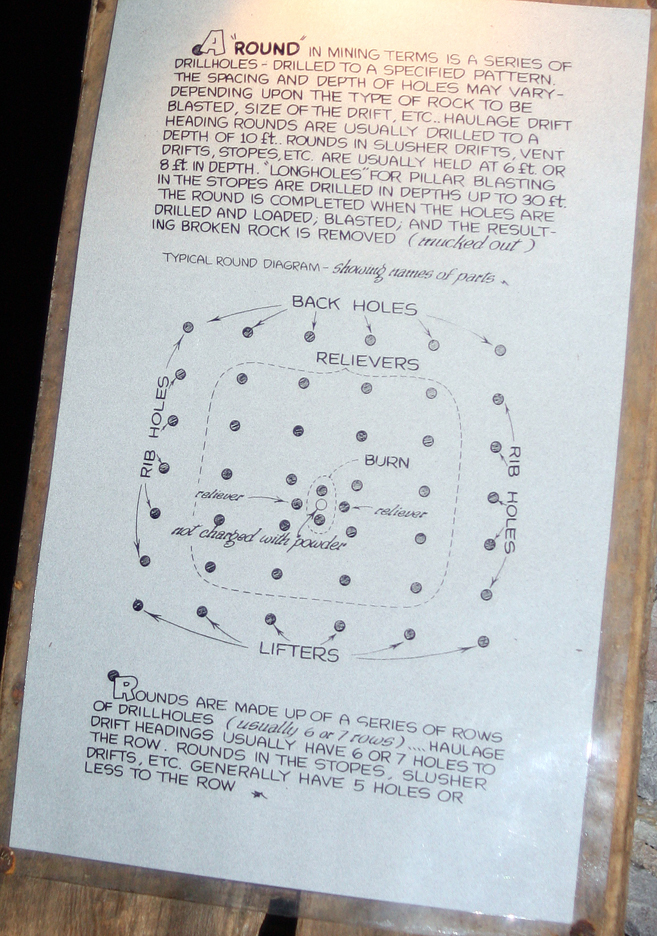
Drill hole pattern

Pattern for drilling holes at the face. The center holes were left open so that the rock would fracture inward. The bottom charges went off last and lifted the rock up and out from the face.

Whether by hand or with a pneumatic drill, the miners would drill a pattern of holes in the face. Each mine used a slightly different pattern, but they all had the same purpose. Once done, dynamite was placed in each of the holes except the center one and fuses with exact lengths were attached so that when the dynamite was exploded, it would start in the first circle out from the center, which would break inward toward the empty center hole. The next ring of holes would explode a millisecond later, then the next, and finally a row of holes on the bottom would explode and lift the fractured rock up and out of the face. These shots were done at the end of a shift, so that the air would be clear when the next shift came in.

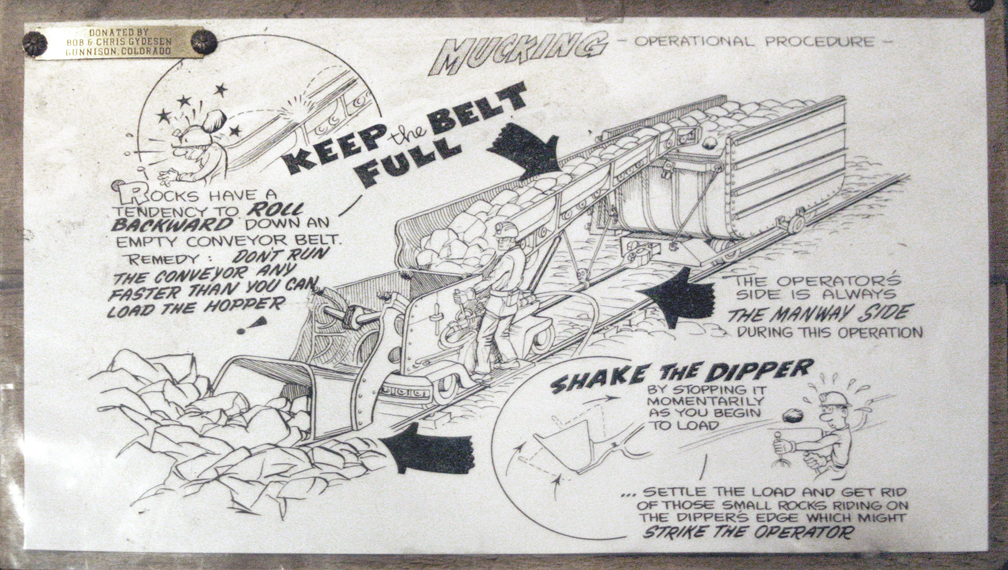
mucker instructions

Instructions for running a mucker (Hard Tack Mine).

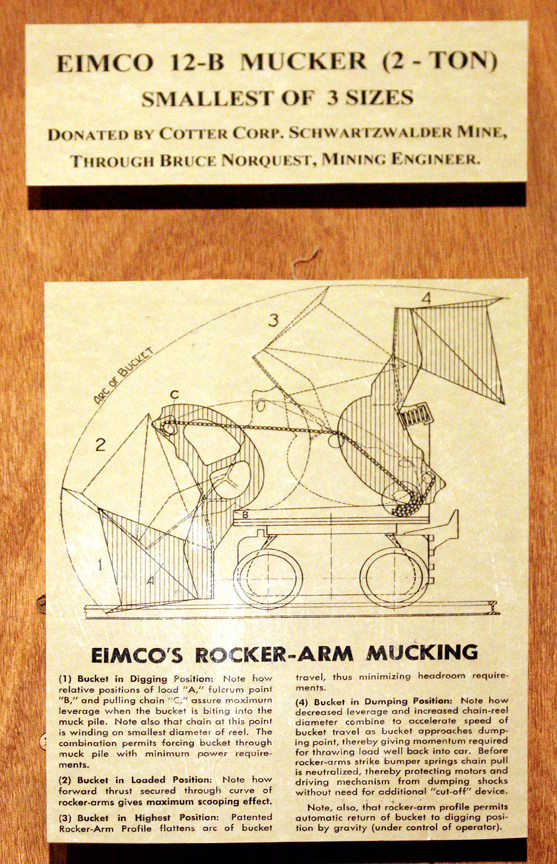
The new shift would remove the fractured rock, a process called “mucking.” At first it was done by hand with shovels, loading the rocks into ore cars and pushing them to the hoist or out of the adit by hand. Mules were sometimes used, but it was hard hoisting them down into the shaft. They had to be trussed up to get them down, and they would stay in the mines, eventually going blind in the darkness. Electric trams were invented to replace the men and mules. Mucking machines that ran on air were also invented that would be pushed to the face on newly laid tracks, then used to scoop up the rock and lift it into an ore car behind. Another device called a slusher acted as a dragline on cables to pull ore away from the face where it could be more easily loaded. Once the rock was mucked, the miners would eat lunch, then begin drilling the holes for the next shot.

mucker diagram

Mucker operation illustration. The hopper is driven by a chain drive ran off of compressed air.

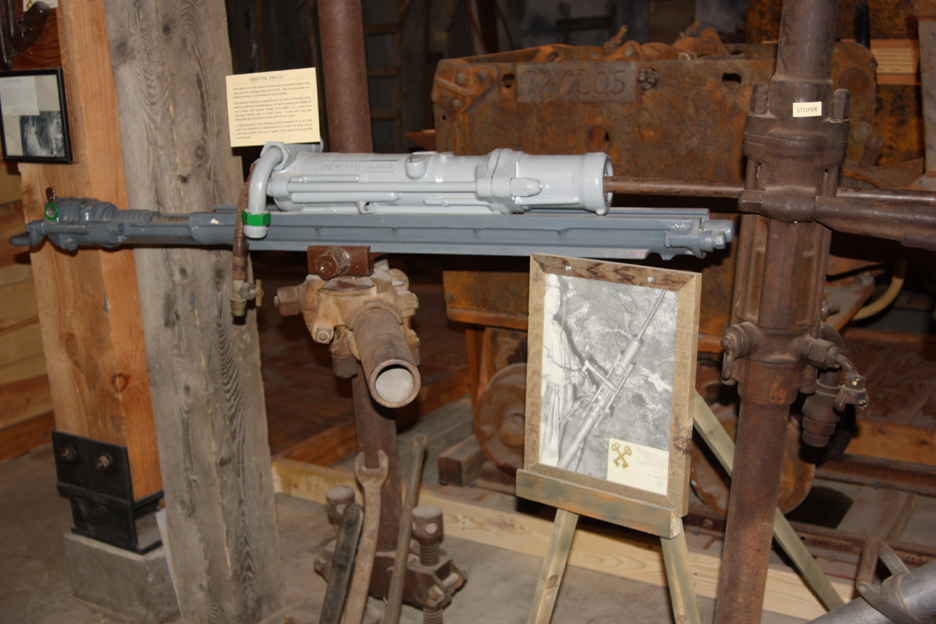
This was the round of work at the face, which was the active area of a vein going basically horizontally. When they reached the ore bodies, they would follow the ore body up and down from the horizontal levels. This process was called stoping, and it required a different type of drill, called a stoper. It was longer and designed to drill vertically upward. The ore body would be followed in all directions and a chamber would result, with sets of timber emplaced as platforms. The miners would work their way up, building more timber sets and raising the stoper higher and higher. The ore would fall down to the bottom of the stope, usually into a wooden bin with chutes from which the ore could be emptied into an ore car.

stoper diagram

How a stoper works (Hard Tack Mine).

To access the ore body, horizontal levels were blasted at 100-foot intervals down the main shaft, which then proceeded to the veins or stopes. Tunnels heading perpendicularly away from the levels were called drifts. Sometimes to get water or ore out of a mine, a long horizontal tunnel was blasted from the outside to a lower level. This was called an adit. All of these longer reaches were done with a type of drill called a drifter or a Leyner drill. It was sometimes mounted on a vertical column anchored into the rock with a long tray that moved the drill along into the face. Several of these could also be mounted on moveable platforms to lower down a shaft in order to extend the shaft deeper or they would be mounted horizontally to lengthen a level. The holes were often longer (up to 30 feet) so that more rock could be removed at a time from a single blast, and the tunnels were often larger than the drifts that accessed the ore.

leyner drill

A Leyner or drifter drill, for making deeper holes. Several of these could be attached to a platform for drilling a pattern for a drift or a shaft (San Juan County Museum).

So it would progress from shift to shift, 24 hours a day, seven days per week except holidays (Fourth of July and Christmas). Miners in remote camps would work for two week straight and get paid, then go into town for a weekend and blow it all on food, drink, gambling, and other pursuits. They would report back to work broke the next Monday.

Miners came from all over; many were from Cornwall England where they had worked in the tin mines. The Cornish tended to save up their money in order to send for their cousins and other family members to join them. These “Cousin Jacks” were hired on as soon as openings occurred at the mines. Given the prevalence of accidents and silicosis, openings were fairly frequent. The Cornish brought a number of mining terms as well as superstitions with them. The most common was the belief in Tommyknockers, small elf-like creatures that inhabited the mines and communicated with the souls of dead miners. When you heard the Tommyknockers tapping in the mine with their small hammers, it meant someone would soon die and the Cornish would refuse to go anywhere near that part of the mine. Small leftover food morsels or pieces of rich ore were left as gifts to appease the Tommyknockers.

Leyner operation

How a Leyner drill operates (Hard Tack Mine).

Those who managed to survive for several years in the mines as young men would eventually be unsuited for work inside and would have to find work topside or elsewhere (being in your mid-twenties was considered old). The daily wage of three dollars was actually considered pretty good pay back then, but eventually miners unions formed which increased the pay, provided more days off, and reduced the shift times to eight hours.

Read Full Post »

ouray in 1876

Ouray Colorado in 1876, soon after silver was discovered in the area.

On Thursday, July 12, 2012, I explored the history of Ouray and Telluride, Colorado. I rode a jeep up into the San Juan Mountains to the high mining camps, delved into an adit at the Bachelor Syracuse Mine, and floated in a gondola high above Telluride.

History of Ouray:

Chief Ouray stained glass

Chief Ouray making peace with the Governor of Colorado

The town of Ouray (pronounced “you-ray”) is named for an Uncompahgre Ute Indian chief in the 1800s who tried to keep his people and their land safe from the gradual encroachment of white settlers and miners. Despite all kinds of provocations, he tried to keep the peace. When silver was discovered in the San Juan Mountains, each treaty that promised them they could keep their land “as long as the grass shall grow” was soon broken. Chief Ouray likened their situation to a buffalo that has been shot several times and has no choice but to lie down and take whatever will come. After Chief Ouray’s death the Utes were rounded up and forced to move to the Uintah-Ouray Reservation in northeast Utah, near the towns of Roosevelt and Ft. Duchesne. Chief Ouray was known for his intelligence and ability to negotiate, and his stained glass portrait in the old supreme court building in Denver is one of only a few to show Native Americans among the state’s leaders.

Box Canyon

Box Canyon above Ouray, where silver was first discovered.

The original name for the valley and the town was Uncompahgre, the Ute word for the hot mineral springs located there (which Chief Ouray was known to soak in). Spanish explorers, including the Dominguez-Escalante party of 1776, explored the area but it wasn’t until the 1870s that silver deposits were discovered up what is now called Box Canyon. By 1876 the town of Ouray was incorporated and gradually grew. The best deposits were found around Gold Hill and further up the canyons, including the Imogene Basin and the area around Ironton and Guston in the Red Mountain District (which I drove through yesterday). The town itself became the transfer and shipping point, but growth was slow because of the isolation and difficulty of getting the ore to market on wagons.

The main line of the Denver and Rio Grande Railroad extended itself up from Pueblo to Gunnison and on through Grand Junction to Salt Lake City between 1880 and 1883 (I talked more about this on Day 1 when I visited the railroad and mining museum in Helper, Utah). A branch line travelled through Durango, and a narrow gauge line extended up the Animas River Valley to Silverton (which I rode on Day 2). Knowing that the mines of the Red Mountain District could make great fortunes if only the ore could be gotten out, Otto Mears built a series of toll roads over the high passes between Silverton and Ouray and from Durango around to Rico and Telluride. The roads met up at what is now Ridgway, north of Ouray. But he saw even greater potential in building railroads.
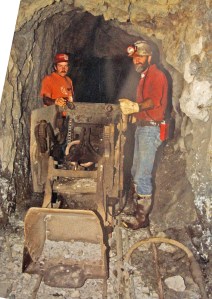
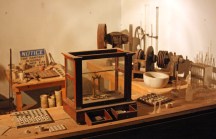
Mears road

Road from Silverton to Ouray, built by Otto Mears.
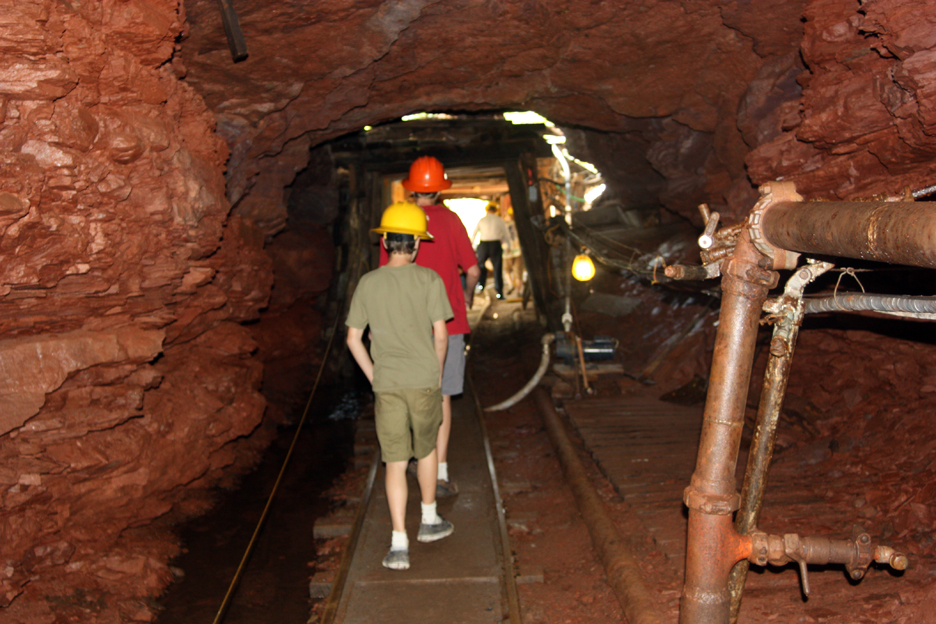
The gulch between Ouray and Ironton was considered too difficult a route for a railroad, as it would require a 7 percent grade, a tunnel, and a double loop to get a train through the defile. Not even a Shay locomotive on a narrow gauge track could have done it. Mears decided instead to build a railroad from Silverton over the top of Red Mountain Pass to Guston and Ironton, which would link up with the Durango to Silverton line and bring the ore to smelters in Durango.

Ouray in 1892

Ouray in 1892 at the height of its prosperity.

Meanwhile, the Denver and Rio Grande Railroad built a narrow gauge extension line in 1897 from Montrose up the Uncompahgre River to Ridgway and on to Ouray. With these two railways in place, the town of Ouray really took off. By 1890 it had over 2500 people. Unlike many mining towns, most of the miners brought their families with them and Ouray was never quite as wild and wooly as some towns. Ouray was also fortunate to never have a devastating fire such as the ones the burnt down most western mining towns. Many of the original buildings are intact, and along Main Street there are metal signs on each block showing what the buildings on the opposite side looked like in the 1890s. The businesses in them have changed hands many times, but the buildings are still there, giving Ouray a much more authentic flavor. Some of the best-preserved buildings are the Beaumont Hotel, the St. Elmo Hotel, Wright’s Opera House, and the County Courthouse (which was used for the courtroom scenes of the 1968 version of the movie True Grit with John Wayne, Kim Darby, and Glen Campbell).

ouray today

Ouray Colorado today.

Ouray opera house

Wright Opera House in Ouray, Colorado.

The Western Hotel, where I stayed, is another historic building. Built near the railroad terminal, it saw good business from the start and is restored very much like it was in the 1890s. The saloon boasts an unusual painting of a lady’s face on the floor. I had originally planned to stay in a campground up at the Amphitheatre above the town, but my reservation got messed up, so I booked this hotel at the last minute. It was in the style of hotels of the day, with a shared bathroom down the hall and fairly small rooms without air conditioning (or many electrical outlets, which had to be added later). I’m glad I brought a power strip to plug in all my electronics. But I thoroughly enjoyed my stay in an authentic piece of western history. If you’d like to stay there, please visit their website at: http://www.historicwesternhotel.com/home.html.

Western Hotel

Western Hotel in Ouray, Colorado, built in 1891.

I ate a breakfast of chocolate glazed donuts and orange juice and walked around town, taking photos while waiting for my jeep tour. It’s a beautiful location, and the town lives up to its nickname as the Switzerland of the West (although it has some competition from Midway, Utah for the same title). Our jeep tour actually began with a tour and brief history of the Western Hotel. Owner Gregg Pieper led our tour of the ballroom and saloon bar, telling some of the colorful stories associated with the hotel, which was built in 1891.

Map of San Juan Tour

Map of the San Juan Scenic Jeep Tours at the Western Hotel.

Face on floor

The Face on the Saloon Floor.

Western Hotel bar

Into the San Juans by Jeep:

Our jeep tour began at 8:30. There were several groups taking different routes, some up over Imogene Pass, others taking different canyons into the high San Juans. Gregg drove our jeep up Canyon Creek to the southwest of Ouray. The morning sun was just topping the mountains to the east, and the road remained quite good all the way to the Camp Bird Mine, where one branch continues up left to Imogene Pass and the other heads higher up the main canyon toward the ghost town of Sneffels and the Yankee Boy Mine, our destination.

Thomas F. Walsh

Thomas F. Walsh, owner of the Camp Bird Mine.

In 1893 the good times in Ouray ended when the Silver Panic hit, the price fell out of the market, and many of the mines closed. Yet some, with enough gold in them, were able to stay open. One man who decided to stay and ride out the bad times was Thomas F. Walsh. An Irish immigrant from Tipperary, Ireland, Walsh worked his way up from being a carpenter to selling supplies to miners in the Dakotas during the gold rush there. Along the way, he learned a bit about gold mining, married a beautiful schoolteacher from Leadville, and moved his young family to Ouray. He had put together a modest fortune from his interests in the Dakotas and had built a smelter in Ironton. While looking for silaceous earth to use as a flux in his smelter, he examined some old tailings up Canyon Creek and saw they contained gold. Following the tailings to their source, he found a rich vein that had been overlooked by previous prospectors. He came home and told his daughter, Evalyn, “Daughter, I’ve struck it rich!”

Camp Bird tailings

Tailings near the Camp Bird Mine.

The first miners at his claim were bothered by a bold mountain jay that stole their lunches. He was known as “the camp bird,” and the mine was named after him. It became one of the richest gold mines in the United States and propelled Thomas Walsh into fame and fortune. At one point, the mine and mill were producing $5000 of gold per day, a great amount in the 1890s. The miners at the Camp Bird Mine were treated well; their boarding house was more like a hotel, with excellent meals served on china. Walsh built a mansion for his family in Washington, D.C., which is now the Indonesian Embassy. He even bought the infamous Hope diamond from Cartier for Evalyn as a wedding present (of course, her family then became part of the Hope diamond curse).

The Camp Bird mine continued to produce into the 1950s and has been opened for exploratory mining occasionally since. There appears to be some activity going on around the site even now, since gold prices have gone so high. The mill was eventually dismantled and moved to Mongolia.

overhang

Looking back at the overhang on the road to Yankee Boy Basin.

Jeep on cliff

Jeep on a cliff on the road to Yankee Boy Basin.

Further up the canyon we came to the ghost town of Sneffels, once containing about 200 people. Not much remains except the hotel and a few shacks, as the historical structures have been mostly demolished by further development and the harsh climate. The town and a nearby mountain were named for a character in Jules Verne’s book Around the World in 80 Days. Just beyond Sneffels are the ruins of a large stamp mill that pulverized and concentrated the silver and gold ore.

Sneffels hotel

The hotel at Sneffels.

Our route became more steep and precarious, with the road carved out of the cliff face and sheer drops on our left side. Gregg stopped to tell us stories from time to time, and at one point the cliff actually overhung the road. We stopped for several minutes to make sure no one was coming down as one can’t see beyond the overhand and meeting a car under it would not be a good idea. Eventually the deep gorge opened up again into a glacial cirque where the Yankee Boy Mine was located. Not many structures remain, only the stains of old tailings piles and a few low-grade outcroppings. But there were many wildflowers and twin waterfalls and gorgeous scenery all around. From here we could see the St. Sophia Ridge, a jagged series of tooth-like pinnacles separating Yankee Boy Basin from Telluride. We were only a few miles from Telluride as the crow flies (although I doubt one could fly over that ridge).

St. Sophia Ridge

St. Sophia Ridge as seen from Yankee Boy Basin.

We got out and explored for about 30 minutes, then met the jeep further down the road and bounced our way back to Ouray. I had tried a number of things with my camera gear, including attaching a Flip camera with my gripping tripod onto the frame of the jeep as we drove around Telluride. I finally decided holding it in my hand was easier and smoother.

Yankee Boy Basin

Yankee Boy Basin

I talked with Gregg for a while at the hotel front desk. He was nervous about all the video taping I had done, thinking I might be working for one of the competing jeep tours, but when I assured him this was for education and for my students, he opened up more. I laid down in my room for a hour or so to rest my spine and charge up my equipment again. It had been an unforgettable tour of the San Juan Mountains.

ladder to mine

An almost inaccessible mine on the Canyon Creek road. Miners had to climb down the ladders to reach the adit at bottom right.

Waterfall

Waterfall in Yankee Boy Basin.

Read Full Post »

Nothing happened

Nothing happened here. Move on.

Wednesday, July 11 marked the third day of my journey through Colorado’s mining towns. Because of hitting a rock on my first day, I had to deviate from my carefully planned timeline in order to find a new rim for my minivan, which led to an unexpected detour.

Finding a Rim

The Shiprock

The Shiprock as seen from Farmington, NM.

After striking camp, I set to work trying to track down a rim for my car. A shop in Durango didn’t have anything, and said my best shot was to try the wrecking yard south of town on Highway 160. They didn’t have anything like it, and the owner there checked his computer which located several new rims, for over $300: one in Albuquerque, one in Cañon City, and one in Denver, all too far away and too expensive. I called the Dodge dealership in town, and they suggested calling some wrecking yards in Farmington, New Mexico. The second yard I called did have a used rim for a Dodge Grand Caravan. Finally! But it meant a 45-mile detour south. I had never been to New Mexico before, unless you count the time I visited Four Corners years ago, and then I only had part of my body in the state. Of all the western states, it is the one I’ve missed visiting. So here was my chance at last!

Ore Chute

Ore chute on the road to Ouray

At the suggestion of the lady at the wrecking yard, I took 160 west about 10 miles, then 140 south. I got stuck for half an hour waiting for road resurfacing near Breen, travelled on through Red Mesa and La Plata into New Mexico to Farmington. I missed the turnoff to the wrecking yard, and realized I’d gone to far and pulled over. Up ahead to the west I could see the Shiprock, a famous landmark in these parts. I’ve never seen it before, and snapped a photo even though there were power lines in the way. I knew a Navajo kid in high school named Albert Todacheenie who was from Shiprock and I’ve wondered since whatever happened to him.

Silverton to Ouray route

My route from Silverton to Ouray over Red Mountain Pass

I got the used rim and found a tire store to mount the rim and tire. They had quite a crowd waiting, but the prices were good. I walked in blazing heat (near 100 ° F) to find someplace to eat, a good Mexican restaurant about a half-mile away. After getting my car back about 3:30, I headed north out of town on Highway 550.

The Million Dollar Highway

I was over six hours behind schedule and knew I wouldn’t be able to stop in Silverton to take the mine or the mill tour as I had originally planned. I had to be in Ouray that evening, as I had a reservation at the Western Hotel there. So I had to make some choices. In order to get back to Silverton, I would have to miss going through Alamosa and seeing Great Sand Dunes National Park on Saturday. It was a hard choice, but I was here to see the history of Colorado mining and the sand dunes had always been optional.

Molas Pass

Panorama of Molas Pass on Highway 550

Route over Molas Pass

Route over Molas Pass to Silverton

So I wound up back in Durango. Again. After favoring the spare tire for three days, it was hard to get used to driving at normal speeds. I took 550 north past the ski resorts, then the road began to wind its way up into the San Juans. It is called the Million Dollar Highway here because it cost that much and more per mile to build. It wound over Coal Bank Pass and then Molas Pass (10,910 ft.), where I stopped to take some wonderful photos. It then curved its way down steeply to Silverton. I stopped wherever the road allowed for good views of the town below.

Silverton

Silverton, Colorado as seen from Highway 550

Beyond Silverton the road travelled up a broad glacier-carved canyon toward Red Mountain Pass. I had seen a video on the Internet called “America’s Most Dangerous Highways” about this pass, and it seemed much worse on the video than it actually was. I wouldn’t want to drive an 18-wheeler around the switchbacks, but it was no problem in my minivan. In fact, I quite enjoyed the drive and the views were amazing.

Red Mt Pass

Red Mountain Pass in 3D

The Red Mountain Mining District

Treasury Tunnel trestle

Treasury Tunnel trestle and Red Mountain #3

Just beyond the pass was the Idarado mine, with a great deal of infrastructure and even houses intact. I stopped and photographed it all. Large silver chimneys were discovered here in 1882 and within a few years, six different towns grew up around the pass, including Guston and Ironton. The most prosperous mine in the 1880s was the Yankee Girl; its headframe is still intact. Later, as prices dropped after the Silver Panic of 1893, some of the mines were closed and others consolidated as other metals were mined.

Red Mountain 2

Red Mountain #2 and Champion Gulch

Eventually the Idarado became the leading mine, gradually expanding its drifts, levels, shafts, and stopes. After World War II three major ore bodies were connected underground through the Treasury Tunnel. It began here at Red Mountain Pass and continued underground (with a few internal shafts which dropped over 1700 feet) until it reached the Pandora Mill above Telluride. Altogether, over 100 miles of drifts and tunnels were blasted out of these mountains. Mining continued here until 1978.

Yankee Girl and Guston

Yankee Girl headframe and the town site of Guston

Idarado Tunnel

The Treasury Tunnel of the Idarado Mine at Red Mountain Pass

It was just past sunset as I travelled on toward Ouray. The worst part of the road was the last five miles as it was carved out of the side of a steep canyon cliff face without any guardrails to speak of. It was just getting dark as I drove into Ouray and checked into the Western Hotel. This is an authentic 1800s hotel and saloon, with European style rooms and a shared bathroom down the hall. I got everything charging up, and ate supper of excellent pizza in the saloon.

Toward Ouray

Highway 550 north of Red Mountain Pass looking toward Ouray

Company town

Miners houses at the Idarado Mine at Red Mountain Pass

Ouray
Ouray, Colorado

Read Full Post »

« Newer Posts - Older Posts »