Feeds:
Posts
Comments

Archive for the ‘Uncategorized’ Category

A Project in Engineering Design and Materials Science

The STEAMpunk Club at Walden School of Liberal Arts

The STEAMpunk Club at Walden School of Liberal Arts

I am a pack rat. I grew up with my grandparents living next door in my hometown of Deseret, Utah. Both my parents and grandparents lived through the Great Depression and never wanted to throw anything away. Anything that could be salvaged and re-tasked or reused was kept in case it might come in handy later.

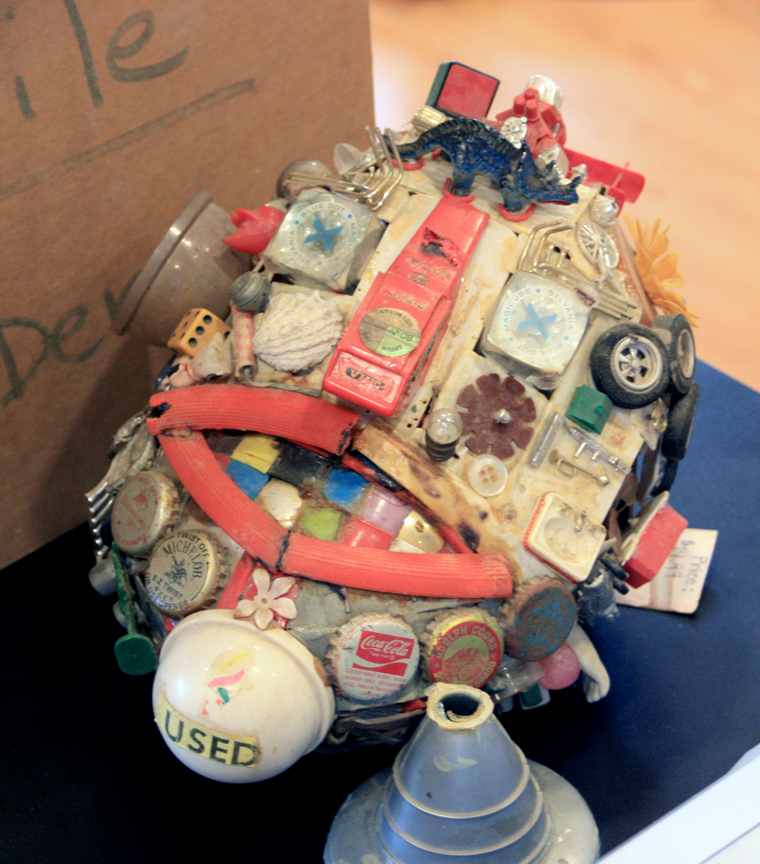
This is Herbie the Head, my first junk sculpture. It's a bit the worse for time. The frame is made of welded plastic girders. The neck and support are the rocket nozzle and heat shield of an Apollo space capsule.

This is Herbie the Head, my first junk sculpture. It’s a bit the worse for time. The frame is made of welded plastic girders. The neck and support are the rocket nozzle and heat shield of an Apollo space capsule.

I have the same compulsion, only in my case I collect objects that are clearly past being useful for their original purpose. In other words, I collect junk. But I’ve done some things with it, including making sculptures from the junk. This started during the summer after I graduated from high school. I went on a long wilderness trek wearing old boots. The trek included a 25-mile hike during a single day and night, and by the time I finally got to camp I had 16 blisters on my feet and toes. By the time I got home again, I had to take a few days off from walking or wearing shoes to let all of these blisters heal.

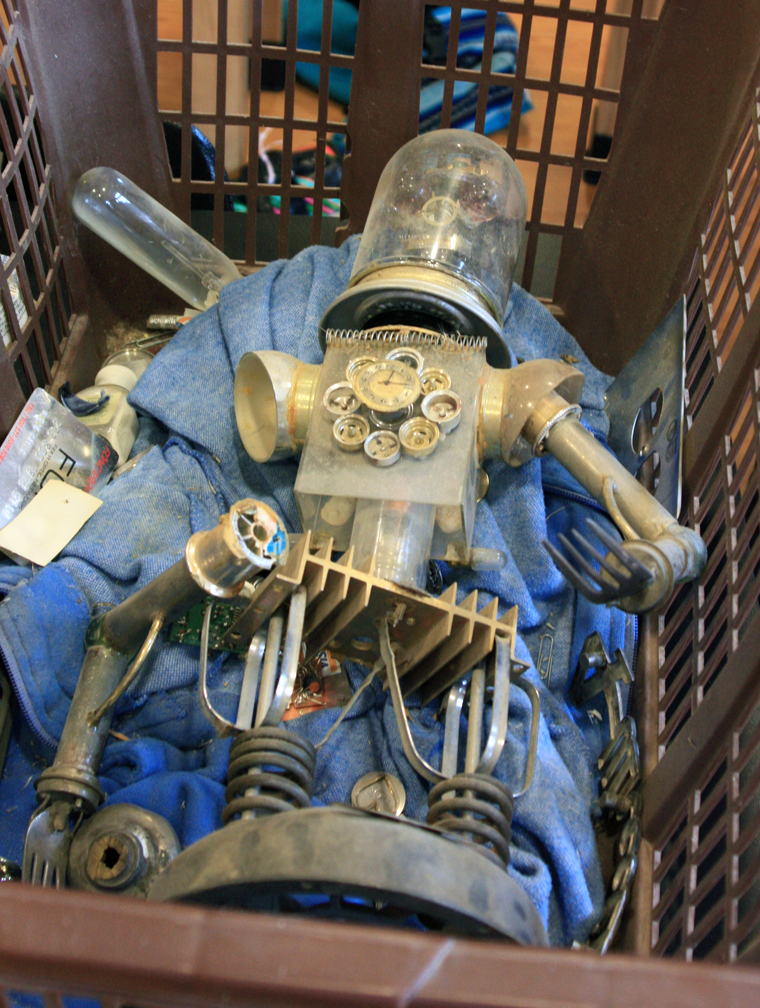
Philo the Robot, named for Philo T. Farnsworth, the inventor of television. He needs some repairs.

Philo the Robot, named for Philo T. Farnsworth, the inventor of television. He needs some repairs.

I decided to spend the time making something fun out of my old model kits that had all fallen apart but which I hadn’t thrown away. These included everything from a funky bathtub car to a five-foot model of a Saturn V rocket. I took the girders that held the plastic parts and used a candle to melt them together to form the frame of a head, then glued in parts and other interesting objects. The end result was rather fun, and I called the junk head “Herbie” after the Love Bug in the old Disney movies. I decided (over my mom’s protests) to enter the sculpture in the county fair. It won a sweepstakes prize!

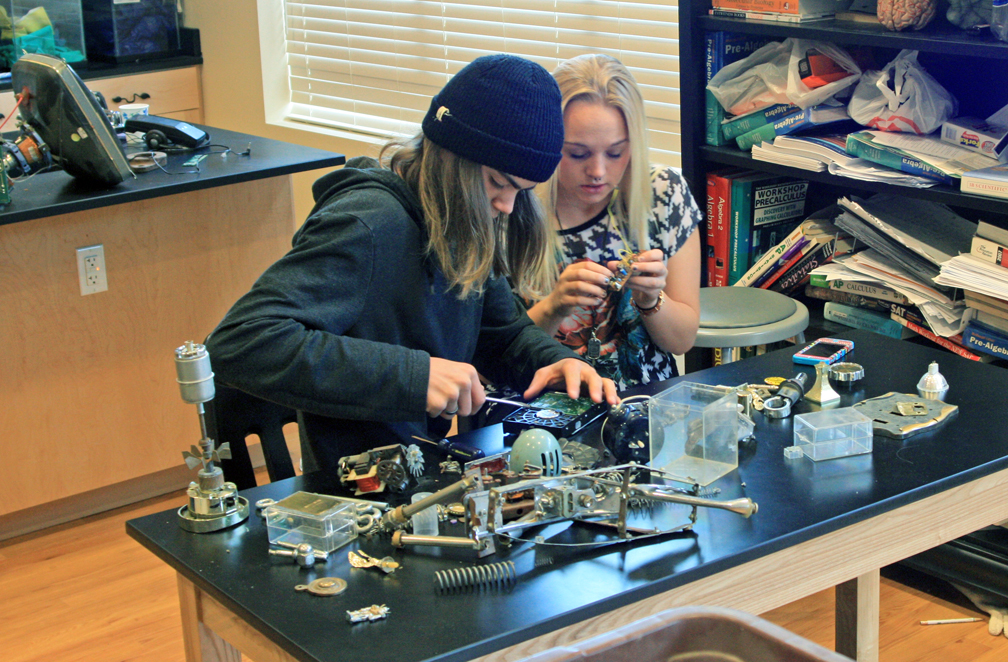
Looking through junk, coming up with ideas.

Looking through junk, coming up with ideas.

(I met one of the judges several years later who admitted to me that they didn’t have any idea what category this sculpture was supposed to be in, so they figured it had to be the best in whatever category it was. Hence the sweepstakes ribbon. So much for my artistic ego!)

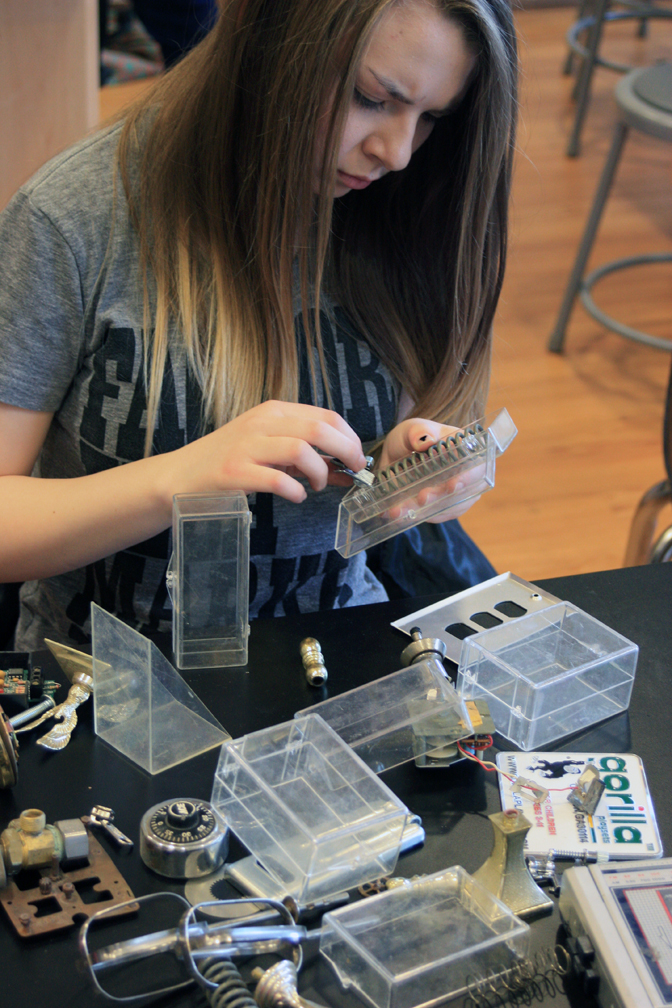
Demolishing used electronics, including old VCRs, DVD players, phones, remote controls, and calculators.

Demolishing used electronics, including old VCRs, DVD players, phones, remote controls, and calculators.

With that bit of undeserved encouragement, I continued to build other sculptures, including a robot (Philo), a three-legged dog, even a working lamp which tripped the circuit breaker the first time I turned it on. I’ve kept the robot in repair, mostly, but the others have fallen apart due to the deterioration of the glue from UV light. Yet I’ve kept all the parts.

Assembling the junk using engineering and material science knowledge.

Assembling the junk using engineering and material science knowledge.

It occurred to me last fall, as I was starting up the STEM-Arts Alliance project at Walden School, that it might be fun to teach a junk sculpture class for our Intersession program. We take two weeks between third and fourth terms to teach specialty classes. So I got approval and wrote up a description and had about ten students sign up. I bought some tools and various glues, nuts, bolts, screws, etc. and carried all my boxes of junk into school. It was quite the collection by now.

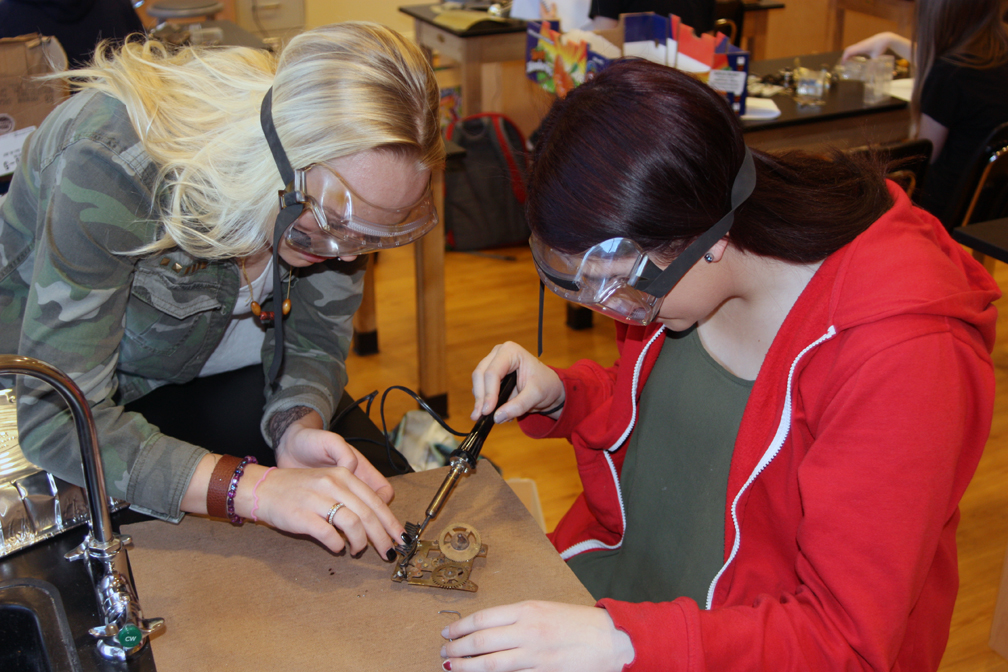
Soldering pieces together

Soldering pieces together

Although this is essentially an art project, I knew that it also tested one’s ability to attach and adapt different objects made from widely different materials. In other words, this was really a material science and engineering project. The students looked through the junk, came up with ideas, and were required to plan and sketch out their designs, including how they planned to attach the parts together. They had to use secure fasteners such as nuts and bolts for any load bearing members.

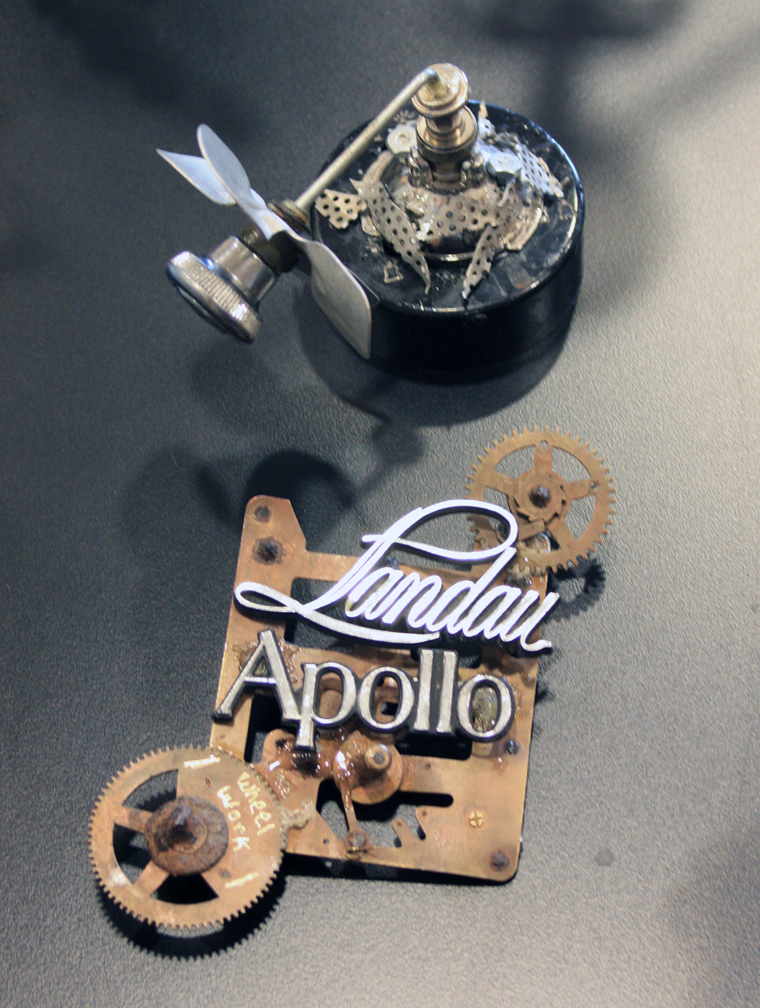
Small sculptures created by students at Walden School.

Small sculptures created by students at Walden School.

The end results were well done, and those that did the most planning were the most successful. We used drills, saws, Dremmel tools, soldering irons, hot glue guns, epoxy, and other materials to cut and adapt parts, then fasten them together.

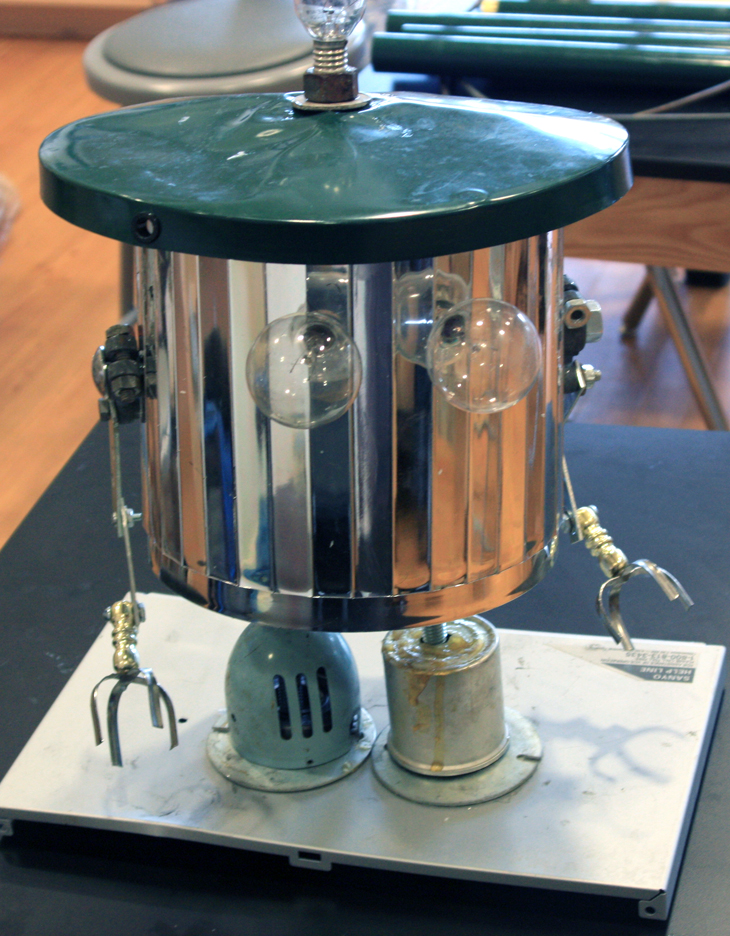
A robot created by a student from found and re-tasked objects.

A robot created by a student from found and re-tasked objects.

Even after having ten students built projects, I still had junk left. In fact, it seemed I had more than when I started. I had kept all my old broken VCRs and DVDs, telephones and calculators, and other electronic junk, which the students tore apart. There is some fascinating stuff in there. So I decided to try the class again as a fall after school club. I named it the STEAMpunk Club, which I thought was a nice play on words.

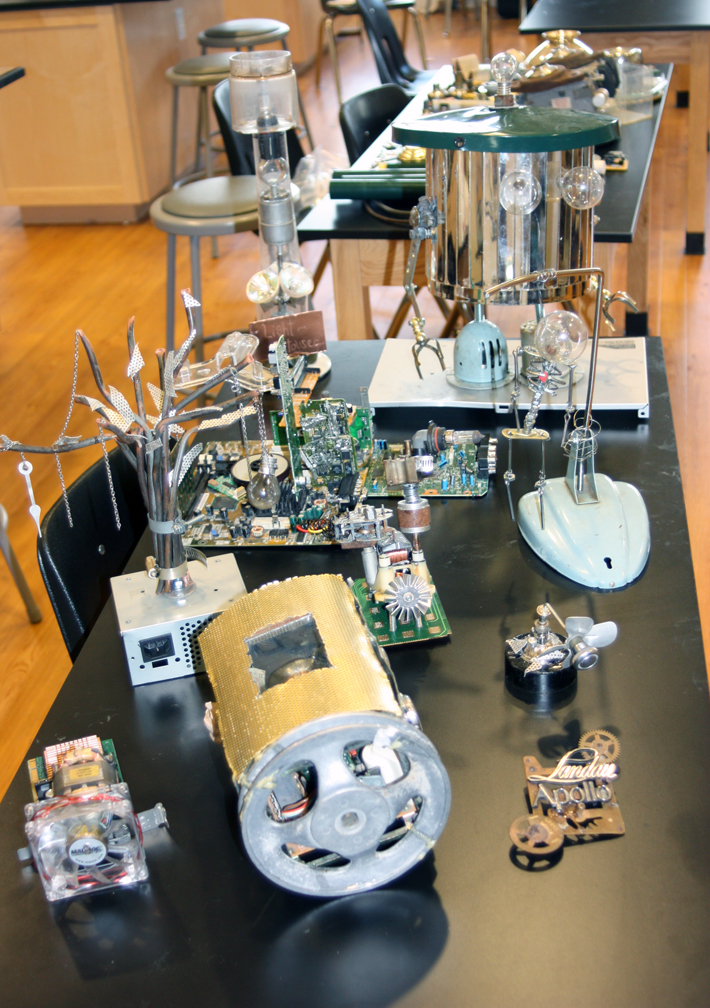
Some of the final sculptures by the Junk Art class at Walden School.

Some of the final sculptures by the Junk Art class at Walden School.

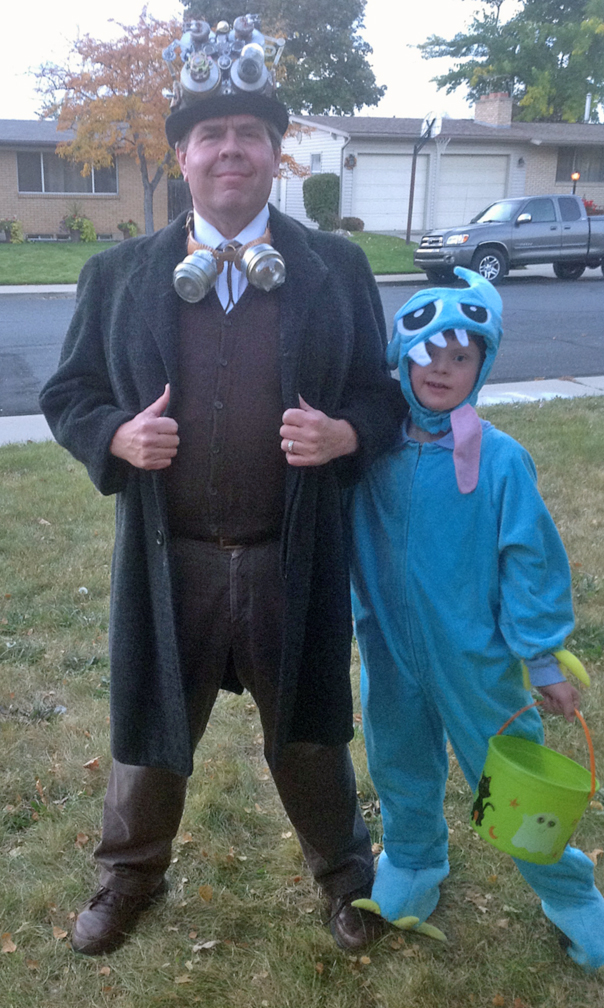
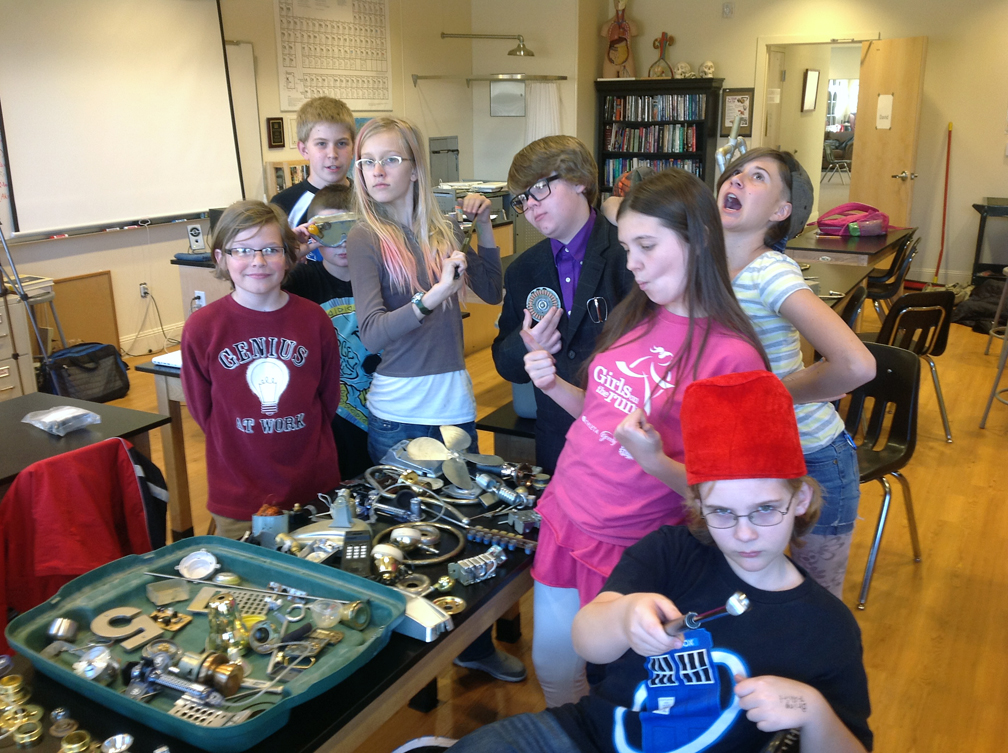
Our objective was to build steampunk goggles and other costume items for Halloween. I went to dollar stores and hardware stores looking for possibilities for objects that could be re-tasked. Princess tiaras and canning jar rings became telephoto lenses, and old softballs became leather eyepieces. We added gear decorations and plastic parts that had been spray painted silver and gold. I also found a black derby hat for cheap in a discount store and tied my elaborate goggles to it with safety pins. I also made a second, less ornate set of goggles. I wore these with my old black coat and completed a pretty good steampunk costume. The next time ComicCon comes to town, I’ll be ready. The students came up with interesting goggles and props of their own, and even a few more junk sculptures.

Steampunk goggles I made for the STEAMpunk Club

Steampunk goggles I made for the STEAMpunk Club

I have planned out a larger sculpture for my classroom, another robot that will stand about three feet tall and have a framework or core of glued, spray-painted PVC pipe for strength and structure. I have collected all the parts, and hope to complete him sometime in the spring when my workshop warms up again.

My Halloween steampunk costume, plus a monster.

My Halloween steampunk costume, plus a monster.

Maybe by next summer I will have exorcised this current drive to make junk sculptures. I seem to vibrate between several modes or interests, including science, history, and art. Lately, I’ve been in an art mode, which is why I decided to initiate the STEM-Arts Alliance in the first place; it would give me a chance to do all the things I love. It’s been fun so far, and I think my students have responded well and enjoyed the crossover opportunities. I know these projects are a bit idiosyncratic and won’t generalize to most teacher’s classrooms, but then again, maybe someone out there can use this idea to their own advantage. I’d love to hear what you come up with.

Read Full Post »

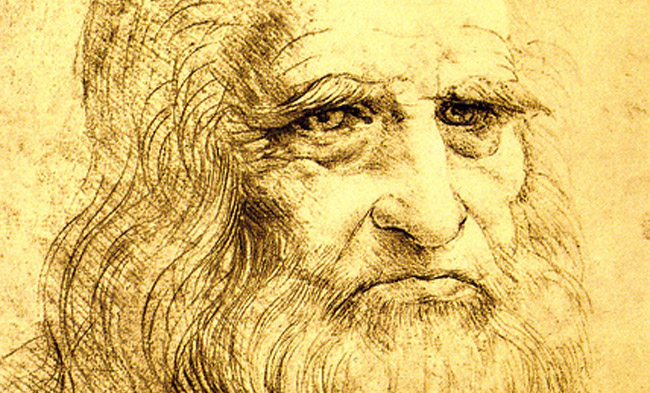
Self portrait of Leonardo da VInci

Self portrait of Leonardo da VInci

Ever wonder where ink comes from, how it was invented and how it is made? I do. Most of the ink we use today for printing newspapers or drawing is called “India” ink (although it was invented in China). It uses carbon black, or soot, for the pigment. But before this ink formula reached Europe, artists and scientists used a type of ink based on iron known as iron-gall ink.

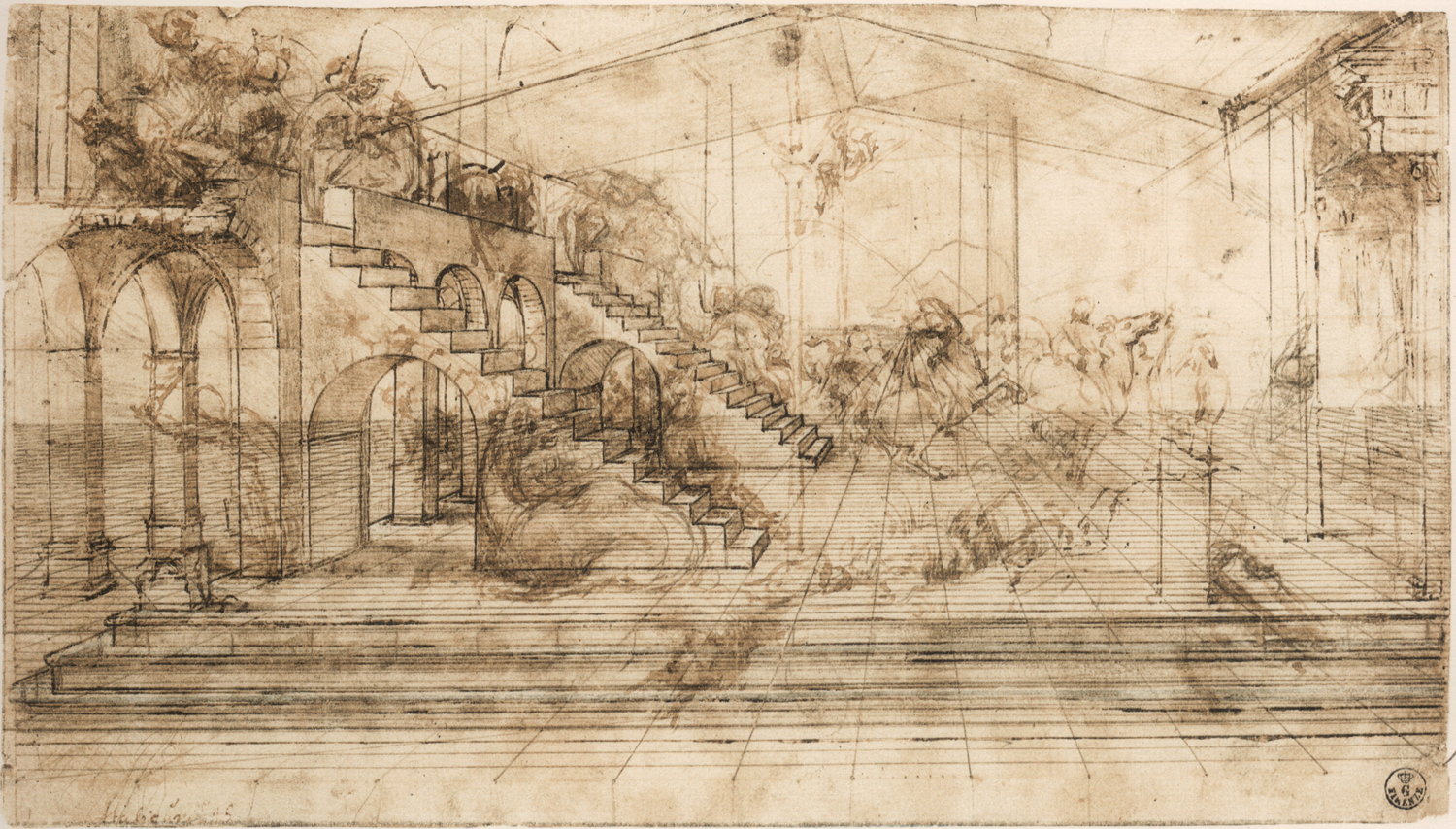
Original drawing by Leonardo da Vinci using iron-gall ink

Original drawing by Leonardo da Vinci using iron-gall ink

In July, 1984, I had the opportunity to travel to Europe with my family. Among many works of Renaissance art, I saw a display of original drawings by Leonardo da Vinci in Florence. There were plans of statues he was commissioned to cast, sketches of human anatomy, and designs for fantastic devices. One thing that caught my eye was his artistic ability; how well he could draw directly using pen and ink. I remember wondering where he got his ink from, which had turned brown with age. Now I know the answer, and I’ve turned it into one of my favorite activities in chemistry.

Alchemical manuscript by Sir Isaac Newton, at the Chemical Heritage Foundation

Alchemical manuscript by Sir Isaac Newton, at the Chemical Heritage Foundation

Iron-gall ink was used for about 1400 years and only lost favor in the mid 1800s when India ink replaced it (because it was cheaper and easier to make and produced a more consistent, longer lasting black). But there’s something to be said for the artistic variety and richness of the shades of iron-gall ink and how it has oxidized with time. The manuscript shown here was written by Sir Isaac Newton with his own homemade ink. It is one page of 24 in the possession of the Chemical Heritage Foundation in Philadelphia and is a series of notes he made on his alchemical experiments (yes, Isaac Newton was an alchemist; in fact, he wrote far more pages on alchemy than he ever did on physics).

Isaac Newton's recipe for iron-gall ink

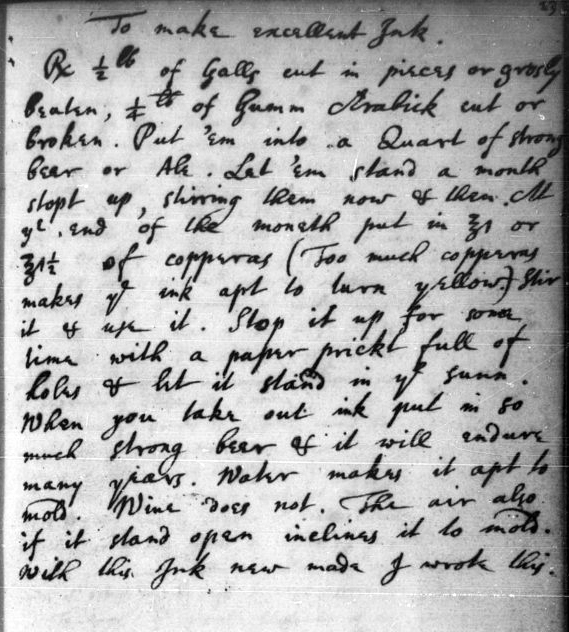
Isaac Newton’s recipe for iron-gall ink

Newton also left behind his own recipe for ink, as seen here. He started out by collecting galls off of oak trees. These galls are formed when a species of wasp lays an egg in an oak bud, which causes the oak to form a rounded ball or gall around the developing wasp larvae. As Newton’s recipe shows, he soaked the galls in strong ale or beer for a month along with solid gum Arabic. The rotting oak galls would produce tannic acid. The gum Arabic, which comes from the gum of acacia bushes in northern Africa, is used here as a binder to help the ink stick to the paper and keep the pigment in suspension, as well as make the ink have a better flow and consistency. Newton would then mix the tannic acid/gum solution with copperas. This is a chemical with a greenish-blue color that was mistakenly thought to contain copper (hence the name) but is really iron (II) sulfate. The mixture of the iron (II) ions with the tannic acid produced a rich dark brown-black suspension ideal as an ink pigment.

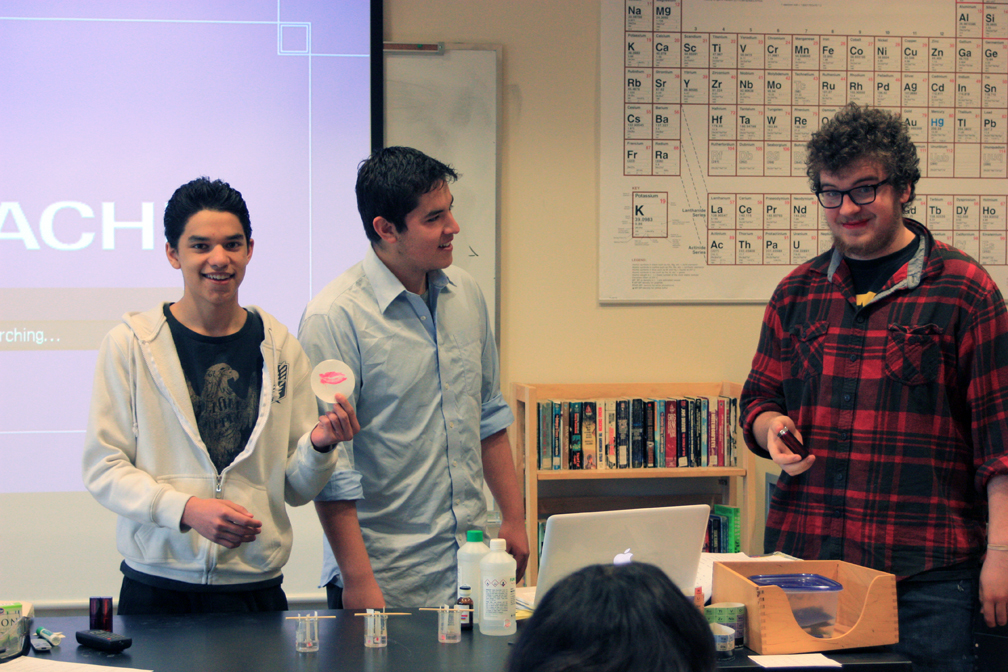
Chemistry students making ink

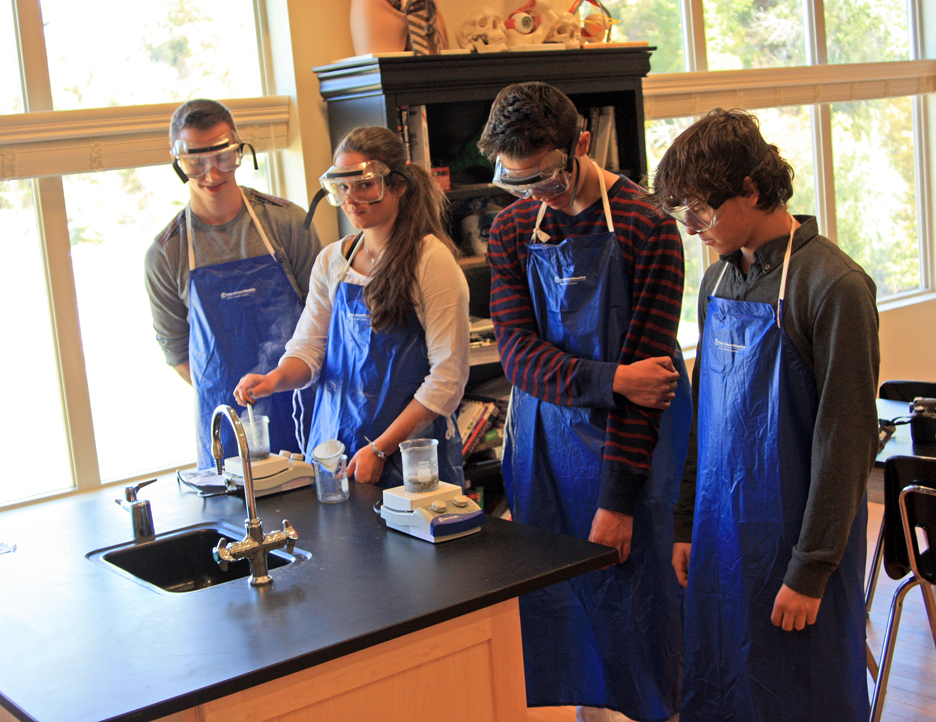
Chemistry students making ink

The question is how to make similar ink using modern equivalents. I’m not about to soak oak galls in ale for weeks; as it turns out, tannic acid is readily available from strong tea. The iron (II) ions can be produced from steel wool by boiling it in vinegar, filtering the solution through wet filter paper, then adding a small amount of 3% hydrogen peroxide. The trick is to not oxidize the iron too much, or you’ll get too much rust (iron (III) oxide) and your ink will be too brown. Getting a nice black color with just a hint of brown is ideal. If the ink is too thin, then it can be left out to evaporate and make it more viscous. A few drops of gum Arabic are added at the end. You can buy gum Arabic in most craft or art supply stores. If you add too much, the ink will be too glossy when it dries. I originally came across this procedure in ChemMatters magazine (“An Iron-Clad Recipe for Ancient Ink” ChemMatters, October, 2001) and have tinkered with it over the years.

Chemistry students drawing illustrations with their own homemade ink

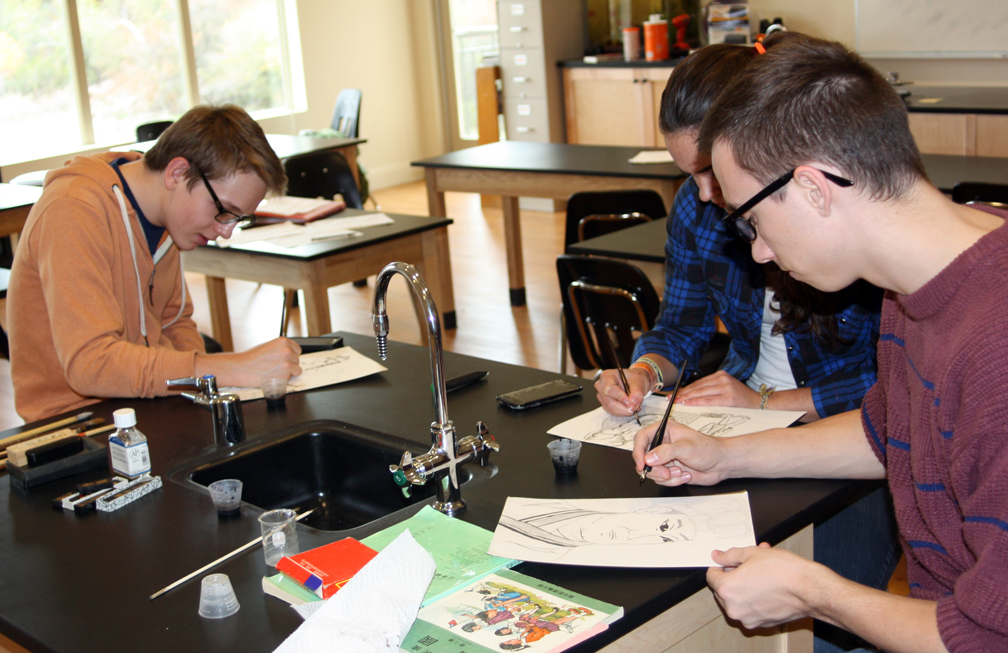
Chemistry students drawing illustrations with their own homemade ink

So what is the ideal recipe to make the darkest ink? That’s the inquiry part of this lab. I have the students experiment with different formulations to see what the best ratios of steel wool, vinegar, hydrogen peroxide, and tea would be. They also change the time that the steel wool/vinegar mixture is allowed to boil. They begin by learning the old recipe using oak galls, then learn the modern equivalents. From that, they identify variables to test. These factors (or ingredients or procedures) can be listed on the board and divided into comparison groups. Small groups of 2-3 students are assigned to each possibility, such as one group testing the amount of steel wool and its gauge, another testing the strength and amount of the vinegar (kitchen strength or glacial acetic acid) and how long to cook it, another group can test the hydrogen peroxide amount, and another the strength and amount of the tea to add. All of these results can be compiled and compared to create the ideal recipe for making the darkest ink.

Using a traditional drawing pen with homemade ink

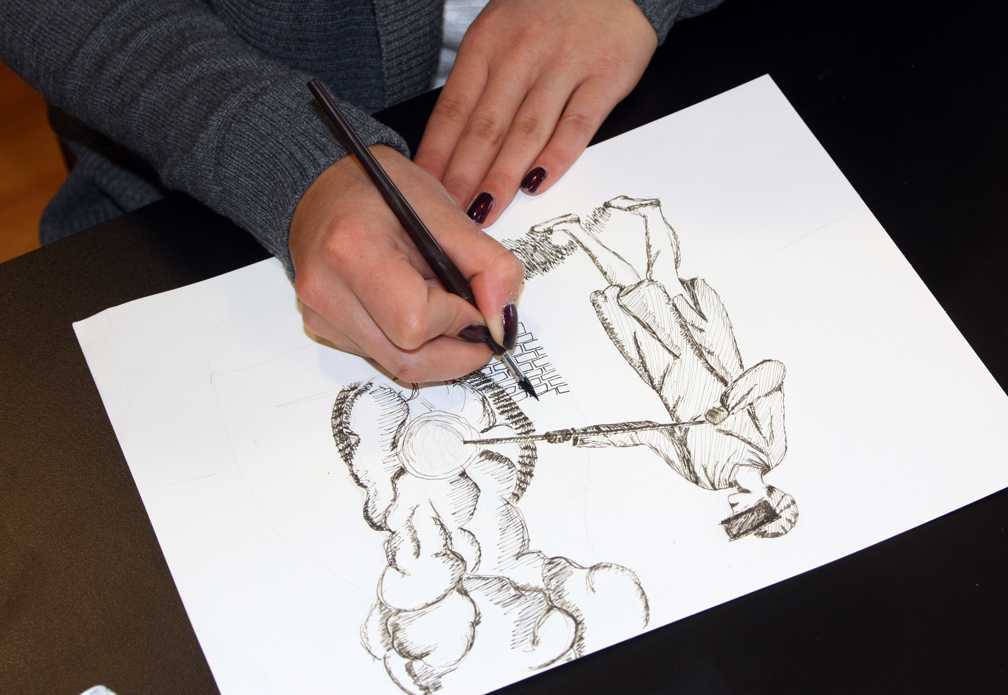
Using a traditional drawing pen with homemade ink

The procedure outlined in the ChemMatters article calls for students to boil 200 mL of water, then soak two tea bags in it for five minutes. Meanwhile, a steel wool pad is placed in a beaker with 100 mL of vinegar and boiled for seven minutes. The solution is filtered and cooled to room temperature, then 1 mL of 3% hydrogen peroxide is added. The grayish solution turns a reddish brown as the some of the iron (II) is converted to iron (III) ions (during our Intersession class, I had students use 10 mL of the hydrogen peroxide by mistake and their ink turned too brown). The iron solution and the tea are both added to small cups or vials in equal amounts and stirred together. A few drops of gum Arabic are added. My experience using this recipe produced rather anemic gray ink. As you can see from the illustration of Cai Lun (the inventor of paper) by Evan, with some experimentation you can achieve a very nice dark ink which compares favorably with India ink.

Cai Lun, the inventor of paper. Notice how rich and dark the ink is.

Cai Lun, the inventor of paper. Notice how rich and dark the ink is.

Of course, what my students have done deliberately in one class period took people during the Middle Ages centuries of trial and error to develop, and even by Newton’s time, everyone still had their own recipe. As you can see from the manuscript page, his was a good formula and made dark brown-black ink that has held up well for almost 400 years.

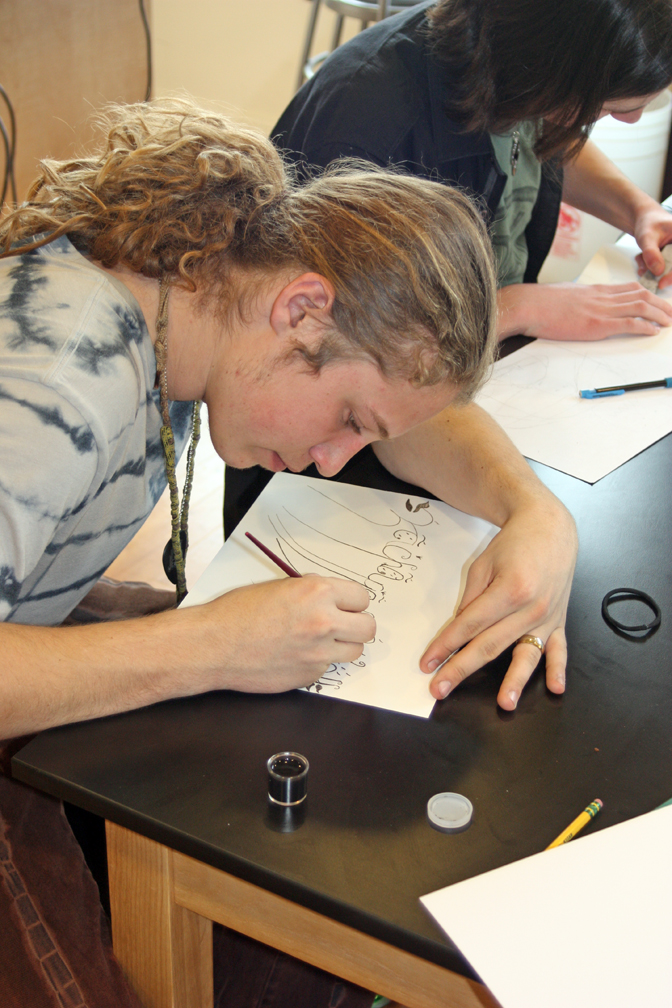
Zach practices daring Elvish calligraphy using homemade ink

Zach practices daring Elvish calligraphy using homemade ink

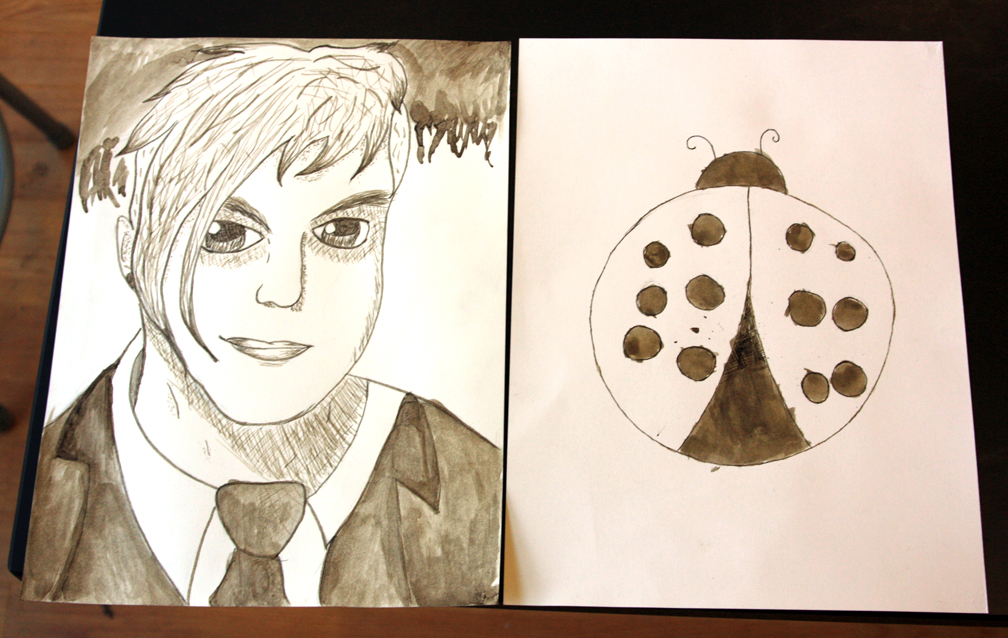
Once my students create good ink, they go farther and use traditional drawing pens to create illustrations related to the history of chemistry. They pick a material to research, such as glass or steel or armor or stained glass or paper, write up its history and manufacturing, and create their own illustrations with the iron-gall ink. I am showing some of these in this blog. We’ve tried different formulas. In the Intersession Science and Art class I taught in March, we cooked the steel wool for too long in the vinegar and got too much iron (III) ions, or added too much strong tea. The result was sepia colored ink instead of dark black, as shown in the ladybug drawing.

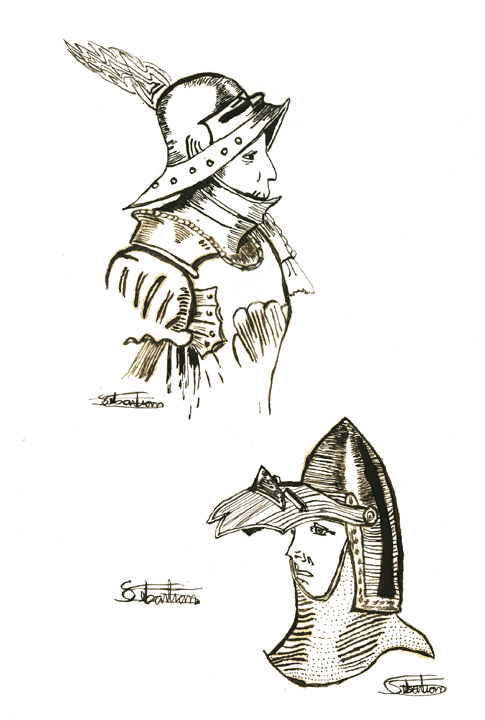
Illustration of armor by Sebastian using iron-gall ink

Illustration of armor by Sebastian using iron-gall ink

Try it out for yourselves! Make sure to use uncoated steel wool. You can get it easily at a hardware store. The other chemicals are household strength and readily found, except for the gum Arabic. Most art supply stores do have bottles of this. It is a bit pricey but a little bit is all that is needed. Two bottles should be enough for a class of 30 students. You will also need some bottles or phials to store the ink (it will last a long time and can be reconstituted with water if it dries out), drawing pens and Bristol board illustration paper, which will be the largest expense of your lab.

Illustrations from my Intersession class where the iron was overly oxidized and turned a sepia color.

Illustrations from my Intersession class where the iron was overly oxidized and turned a sepia color.

As an initial demonstration and “hook”, I use a traditional quill pen and some parchment paper to show how it used to be done. I also demonstrate writing Chinese characters (tsz) using ink sticks, inkwells, traditional maubi (drawing brushes), and rice paper. I’m not very good at drawing tsz, but at least I can show how to hold a maubi and use ink sticks (which are not iron-gall ink – they are “India” ink based on carbon black bound together in stick form, then rubbed with water in an ink well). The “love” character shown was drawn by Miyuki, a Japanese exchange student, on parchment.

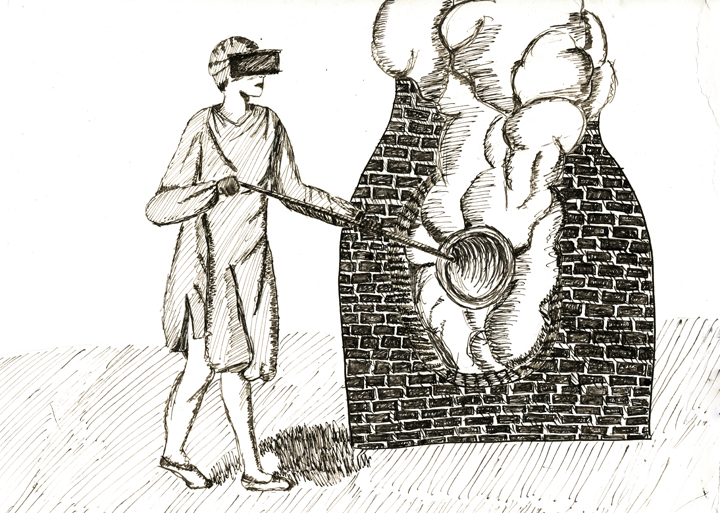
Illustration of plate glass making by Nicole

Illustration of plate glass making by Nicole

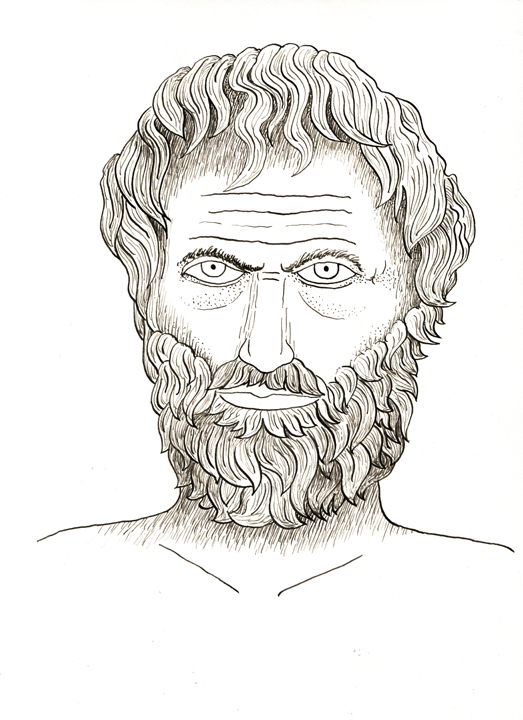
Drawing of Aristotle using iron-gall ink. I did this as a demonstration project for the chemistry students.

Drawing of Aristotle using iron-gall ink. I did this as a demonstration project for the chemistry students.

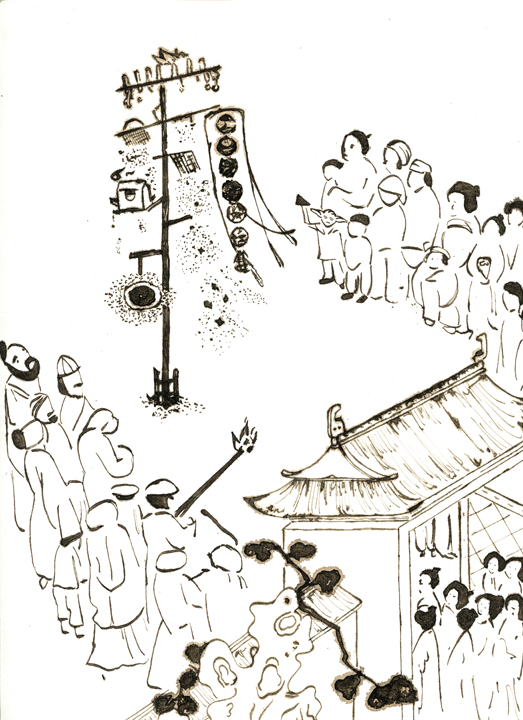
Illustration of Chinese fireworks by Richard, made with iron-gall ink

Illustration of Chinese fireworks by Richard, made with iron-gall ink

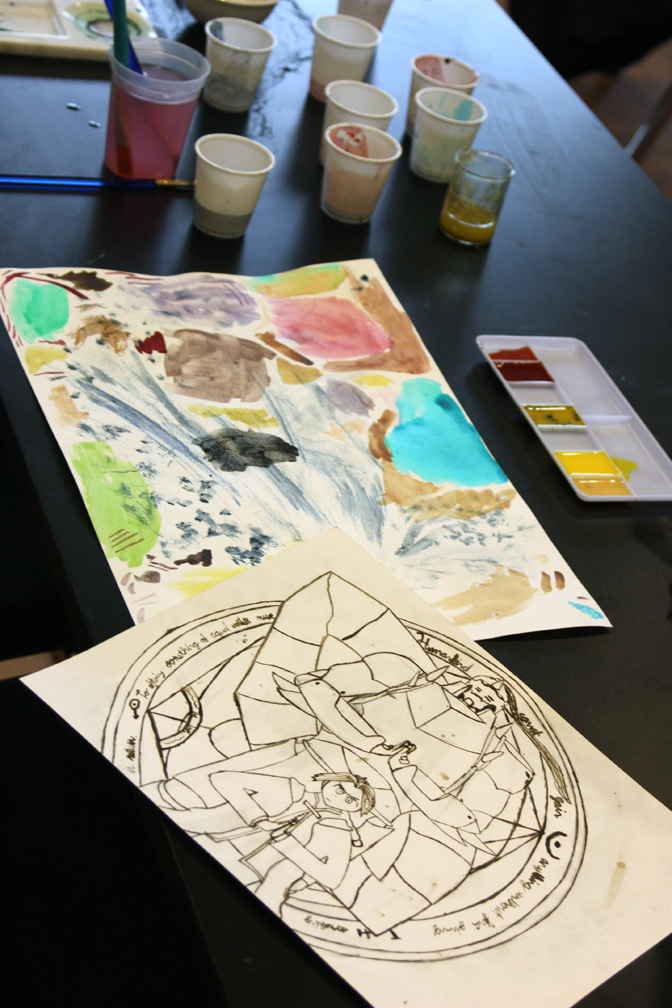
Alec's Anime drawing. Behind it are pigments we made for watercolors. Stay tuned for that post!

Alec’s Anime drawing. Behind it are pigments we made for watercolors. Stay tuned for that post!

Read Full Post »

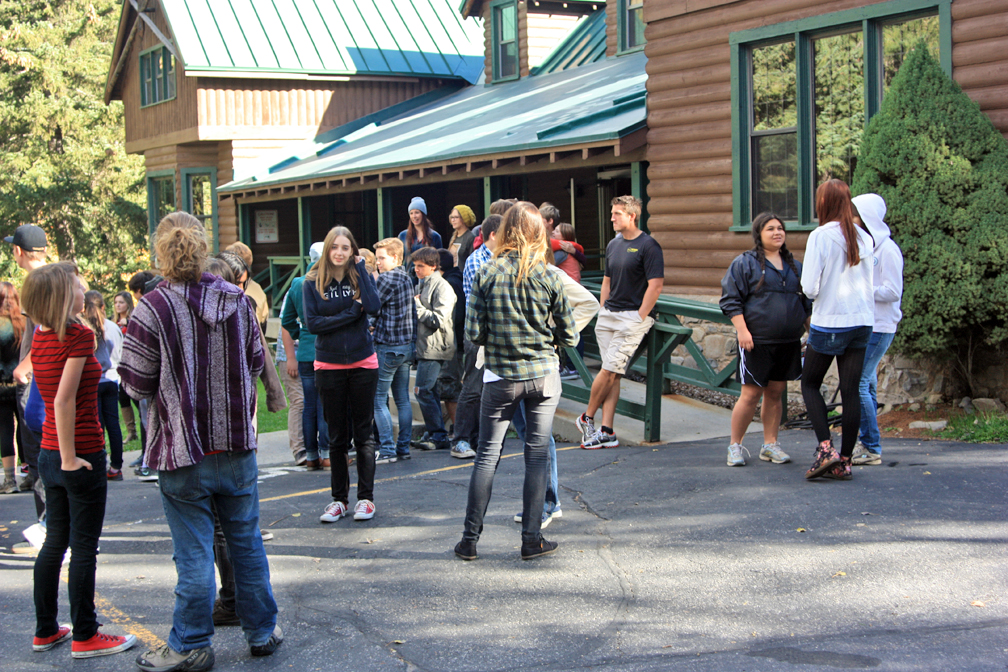
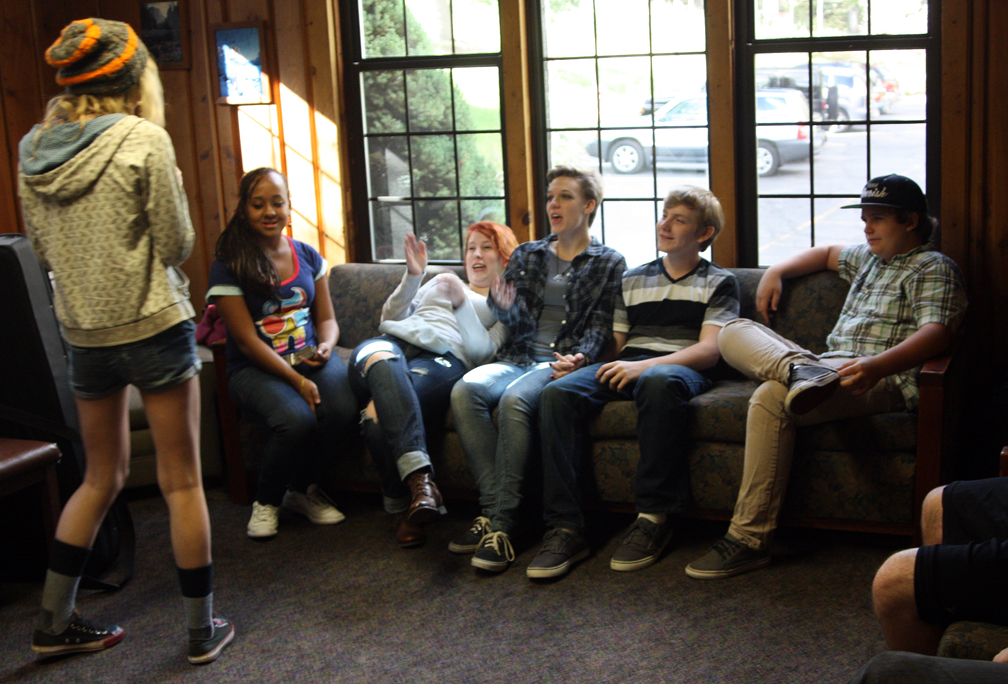
Walden School students at TImp Lodge near Sundance.

Walden School students at TImp Lodge near Sundance.

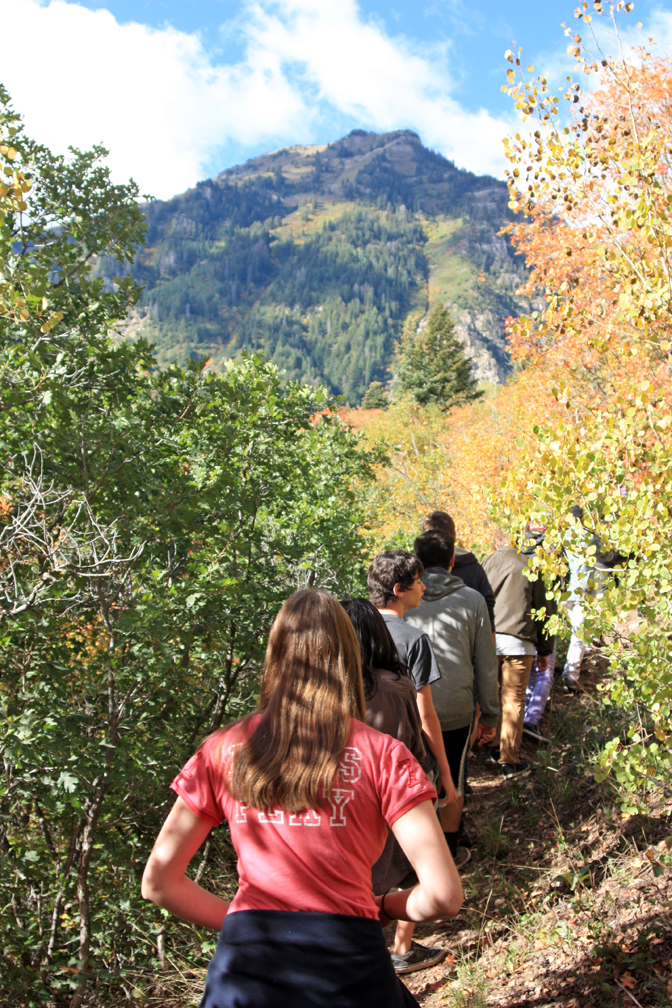
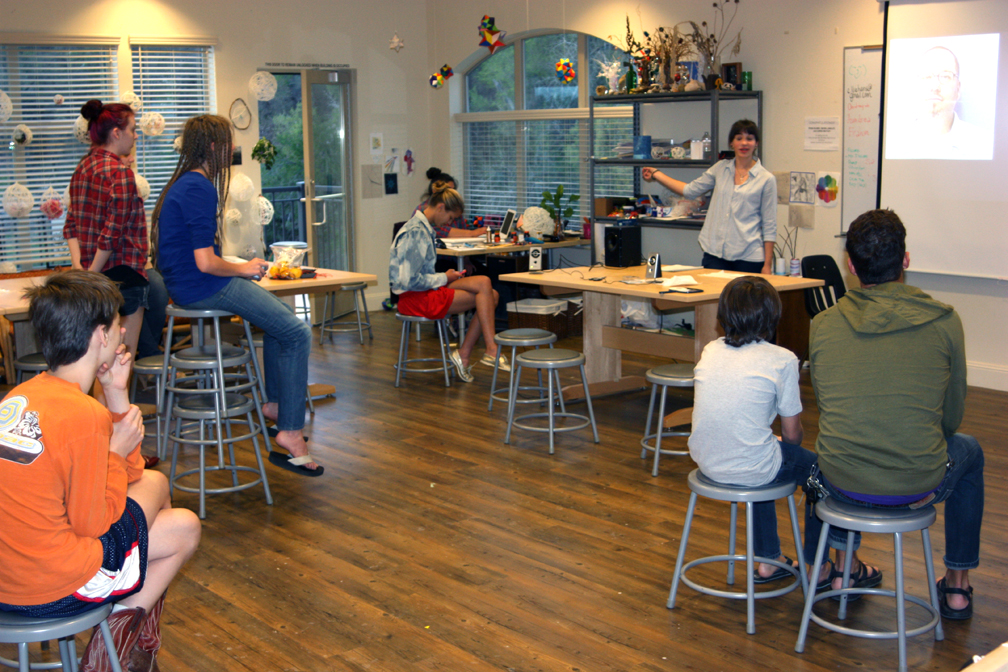
Each year in September we take all the students of Walden School of Liberal Arts up to Timp Lodge, a large cabin above Sundance Ski Resort owned and rented out by Brigham Young University. We rent it for a week and have the different grade levels take turns using it, with the high school using it for three days and two nights. We do this so that students can bond with teachers outside the regular classroom. By breaking up students in various workshops, we also hope to develop friendships between all the students and prevent cliques from forming. We do a variety of activities such as a 2-mile hike to Stewart Falls, workshops for the elementary students, a talent show, and a dance.

Walden School students inside Timp Lodge near Sundance.

Walden School students inside Timp Lodge near Sundance.

During our first day there, each teacher puts together a workshop that is both fun and educational. I had proposed to make Shrinky Dinks using the process I’d learned at the ASM materials science camp this summer, but not enough students signed up for it (I guess I need to come up with a better name . . .). One of our new part-time teachers, Austin, was trying to brainstorm some workshop ideas and I helped out, since he didn’t know what kinds of things would work. We came up with the idea of doing tie-dyed shirts. He had 30 students sign up, so I agreed to help out. Now why didn’t I think of that in the first place?

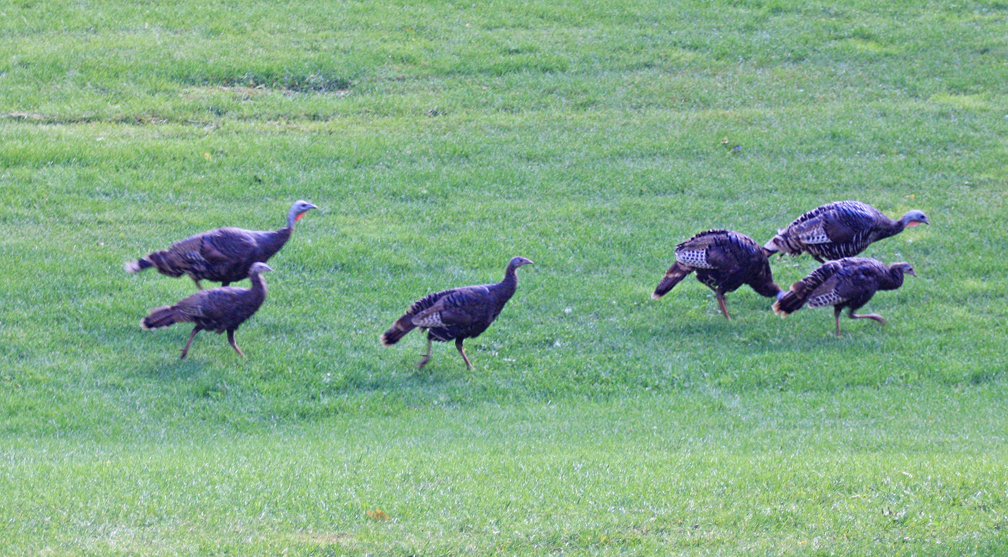
Wild turkeys at Timp Lodge near Sundance. And I'm not talking about students, either.

Wild turkeys at Timp Lodge near Sundance. And I’m not talking about students, either.

Since not all of the 30 could get around the tables and use the dye bottles at the same time, I came up with an additional idea to make marbled paper. I’ll describe this in my next post. But this time, lets talk tie-dye.

Hiking to Stewart Falls.

Hiking to Stewart Falls.

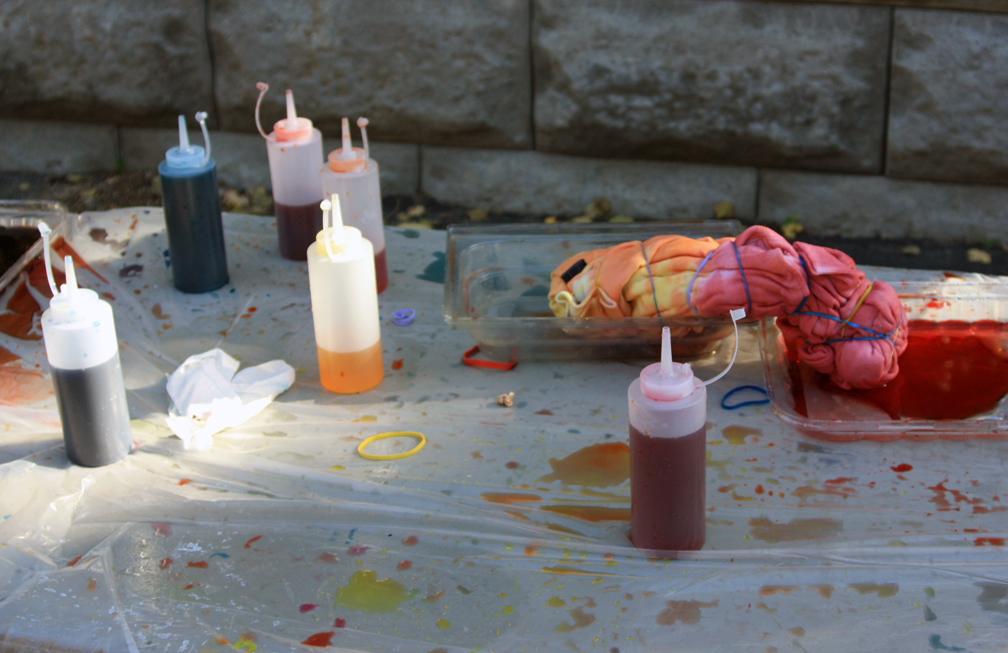
Austin purchased an assortment of standard Ritz dye colors and some plastic squirt bottles (such as used for catsup or mustard). We had the students bring their own shirts or other clothing items (some did socks, and one even did underwear), but we purchased extras for those who couldn’t bring their own. We also brought tubs and buckets for mixing the dye, plastic disposable tablecloths, large Ziploc bags, rubber bands, and washing soda as a mordant.

Squirt bottles full of fabric dye. We used yellow, orange, carmine, purple, blue, and cyan.

Squirt bottles full of fabric dye. We used yellow, orange, carmine, purple, blue, and cyan.

A mordant is a chemical that forms a coordination complex with the dye molecule so that it can attach permanently to the fabric substrate, such as wool or cotton fibers. As for any pigment, for the color to last, it must be insoluble in water, yet the dye itself must be soluble in water when first mixed. The mordant forms a “lake” (from the old Latin “lac” from which the word shellac is also derived) that makes the dye insoluble and permanent. The mordant is usually a metal ion salt that forms a base in solution, such as washing soda (sodium carbonate). Other common mordants used historically include urea, tannic acid, aluminum salts such as alum (aluminum phosphate), and even salt (sodium chloride). I would like to do this in a more controlled setting sometime to test the effectiveness of different types of mordants.

Method for making a bulls-eye pattern. The center is pulled up while the shirt is twisted slightly, then bound in sections by rubber bands and dyed.

Method for making a bulls-eye pattern. The center is pulled up while the shirt is twisted slightly, then bound in sections by rubber bands and dyed.

Our procedure was to mix the washing soda into a bucket of water and soak the T-shirts in it for several minutes. We then spread them out on the plastic tablecloths and folded them to produce one of several patterns. For example, you can make a spiral design by taking the center point and pinching the cloth, then twisting the whole shirt into a spiral and tying it together with rubber bands around the outside and across the center. The dyes are then squirted onto the rolled up shirt to form wedges of color, overlapping them to make gradients. We discovered that you get more color if you really saturate the dye in the wedges, going over them several times and even squirting some in between the cracks and ridges so that color gets down deep and leaves less white.

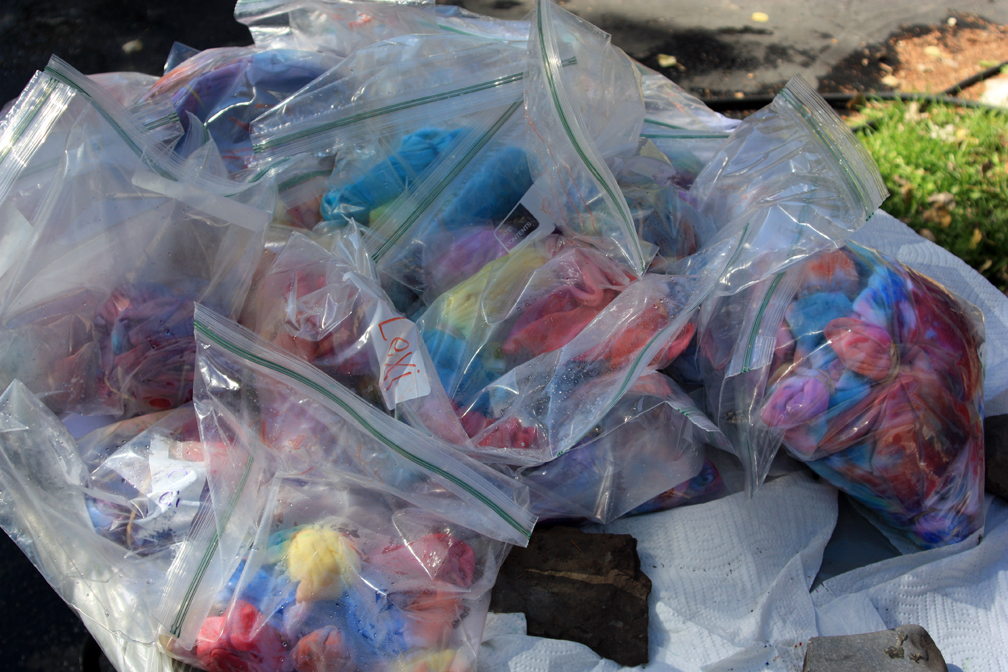
Ziploc bags full of dyed T-shirts. The dye was allowed to set before air drying.

Ziploc bags full of dyed T-shirts. The dye was allowed to set before air drying.

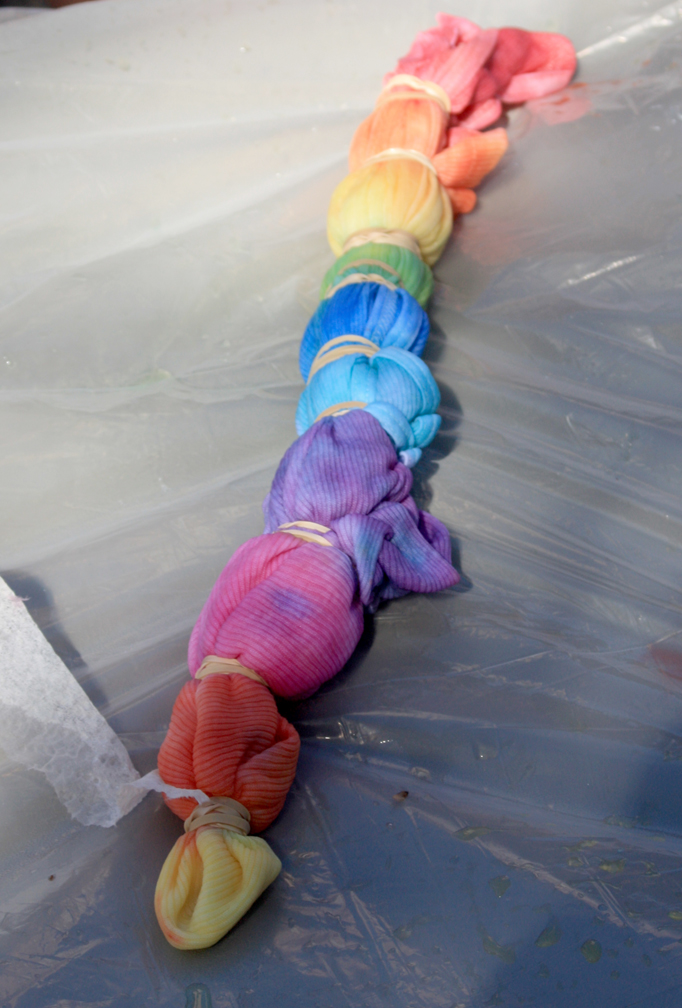
To make bulls-eyes, choose the center and pull it up while twisting to make a long rope, then attach rubber bands at intervals to hold the cloth together. Squirt different colors of dye between the rubber bands. Where the rubber bands are pinching the cloth together, less dye will penetrate and will leave white rings separating the bands of color.

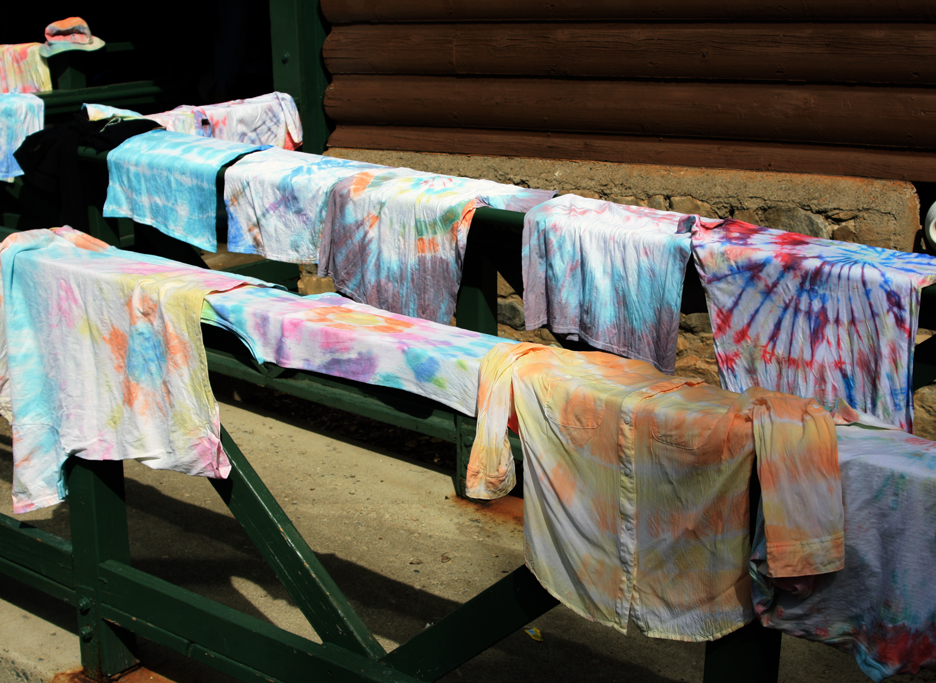
Drying T-shirts at Timp Lodge.

Drying T-shirts at Timp Lodge.

To make tiger stripes, lay out the T-shirt face up, then drag your finger from one shoulder diagonally down to the opposite corner, creating a pleated fold that is then held together by rubber bands. Bands of dye color are squirted along it. To make a plaid pattern, take the tiger striped pattern and make a second set of accordion-style pleats.

Plaid, spots, and spiral patterns.

Plaid, spots, and spiral patterns.

We had enough T-shirts that I tried several different patterns to see which were best. I liked all the results, especially the tiger stripes. I think I would create a gradient of colors (say yellow through orange to red) across an unfolded shirt, then fold it and make a second set of colors (blues and greens). That way, interesting color combinations would result and there wouldn’t be any undyed white areas. Or I could do two different patterns on each shirt, letting them dry in between. I will have to do more experimentation.

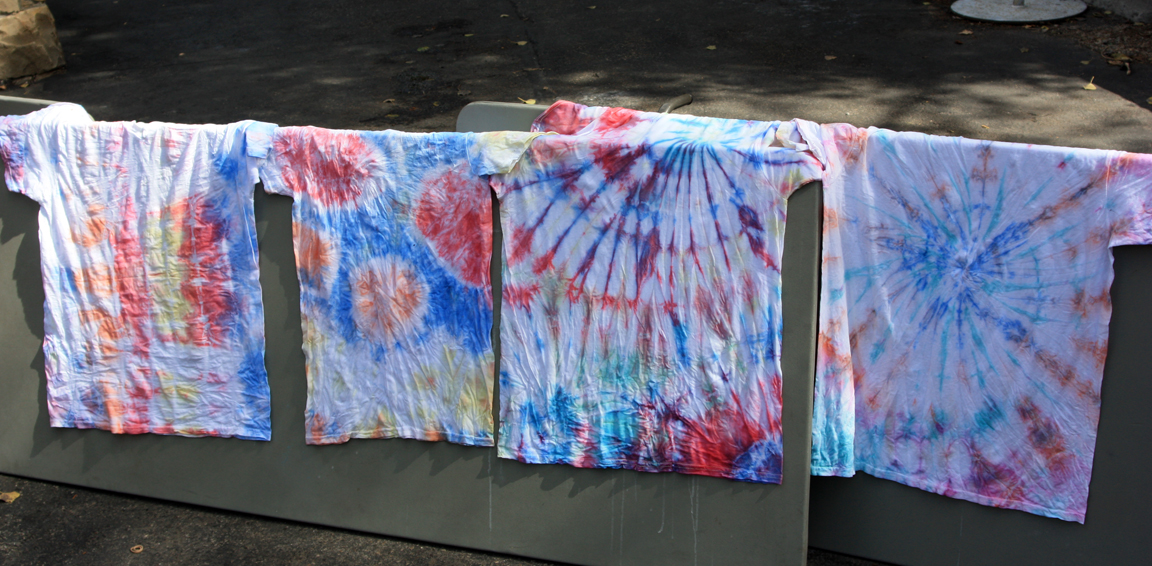
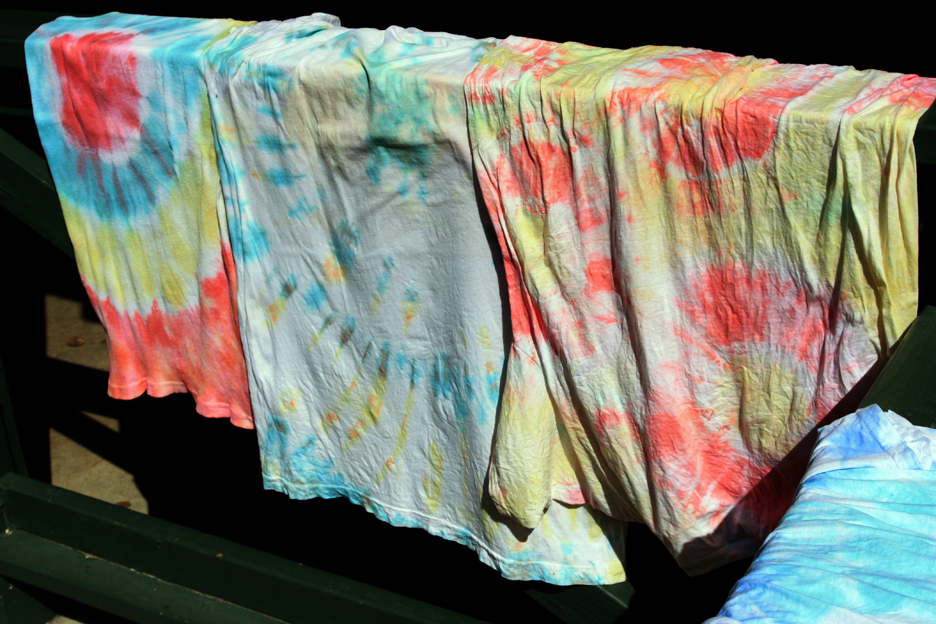
Tie-dyed shirts showing different patterns.

Tie-dyed shirts showing different patterns.

After applying the dye, the students sealed the shirts in Ziploc bags for several hours to allow the dye to set, then gently washed the soda out. They then let the shirts dry completely in the sun. I told them the color would be fast (permanent) if they heat set it by running the shirt through a drier before washing it. It remains to be seen just how color fast our T-shirts are. The ones I’ve made have held up pretty well.

Fall 2014 tie dye samples

A sampler of shirts, socks, and scarves dyed in my 2014 Timp Lodge workshop.

We had T-shirts drying all over the place on the Lodge’s railings and many turned out quite well. For the next several days after we returned from Timp Lodge we had quite the tie-dye fashion show as students wore their shirts to school. We’ve had the reputation of being “that hippie school” in the past, so I suppose this helps verify our image.

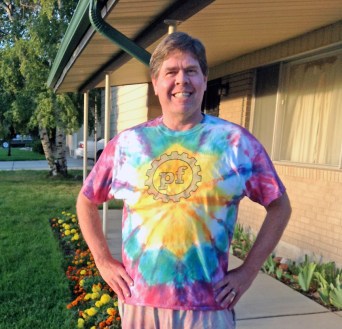
Star shirt

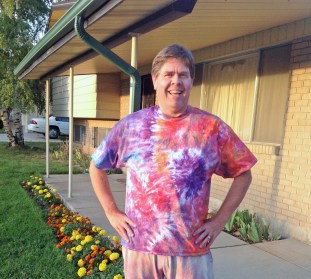
Yours truly wearing a star patterned shirt. I’m running out of white T-shirts, so I’ve been using whatever I can for practice.

Update to Post for Fall, 2015: 

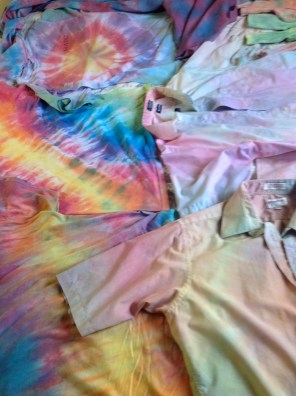
I have continued the tie dye class at our annual Timp Lodge retreat for three years now. Looking at the photos shown above, I can see we’ve made some progress. The main difference has been introducing a better type of dye. Instead of the Ritz dyes you buy at a grocery store, which create the weak colors seen above, I ordered Procion MX dyes from Dharma Trading Company and the results have been much more spectacular. I have even re-dyed some of the shirts from 2013 just to get better results.

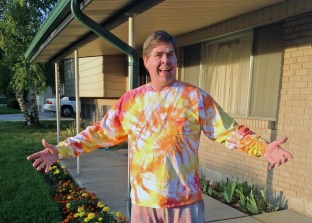
Double spiral shirt

I found a nice long-sleeved white shirt at a local store and dyed it into a double-spiral pattern. It didn’t work as well as I’d hoped, but the colors are fun. You can see that the Procion MX dyes are much more intense than the standard Ritz colors.

I’ve learned how to make several advanced patterns, such as stars (you fold the shirt in an origami pattern similar to a paper airplane and tie it off using chopsticks and rubber bands), double spirals, and even Taoist Yin-Yang symbols, which involve sewing in lines of thread that can be pulled to gather the cloth in a specific pattern of S-curves and circles.

Dao shirt

I was attempting to make a Taoist Yin-Yang symbol by gathering the shirt along an S-shaped curve with two circles. It didn’t quite work, but the colors turned out well.

I have standardized the student samples by purchasing white wash cloths and towels for the students to use instead of relying on them to remember to bring T-shirts or whatever.

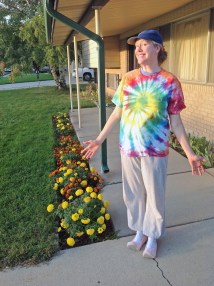
Becca spiral shirt

My wife, ‘Becca, wearing a standard spiral pattern I made for her. This one turned out nicely.

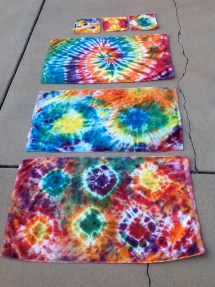
Towels

Some sample towels and dishcloths I did at Timp Lodge.

In other words, I have this fun art form down to practically a science. The only problem is that I now have so many tie dye items, its come to dominate my wardrobe! I even have tie-dyed socks and shorts.

Dao towell

This towel shows the Yin-Yang symbol pattern much more clearly, although I didn’t plan out the colors very well.

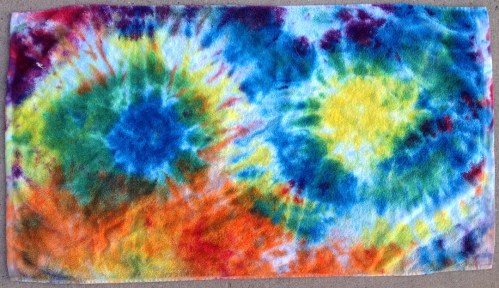
Spiral towell

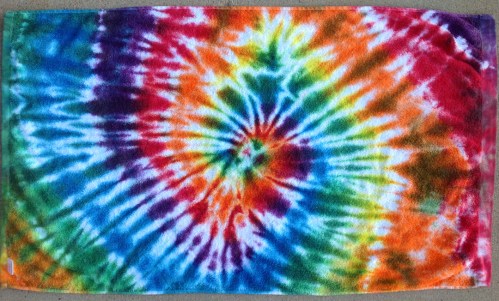
A classic spiral pattern on a white towel.

Read Full Post »

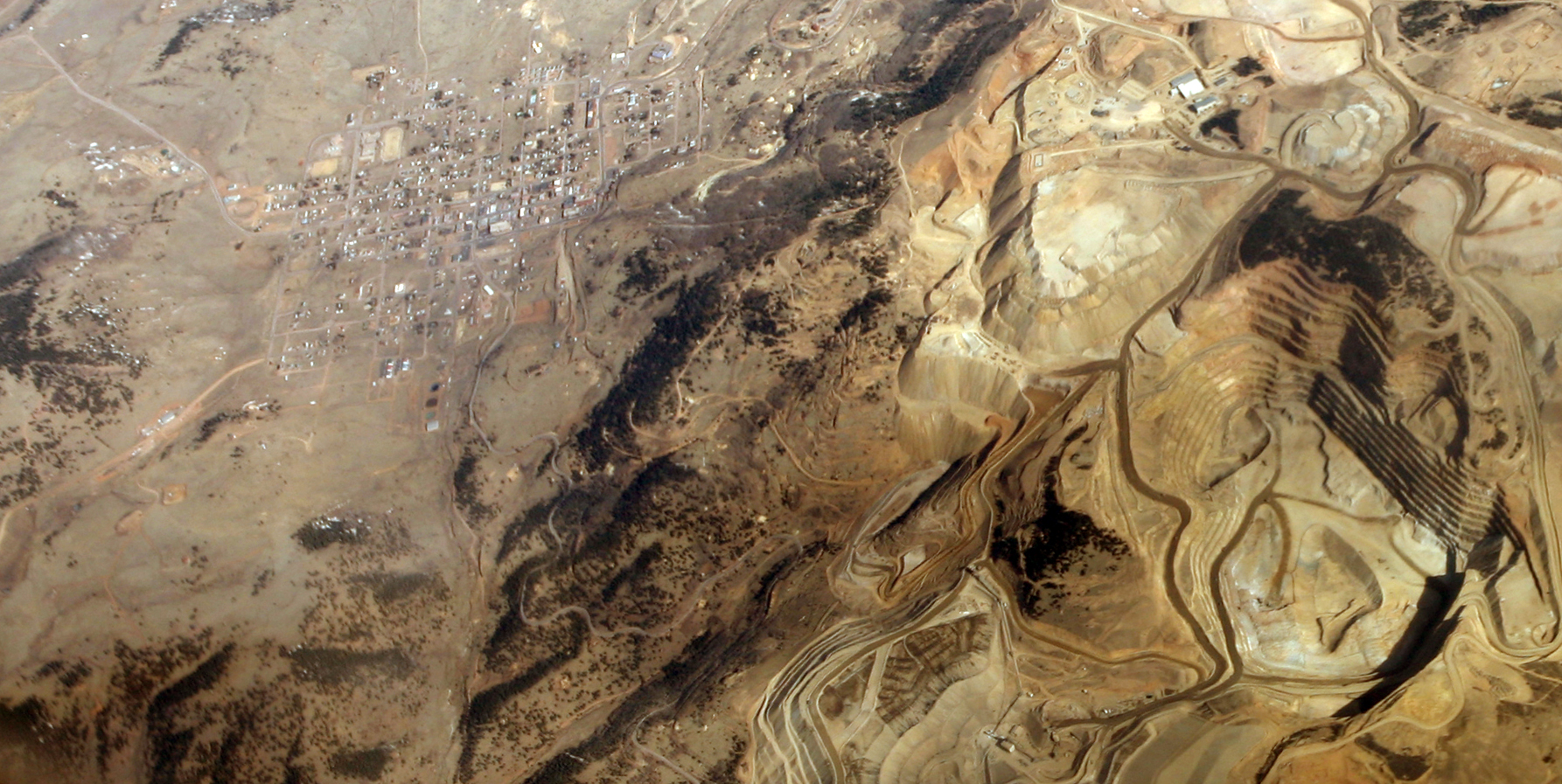
Aerial View of Cripple Creek and Victor Mine

Aerial View of Cripple Creek and Victor Mine

My seventh day touring mining towns in Colorado was spent in the vicinity of Goldfield and Victor in the Cripple Creek Mining District. I traveled to the American Eagles Overlook above the Cripple Creek and Victor Gold Mine and hiked on the Vindicator Valley Trail above Goldfield.

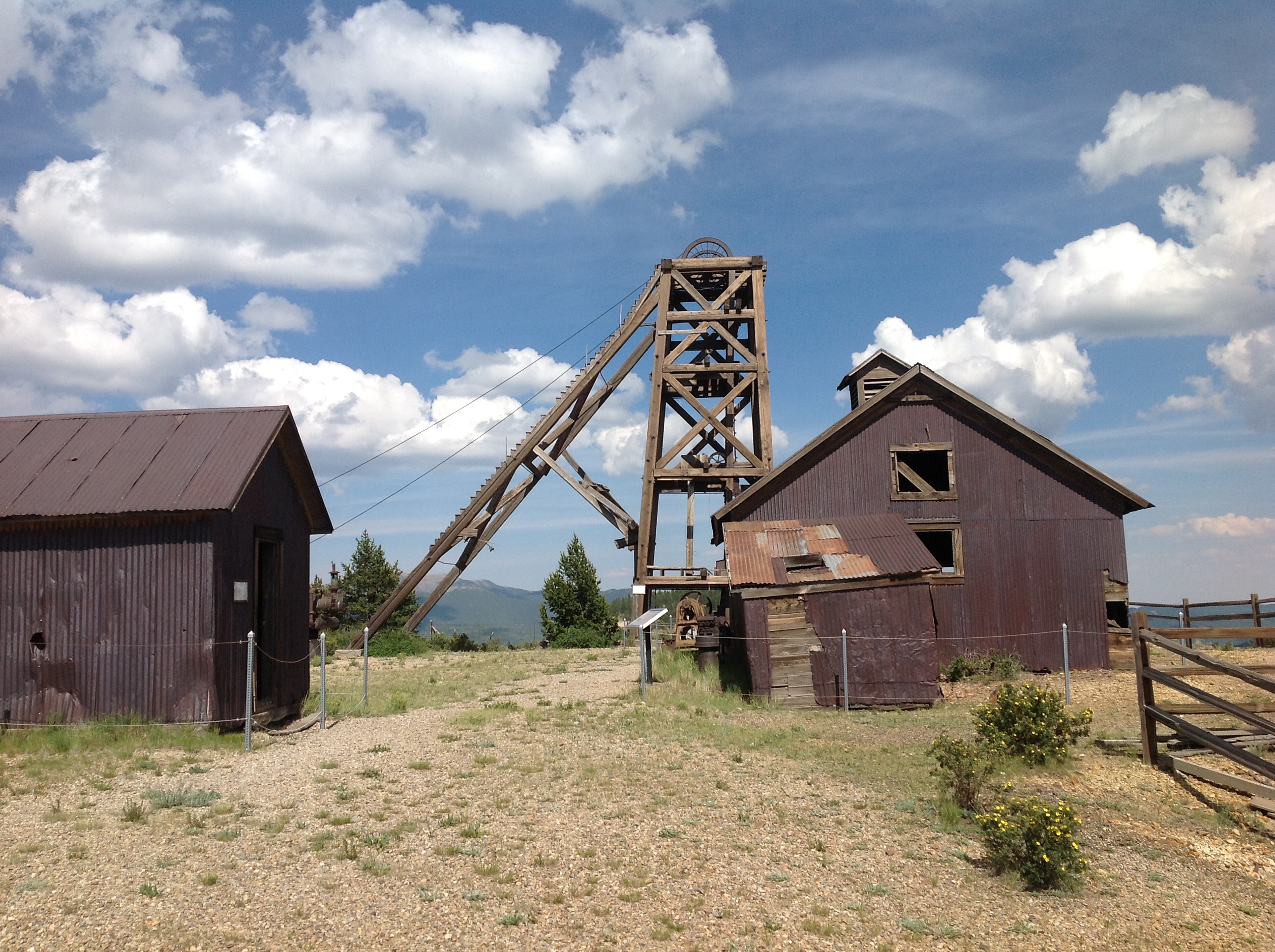
Headframe and Shops at the American Eagles Mine

Headframe and Shops at the American Eagles Mine

Since I had arrived in camp rather late the night before, I took all of the morning to recharge my batteries, literally and figuratively. My long trip the day before which started in South Fork and traveled through Creede, Lake City, and Gunnison had used up all the spare batteries I had for all my cameras, and I was still exhausted myself. I showered in the headquarters building of the KOA and finished setting up camp, making up my tent and sleeping bag for tonight. Then I spent the rest of the morning charging up my various camera batteries and spares in the game room while reading an old Andre Norton book on my iPad.

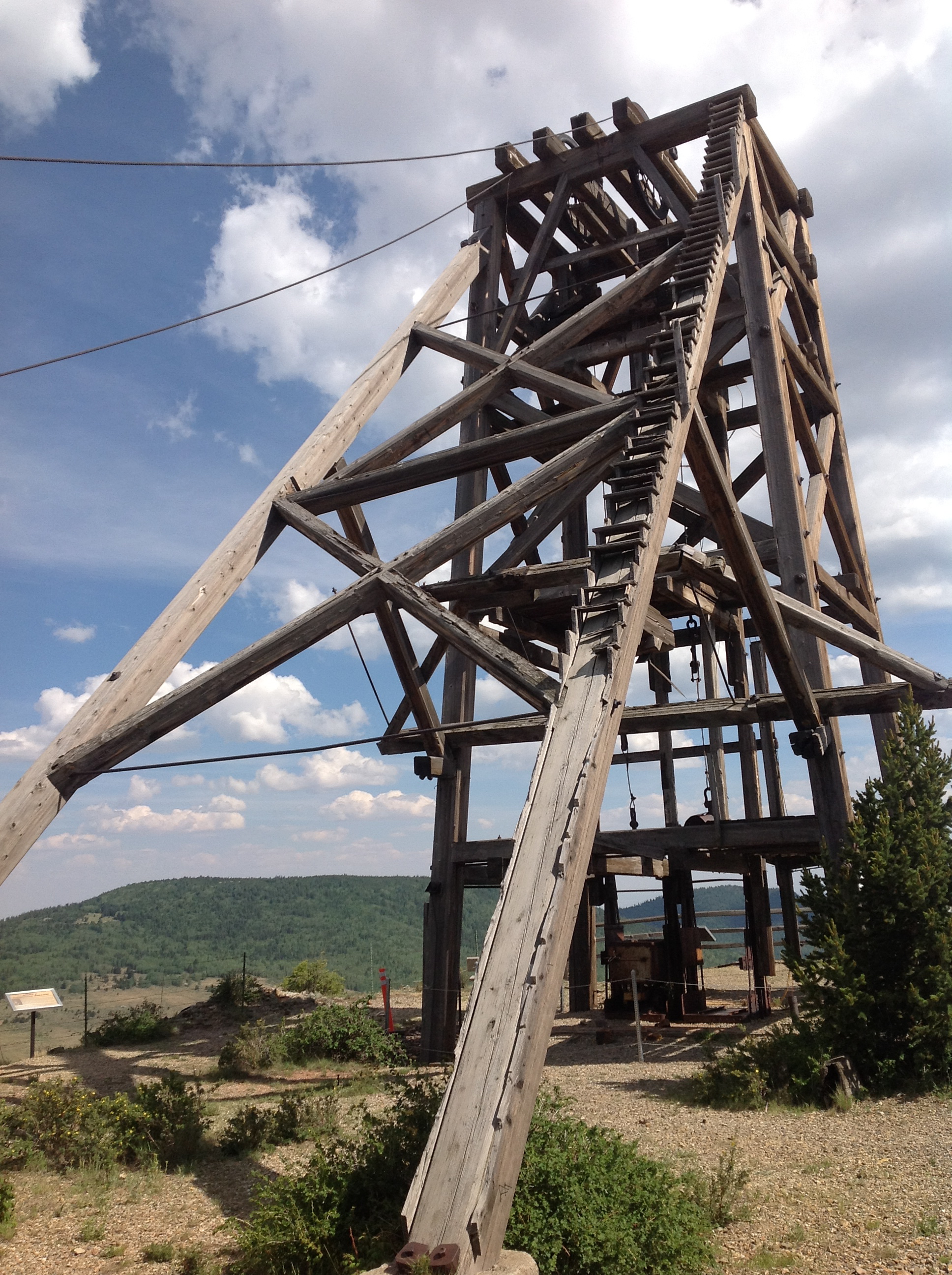
American Eagles Headframe

American Eagles Headframe

Finally in the afternoon I headed out, driving south and taking the gravel road up to the overlook. It crosses the main road used by the ore trucks taking overburden to the dump locations. I stopped on the way to look at the open pit mine operations of the Cripple Creek and Victor Mining Company, which is a wholly-owned subsidiary of AngloGold Ashanti. They are digging a huge pit down through what was the old Cresson Mine (the same mine that discovered the huge vug back in 1914, basically a large geode the size of a room lined with 60,000 troy ounces of gold). I’ll speak more about the open-pit mine tomorrow, because I took an excellent tour of it. While observing the operation, I used a time-lapse app on my iPad to record the huge trucks driving their loads out of the pit.

Panorama of the Cripple Creek and Victor Open Pit Gold Mine

Panorama of the Cripple Creek and Victor Open Pit Gold Mine

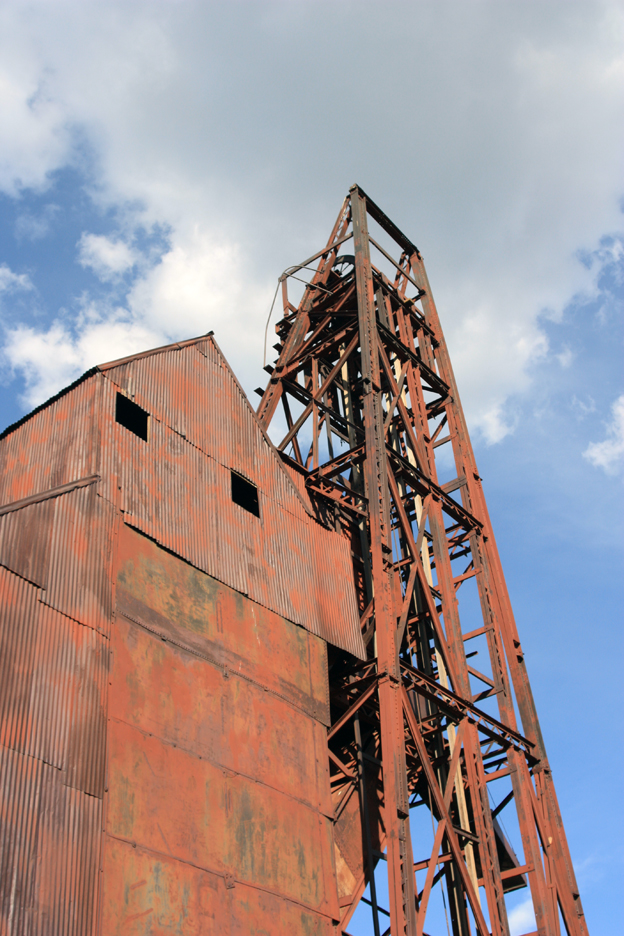
The American Eagles Mine was the highest mine in the district at 10,570 feet with one of the deepest shafts at 1540 feet. The land around it is a small spot of green surrounded on all sides by the CC&V operations. From there, one can see all the way to the Collegiate Peaks in the west and to Pike’s Peak to the northeast. Winfield Scott Stratton, whose famous Independence Mine turned him from an itinerant carpenter into the richest man in the district, bought the American Eagles Mine in 1895 as part of his consolidation of mines in the area. Today, the old headframe still stands with its double hoist and cage. Several out buildings, such as the shifter’s house and blacksmith shop, still stand as well. I spent a very pleasant hour at the top, reading the signs and enjoying the cool breeze.

Dumping Overburden from the CC&V Open Pit Mine

Dumping Overburden from the CC&V Open Pit Mine

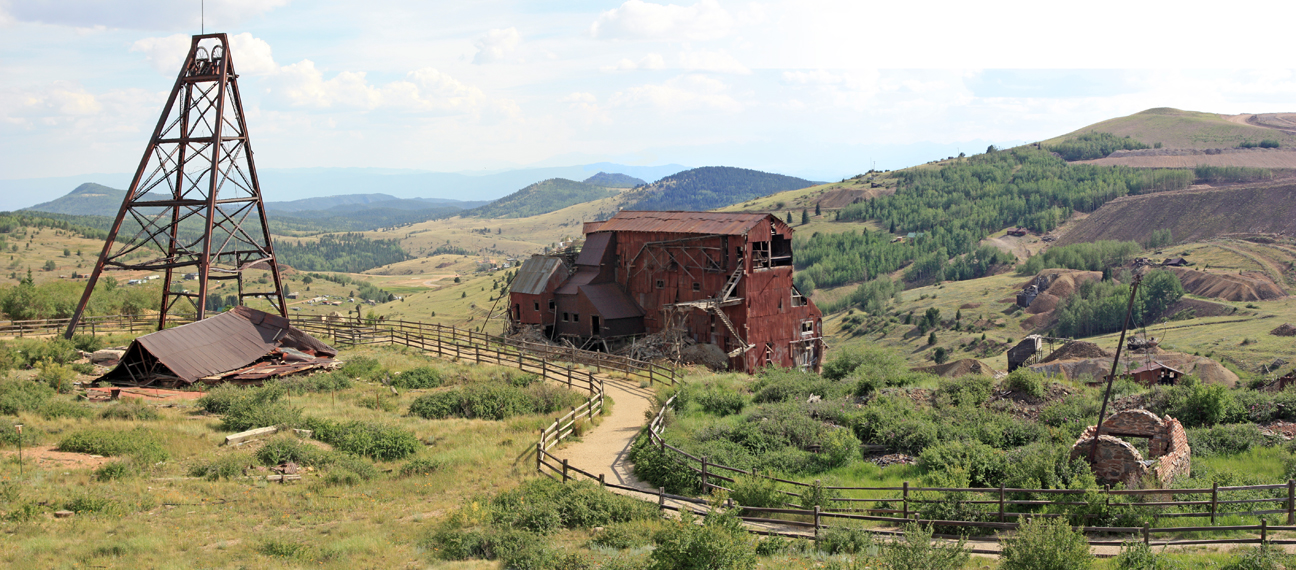
Vindicator Valley with Headframe and Mill

Vindicator Valley with Headframe and Mill

On the way back down, I stopped and hiked the Vindicator Valley trail. This area lies between the overlook and the town of Goldfield. It includes the Vindicator Mine and Mill, with a large steel headframe and the decaying remains of the mill. I walked along the path, which is about 2 miles total. In places it was a bit of an uphill hike, and I should have been tired by the altitude, but I have grown acclimated and I actually felt better and more vigorous that I do at my normal 4500 feet.

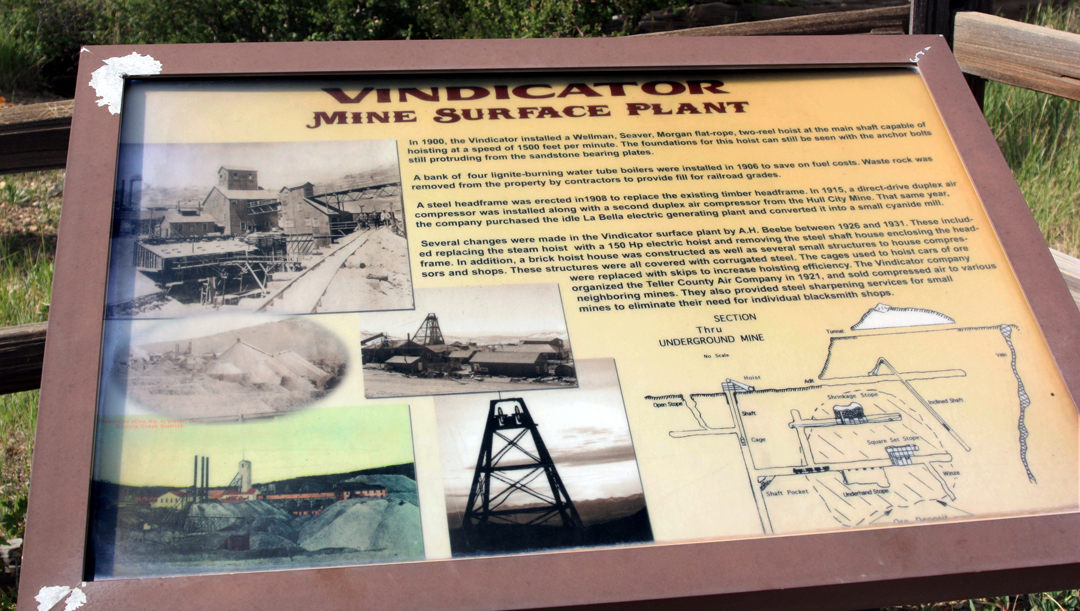
Sign for the Vindicator Mine and Mill

Sign for the Vindicator Mine and Mill

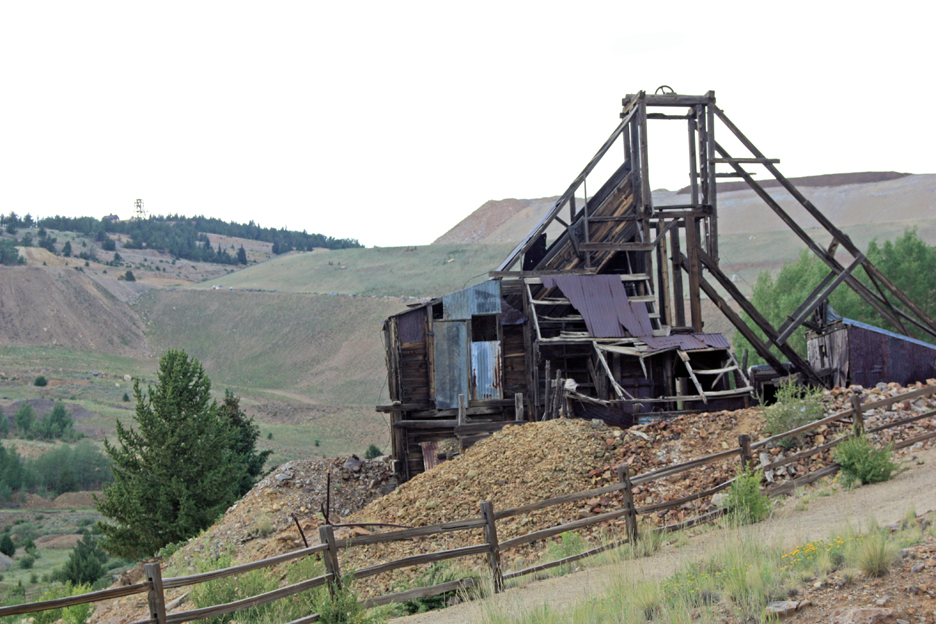
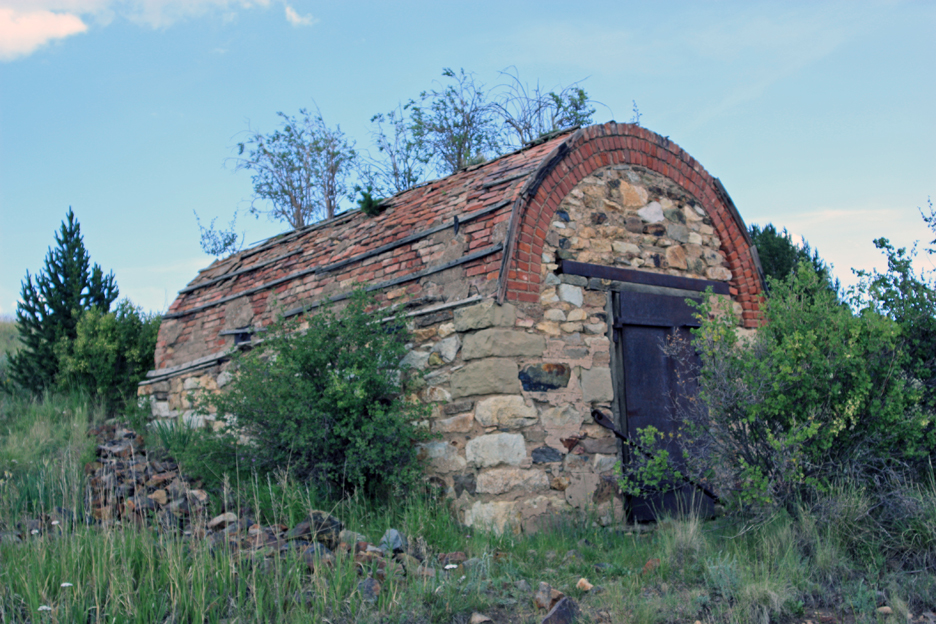
All through the valley are many remnants of mining structures, such as powder magazines, ore bins and transport systems, headframes, and mills. Some of the structures have been moved here to preserve them from the CC&V operations. The company seems to have a real interest in preserving the history of the area, and Colorado overall does a much better job of this than Utah, where the only value seems to be to close the mines, cover the dumps, and pretend mining never happened.

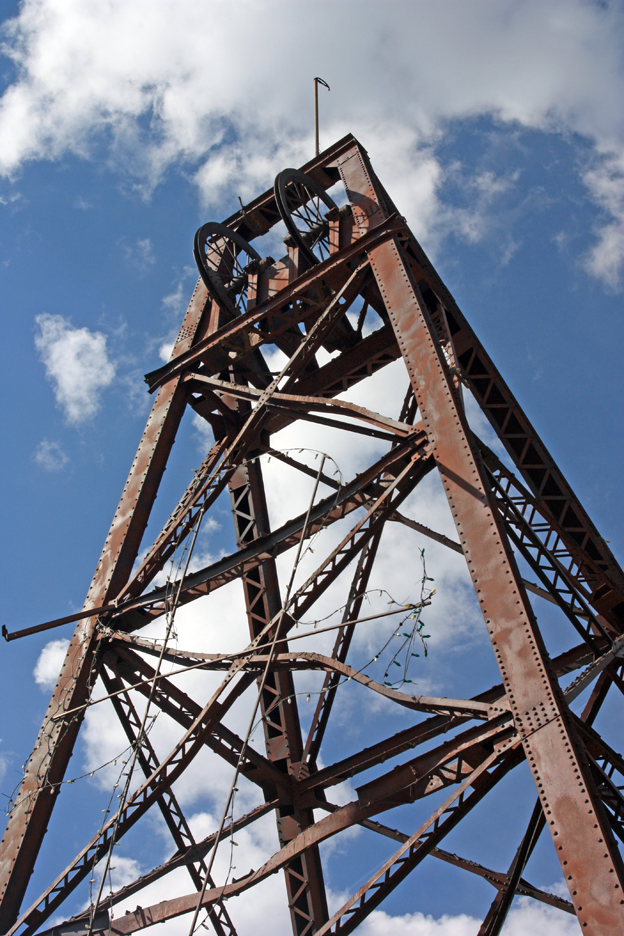
Steel Headframe for the Vindicator Mine

Steel Headframe for the Vindicator Mine

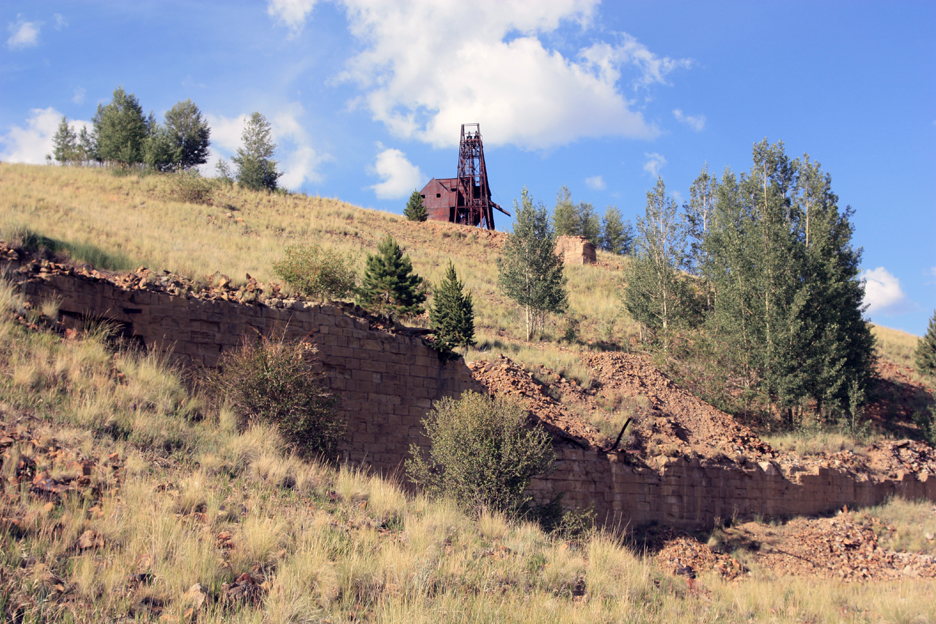
Other structures I passed included the LaBella steam powered electric plant that was at the bottom of the trail and powered the operations in the area, the Gold Knob Mine (seen as wooden cribbing toward Goldfield), and the Theresa Mine headframe. This mine was active from about 1895 through the 1950s. It was closed during World War II, as was all gold and silver mining in the country. By the time the mines reopened, so much work was needed to repair and upgrade them that most of the mines closed. It wasn’t until the 1970s that gold operations started up again, mostly leaching of old low-grade mine waste and some small open pit operations. But in the 1990s a large-scale open pit mining operation was engineered and begun which is now the CC&V mine. As the mine has grown, so have the piles of overburden rock, seen on the upper slopes of Vindicator Valley.

LaBella Electric Plant Site

LaBella Electric Plant Site

From photos I’ve seen of what the area around Victor looked like in the early 1900s, things have changed quite a bit. Many of these mines, such as the Theresa, were worked off and on from the 1890s through the 1950s, and many original wooden headframes were eventually replaced by steel headframes.

Theresa Mine Headframe

Theresa Mine Headframe

Some structures were torn down for scrap metal, others were destroyed by time. Some, such as the Lillie Mine and Mill, were bought out by other companies (such as the Vindicator Mine or the Gold Cycle Mining Group owned by David Moffat and A. E. Carlton, which bought up many of the defunct claims) and their buildings were torn down and foundations buried by waste rock. In the 1970s and 80s much of this waste rock (huge piles of it) were dug up and processed using the leach pile method to recover gold from the marginal ores. This changed the look of the valley and moderated it. The CC&V mine has done a lot to reclaim the slopes and replant native species, such as areas of pine trees growing throughout the valley. They have reinforced some of the structures and built the trail systems with interpretive signs.

Anna J. Mine looking up Vindicator Valley to the American Eagles Overlook.

Anna J. Mine looking up Vindicator Valley to the American Eagles Overlook.

Powder Magazine. The explosives had to be kept separately from the mines to prevent accidental destruction.

Powder Magazine. The explosives had to be kept separately from the mines to prevent accidental destruction.

After this walk I drove into Victor at sunset to try to buy a steak for supper, but the small grocery store only had hamburger. I did take some good photos of the town in nice lighting. Back at camp, sunset lingered as I cooked supper and took some additional photos of the grass and aspens around camp.

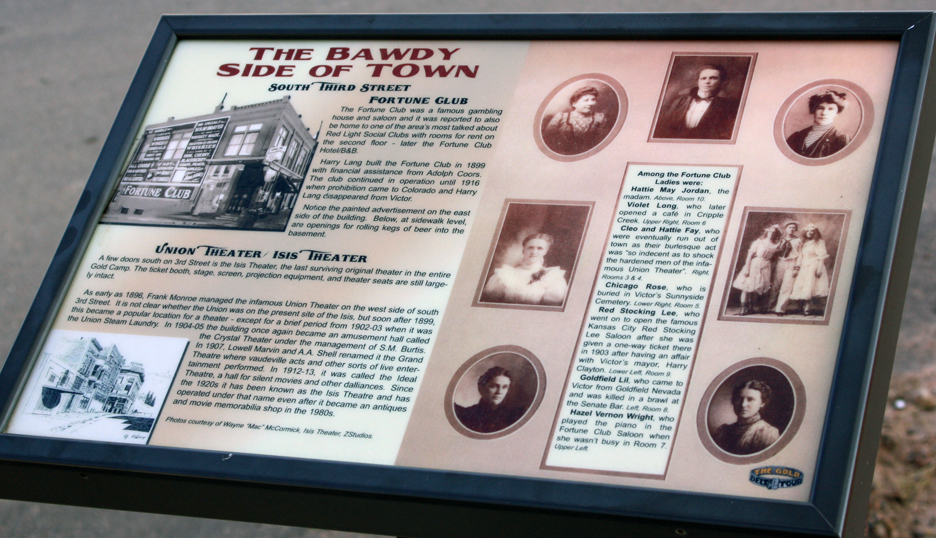
A Sign in Victor, Colorado explaining the bawdy side of town.

A Sign in Victor, Colorado explaining the bawdy side of town.

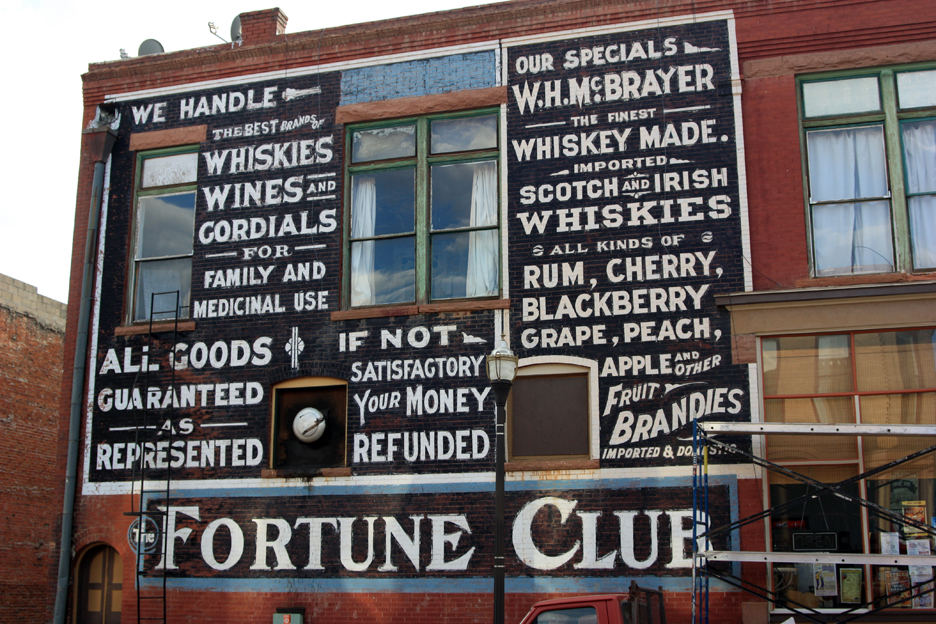
The Fortune Club in Victor, Colorado, known for its . . . er . . . entertainment.

The Fortune Club in Victor, Colorado, known for its . . . er . . . entertainment.

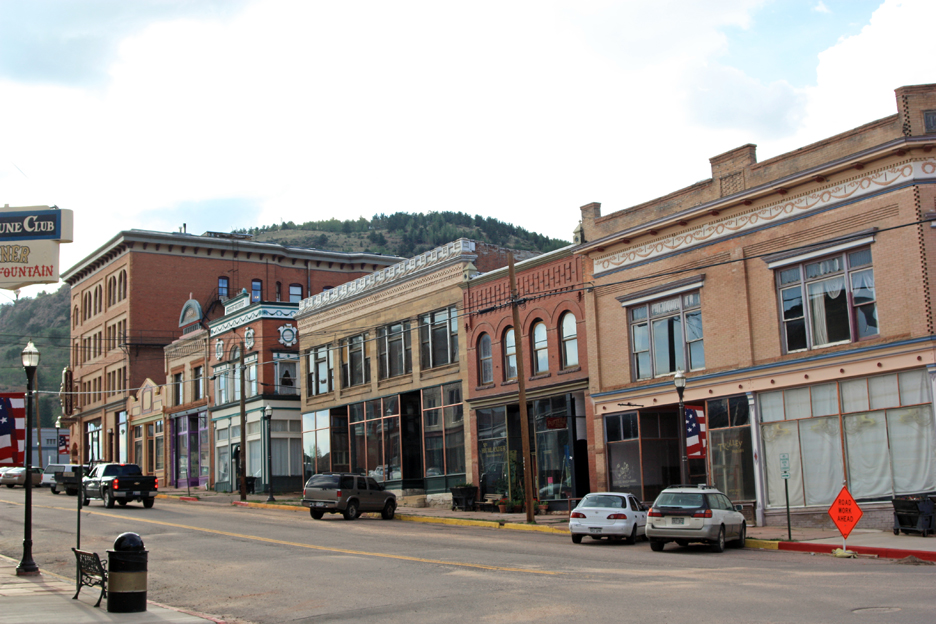
Third Street in Victor, Colorado.Third Street in Victor, Colorado.

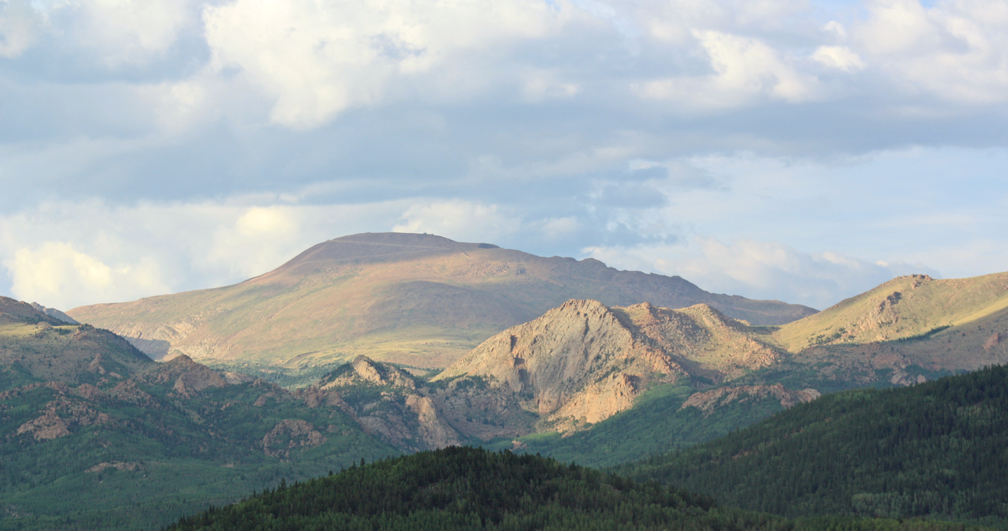
The Back Side of Pike's Peak

The Back Side of Pike’s Peak

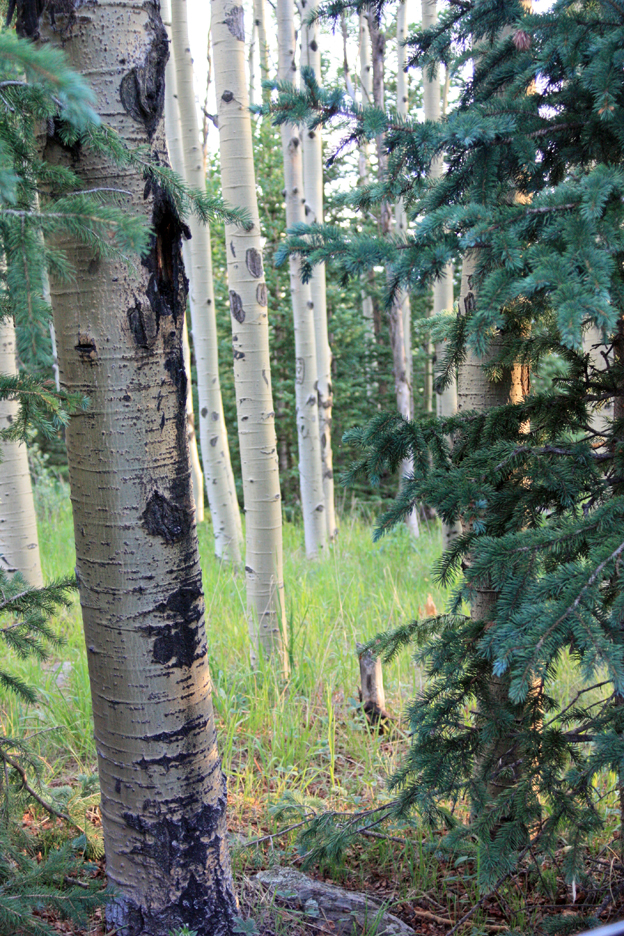
Aspens and Colorado Blue Spruce at my camp.

Aspens and Colorado Blue Spruce at my camp.

Read Full Post »

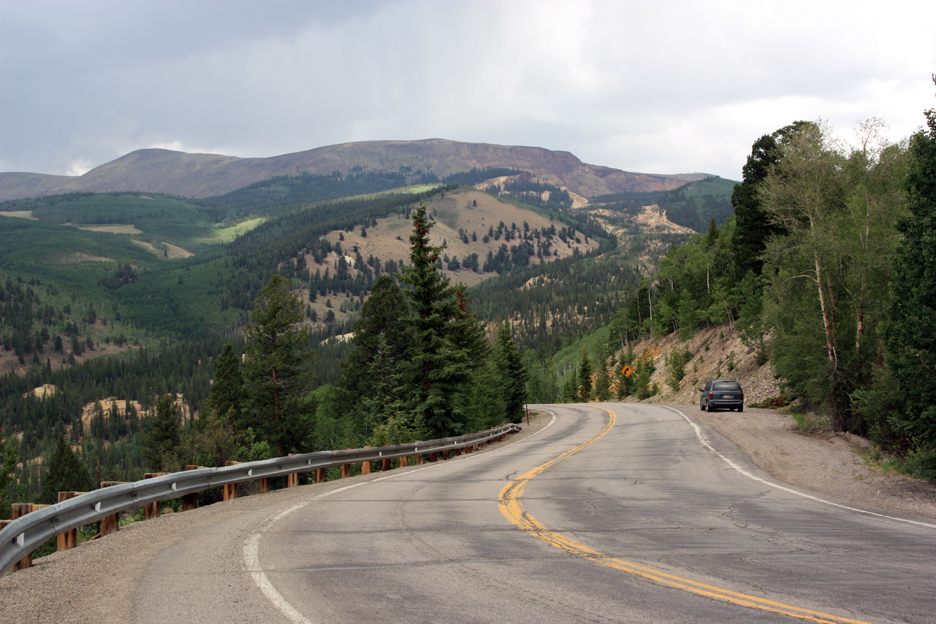
Parked along the switchbacks from Slumgullion Pass

Parked along the switchbacks from Slumgullion Pass

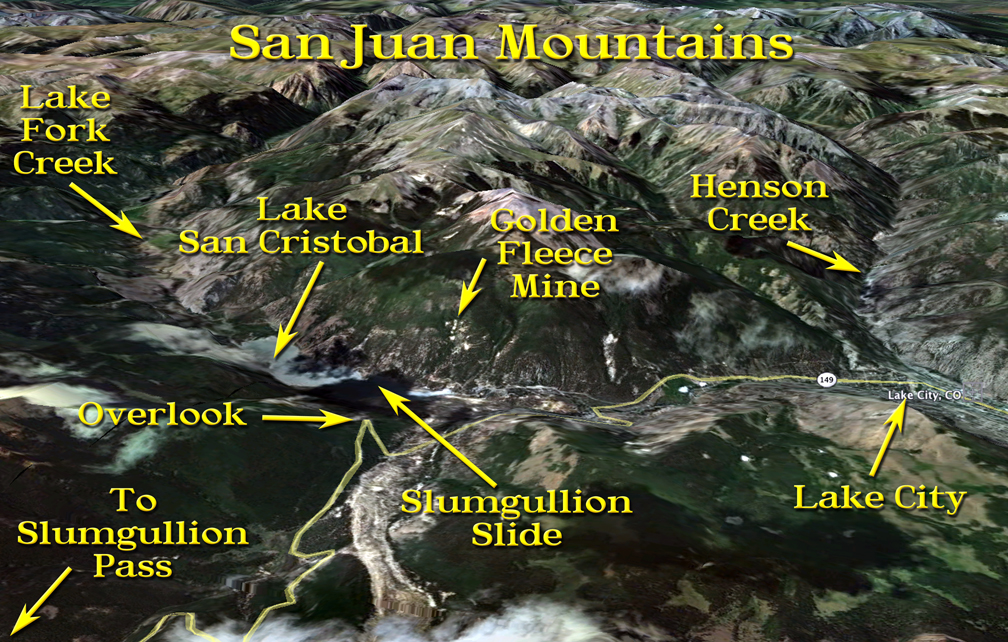
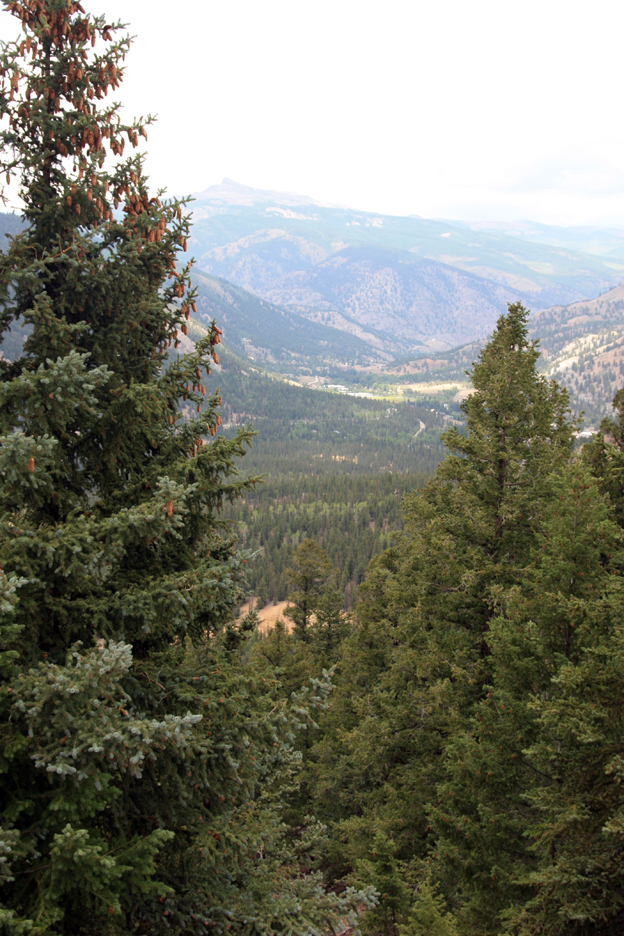
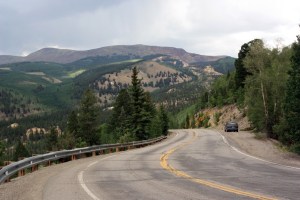
I came to Lake City from the south along Highway 149, driving from Creede along the headwaters of the Rio Grande River over the Continental Divide at Spring Creek Pass (10,901 feet). After staying on the high plateau, the road climbs again to Slumgullion Pass at 11,361 feet. It then descends toward Lake City, taking a series of dramatic switchbacks. At one hairpin turn, there is a nice overlook of Lake San Cristobal and Lake City. I stopped to look at the interpretive signs and take a few photos.
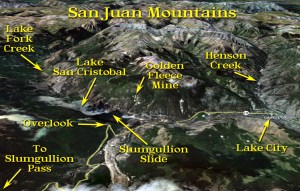
The San Juan Mountains of Southwestern Colorado

The San Juan Mountains of Southwestern Colorado

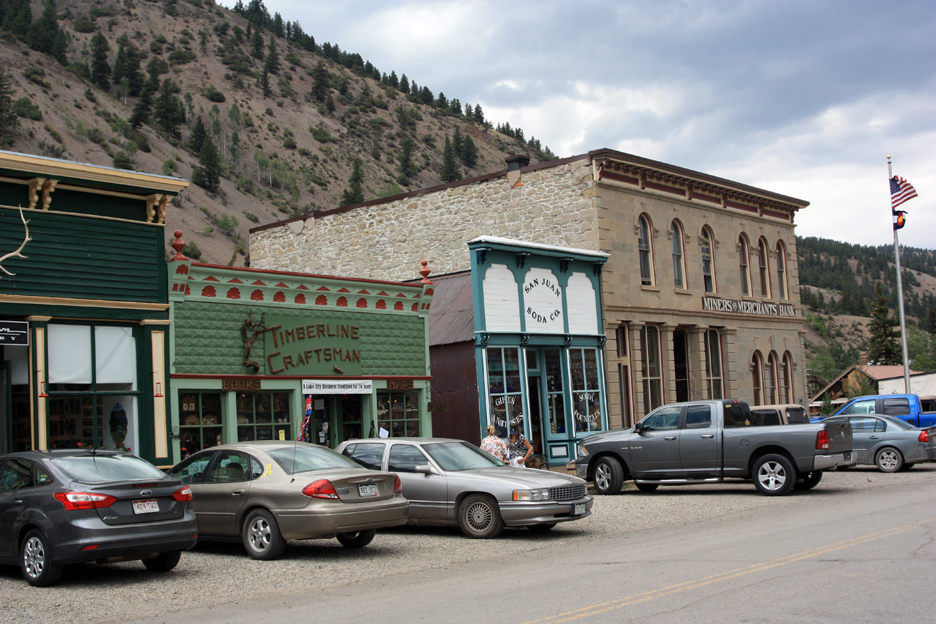
I parked along the old main street of town and found a nice old-fashioned soda fountain, the San Juan Soda Company, in a store next to the historic Miners and Merchants Bank. I had a tasty mint chocolate chip shake, which really hit the spot. I asked for directions and drove northeast out of town up Henson Canyon about two miles in a slight drizzling rain for the Hard Tack Mine.
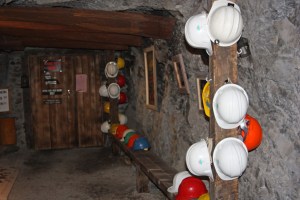
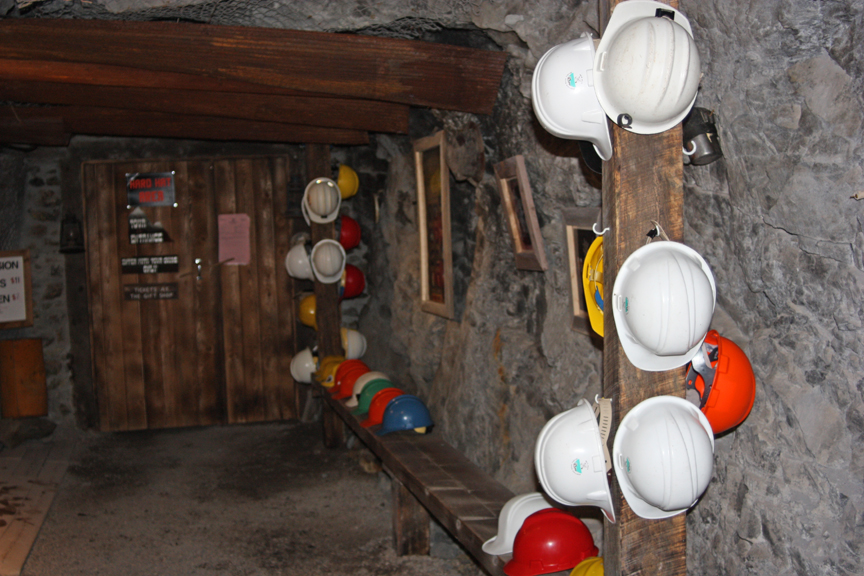
Entrance to the Hard Tack Mine near Lake City, Colorado

Entrance to the Hard Tack Mine near Lake City, Colorado

As I always do, I asked the tour guide if I could videotape the tour, and he told me to check with the owner, who was in the main office next to the mine entrance. She was afraid that I would show their tour to “the competition” and refused to let me videotape it, although she said that photographs were allowed. I tried to assure her that my reporting should help business, but she wasn’t convinced. At least this would give me a chance to take more photographs. As things turned out, I’m glad I didn’t tape the tour. The guide was fairly new, having only done this about two months. He was from out of state, and was unable to answer questions about the types of minerals found here or how mining began around Lake City (which you would think would be standard background any guide would know). Hopefully he’s done more homework since.
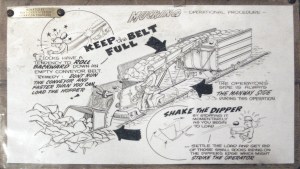
Mucking Machine Diagram in the Hard Tack Mine

Mucking Machine Diagram in the Hard Tack Mine

The tour itself was disappointing compared with other tours I’ve taken on my trip through Colorado. To begin with, the Hard Tack Mine wasn’t a mine at all; it was originally blasted as an adit to reach other mines further up the mountain but was abandoned after reaching only 350 feet. No ore was ever struck. The current owners came in, cleaned out the old works, blasted a few way stations to hold exhibits, brought equipment in from other places, and called it a “mine tour.” Now, if I had never been on any other mine tours (such as the one in Creede just this morning, which was far superior) then I might have learned some interesting things about hard rock mining. But the other tours at least had tour guides who had been miners and knew their stuff, and their displays were better designed and more detailed. And their mannequins were less cheesy.
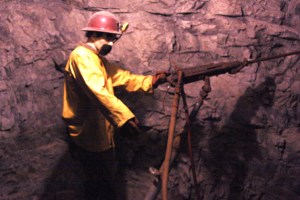
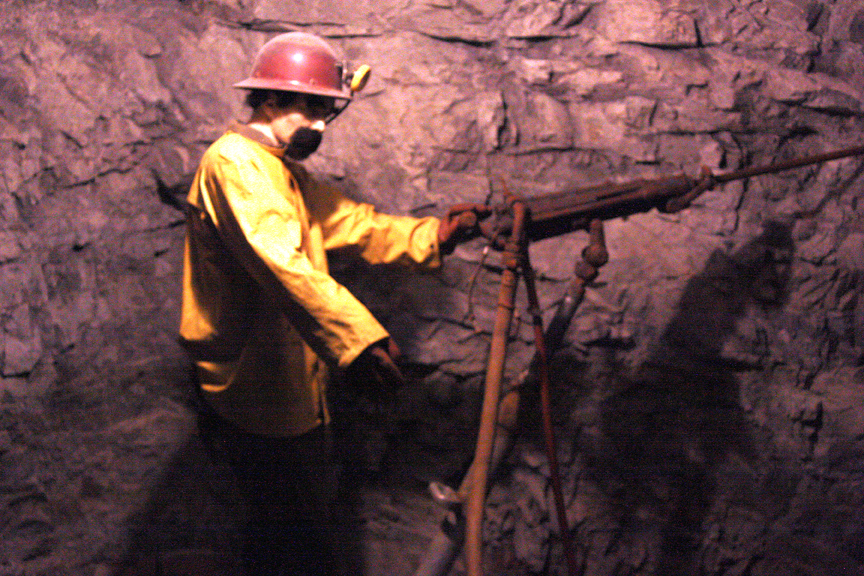
Jack leg drill display in the Hard Tack Mine

Jack leg drill display in the Hard Tack Mine

There were a few good things about this tour. The displays had some illustrated signs that did a good job explaining how the drills and other equipment worked. The signs were on paper inside plastic sleeves and were hard to photograph because they didn’t lie flat, but I did the best I could. There was also a good mineral exhibit and some photographs of the mining in the area. But the tour didn’t last very long nor was it very informative. There is a museum in town that no doubt gives more details about the history of the area, but my time was short – I wanted to get to Victor before nightfall. I’ve had to do some further research on my own.
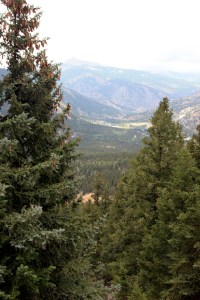
Lake City Colorado from Highway 149

Lake City Colorado from Highway 149

Lake City, Colorado is the county seat of Hinsdale County and the only incorporated town in the county, which is the most sparsely populated county in Colorado. This should tell you something about how remote the town is from just about anywhere else; although it is not very far as the eagle flies from Lake City to Ouray or Silverton, you need a good four-wheel drive vehicle to make it over Engineer or Cinnamon Pass. This silver camp is located on the west slope of the continental divide along Colorado Highway 149, northwest of Creede and southwest of Gunnison.
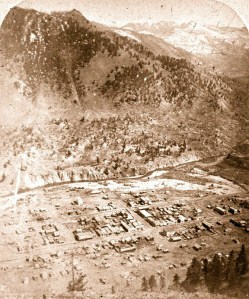
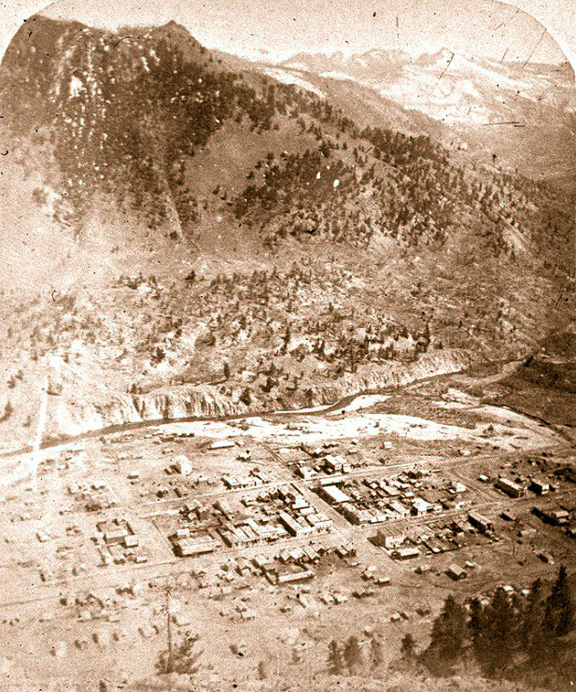
Lake City in 1881

Lake City in 1881

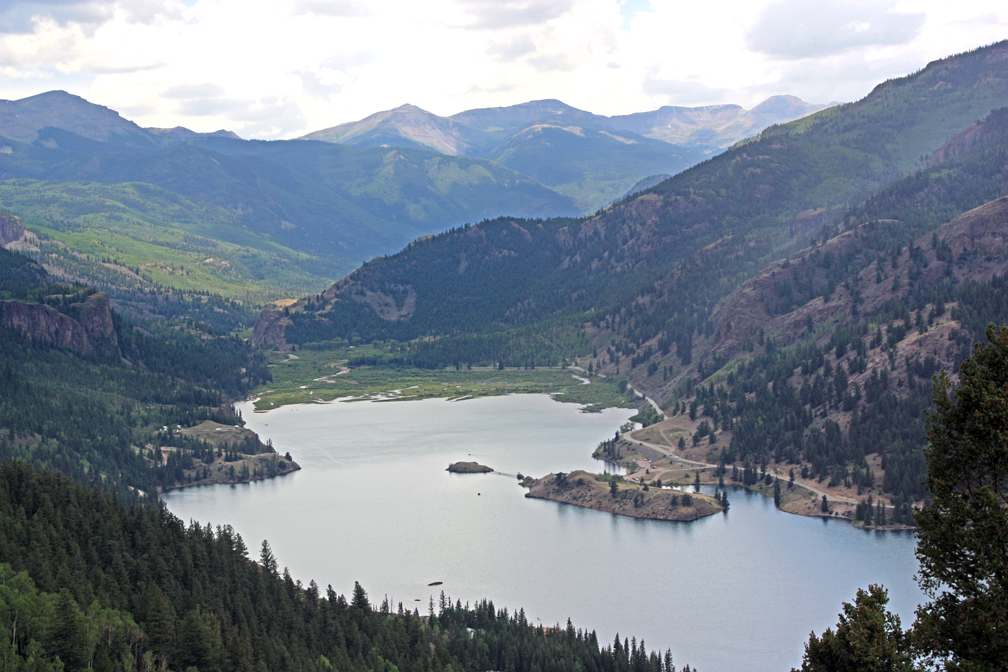
The same caldera eruptions that brought veins of silver, gold, lead, zinc, and copper to the San Juan Mountains also placed veins in this area, cut into by glaciers to form the rugged peaks and ridges of the San Juans. About 800 years ago, a large earthflow filled the canyon and damned off the Lake Fork of the Gunnison River, creating Lake San Cristobal, the second largest natural lake in Colorado. Lake City is located in a dell about three miles below this natural dam. The slide itself is called the Slumgullion Slide, because its brownish-orange color studded with boulders reminded the early miners of slumgullion stew, a beef stew with onions, carrots, and potatoes.
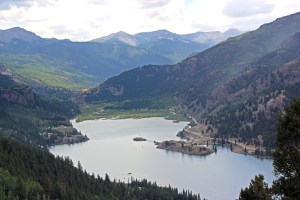
Lake San Cristobal above Lake City, Colorado

Lake San Cristobal above Lake City, Colorado

This area was home to various Ute tribes, especially the Tabeguache Tribe led by Chief Ouray. They originally ranged from the San Luis Valley through the San Juans. But their range was reduced through several treaties, ending with the Brunot Treaty of 1873, which moved the Utes to the Uintah-Ouray Reservation in Eastern Utah.
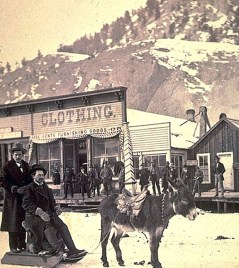
Lake City winter

Lake City winter

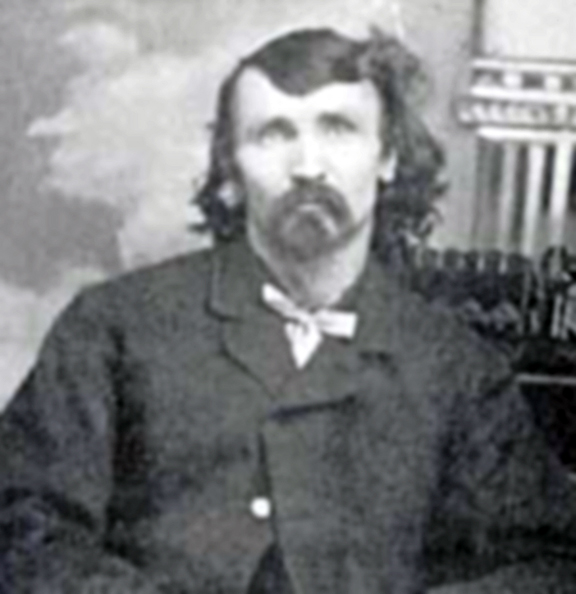
Even before the treaty was ratified, prospectors were heading into the San Juans, pressing south along Lake Fork to the area around Lake San Cristobal. One party of six men, led by Alferd Packer, got caught in deep snows as they tried to hike to the Los Pinos Indian Agency near Saguache. They ran out of food and even ate their shoe leather to try to stay alive. Only Packer made it to the station.
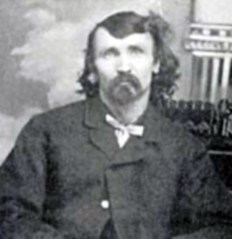
Alferd Packer. You would not want to hire this man as a tour guide . . .

Alferd Packer. You would not want to hire this man as a tour guide . . .

Later that year, the bodies of the other five men were found dead at the base of Slumgullion Pass and showed signs of foul play and cannibalism. Packer had seemed well enough fed, and was spending money from several different wallets. He was arrested and charged with murder, escaped, was captured seven years later and convicted of murder in the Hinsdale County Courthouse. He was retried in Gunnison and found guilty again, then sentenced to 40 years. He was later pardoned by the Governor of Colorado. He always claimed he had killed one of the men in self-defense, and that another man, the oldest of their party, had died of natural causes and was probably eaten by the others.
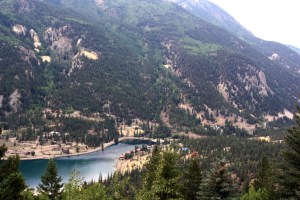
The Golden Fleece mines above the Slumgullion Slide.

The Golden Fleece mines above the Slumgullion Slide.

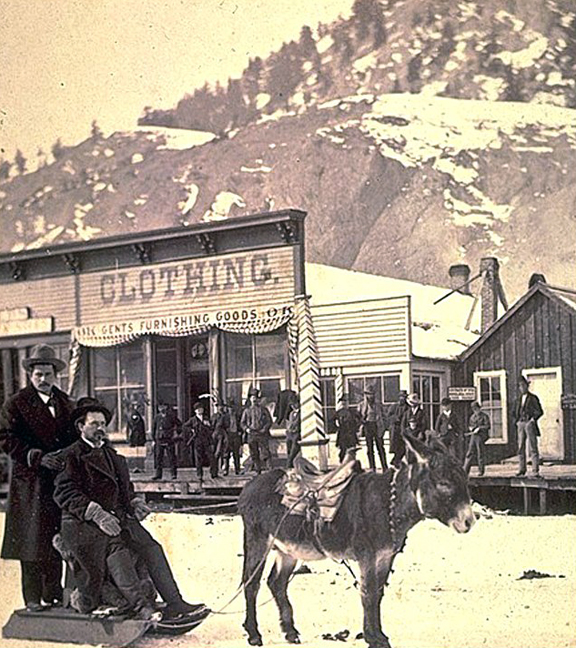
Other prospectors discovered claims, which were staked out and filed just as soon as the treaty was complete. The first big strike was the Golden Fleece claim discovered by Enos Hotchkiss (who also built the first cabin in the area of what is now Lake City). He and Henry Finley and D. P. Church were building a toll road between Silverton and Saguache in 1874 when he located rich gold ore by the lake. By 1875, Lake City was incorporated as a town, and became the county seat. Within a few years over 500 structures had been built and mining had extended all the way into the valleys and passes above Lake San Cristobal. The town itself became an important jumping off, resupply, and smelting point.
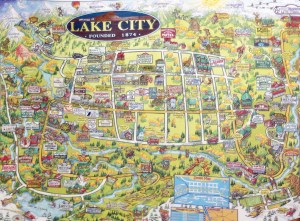
Illustrated map of Lake City, Colorado

Illustrated map of Lake City, Colorado

In 1889 the Denver and Rio Grande Railroad built a narrow gauge line in from the north and the ores could now be transported much more cheaply. Otto Mears built toll roads over the passes from Silverton and Ouray to Lake City and charged $2.25 per passenger for the daily stagecoach runs. It would take two days to make the bone-jarring ride, and the stages would stop over at Rose’s Cabin, originally built in 1874 by Corydon Rose as a one-story log cabin. It eventually grew into a saloon and hotel, stable, store, post office, and cultural center for the mining claims in the area.
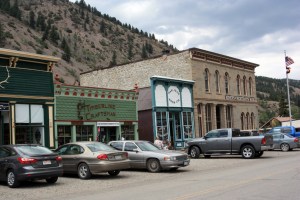
Downtown Lake City, Colorado

Downtown Lake City, Colorado

Lake City reached its peak population of about 6000 around 1900, but the writing was already on the wall. The Silver Panic of 1893 cut the price of silver so much that it doomed much of the mining in the San Juan Mountains and elsewhere in Colorado and throughout the West. Only those mines that contained enough gold and other ores to ride out the downturn were able to survive. Now maybe 500 people live there year-round.
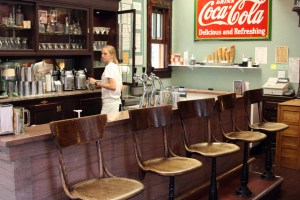
Soda fountain in Lake City, Colorado

Soda fountain in Lake City, Colorado

The last train out of Lake City left on May 25, 1933. After the railway was abandoned, Mike Burke, owner of the Ute-Ulay Mine, had a 1928 Pierce Arrow automobile remodeled with train wheels so it could run on the tracks. It was called the Galloping Goose because of its tendency to weave back and forth on the rails.
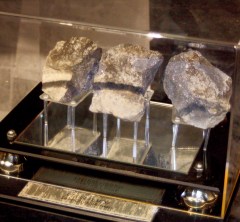
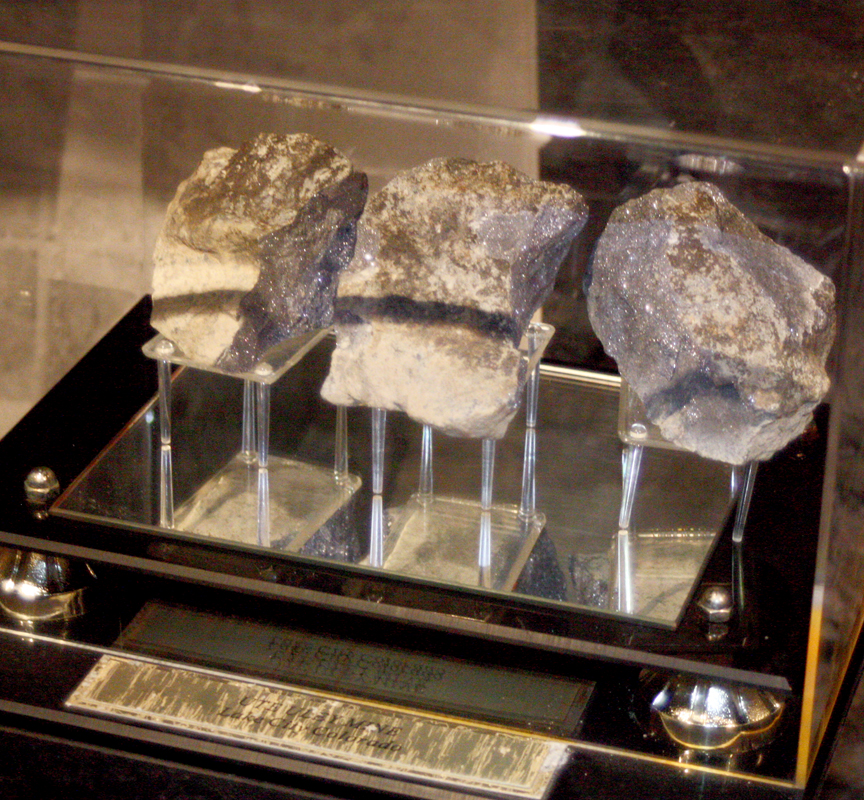
Silver ore from the Ute-Ulay Mine near Lake City, Colorado

Silver ore from the Ute-Ulay Mine near Lake City, Colorado

The Ute-Ulay (or Ule) Mine is one of the more famous in the area, with over $10 million worth of silver and lead extracted. Its mill was used as late as 1983, but now the buildings, mill site, boarding house, tram line, etc. are decaying and in danger of collapsing under heavy winter snows. The current owners, LKA International, have donated the land to Hinsdale County and options are being looked at to renovate the structures and remediate the tailings pile and pit near the mill.
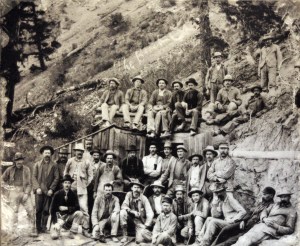
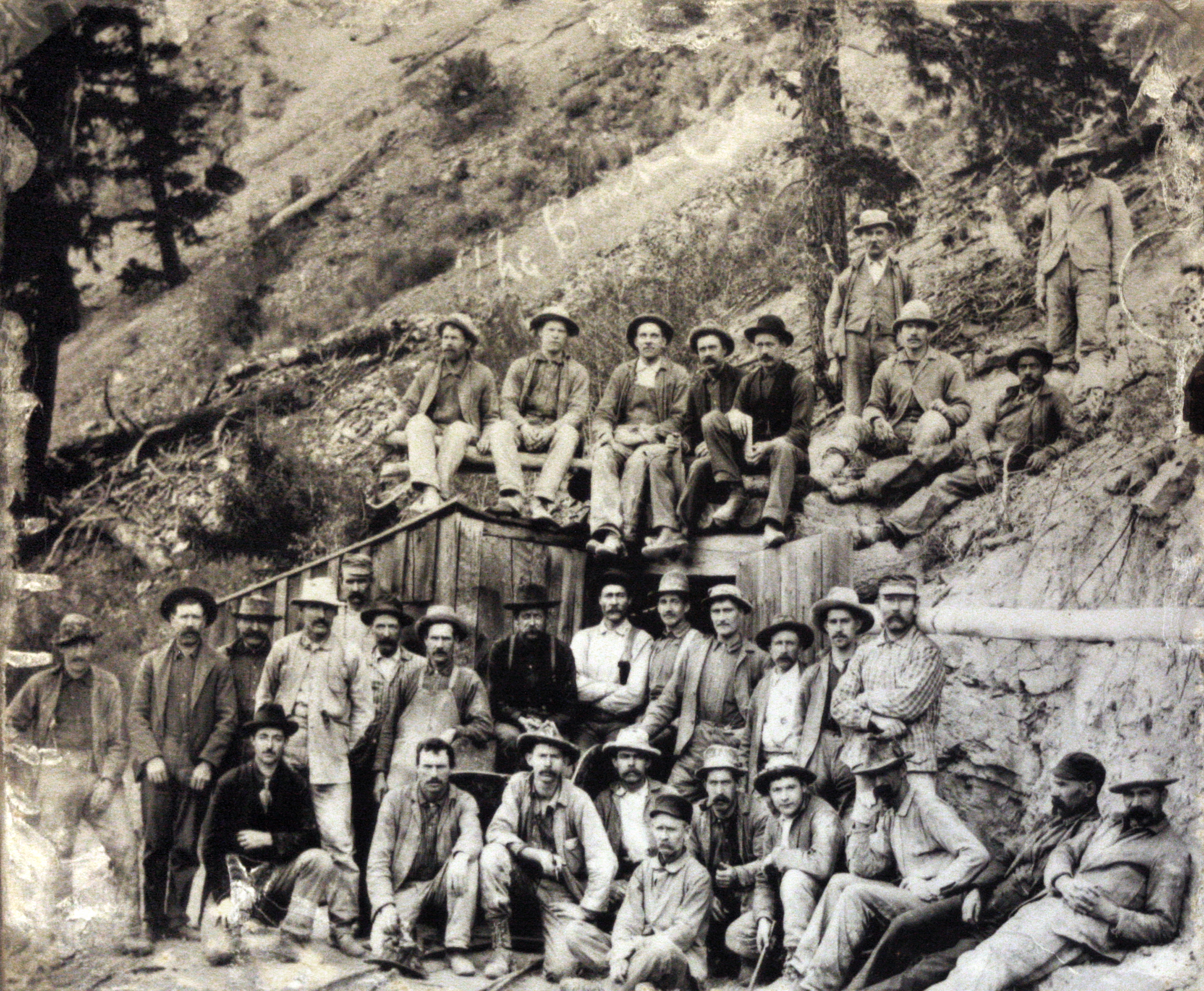
Miners at the Black Creek Mine near Lake City, Colorado.

Miners at the Black Creek Mine near Lake City, Colorado.

The county invited in the nonprofit Colorado Art Ranch to put together the Hardrock Revision Team, a group of seven artists to find creative ways to utilize the property while maintaining its historic appeal. Some ideas include turning the over 100 miles of tunnels into a large Aeolian harp, converting the water tank into a camera obscura, covering the roofs of the buildings with protective tarps painted with mining scenes, and turning the tailings pit into an ice skating rink once it has been remediated. This is not a bunch of outsiders coming in to tell the community what to do – it was initiated by Lake City citizens. It will be interesting to see what happens, and perhaps I’ll have to stop when I come this way again. Here is a link to the article I found on this project: http://www.hcn.org/issues/43.20/can-an-old-mine-become-a-work-of-art/article_view?b_start:int=0. I just wish similar efforts could happen in Utah before the state shuts all our mining history down or all the old structures collapse into oblivion.
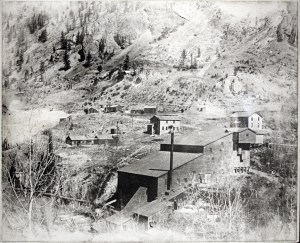
Mining structures in the Lake City area

Mining structures in the Lake City area

As I left the Hardtack Mine, I drove north out of Lake City on Highway 149 and left the San Juan Mountains behind. North of Lake City, large basalt flows continue all the way to the Black Canyon of the Gunnison. I joined U.S. 50 nine miles west of Gunnison and stopped to gas up. Now I was on a familiar road – I’ve traveled most of the length of U. S. 50 at one time or another. I’ve been on this section with my children 10 years ago when I was last in the San Juans.
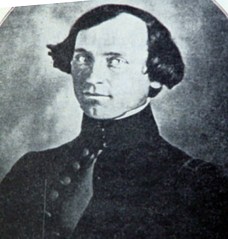
Captain John W. Gunnison, for whom many towns and places are named in Colorado and Utah. His 1853 survey expedition was attacked by a Pahvant war party in Oct., 1853 west of Deseret, Utah.

Captain John W. Gunnison, for whom many towns and places are named in Colorado and Utah. His 1853 survey expedition was attacked by a Pahvant war party in Oct., 1853 west of Deseret, Utah.

Captain John William Gunnison left his name all over Colorado and into central and western Utah, but not in Nevada. He never made it that far. As a Captain of the Army Corps of Topographical Engineers, he was commissioned in 1853 to survey a route for the transcontinental railroad between the 38th and 39th parallels. U.S. 50 and parts of the Denver and Rio Grande Railroad follow the route his team surveyed. They discovered the gorge of black basalt and the river that bears his name. Once they reached Utah, they surveyed along the Sevier River near the site of Gunnison, Utah and passed through Leamington Canyon into the Pahvant Valley. Fearing the approach of winter, he sped up the work by splitting his team into two groups. His half of the party surveyed a large meander in the Sevier River where the Gunnison Bend Reservoir is now located. Several miles further down the river, west of what is now Deseret (my hometown), they were attacked by Pahvant Utes on the warpath. Of eleven men in the group, only three survived. Gunnison was killed. I travelled east on U. S. 50, thinking about how Deseret would be different if Gunnison had finished his survey and the transcontinental railroad had followed that route instead of the more northern route it took.
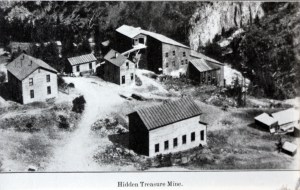
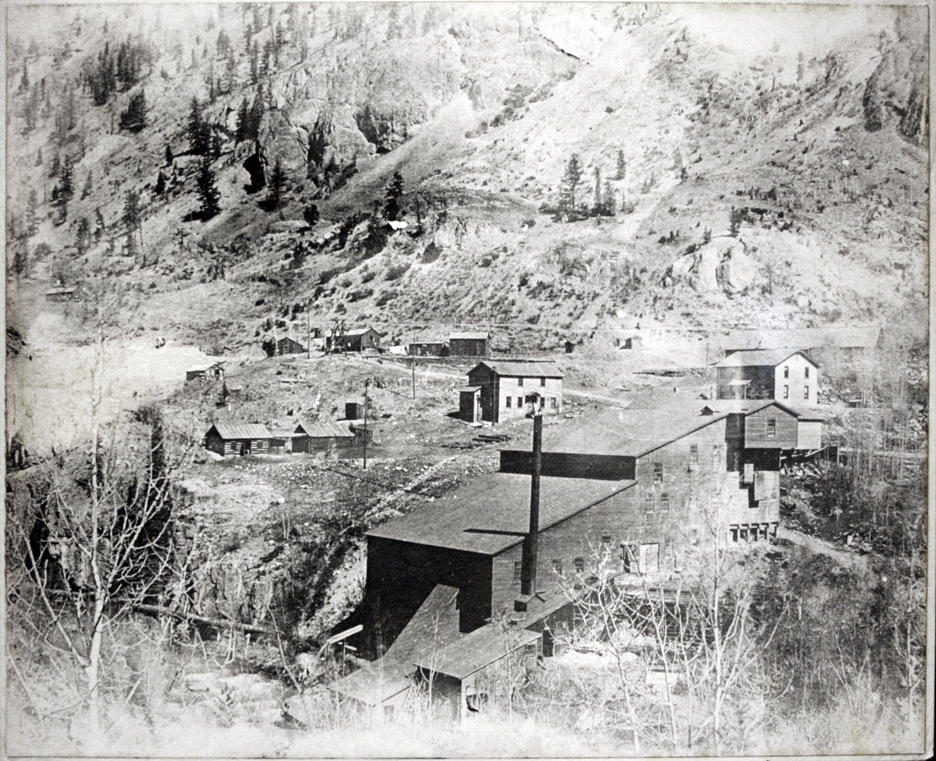
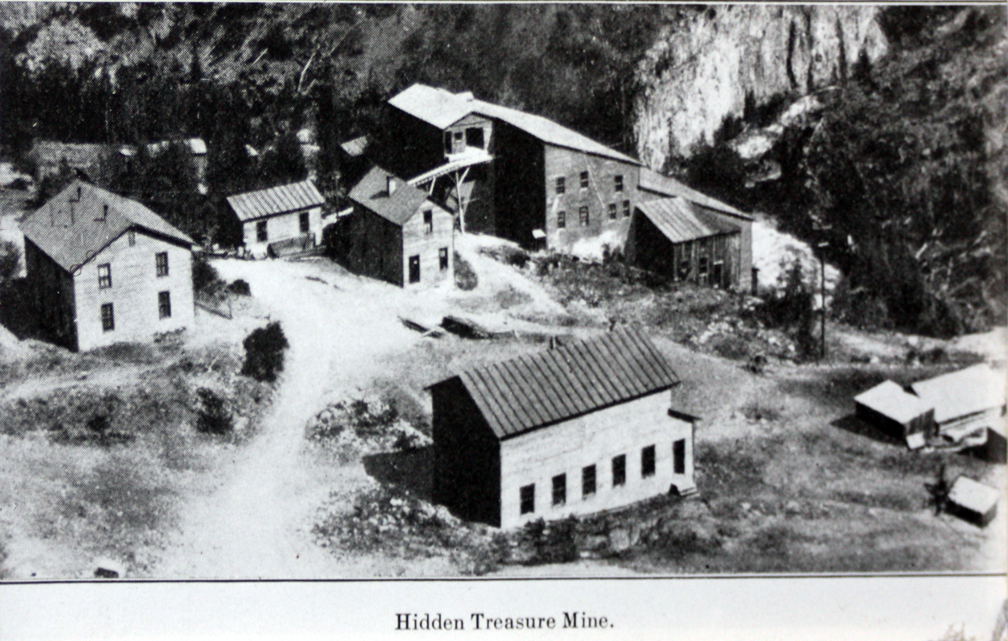
Hidden Treasure Mine near Lake City, Colorado

Hidden Treasure Mine near Lake City, Colorado

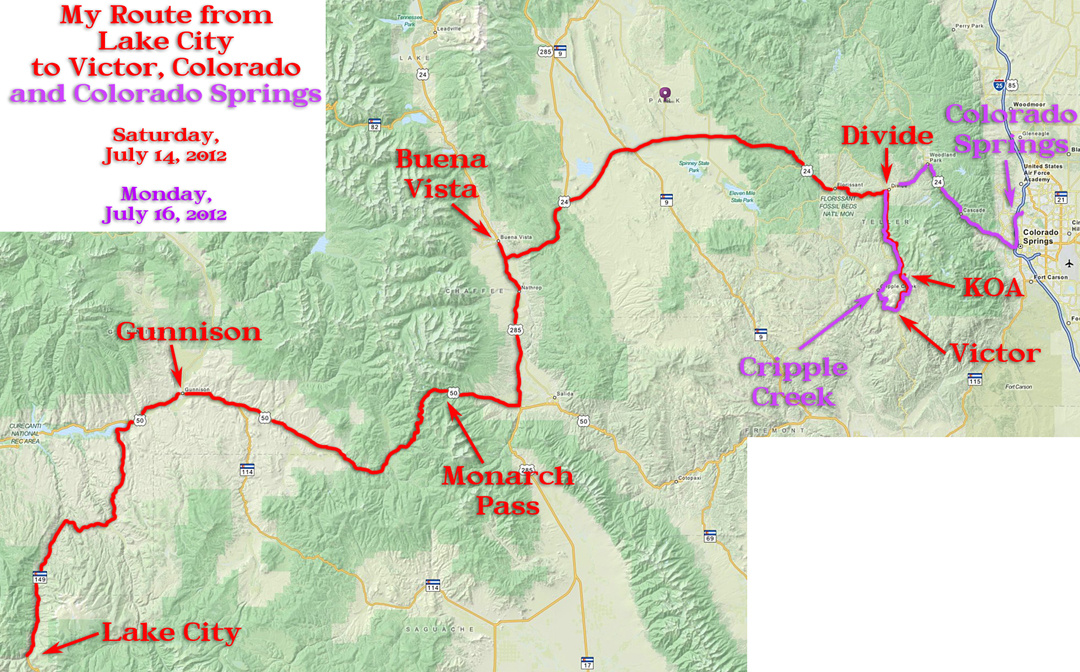
I became so sleepy that I had to pull over and take a nap for an hour, then press on. Clouds gathered as I drove up into the Sawatch Range and it began to drizzle. I had intended to take the tramway to the top of Monarch Pass, but I was behind schedule and it wouldn’t have been much of a view in the rain, so I pressed on. I drove into Buena Vista and ate supper at a burger place, then tried to get the phone number for the KOA campground outside of Victor that I was going to stay at. It was getting dark and I wanted to let them know I was going to be late coming in. My wife looked up the number for me (somehow I had forgotten to write it down with all my other contact information when planning this trip) as I drove east on U.S. 24. I had to double back to find a spot with cell tower reception in order to get the number, but was not able to get through to the campground. They must have already closed the office.
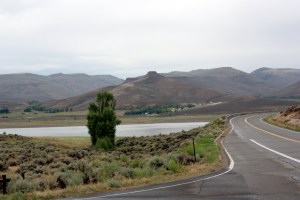
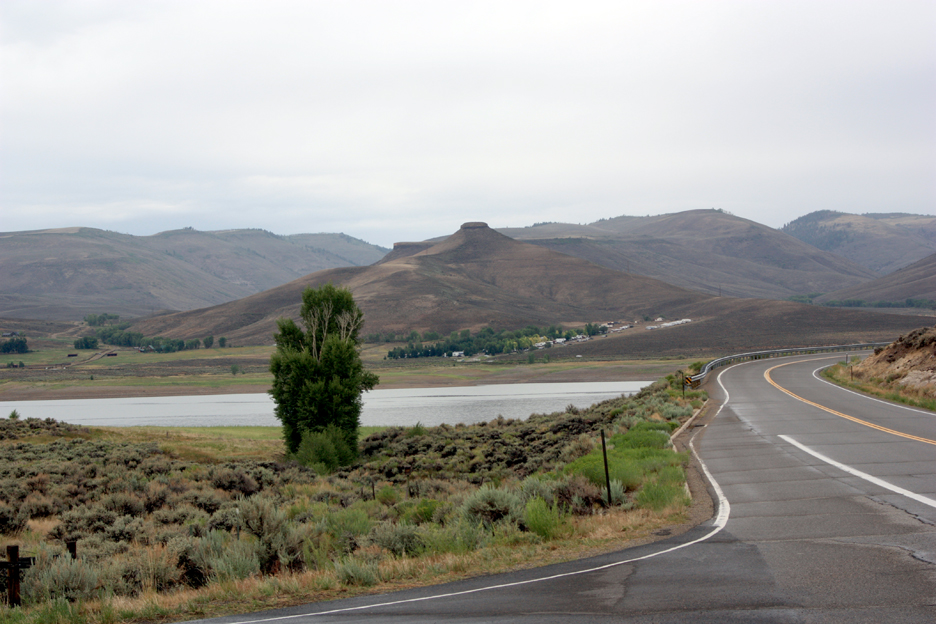
The Road to Gunnison

The Road to Gunnison

By now it was completely dark, so once again I travelled this highway in the night, the last time being in 2010 when we drove out to Denver, stopping in Cripple Creek. Now I was returning to complete the visit I made then. At least I had driven this route once in the daytime, back in September, 2009 on my way back from Philadelphia, and had good photos of the scenery.
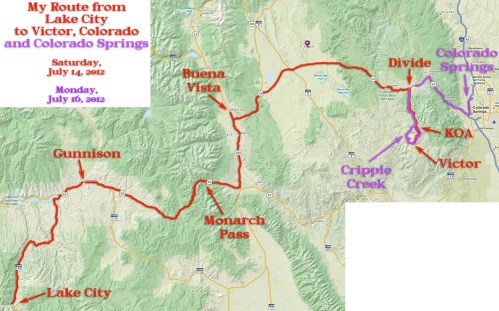
My route from Lake City to Victor, Colorado on July 14, 2012.

My route from Lake City to Victor, Colorado on July 14, 2012.

I was getting very tired by the time I got to Divide and turned south. I took the turn toward Victor, but somehow missed the KOA in the dark and wound up driving all the way into town. I turned around and headed back. I almost missed the sign again. The KOA is located just south of the turnoff to Victor, and I arrived about 11:00. The manager had left a map for me in the entranceway to the office with my site circled, a tent site on the outer edge of the camp. It took a couple of drives around the camp before I found the right trail leading off to the tent sites. Mine was Site 1, nestled back in the aspens with good privacy. I was too tired to make camp, so I just rearranged my gear, setting stuff outside like the tent that I knew bears wouldn’t get in to, and made a fairly good bed in the back of my minivan.

Read Full Post »
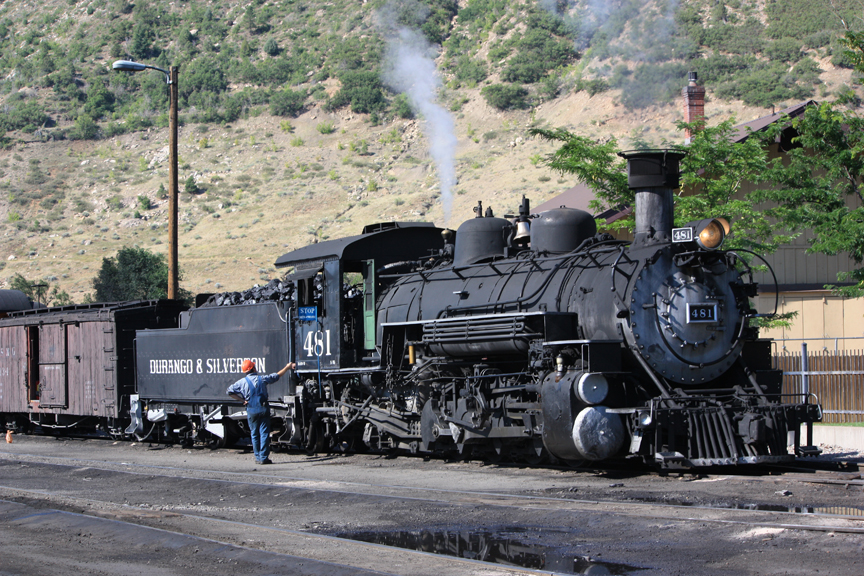
Preparing to leave

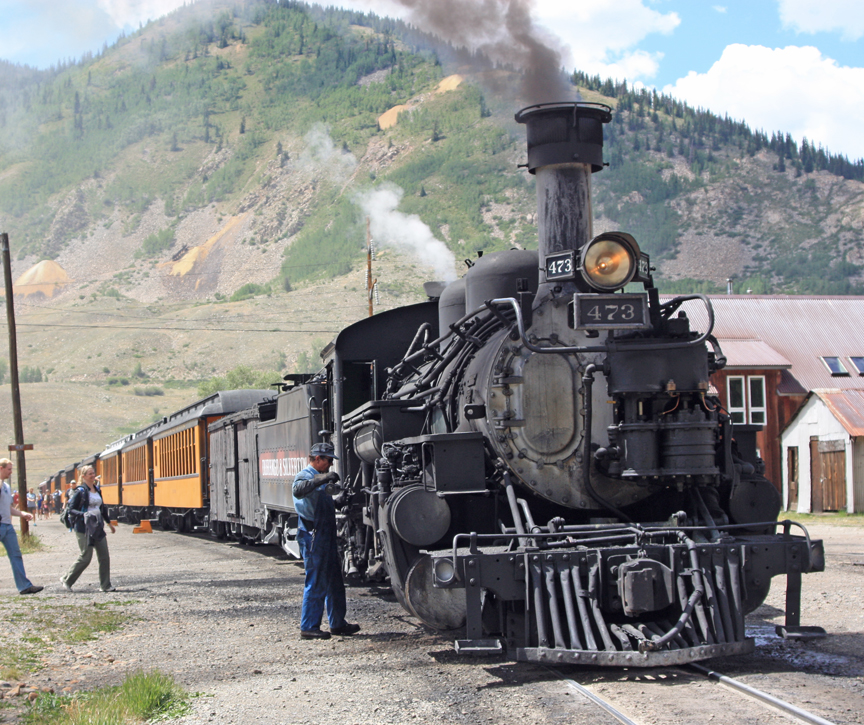
Preparing the steam engine to leave in Durango, Colorado

On the second day of my journey through Colorado’s mining towns, I rode the Durango and Silverton Narrow Gauge Railroad. I had reserved a seat in an open gondola on the second train. This is the second time I’ve ridden this train; the first was ten years ago, in 2002, when I took my two oldest children. I had a camera malfunction and could only take a few photos with my daughter’s film camera. This time I was loaded for bear, with my HD video camera and two batteries, two Flip cameras, my still camera, and my iPad, as well as a tripod, panoramic head, and my wireless microphone system. All this was in a backpack which was quite heavy.

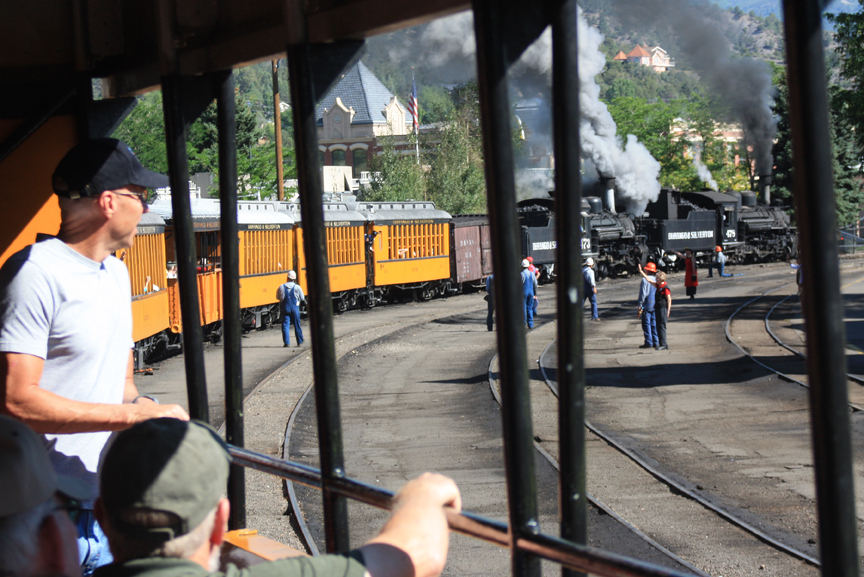
Leaving Durango

Pulling out of the Durango Station on the Durango and Silverton Narrow Gauge Railroad

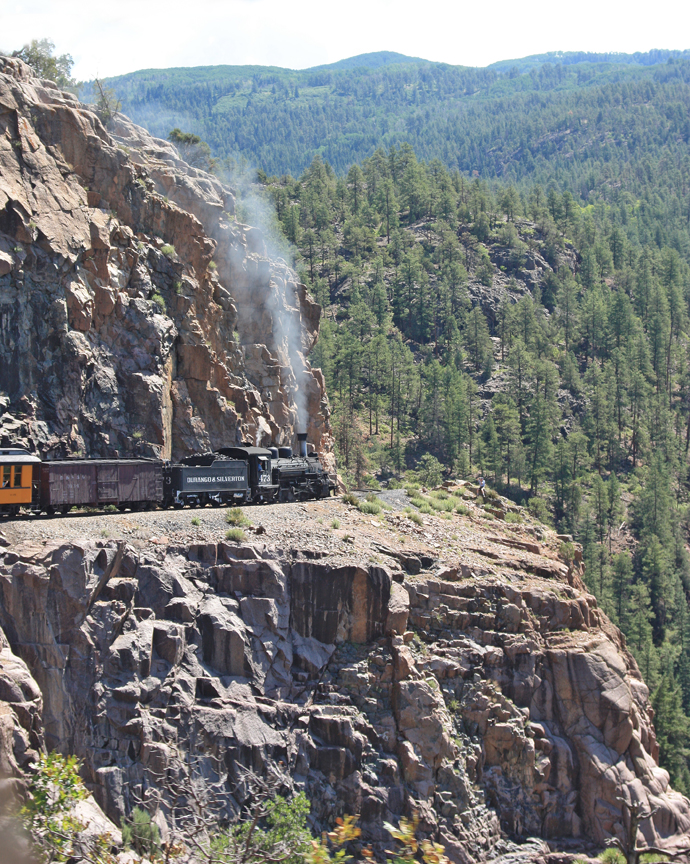
The D&SNGRR uses authentic steam engines to pull a combination of closed and open cars. The gondola car I was on has a roof and benches facing the sides but no windows – the sides are open to the air (and the soot from the engine). I was in car 30, toward the end of the train, which allowed some great photos as the train pulled around curves.

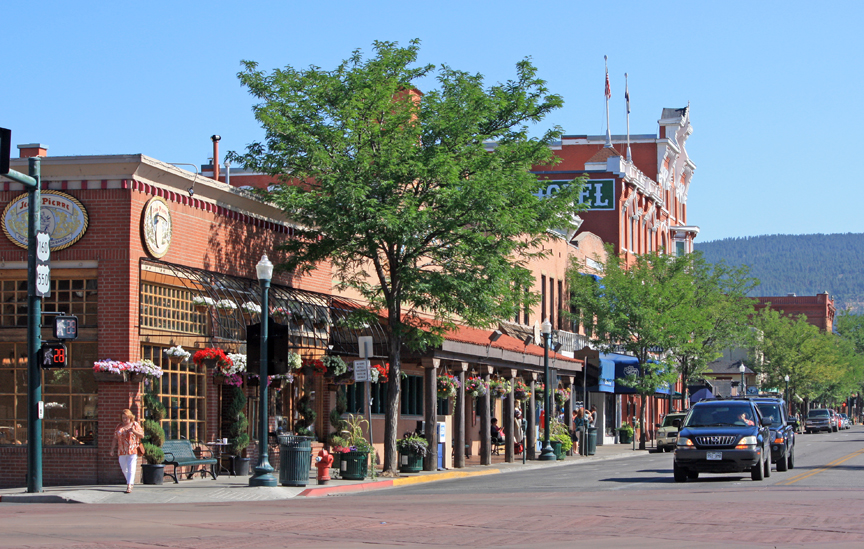
Durango Colorado

This train follows the actual route and grade laid down to service the mining town of Silverton. Durango was built as a railroad town and hub for the Denver and Rio Grande Railroad in 1881, and a narrow gauge track was built in 1882 along the Animas River from Durango to Silverton, a distance of 45.6 miles. Part of the route was carved out of steep cliffs overlooking the Animas River Gorge, and it is spectacular scenery. Three shorter routes extended on from Silverton into the canyons northward to service the mines and smaller communities.

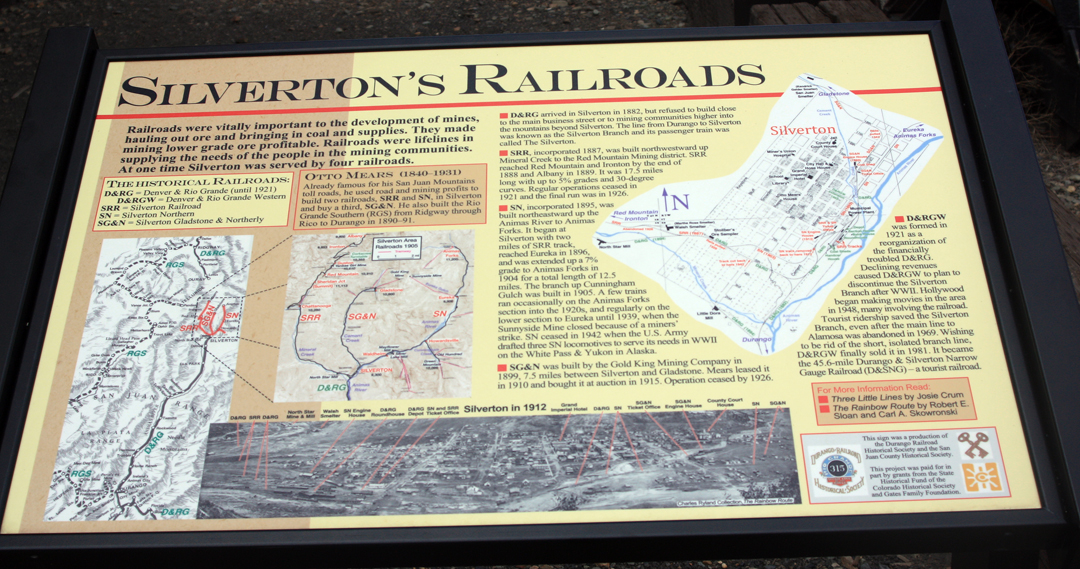
Railroad sign

Sign describing the railroads around Silverton, Colorado

The route takes three hours each direction. The first hour out of Durango is not very interesting – you gradually work your way north, crossing Highway 550 several times as you travel through trailer parks, along golf courses, farms, and a few towns and tourist traps along the Animas River. As we traveled, we noticed a lady by one of the crossings dressed in Native American costume waving a stick with feathers on it. Then a few miles up the track we saw her again at the next crossing, and again at the next. Either she’s a clone or she has fun every day greeting the trains as they pass, then jumps into her car and drives to the next crossing (the train is quite slow, so this is easy enough to do). I remember seeing her ten years ago doing the same thing.

Around the cliff

Chugging along the cliff above the Animas River Gorge

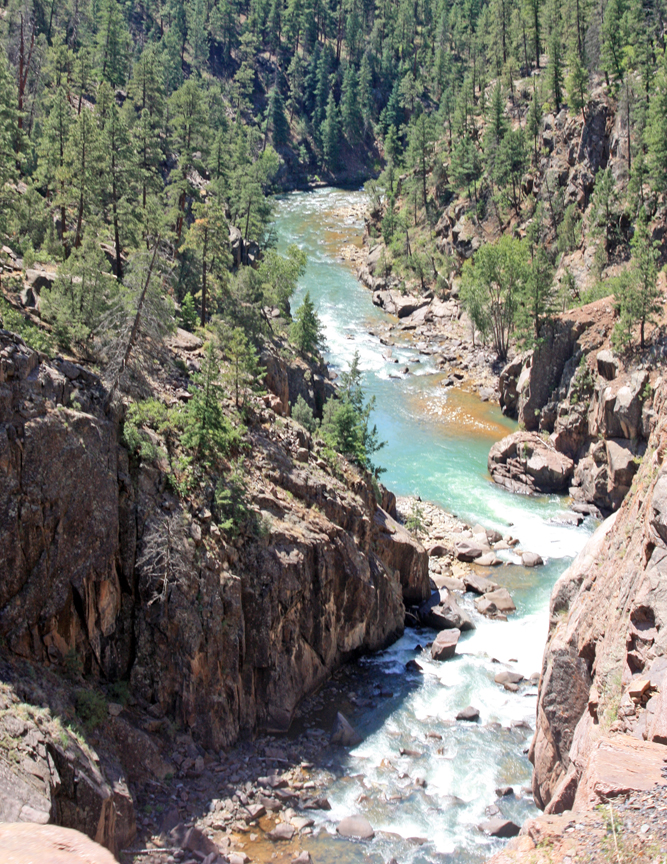
We reached the town of Rockwood and stopped to take on water and to pick up a few more passengers. This is the last town before the gorge. Leaving Rockwood the grade winds its way up the side of the canyon wall, with shear cliffs falling into the swirling river below. The train inched its way around curves, puffing and belching soot and steam. If you’ve seen the movie Butch Cassidy and the Sundance Kid, it is here that Robert Redford and Paul Newman (or their stunt doubles) jumped from the boulder onto the train. It was also here in the gorge where they jump into the river to escape the persistent posse.

Animas River Gorge

The Animas River Gorge. If you were to jump in, the fall would probably kill you . . .

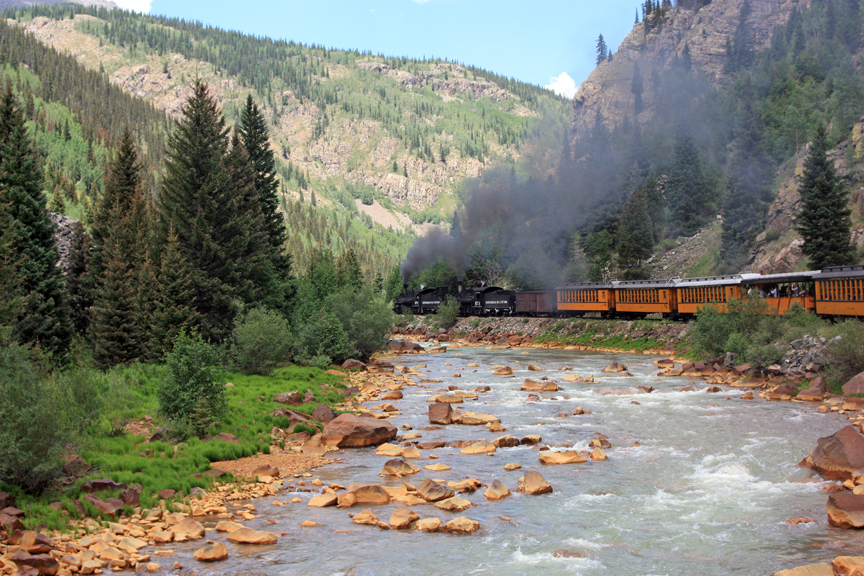
Further up the river the rocks along the edges of the river take on a reddish-orange tint. Some of this is natural staining from iron sulfate deposits further up stream. The silver ore was associated with these same deposits and years of smelters and concentration plants, along with exposed tailings piles, have added greatly to the stain.

I videotaped much of our journey and tried to narrate some of it, but there was too much noise even for the wireless microphone. I talked with other passengers. One had gotten a teaching credential from San Jose State in science education the year after I went through the program. I also walked between the cars with a Flip camera and got some good footage. As the valley opened up just before Silverton, a stray gust of wind blew my hat off and out of the gondola.

Staining along the river

Iron sulfate staining along the Animas River near Silverton, Colorado

In Silverton, I walked with my heavy backpack over to the depot office to see if the chase car that follows the train (just in case the steam engine lights any fires) could look for my hat. I ate a buffet lunch, then used my panoramic head to get some panoramas from the center of the streets in Silverton. I also videotaped the first train pulling out, our train using the triangle tracks to turn around and back into the station, then got some great footage of the train blowing off steam. We boarded about 3:00 and left at 3:15.

Oiling the engine

Oiling the engine in Silverton, Colorado

On the way back to Durango I saw my poor hat lying right beside the river, but there were no good landmarks to locate it by. It never was recovered. And I liked that hat . . . I used up all the batteries on my HD camera, filled two SD cards on my still camera and used the batteries up for that as well (I wasn’t able to get them completely recharged this morning), and filled up most of the Flip cameras. Inching along the gorge, I was on the outside this time and got some great shots (I hope) of the train and the gorge below, with my last battery dying just as we got to Rockwood. From there on I dozed as best I could on the uncomfortable bench with the constant rocking of the car. We arrived back in Durango about 6:30.

stagecoach

Stagecoach in Silverton, Colorado

Back at Lightner Creek Campground, it was raining slightly and I did the best I could to charge up my camera batteries by wrapping the cameras in plastic bags and setting them on a camp chair to keep the rain out. I had set up my tent that morning, so I called home while waiting for the rain to end, made supper, read a book on my iPad, and enjoyed a comfortable evening.

Read Full Post »
mining terms

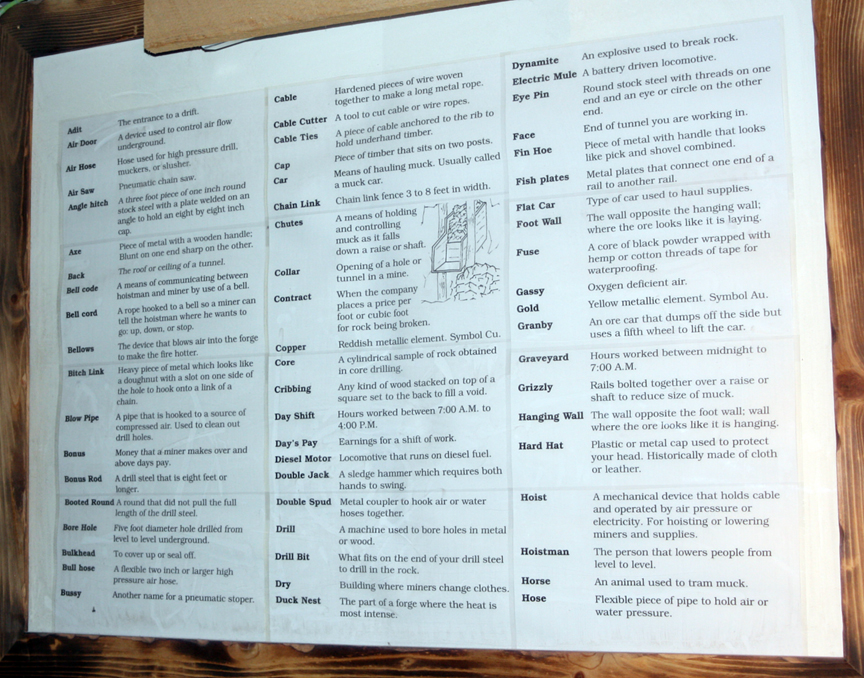
Mining terminology, at the Creede Underground Mining Museum

As mentioned in my last post, I am embarking on a two-week tour of Colorado mining towns. Before I go, there are some basic mining terms that any greenhorn or tenderfoot like me should know before venturing into a mine. Many of these terms come from the Cornish miners who came to America to work when the tin mines in Cornwall played out in the 1800’s.

First, the basic parts of a mine: you always refer to a mine as if you are facing into it. The part of the mine you are working to drill, load, and blast is called the “face.” The left-side wall is the “left rib” and the right-side wall is the “right rib.” The ceiling is the “back” and the floor is the “foot.” The back is also called the “hanging wall” and the floor the “foot wall” depending on the orientation of the ore vein.

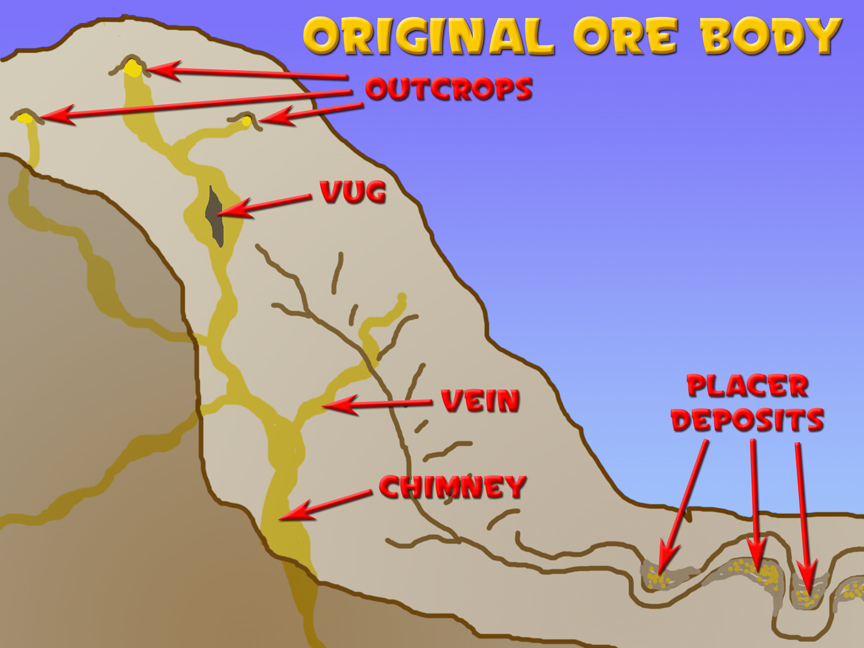
Ore body diagram

Diagram of the original ore body.

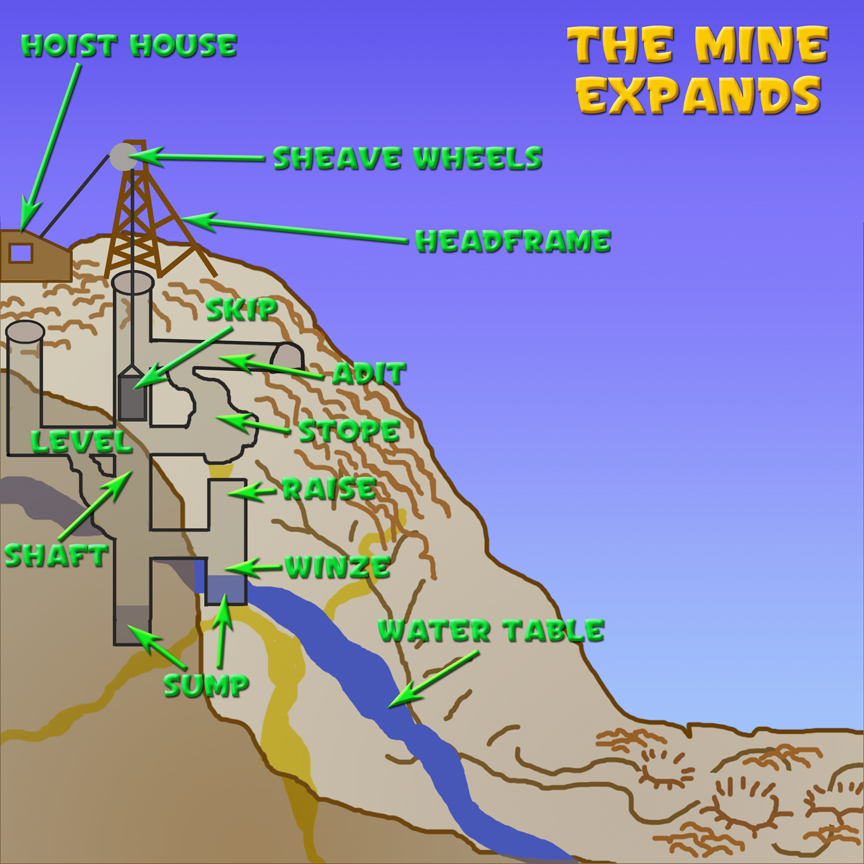
A “tunnel” is horizontal and must see daylight at both ends. If it only opens to the outside on one end, it is called an “adit.” If it doesn’t connect to the outside at all, it is a “level.” Levels are like the various floors of a building, only underground in a mine, and they provide access to the ore body. A vertical hole that connects with the surface is a “shaft.” If it is a hole that is dug down from a level or an adit, it is a “winze,” and if it is dug upward it is a “raise.” A hole dug to follow a vein horizontally away from a level or an adit is called a “drift” and to dig out a large ore body going up or down is called a “stope.”

The valuable mineral that you are trying to dig out is the “ore,” along with useless rock called “tailings.” Usually the ore is injected as a hydrothermal body along a fault or other natural zone of weakness in the rock, and the entire mineralized zone is called the “ore body” or “lode.” If it is found as a large vertical mass with branches, it is an “ore chimney” and if it is a thin line following any direction it is a “vein.” Sometimes ore is found as crystals deposited along the walls of a natural chamber. This is called a “vug.” When a vein reaches the surface, it is an “outcrop,” and when parts of the outcrop erode away and are carried down into river valleys by water, avalanches, and gravity it will pile up in still areas of the stream, such as the inner parts of meanders along with gravel. These are called “placer” deposits (pronounced “plah-cer” and not “play-cer”).

exploratory mining

Prospectors mine the placers and conduct exploratory mining

The first miners in a new mining district are prospectors, because they are looking to find, develop, and sell a good “prospect.” Typically the first discoveries are placer deposits, because they are easy to find and work using pans, rockers, and sluices. Once the placers are played out, the prospectors head upslope to find the source outcroppings, or the “Mother Lode.” Once they find evidence of ore (such as associated minerals like iron pyrite or chalcopyrite, quartz, etc.) they will “stake a claim” by pounding stakes in the corners of the land and starting to dig exploratory shafts or adits using hand tools such as picks and shovels. They will use a windlass to haul the “muck” or loose rock out of a developing shaft with a bucket. Claims have to be an allowed size (a long, thin swath of land) and registered in the county mine office to be legal. It’s good to set up with a partner so that when one of you leaves to register a claim, the other can guard it from “claim jumpers.”

Samples of the ore are taken to an “assay” office where they are analyzed chemically to see how much valuable metals are actually in the ore. If the ore is rich, or “high grade” or if the vein widens and appears to continue, the prospector will usually sell out to a mining company with the resources and capital needed to further develop the mine.

Once the mining company buys out the prospectors, it starts to build the infrastructure needed to enlarge the mine. The irregular prospector shafts and adits are enlarged and shored up with timbers. The top of a shaft is boxed in with a “collar” and an adit’s entrance is shored up and extended outward to prevent loose rock from falling into it. This becomes a “portal.” At the top of a shaft, a “headframe” or “gallows frame” is erected out of large timbers or steel with pulleys called “sheave wheels” at the top. A braided rope or cable is brought over the sheave wheel and attached to a metal cage called a “skip” which can carry men or ore buckets in and out of the shaft. The other end of the cable is brought to a “hoist,” which is an electric or diesel winch. As the skip is raised and lowered in the mine, a series of electric bell chimes are used to signal the “hoistman” how far to raise and lower the skip. A mark on the cable tells the hoistman when the skip is “on the level.”

mine expands

After a mining company buys the prospect, it expands the mine and adds infrastructure

As the mine deepens, it will usually encounter underground aquifers or water tables which become a major problem as they start to flood the lower mine shafts. The main shaft must be dug lower than the lowest level and a pump installed to remove the water. This low-lying shaft is called a “sump” and the pumps used ran on steam, diesel, electricity, or compressed air. The biggest of these were the famous Cornish pumps found in some mines.

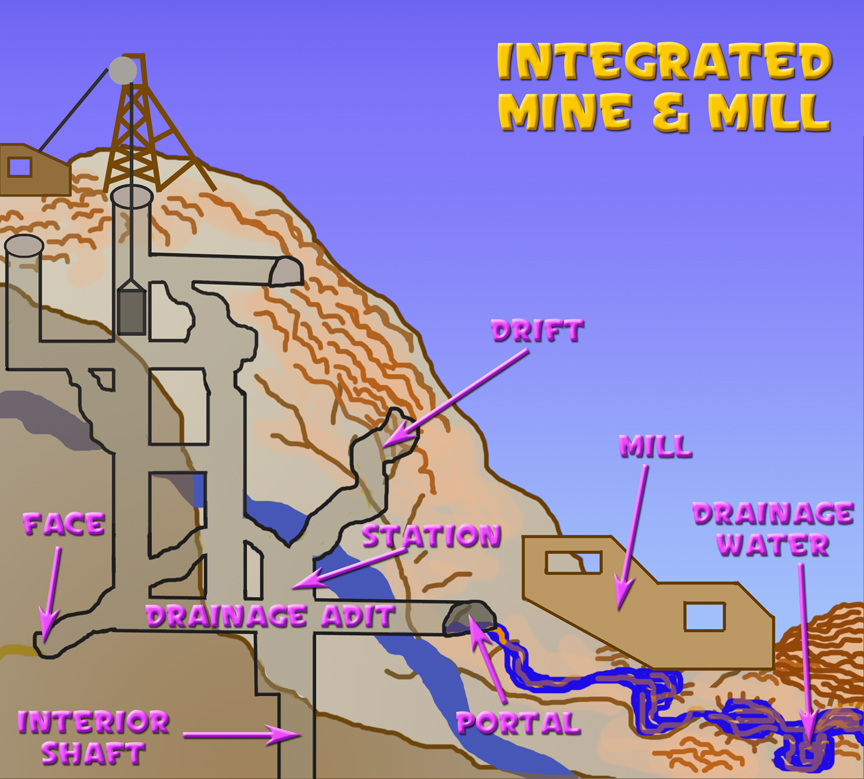
Eventually the shafts are too deep to economically raise all ore cars, sump water, and men to the top of the shaft. A drainage and ore removal adit is sometimes dug at the bottom of the mine that will drain out the waste water and allow easy passage of ore cars out of the side of the mountain. These adits usually have a slight downward slope to the outside so the loaded ore cars can be more easily moved. Waste rock was simply dumped out of the shaft or portal and created a “tailings pile” downslope from the mine or mill.

integrated mine

Integrated mine and mill. As the mine develops, drainage adits, interior shafts, reduction mills, smelters, and other structures are built.

As the mine gets bigger, with additional levels every 100 feet and a complex set of drifts, adits, winzes, raises, interior shafts, stopes, etc. it becomes advantageous for the owners to build their own mill instead of sending their ore elsewhere for processing. A mill is built on the side of the mountain below the lowest portal. It first sorts, then pulverizes the ore into powder, then concentrates the ore mechanically or chemically. The concentrate is then shipped by rail to a smelter for final processing and purification. Sometimes the concentrated ore is heated in a retort or furnace but not separated into its final constituent metals. This combination of metals is poured into bar-shaped or cone-shaped molds and cooled, creating “dore bars” or “buttons” which contain gold, silver, and other metals.

Once the mine is exhausted of ore, or the shaft extends down below where it can be economically drained of groundwater, or the price of the final metal drops so the mine can no longer turn a profit, it is closed down (sometimes temporarily). Today, mines have to post bonds that force them to reclaim the mine and make it safe once mining has concluded. But in the old west, the mines simply shut down and left everything where it was. Tailings piles are the most obvious evidence of mining, and the rocks are often stained a yellow, orange, or reddish brown color from iron sulfides and sulfates. Rotting timbers poke from the ground, and rusted metal scraps adorn the slopes. Drainage water still seeps from adits, often contaminated with metals or other effluents. And the shafts and portals remain, too often a temptation for the unwise to explore. A few people die each year from cave ins while exploring old mines, or get killed by handling old dynamite left in mines. In some states, such as Utah, a concerted effort is underway to close all of these abandoned mines in the name of public safety but at the expense of history. Other states, such as Colorado, seem to strike a better balance between history and safety.

Mining terms B

More mining vocabulary terms. From the Creede Underground Mining Museum.

Now there are many more terms, such as how a typical miner spends his shift to drill, load, shoot, and muck the face. We’ll talk about these later as they come up on my journey. I’m amazed at how many mining terms have made it into general vocabulary, such as “big shot” [blasting out a large section of the face], “hang-up” [when ore is blasted to fall into a lower chute but gets stuck], “getting the shaft” [to buy a worthless mine], etc. For better or worse, hard-rock mining has had a big impact on our history and our culture.

Read Full Post »
David Black at NSTA

David Black at the NSTA Conference

The NSTA conference in Philadelphia is over the convention center crews are tearing down the displays and signs and the teachers have pretty much disappeared, many flying out this morning back to their home states. I’m still here because this building has free WiFi for attendees, so I’m writing one more blog before flying back to Utah this evening.

I attended Eric Brunsell’s session this morning. I’ve known him since 2000 when he was with Space Educators directing the Solar System Educators Program at JPL. He is now a professor at the University of Wisconsin-Oshkosh and presented on the stages of inquiry learning, which isn’t limited to the narrowly defined scientific method (PHEOC) steps we learned in school. There are many methods of inquiry that scientists use. I talked with Eric a bit after, dropped off my evaluation forms from the day before, and hoofed it to the other side of the convention center (it takes up two city blocks) to a presentation on how and why to use Wikis in the classroom. The presenter had excellent ideas that will help the collaboration component of this project. I then attended the final session to learn how teachers in Tampa, Florida are using podcasting, video casting, and stop motion animation in their classrooms. Now I’m out in the hall blogging. My wife just called to suggest some corrections to last night’s blog (I was very tired and not all of it made sense).

It will take me this next week to follow up on all the leads, visit all the websites, and assimilate all the information I’ve learned here. I have to say that the experience has been well worth the time, effort, and expense. Next year’s conference is in San Francisco. I hope to be there.

Read Full Post »
Periodic Table of Elements

Periodic Table of Elements

I had hoped to have the two episodes on the history of the periodic table ready to upload by yesterday but the editing is progressing slower than planned, mostly because my “day” job has picked up and I am editing Business Profile Videos for three clients at the same time. Work on the Elements Unearthed podcasts has had to take a back seat to actually earning money. It has also taken more time to create the animations for the episodes than expected. I added an extra section to my original script, explaining what elements were known at the time Mendeleev built his table, and since this will be done by narration there must be some sort of visual material to show while the narrator (me) is talking, and I have devised several animations that go along with the script.

I’ve put these animations and a few still renders into a compilation clip that I am attaching to this blog here:

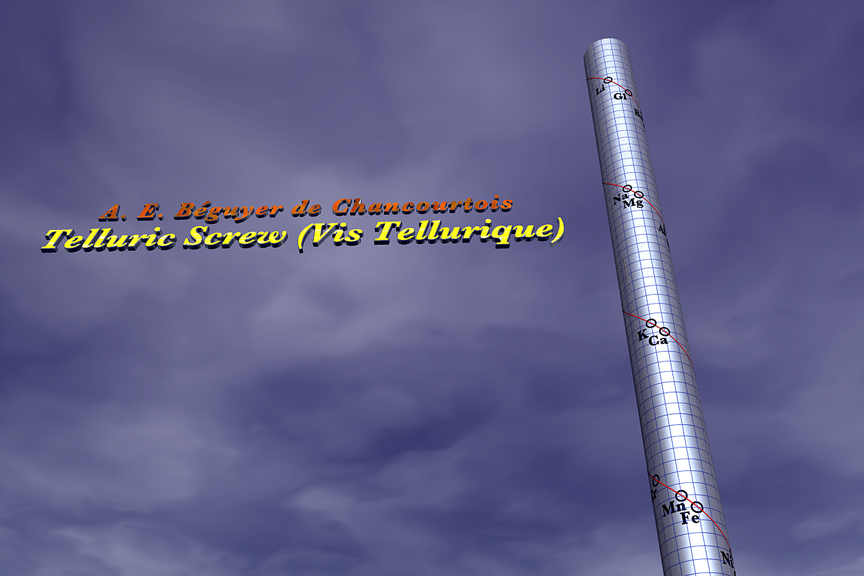
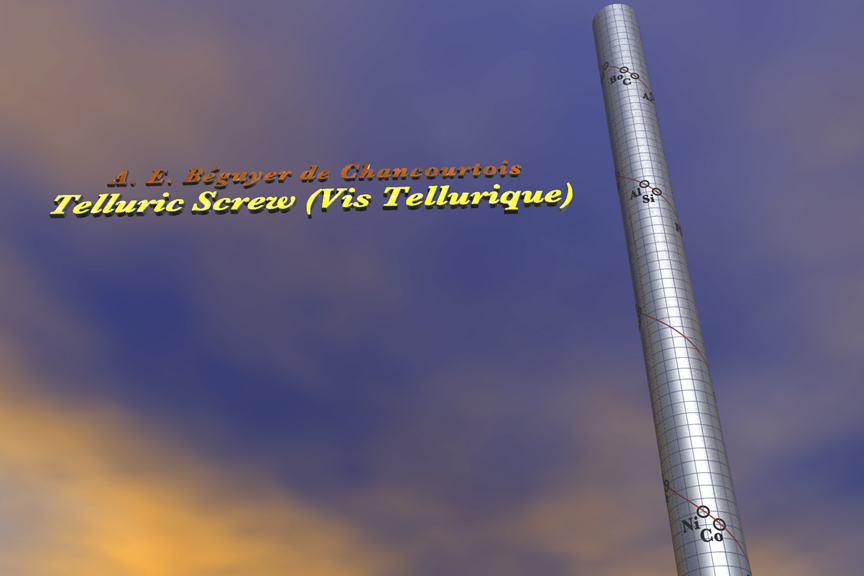
To explain the animations, the first two animations (after four stills) are of A. E. Béguyer de Chancourtois’ Telluric Screw, which was the first table to recognize the periodic law. He envisioned a cylinder with a spiral sequence of the elements, listed by order of atomic weights from the top down. He divided the elements into periods of 16 columns each, so that every 16 positions the pattern repeats, although not every position is occupied (atomic weights often increase by several units from element to element). It works quite well for the first few turns of the screw, but by the time it gets past titanium into the transition metals, the pattern of periodicity starts to break down because, as we now know, the periods of the periodic table aren’t the same length. The second animation shows the alignment of the elements into groups. Here are two still images rendered from the animation that show this alignment of elements by properties.

The Telluric Screw 1

Alignment of Li, Na, and K

Telluric Screw 2

Telluric Screw: Alignment of B & Al, C & Si

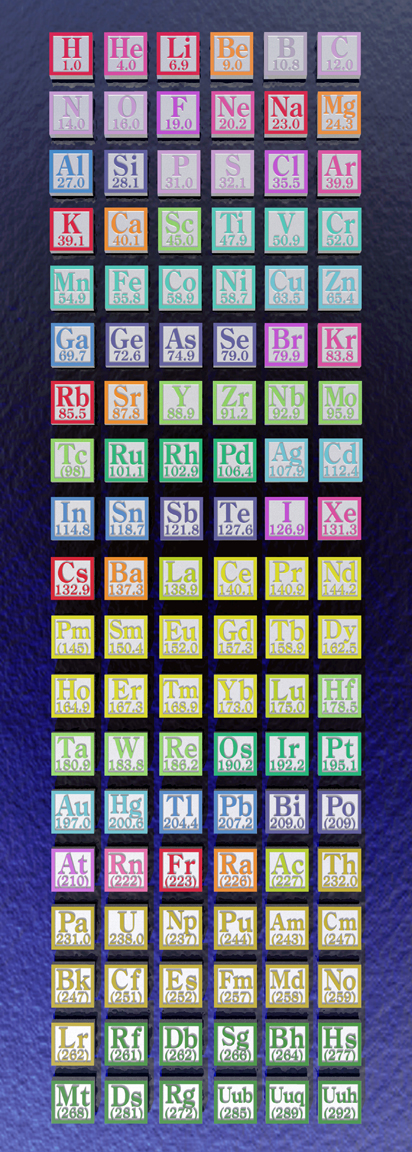
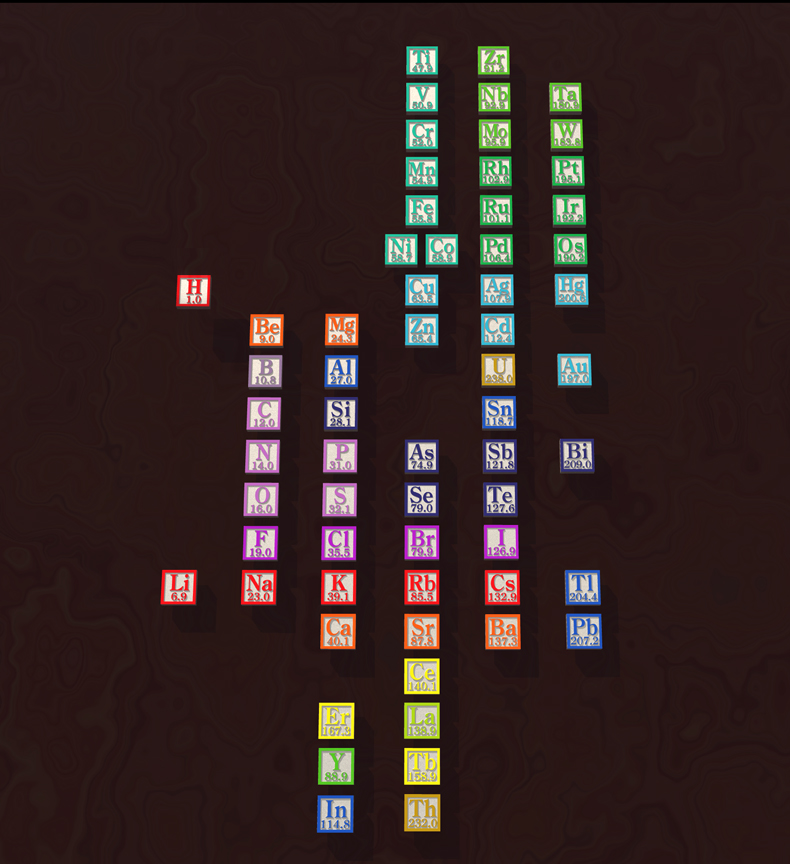
The next animation is simply a list of the elements by date of discovery, divided into periods of 25 years. 63 elements were known by 1869. The next animation shows all of the elements arranged in order by atomic number into six columns (there’s no reason for the six; it was just the number that I picked to set up the animation). They are also given colors by elemental families: red for the alkali metals, orange for the alkaline earths, green and blue for the transition metals, indigo for the metalloids, purple for the non-metals, bright purple for the halogens, magenta for the noble gases, and yellow and brown for the rare earths. The next animation shows the same list, but now takes away the elements that were unknown to Mendeleev, leaving only those that he was able to work with when building his table. Only a few rare earths were known, there were significant gaps, and an entire group of elements, the noble gases, was unknown. So trying to organize these elements into some sort of table was a difficult task.

Elements by atomic number

The elements listed by atomic number

The next animation shows this list of known elements moving into position to form Mendeleev’s first periodic table of Feb., 1869. One can see that he made some mistakes – beryllium and magnesium should be moved down to a position underneath lithium and sodium, and he has the rare earths out of place (mostly the trouble was that their atomic weights hadn’t been accurately measured yet). He has gold and mercury reversed, and a few groups shifted. His table is also organized vertically by periods instead of horizontally as is our usual medium format table today. If you were to take his table and rotate it clockwise 90 degrees, then flip the whole table horizontally, it would be oriented as our standard table is today and quite recognizable. This was quite an achievement given the limitations he worked with. His main insight was realizing that the periods didn’t have the same lengths; all his competitors had tried to force the elements into periods of equal lengths and it just wouldn’t work. Another insight was that he realized there were gaps in the table –  jumps of atomic weights and properties, and Mendeleev put himself out on a limb predicting that those elements were yet to be discovered; he even predicted their properties with high accuracy. The three most famous cases were gallium (discovered about five years later), scandium, and germanium.

Mendeleev's first table

Mendeleev's First Periodic Table, 1869

I am still working on several animations and one is rendering right now showing the medium format table opening up to become a long format table; I’ll do another one where the medium format table rearranges itself into a left-step table, and even try a few 3D tables as well. To build these tables, I created each element as a separate, moving tile which can be arranged in any position. The software used is Daz3D Bryce. The music playing in the animations is a simple loop I created using Garageband on my Mac. As for the sample images I’m showing here, feel free to download them and use them however you like as long as you give me credit. I’m trying to provide accurate scientific information but do so with visual appeal and artistic merit.

Meanwhile, editing on the video itself is progressing and I will have these two episodes posted along with the Rationale episode ASAP. I’ll then follow with the beryllium episodes and one on Greek matter theories, then move on to blown glass, cement making, stained glass, synthetic diamonds, and the Tintic mining district in Utah. I hope to have all of these done and posted before March 17, as I will be traveling back to Philadelphia then to attend and present at the National Science Teachers Association annual conference. My proposal to present was accepted by NSTA, and I will need to have several episodes posted by then to use in the presentation, one way or another, even if I have to put some client projects on hold.

Read Full Post »
« Newer Posts - Older Posts »