The second part of the video on beryllium is now finished. You can watch it here:
This video has literally been 2 1/2 years in the making; my students Amy Zirbes and Nathan Jane videotaped our interview with subject expert Phil Sabey, the Manager of Technology and Quality at the Delta mill, in NOvember, 2007. This video discusses the history of mining beryllium at the mine site in the Spor Mountains of western Utah, including how the bertrandite deposit was discovered, and the land rush that occurred as a result (including an incident involving Maxie Anderson, who was head of Ranchers and the general counsel for Anaconda. Maxie Anderson went on to be one of three men to first cross the Atlantic in a helium balloon in 1978). This video also shows how bertrandite it is mined today by Brush Engineered Materials using open pit mines, then transported and processed at the concentration plant near Delta, Utah. The concentrated beryllium hydroxide is then shipped by rail to Elmore, Ohio for final refining into beryllium metal, alloys, and ceramics products. This episode also discusses Chronic Beryllium Disease, the main health hazard of refining or working with beryllium.
Chronic Beryllium Disease:
Beryllium dust, when in the air in concentrations of greater than 2 micrograms per cubic meter, gets inhaled and irritates the lung alveoli. The body treats it as an invading body, and sends white blood cells which surround the beryllium particle and form small granules called granulomas in the lungs. At this point, a person is said to have sub-clinical CBD or is “sensitized” to beryllium. Most people who are sensitized do not develop clinical CBD, but in about 2-5% of sensitized people, the immune system overreacts and the granulomas build up to where the lungs become stiff and respiratory function is impaired, leading to symptoms similar to pneumonia. There is no cure once CBD has set in, and the eventual result is painful death.
Before the effects of beryllium dust were known, a high number of workers in the beryllium industry were getting sick, especially in certain plants such as the old Brush Wellman plant in Lorain, Ohio. Beryllium in its ores (beryl crystals and bertrandite) is tightly bound to the crystal lattice and is therefore harmless. But refining bertrandite or beryl means that the beryllium is physically and chemically separated from the crystal, resulting in fine beryllium particles getting into the air unless precautions are taken. The effects of beryllium disease were well enough known by the mid-1960s that when the Delta concentration plant was built, safeguards were put in place that reduce beryllium dust to under 0.2 micrograms per cubic meter of air, or less than 10% of the maximum safety levels. Workers also wear respiratory equipment such as facemasks with filters to prevent even that level of dust from entering their lungs. There has not been any incident of chronic beryllium disease in the workers at the Delta plant.
Final beryllium metal, alloys, and ceramics are also fairly safe as the beryllium is part of the metal and not airborne. The danger occurs when these materials are cut, machined, or milled, which allows beryllium particles to get into the air where they can be inhaled. The only way to cure chronic beryllium disease is to avoid it in the first place by preventing beryllium dust from entering the air. Special precautions must therefore be taken in any business that handles beryllium. OSHA has been studying CBD and is likely to be coming out with new and even stricter standards soon.
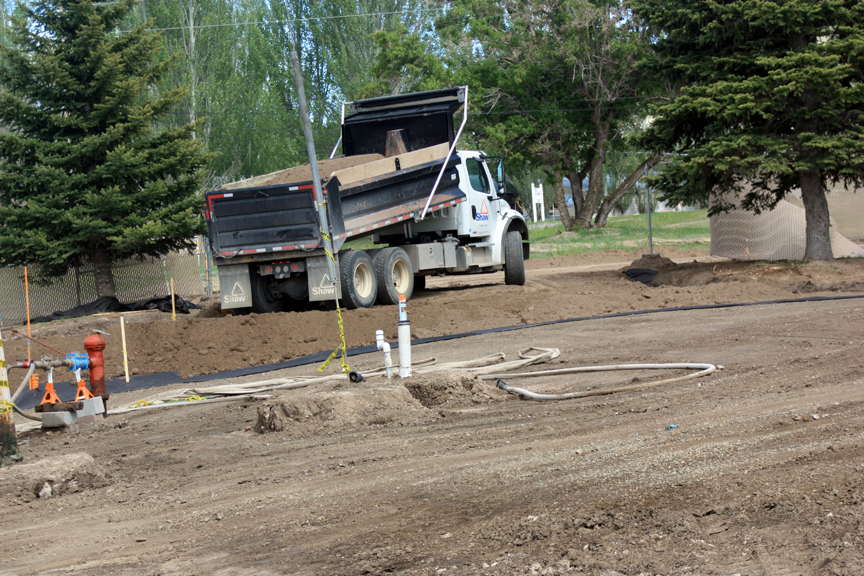
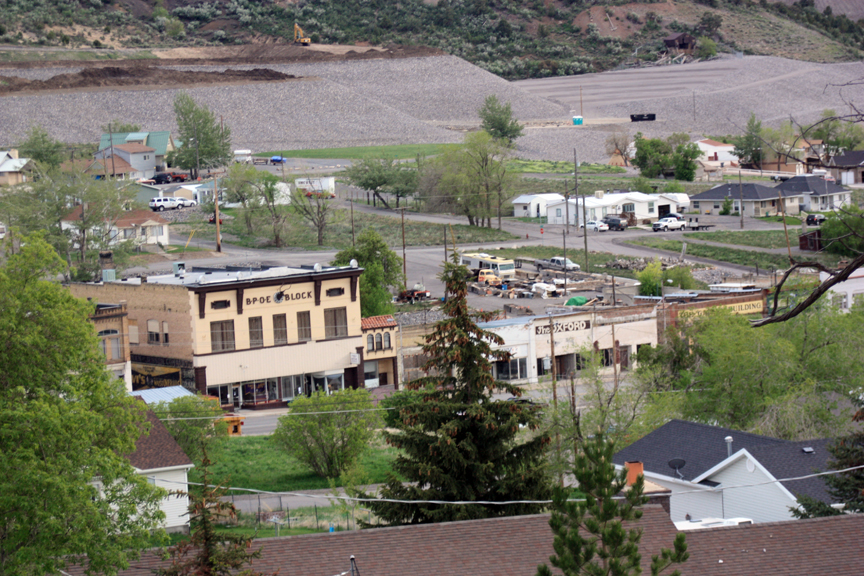
On my visit to the area around Eureka, Utah last Friday, June 4, I not only wanted to visit Mammoth and Silver City, but to also document the efforts by the Environmental Protection Agency to clean up the town. I had traveled through Eureka a few days before on Memorial Day and noticed that the lawn and soil around the LDS chapel in Eureka was being dug up to a depth of about 18 inches. On Friday, crews were in the process of bringing in new soil in dump trucks and spreading it over a layer of black plastic where the lawns used to be. Normally I wouldn’t have noticed it much – just chalked it up to them putting in a new sprinkler system or something similar. But I knew differently. This was the latest site in an ongoing process to replace the topsoil throughout the entire town, which is a huge undertaking. All the old mine sites throughout the district have left a legacy of environmental contamination and pose a danger to careless explorers who try to enter mine shafts or tunnels or ruins.
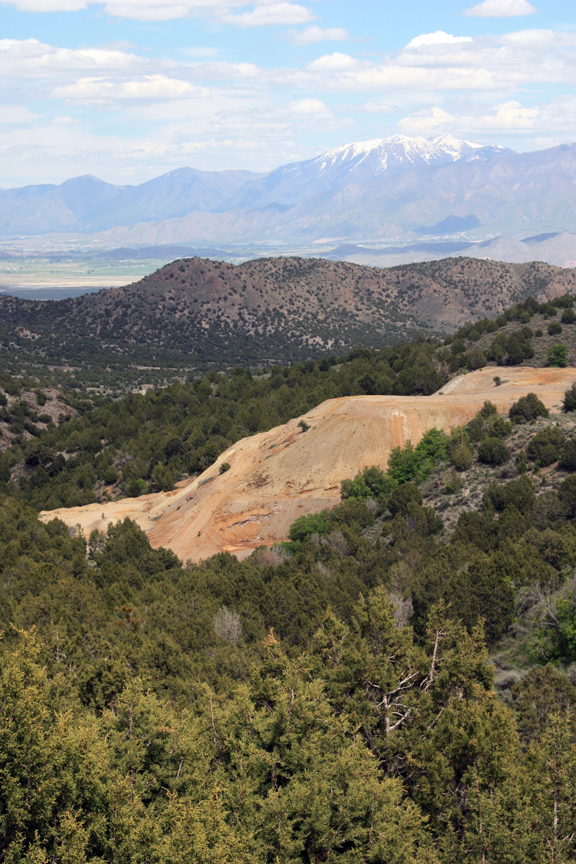
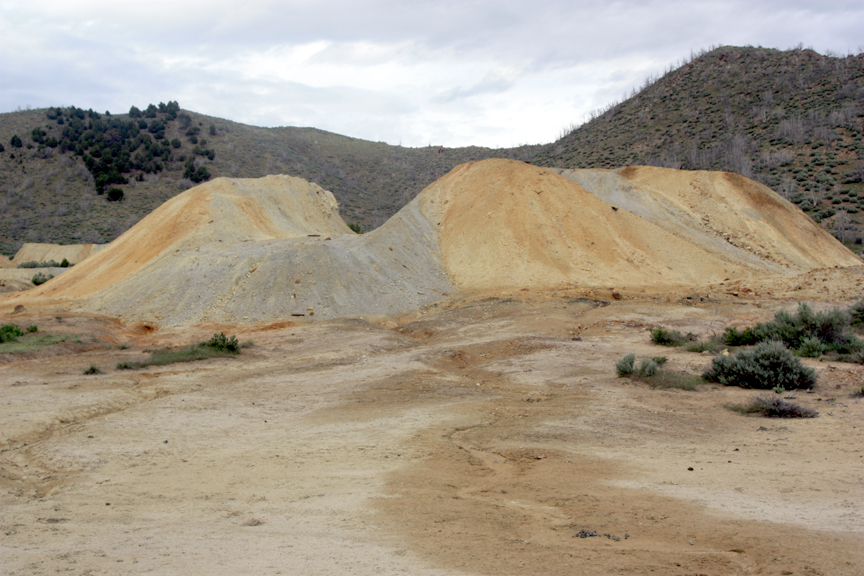
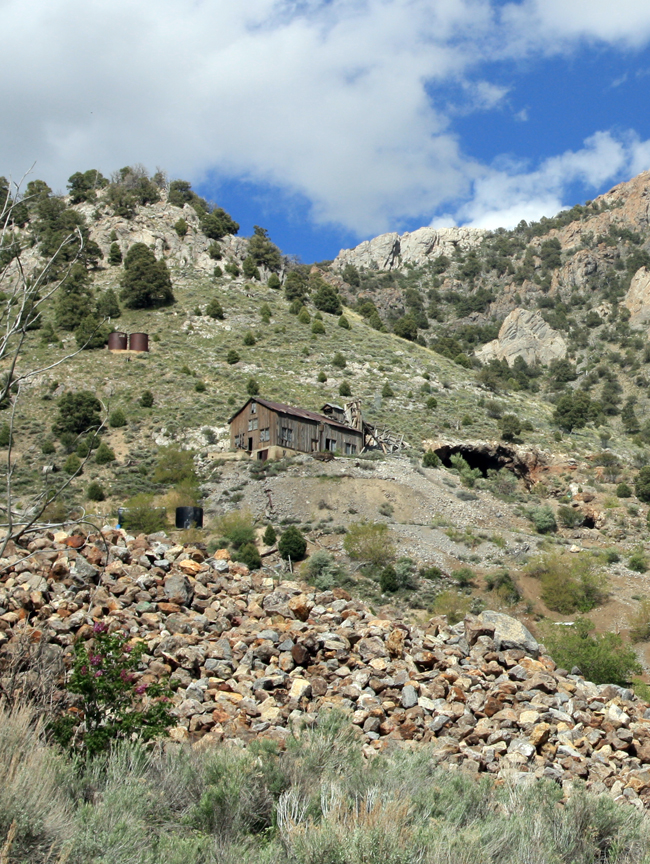
Ore dump at Dividend, Utah
When silver ore was discovered in the East Tintic Mountains by George Rush in 1869, it ignited a stampede of mining claims that spread throughout these mountains. New deposits were soon located and claimed, and the ore was assayed to be rich in silver, gold, lead, zinc, copper, and other minerals, usually in the form of metal sulfides. The most level sites near the mines quickly grew into the towns of Eureka, Mammoth, Silver City, Diamond, Knightsville, Dividend, etc. These towns were usually as close to the mines as possible so the miners didn’t have far to walk, so that miner’s houses and the mine buildings, hoists, smelters, railroad depots, and city businesses all competed for space in the narrow canyons. Tailings dumps of discarded minerals and slag from the smelters covered the hillsides around and above the town. Dust from these piles was blown by the frequent winds (this is western Utah, after all) and blanketed the whole town. Nobody thought much of it at the time. It was all just part of life in a mining town. But the entire topsoil was contaminated with lead and other metals down to about two feet under the surface.
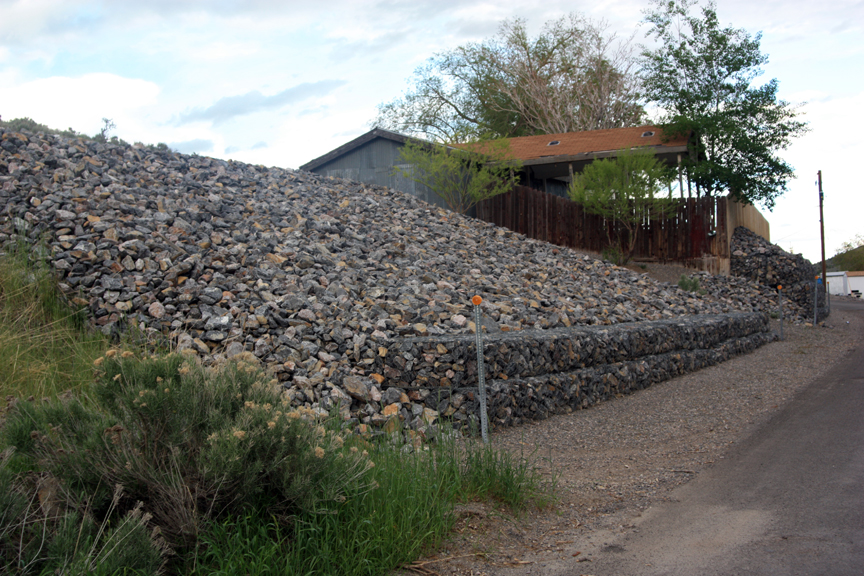
Limestone rip-rap covering a slope in Eureka, Utah
Clean-up operations near downtown Eureka, Utah
Today, the EPA has identified the area around Eureka as a SuperFund site, spending millions of federal dollars to clean up the contamination. One by one, the yards of the residents and businesses are being dug up and the soil replaced, brought in from a staging area east of town. To prevent the tailings piles from blowing more toxic dust around the town, broken limestone rocks called rip-rap are being hauled in from a nearby quarry and are carefully placed to cover over the tailings piles to prevent further erosion by wind and water.
Mine dump in East Tintic Mtns.
The work is progressing throughout Eureka, but the entire mining district has the same problem. Recent exploratory work has dug up the tailings piles in Silver City again, leaving the yellowish sulfides once again exposed to erosion. Many of the mine sites in the hills are owned by small-time private owners who keep the mines open on an occasional basis. They don’t have the resources to prevent the erosion of their tailings piles, and much of the East Tintic Mountains is contaminated just as Eureka itself is.
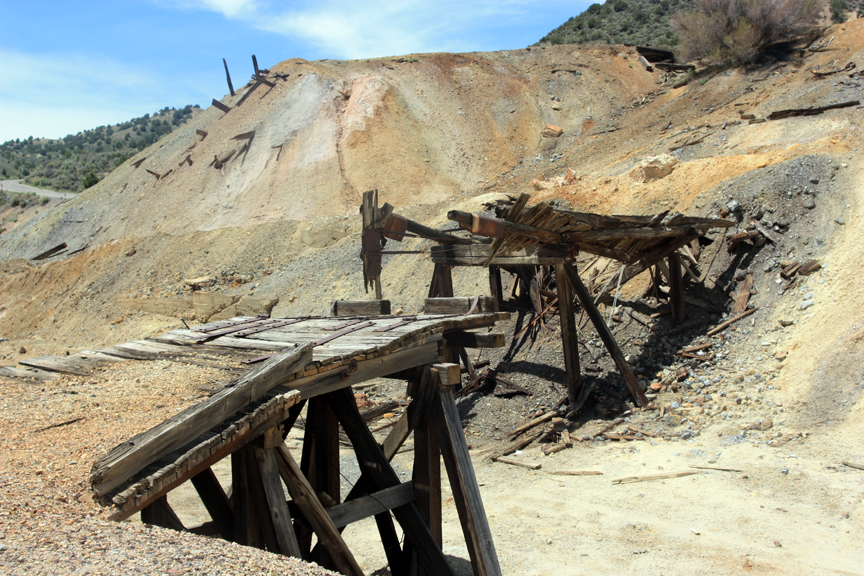
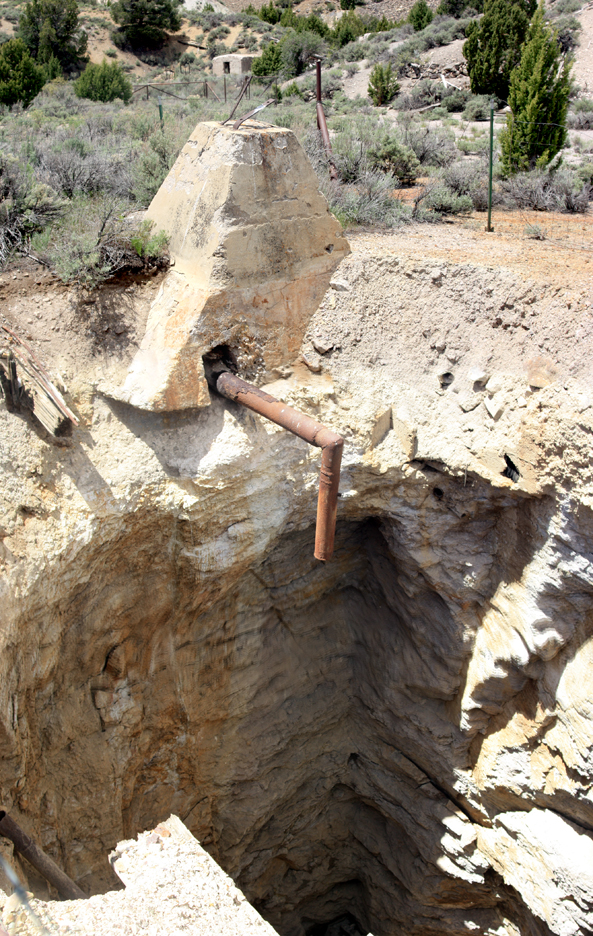
Abandoned mine shaft at Dividend, Utah
Another problem in the area is the many abandoned mine tunnels and shafts. Mines today are required to provide reclamation funds before the mine can even open, but it wasn’t an issue in the 1800s and early 1900s when most of these mines were active. The owners took the ore from the hills, then left all the scars, holes, pits, slag, tailings, and buildings behind when the ore ran out and their companies closed. Now these ruins are a hazard to casual explorers; every year or two someone dies falling down an abandoned mine shaft in Utah. The state has begun a program to close off these mines; to place grates or metal doors in the tunnels and shafts or to blast the entrances closed. Over 8000 mine sites have been closed off throughout the state through this program, but many, many more remain to be done.
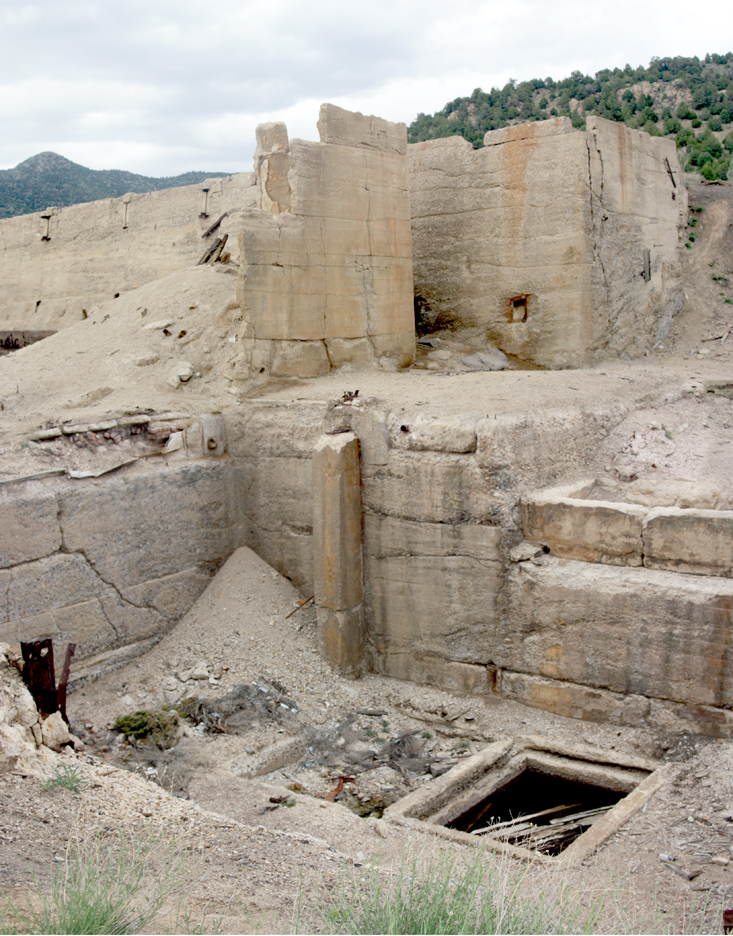
Ruins of the Knight Smelter at Silver City, Utah
Smelting or concentrating the ore brought its own environmental problems. Jesse Knight, the silver magnate that started Knightsville just southeast of Eureka, also built a smelter at Silver City in the early 1900s that operated for about eight years. The foundations of this smelter still remain, as do residual chemicals used to concentrate the ore, including mercury. When I visited the site on Friday, I found a man and his two young girls exploring the site. I suggested that he wash off his girls’ hands and shoes carefully once they were done because the whole site is contaminated with mercury (June McNulty, who runs the Tintic Mining Museum in Eureka, told me that he used to play with pools of liquid mercury metal that would seep into pockets around the smelter).
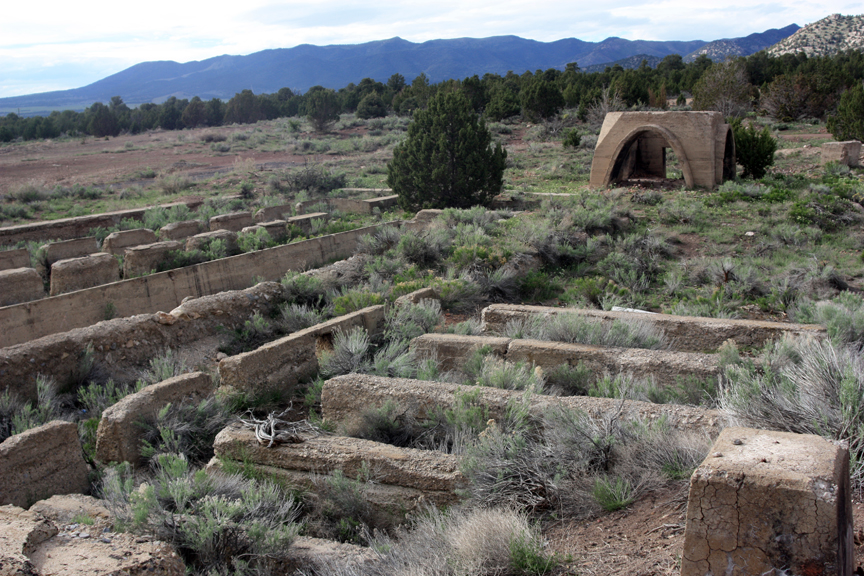
Remains of the Knight Smelter at Silver City, Utah
Right to the south of the old smelter lies a large heap of grayish tailings, now slowing growing a crown of weeds and grass. All the tailings left from the Knight mill were scooped up in the 1980s and placed on a pad with drainage pipes running through the pile, then a solution of cyanide was pumped and sprayed over the pile, leaching its way down through the tailings and chelating with the remaining gold and silver. The ore from these mines has been worked and reworked to get every last fraction of value out of it. But now the pile has been left just like all the other piles around, but with the addition of cyanide. I don’t know if steps have been taken to reclaim the pile, but I wouldn’t want to walk around on it.
Cyanide leaching pile at Silver City, Utah
The efforts to clean up these environmental messes is necessary, but it does come at a cost beyond just money. To clean up the town and make it safe to live in, its essential history and character has been changed. The heavy equipment moving in limestone and soil has shaken apart a number of fragile historical structures, including buildings, homes, and headframes. Where there were colorful tailings piles slowly returning to nature, there are now carefully constructed fresh piles of gray limestone rocks, an ideal hideout and breeding ground for rattlesnakes (no joke here – I ran over one in my minivan as I was driving up the road to Mammoth). Eureka doesn’t look the same as it did ten years ago.
One can argue that Eureka must be dynamic and capable of changing. It’s not a museum but a living town, and change is part of life. But the historian in me hates to see history destroyed in the process. That is one of the main reasons I’ve started the Elements Unearthed Project and have traveled to Eureka several times in the last few years with my cameras and equipment; as the EPA clean up progresses, the town is changing and I want to preserve what can be preserved of the history before it’s gone forever.
Erosion of tailings piles at Silver City, Utah
The beryllium video second half is progressing well. I’ve decided to do the three episodes on the TIntic Mining Districts next instead of blown glass because It’s fresh on my mind and I now have all the footage and photos I’ll need. My goal is to get the beryllium video done and uploaded by the end of this week, then the Tintic videos by mid-July. Then I’ll start hitting the streets looking for financial sponsorship to continue this project.
The last few weeks I’ve had to neglect the Elements Unearthed project in order to finish a client video that had a tight deadline. It was uploaded to YouTube Thursday night, so I now have a little bit of a breather before the next project and am back at work on Part 2 of the beryllium video. Winter has finally decided to let go (after one last gasp – we had a snowstorm here just two weeks ago), and already the early summer heat is drying out the cheat grass and turning it a brownish-purple color on the lower south-facing slopes. I decided now was the time to do some exploring and photography while the grass is still green in the mountains.
Belt Wheels and Mt. Nebo
Over the last two years I’ve visited the Tintic Mining District several times with students and my own children and have collected a considerable amount of photos and video clips, including a tour of the Tintic Mining Museum and an interview with June McNulty, who runs the museum with his wife. But there were several places in the district that I hadn’t visited, including Mammoth and Silver City. So yesterday (Friday, June 4) I packed up the cameras and headed for the hills.
Glory hole at Dividend, Utah
Change room and stove at Dividend, Utah
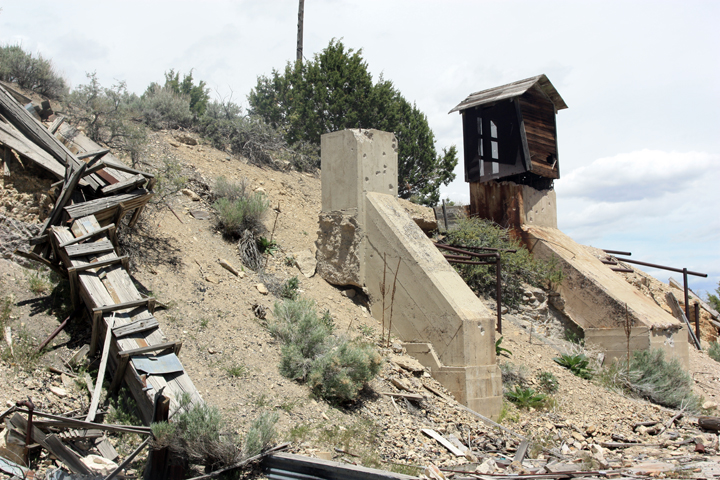
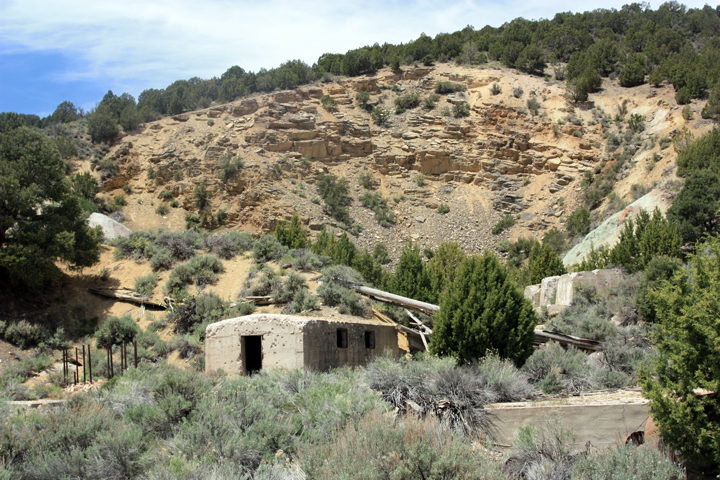
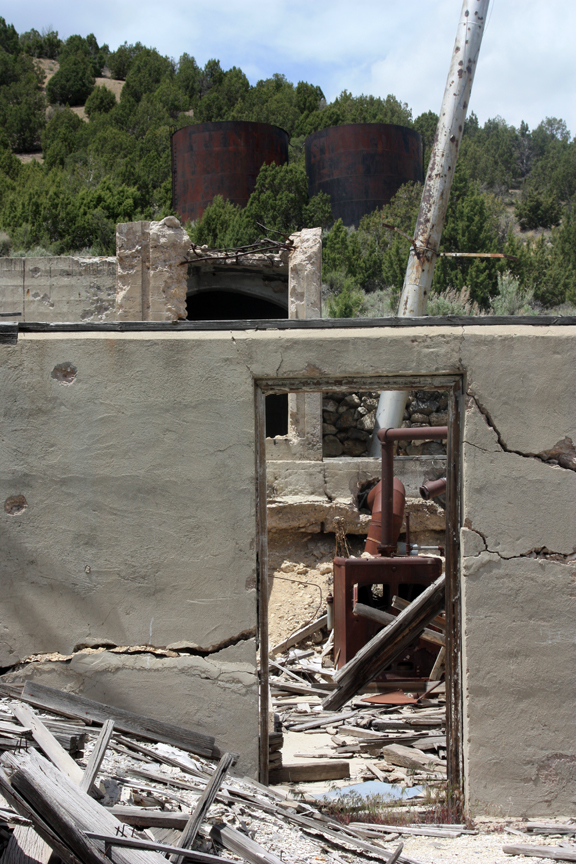
I stopped first in the hills above Burgin, the site of the town of Dividend, so called because the mine paid out fairly decent dividends to the miners compared with other mines in the district. I decided to climb up the hill further than before, toward the two large rusty tanks that can be seen from the road. I was surprised to find much more there than I had known about before, including the ruins of miner’s houses (some semi-wild purple irises and lilacs were still alive and blooming). A processing plant once existed here, and the ground is covered with yellowish-stained rocks and pieces of slag and everything smells of sulfides. One ruin 2/3 up the hill still has an old rusted stove for keeping the miners warm in what was probably the change room – the mine portal itself is just above the room, and there are even a few remains of timecards used to clock in and out of the mine. The few I looked at were dated from 1971, which was about the time that the mine at Dividend finally closed down. Mining continued, periodically, further down the slope at Burgin. Almost forty years of weather has taken its toll; all the roofs and any other wooden structures have long since rotted away, leaving old, dry fragments of boards with rusted nails sticking out littering the ground. Most of the equipment is gone, taken by looters and souvenir hunters, but enough of the foundations and structures remain that one can imagine what Dividend looked like in its heyday.
Wild irises at Dividend, Utah
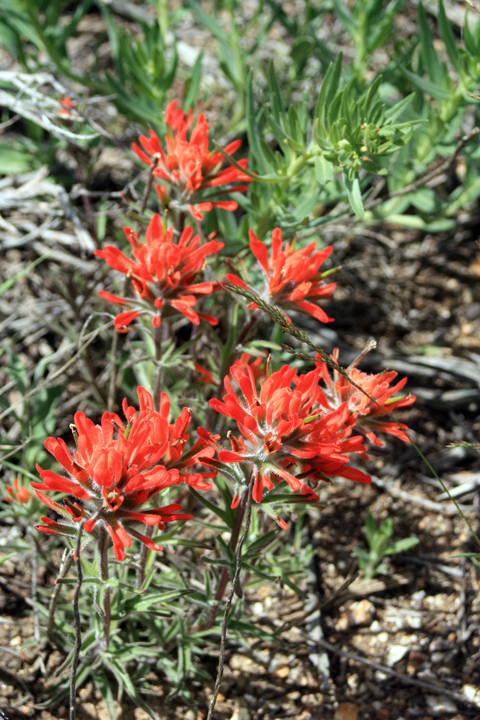
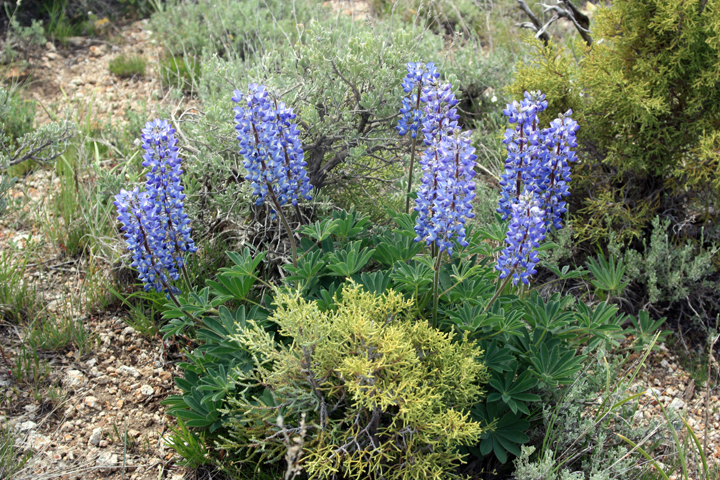
The road past Dividend is off the main path of Highway 6. It’s a good road, well maintained and asphalted but not much visited. I only saw two other cars and a motorcycle during the four hours I spent exploring along the road. The East Tintic Mountains between Dividend and Eureka are dotted with old mining ruins and tailings piles, with dirt roads leading off frequently up every side canyon and ridgeline. Most of the area is posted No Trespassing, so I limited myself to taking photos from the main road. It is still late spring up there; the maple trees in the canyons have only just gotten their leaves, and wildflowers including mountain lupine and Indian paintbrush cover the hillsides.
Indian paintbrush near Eureka, Utah
Blue Lupine near Eureka, Utah
I traveled through Eureka and saw the continuing cleanup efforts there (more on this in my next post) and drove on to the town of Mammoth. Located in a side box canyon just to the south of Eureka, this was one of the richest areas of the Tintic Mining District. The mines are located ringing the valley – many long since abandoned but several showing recent work. With prices for gold and silver high right now, much exploration is underway to re-work the old claims and tailings piles and to do new exploratory drilling. Again, most of the area is posted and is private property; I limited myself to the main streets of Mammoth to photograph the old buildings and mine dumps.
Mine at Mammoth, Utah
At one time, when the processing plant was in full operation in the early 1900s, Mammoth boasted a population of about 2000. The people lived in the upper eastern portion of the canyon (Upper Mammoth) while the mill was at the mouth of the canyon lower down the slope (called Robinson after the mill’s foreman and later Lower Mammoth). Once the town was incorporated, public works such as churches and even a hospital (rare for a mining town) were built in the middle, or Midtown. In the early 1930s, my father used to visit his first cousin Ralph Larsen, whose family lived in Mammoth. During the winter the road leading up to town would be covered in packed snow, and the two of them would ride their sleds from Upper Mammoth all the way down to Highway 6, almost two miles, without ever stopping. Then they’d have to wait for someone to give them a lift back to the top.
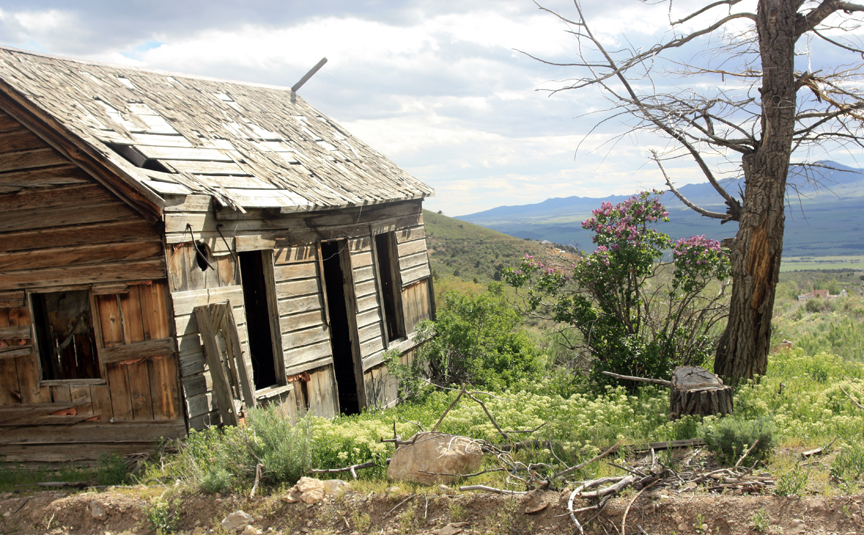
Miner's Shack in Mammoth, Utah
Even though the mines had all closed by the 1950s, Mammoth somehow escaped the fate of most boom-and-bust mining towns; it never completely died. A few people hung on. Over the last ten years, since I last drove up here, it even appears to have grown in population. More houses have been fixed up and are occupied than before, and it is becoming an artistic community of sorts. Renewed interest in mining has also given the town a boost.
Lizard in the ruins at Dividend, Utah
After Mammoth, I visited the old Jesse Knight smelter at Silver City and drove up the canyon there, but I’ll leave that for next time.
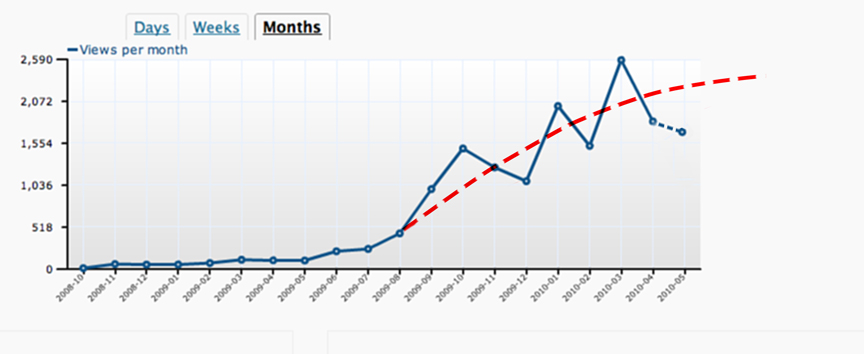
This blog has reached a milestone over the last week. Over 15,000 people have visited this blog since it was begun in Oct., 2008. Since my fellowship in Philadelphia last summer, the viewership has risen greatly, and I’ve been averaging over 1500 visitors per month with 2600 in March as my top month. I don’t know how that compares to other blogs out there, especially on such an esoteric topic as the origins and uses of the chemical elements, but it represents to me that my purposes in creating this blog are being fulfilled – people are finding out about the Elements Unearthed project and are hopefully learning about the elements (although this is impossible to assess using just the WordPress stats).
Stats for The Elements Unearthed blog
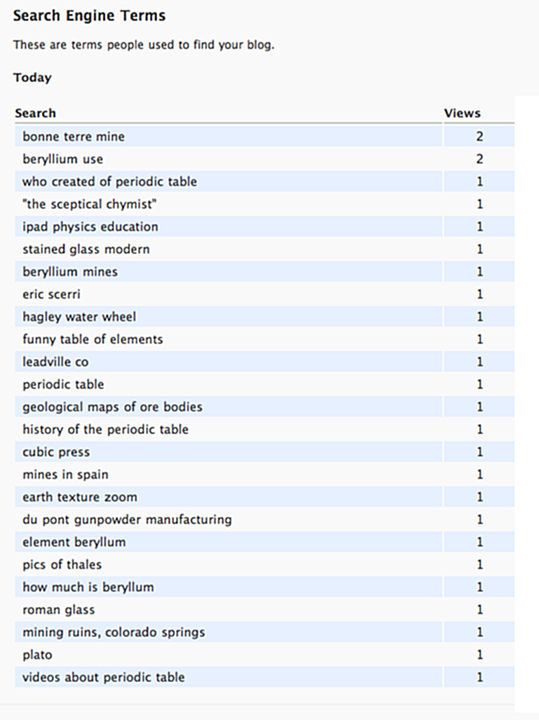
I can’t track demographics about the age or interests of the visitors except by looking at the most common search terms they’re using. Some of the time the searches bring people here accidentally – for example, they might be looking up how to build a water turbine and find my post on the water turbines used at the Du Pont Gunpowder Factory in Delaware. I don’t have any instructions that would be useful for them, and their purpose wasn’t to find out about how gunpowder was made, but here they are. A rough estimate is that about two-thirds to three-fourths of the people coming to this blog are doing so because of legitimate searches involving chemistry, the elements, or the history of science or mining. I hope that I have provided the information they need.
I get a few searches every day about the Tintic Mining District around Eureka, Utah. This is probably because not many other sources exist. Some of the comments written show that some of these visitors had relatives that worked there (so do I – one of my great grandfathers died as a result of injuries received as a miner in the town of Diamond, part of the Tintic District). This lets me know that I need to soon do the episodes on the Tintic District. Now that the weather is (mostly) getting better, I hope to take one final trip to the area around Mammoth, Diamond, and Silver City to complete the photos and video I’ll need. My plan this summer is to visit a mining area at least twice per month. Then, if I have a school team that wants to do that area, we’ll have much of what we need all ready to go for the 2010-2011 school year.
Recent search engine terms which brought visitors here
Ultimately, it’s the videos that this site is about. If you want to play them on YouTube, you can simply look up “davidvblack channel” in the YouTube search engine and all 23 of my videos (including the Business Profile Videos and my animation demo reel) are there. This blog’s purpose is to promote the videos and talk them up, giving some background into their creation. Once I have three topics done (the next topic after beryllium will be glass blowing), I will set up a dedicated website and upload the videos to iTunes, which will provide another location in addition to their existence here on this blog and on YouTube. There are some drawbacks to this blog as the primary source of the videos: since WordPress converts the video to FLV format, these videos won’t work on an iPod, iPhone, or iPad (I went to the local Mac store recently and tried out an iPad. The videos, being Flash based, won’t play). So I need a site like iTunes that can work for the Apple crowd as well (my kind of people).
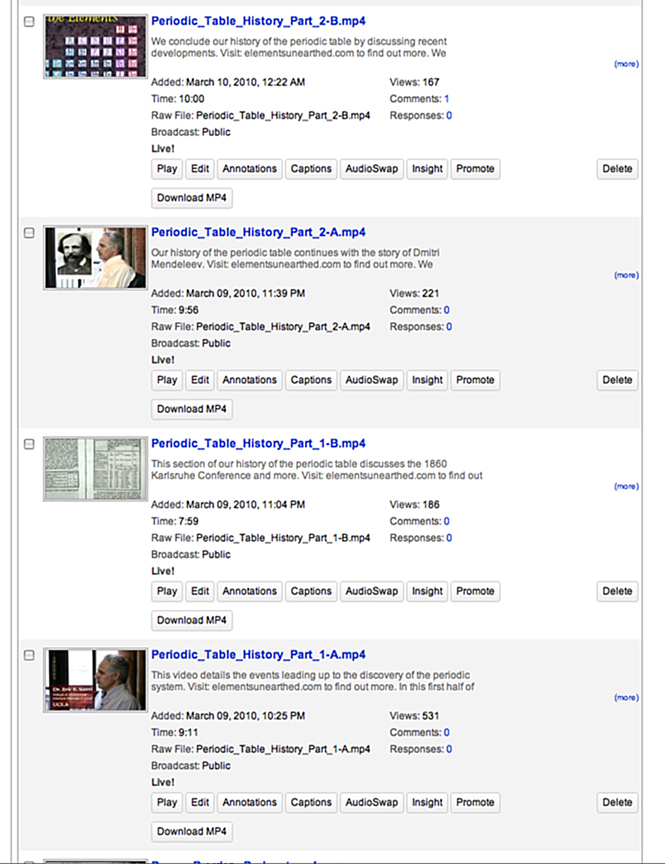
Here are some stats on how the videos are doing: The episodes that have been finished so far have been the two parts of the Periodic Table featuring my interview with Dr. Eric Scerri of UCLA and the first half of the episode on beryllium. On this blog site, the periodic table videos have been played over 370 times, and on YouTube they have been played over 1100 times. This isn’t to say that they have been played all the way through; the average play is about three minutes (which is why I try to keep my Business Profile Videos to three minutes or less). They were uploaded about two months ago, so they’ve seen about 1500 plays or about 4500 minutes of viewing so far. I’m pleased with that. The beryllium video (which covers the uses, sources, and geology) has been viewed 82 times here and 27 times on YouTube since it was posted about two weeks ago. Considering it is a more limited topic, I feel that is a good start as well.
Now it might seem that I’m just into an ego trip, obsessing over these stats, seeing who is referring to this blog from their site, who is putting links to these videos on their sites, etc. It’s like typing your name into a Google search to see if you really exist (I don’t show up until something like Page 19 of the search results . . . there are a lot of other David Blacks out there). But I do have a reason for tracking how this blog and the videos are doing: I hope to be able to show the reach of this project to potential funding sources. Since NSF turned me down this year, I’ll have to go begging hat in hand from other sources, and being able to show how many people are finding and using this blog and viewing the videos will be essential for a successful pitch.
If any of you out there read this, I would appreciate your writing a comment on how you’ve found this blog, what needs (if any) it has met for you, how you’re using it, etc. Any information I can get on how effective this blog is which goes beyond the bare numbers will be very useful for me. Meanwhile, I’ve been very busy with some client videos that were on a tight deadline, but I have a lull now for a few days and I’m getting back to Part 2 of the beryllium episode (this section on the history of mining, refining, and hazards). I’ll get it posted within the next week or two, give or take the weather (I’m also trying to plant a vegetable garden, if the ground will ever dry out enough). Then I’ll start on the blown glass video, which already has the narration and much of the video editing complete from my students last year. I’ve gathered more photos and need to add them. It will be done in two parts as well: one on the history and process of blowing glass, the other on the science and hazards of glass blowing. I’m shooting for mid-June to have those done, and will set up the iTunes site then. That should be enough episodes complete to start pounding the pavement looking for funding.
After weeks of editing and tweaking, I have completed the first half (part 1) of the video on Beryllium. This section is on the uses and sources of beryllium, and the geology of the bertrandite deposit of western Utah. The second half will take another week or so (I have quite a few tight deadlines on client projects that must be completed right now) and will include the history of mining, current mining operations, refining, and hazards. Here is Part 1:
Beryllium Part 1
I am including here the script for the section on sources of beryllium:
Sources of Beryllium
Beryllium is the first member of the alkaline earth family of elements, which means that it’s highly reactive and easily bonds to form compounds but is difficult to separate into a pure metal. Beryllium was discovered by Louis-Nicolas Vauquelin in 1798 as a component of beryl and in emeralds. Friedrich Wöhler and Antoine Bussy independently isolated the metal in 1828 by reacting potassium with beryllium chloride. Beryllium’s chemical similarity to aluminum was probably why beryllium was missed in previous searches. We now know that beryllium is found in only a few minerals, including the beryl family and bertrandite.
Emerald necklace in the National Museum of Natural History
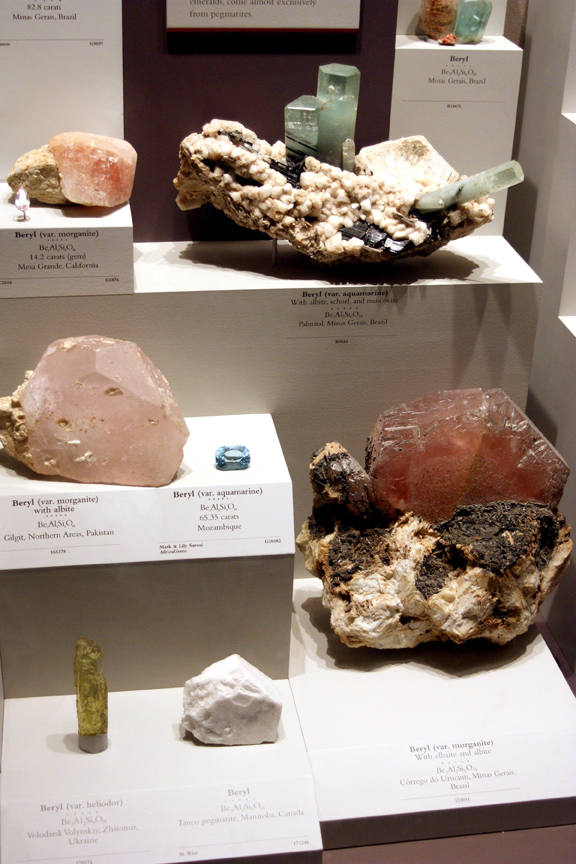
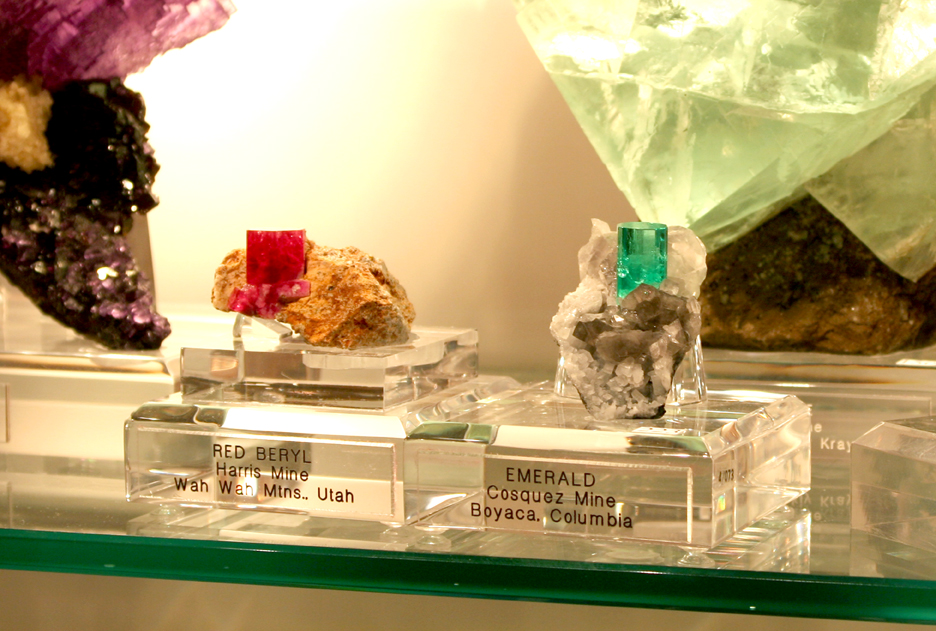
Beryl is a hexagonal crystal of beryllium aluminum cyclosilicate that can have various colors depending on impurities. Trace amounts of chromium or sometimes vanadium give it a deep green color; when crystallized slowly into a transparent crystal, it is called emerald. Emeralds have been prized as gemstones for thousands of years; today, the main source of emeralds is Columbia in South America.
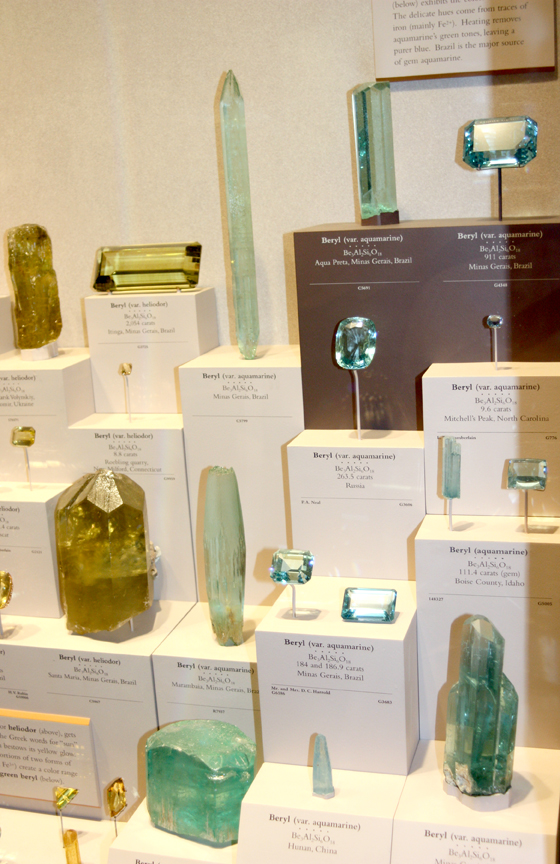
Heliodor and Aquamarine at the National Museum of Natural History
Trace amounts of iron (II) ions produce a blue-green variety of beryl called aquamarine. Small amounts of iron (III) ions produce shades of beryl from golden yellow to greenish yellow called heliodor. Manganese (II) impurities produce pink beryl called morganite. Completely pure beryl is colorless and is called goshenite.
Morganite and Heliodor
The rarest form of beryl is red beryl, mined only in the Wah Wah Mountains of southwestern Utah. It gets its color from traces of manganese (III) and is a deeper red than morganite. In addition to these gem varieties of beryl, there is non-gem beryl, which is opaque and considered semi-precious. It is chiefly mined in Brazil in the Minas Gerais District although some deposits exist in Colorado and New England as well; it is New Hampshire’s state mineral. A large specimen 5.5 meters by 1.2 meters was found in a quarry in Maine, and the largest crystal ever found is a beryl crystal from Madagascar that is 18 meters long and 3.5 meters in diameter.
Red Beryl and Emerald, from the collection of Keith and Mauna Proctor
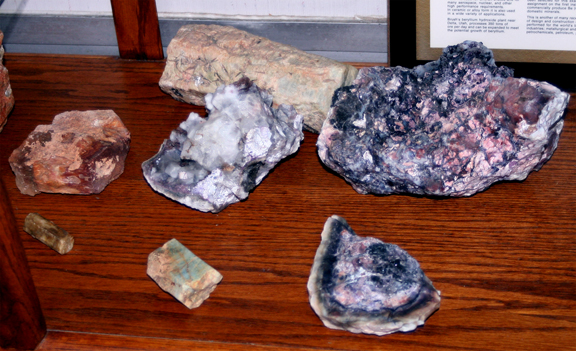
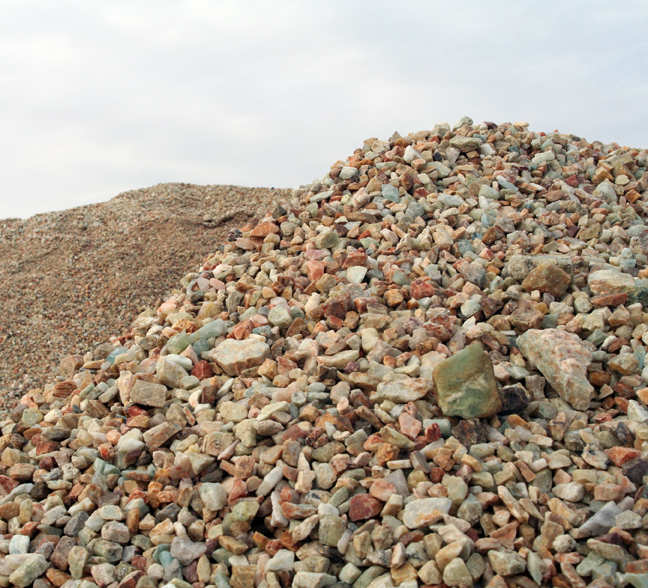
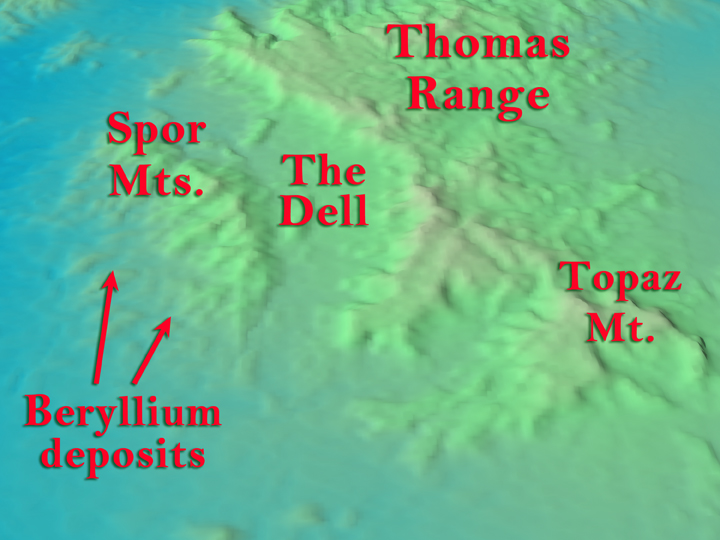
Bertrandite, on the other hand, is a pinkish mineral consisting of hydrous beryllium oxide silicate that doesn’t form very large crystals. It tends to be found clinging to grains of igneous pegmatites such as granite. The bertrandite in the Spor Mountains of western Utah is found in highly altered rhyolite and is the only deposit large enough and concentrated enough to mine commercially. It is the sole source of beryllium for all of the United States.
Bertrandite and Beryl, on display at Brush Resources Delta Plant
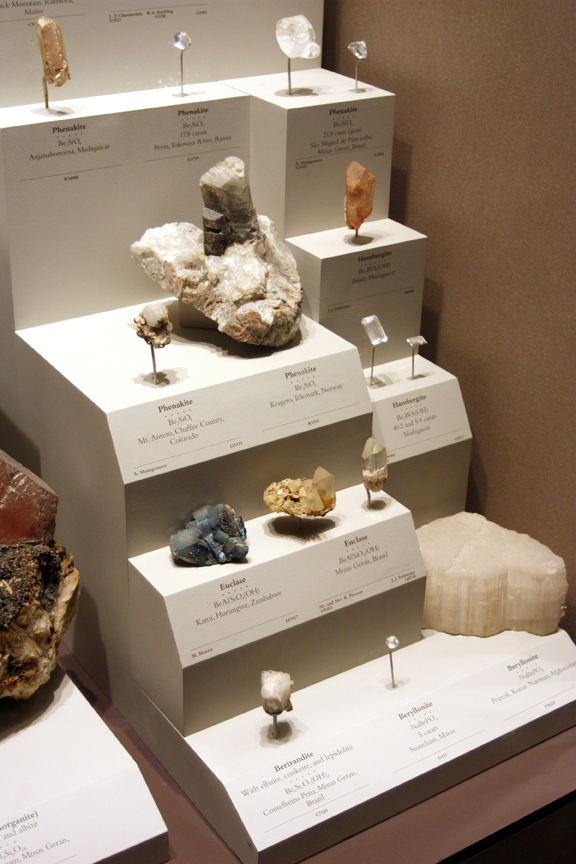
Beryllium is also found in a few other rare minerals, such as chrysoberyl (beryllium aluminum oxide), phenakite (beryllium silicate), euclase (hydrous beryllium aluminum silicate), hambergite (hydrous beryllium borate), and beryllonite (sodium beryllium phosphate).
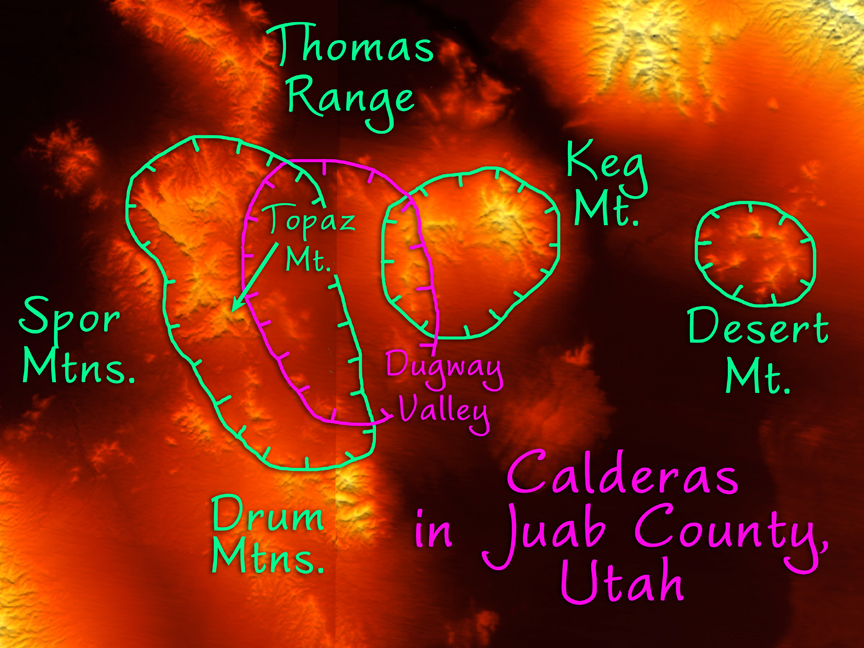
Volcanic Calderas of Millard and Juab Counties, Utah
Usually, when one thinks of rocks and geology it’s all a bit impersonal; after all, they were formed in the distant past, in many cases hundreds of millions of years ago. Most of the rocks in western Utah, where I’m from, were laid down as ocean deposits during the Paleozoic Era. Now all the layers of shale, limestone, and dolomite have been thrusted, twisted, and even overturned, so that in some areas the Paleozoic rocks lie on top of younger Mesozoic rocks. How could this have happened? But in addition to these sedimentary rocks, there are some anomalies; whole mountains that puzzled me because they didn’t fit in. My grandfather, who lived next door to us in our small hometown of Deseret, would take me for drives out on the west desert looking for trilobites or pine nuts or just collecting rocks. One area we visited was Topaz Mountain at the southern end of the Thomas Range in Juab County, where one can find topazes just by walking along an arroyo on a sunny day, following the flashes of light. The rocks there are weird, with strange cavities and a light gray texture much different than the surrounding mountains. I wondered where it came from, how the topazes got there, how old the rocks were, and above all, how geologists were able to answer these questions.
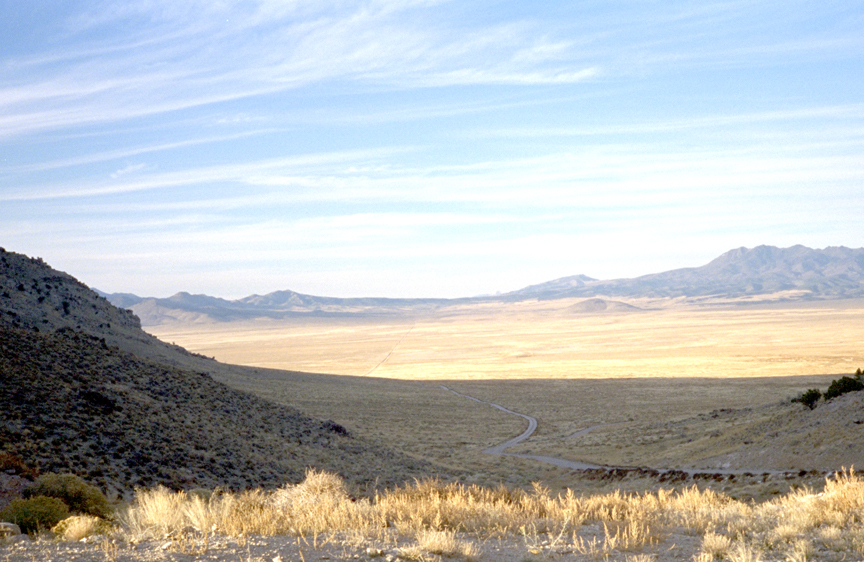
View from Desert Mt. Pass
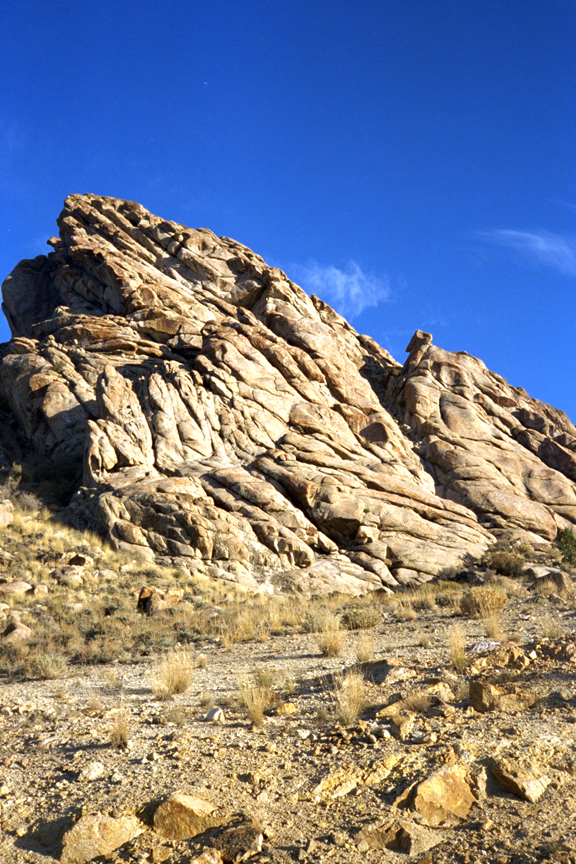
This was all very interesting to me as a child, but then geology got personal. My father was a farmer and cattle rancher, and one day in June of 1971, we were hauling a load of yearling heifers out to our ranch in southern Tooele County (about 50 miles due north of Deseret). As we were driving our old 1952 model half-ton truck over the pass on Desert Mt., the brakes and clutch both failed at the same time and we found ourselves rolling down the steep and winding road without any means of stopping (the road has since been improved, as you can see at right. Back then the road cut along the left side of the pass and was much more dangerous). Dad tried to slow the truck down by ramming it into the embankment on his side, but the impact jarred the cab, flung open the door on my side, and threw me from the cab (this truck had no seat belts). Fortunately, there is a gap in my memory at that point for several seconds. The next thing I can remember is lying on my back looking at the truck as it rolled away from me and disappeared out of sight over the edge of the embankment. Then I saw my right leg, which was twisted unnaturally, with my thigh badly torn up – a whole piece of my thigh seemed to be missing, as far as I could see through the tattered remains of my pants. The best I can figure is that the rear dual tires of the truck rolled over my leg, breaking it in two places and tearing up the skin and underlying tissue badly. Or my leg dragged over the rough, sharp rhyolite rocks of the mountain. Or both.
Rhyolite formations at Desert Mt. Pass
This was a hot day in June. We had water and snacks, but my father had sprained his ankle and could not walk. This was before cell phones or even CB radios, and we had no way of getting help. You have to visit the west desert of Utah to appreciate just how isolated it is. Dad lit the truck on fire, hoping the column of smoke would attract attention from the ranchers (including my grandfather) across Ereksen Valley, but no one saw it. Hours dragged by. I was slowly bleeding to death as blood seeped out of my wound, and I was going into shock. After about five desperate hours, my father saw a car sitting on the road leading up to the pass; they had stopped when they came around the corner and saw the smoldering remains of our cattle truck. Dad stood up and waved, and they drove on up. The car was driven by a an elderly couple from Odgen, Utah: rockhounds who were out on the west desert looking for Topaz Mt. All they had was a hand-drawn, inaccurate map and they were off course by 40 miles. Dad was able to ride in to the nearest phone (about 15 miles) and call the ambulance and Doc Lyman from Delta. After several days in Intensive Care, two months in the hospital with skin grafts, and another three months in body casts, I was finally able to walk again. I am lucky to have two legs.
So my life was profoundly affected by the geology of Utah’s west desert. Desert Mt. almost killed me; Topaz Mt. saved my life. So I have understandably been curious about the geology of these two mountains. I can honestly say that I am a part of that geology – somewhere on Desert Mt. there’s a small patch of dirt that used to be me. And that geology is a part of me, too – the doctors were never able to get all of the small rock fragments out of my leg that had been ground in. Yes, I know it’s a bit grotesque, but it’s literally true.
That’s why I’ve wanted to complete these episodes on the beryllium deposits of western Utah before doing any others, because telling that story includes the story of the geology of the area and how those two unusual mountains came to be there in the first place. The episodes are coming along nicely, and I have completed the geology section completely and offer it now for your enjoyment. The first episode (on the sources, uses, and geology of beryllium) will be ready in a few days; the second episode on the mining, refining, and hazards of beryllium will be ready by next week.
Here is the script of this section, in case you’d like to read along with the video:
Geologic Origins of the Bertrandite Deposits in Western Utah
To understand the origins of the beryllium deposits in the Spor Mts. we have to go back to when western Utah was still under the ocean. For hundreds of millions of years, this ocean floor built up gradual layers of shale, limestone, and dolomite. The North American tectonic plate began to separate from the rest of Pangaea about 200 million years ago and was moving westward into the Farallon Plate, which was subducting under the western margin of North America. The sediments carried down with it were heated and rose toward the surface to cool as the granitic plutons of the Sierra Nevada Mts. For the first time, the western half of Utah and Nevada rose above the ocean.
Aerial View of Topaz Mountain Area
Then, about 150 million years ago, the North American Plate sped up; instead of moving about 2.5 cm per year, it leaped ahead at the breakneck speed of about 8 cm per year. Instead of subducting, the remnants of the Farallon Plate were pushed under western North America, scraping and dragging the roots of the continent with it. This friction caused a wave of thrust faulting and mountain building to travel west to east across Nevada (the Nevadan Orogeny), then across western Utah (the Sevier Orogeny) about 125-75 million years ago. A huge mountain range rivaling today’s Rockies sat on the Utah-Nevada border, with sediments washing off of it into an inland sea to the east to form the upper layers of the Colorado Plateau as dinosaurs wandered through the mud flats and swamps. These swamps became the coal deposits of central and eastern Utah.
As the thrust faulting continued east, it encountered the thick Colorado Plateau and bent it into the huge anticline of the San Rafael Swell. When it reached Colorado and Wyoming about 55-60 million years ago, the thrust faulting created the Laramide Orogeny that resulted in the Rocky Mountains, including the Uinta Mountains of northeast Utah.
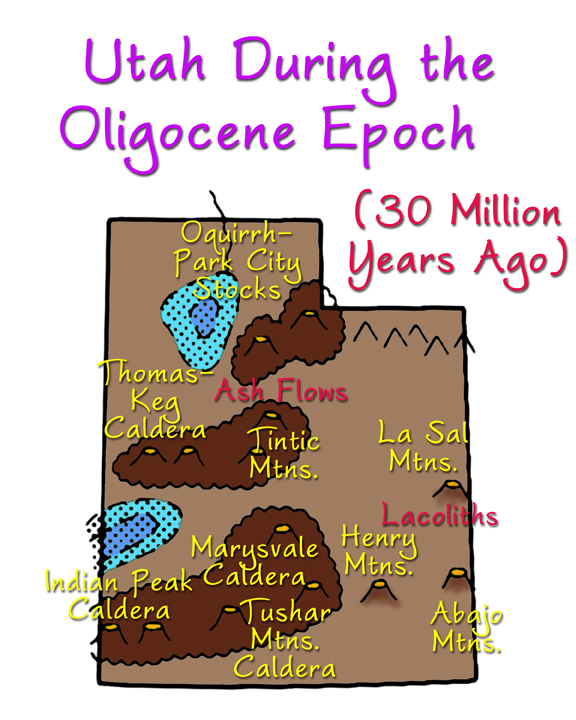
About 50 million years ago the North American Plate slowed down again and the remnants of the Farallon Plate collapsed from underneath, pealing away in a wave that now traveled from east to west. A wave of volcanism traveled with it, moving back across Utah and Nevada. Much of the mineralization found in Colorado, Utah, and Nevada occurred at this time, including the silver, copper, zinc, lead, and beryllium deposits of Utah. In western Utah, the volcanism produced several zones of Andesitic volcanoes with calderas and ash flows, including the Thomas-Drum Mt. caldera along with calderas at Keg Mt. and Desert Mt., about 45-39 million years ago and continued for at least 30 million years through several phases. In the first phase, quartz-rich magmas formed the calderas and ash flows that covered much of the area and produced the gold, copper, and manganese deposits of the Detroit District in the Drum Mts. The second phase of area volcanism occurred as the calderas in the Spor and Drum Mountains subsided and were filled with rhyolite from the Dugway Valley caldera about 38-32 million years ago.
Utah During Oligocene Epoch, 30-40 million years ago
The ancient thrust faults and collapsed calderas created fractures, which served as avenues to intrude veins of mineral-bearing magmas. Beginning about 25 million years ago, a third phase of volcanism pushed domes of highly alkaline rhyolite rich in fluorine and beryllium up through these fractures. The fluorine and beryllium minerals formed gases that were injected into the thrust faults and eventually encountered ground water, which flashed into steam, shattering the surrounding rhyolite and forcing the beryllium minerals to precipitate throughout the fractures and empty spaces in the host rhyolite rocks. Gradually, minerals were deposited as crystals of topaz, fluorspar, garnet, and bertrandite in the Thomas-Spor Ranges, and red beryl in the Wah Wah Mts. Additional trace elements such as uranium, lithium, aluminum, zirconium, iron, and thorium were also deposited.
I am continuing this series of posts on the sources, mining, and refining of beryllium ore. I am in the middle of editing the interview my students did in Dec., 2007 of Phil Sabey at the Brush Resources’ Delta Concentration Mill and will have the final videos done by next week. Today I’ve been creating a series of Flash animations showing the geologic history of the Spor Mountain area where the bertrandite deposits are located. Today’s post will be on the refining process used at the Delta Mill to concentrate the bertrandite and beryl ore into beryllium hydroxide.
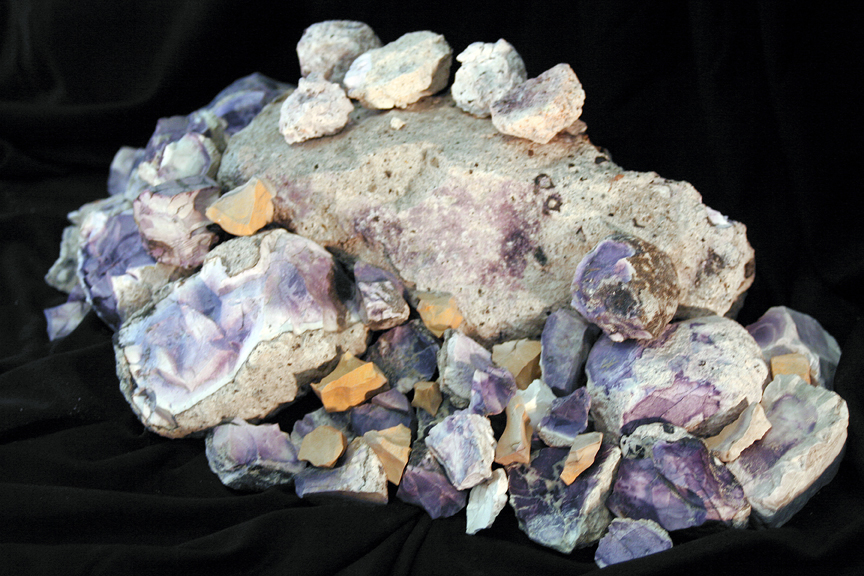
Fluorspar with Bertrandite
Refining Beryllium Ore
With only 0.65 % beryllium oxide (or 4.5 lbs. per ton of beryllium) in the final ore, a process had to be engineered to economically concentrate the beryllium for final processing. The properties that make beryllium useful also make it difficult to extract from its ores. Robert Maddox, Howard Gimperline, Jack Valliquet, Richard Shank, and other chemical engineers at Brush Wellman’s plant in Elmore, Ohio in the early 1960’s devised a unique solvent extraction process. With refinements, the process was seen to be economical and the go-ahead was given to build a concentration plant as close to the mine and to railroad transportation and a good water source as possible. In Dec., 1967 a groundbreaking ceremony was held at the mine and in April, 1968 a ceremony was also held at the mill site north of Delta, Utah. By the end of 1969, the plant was producing its first beryllium hydroxide concentrate.
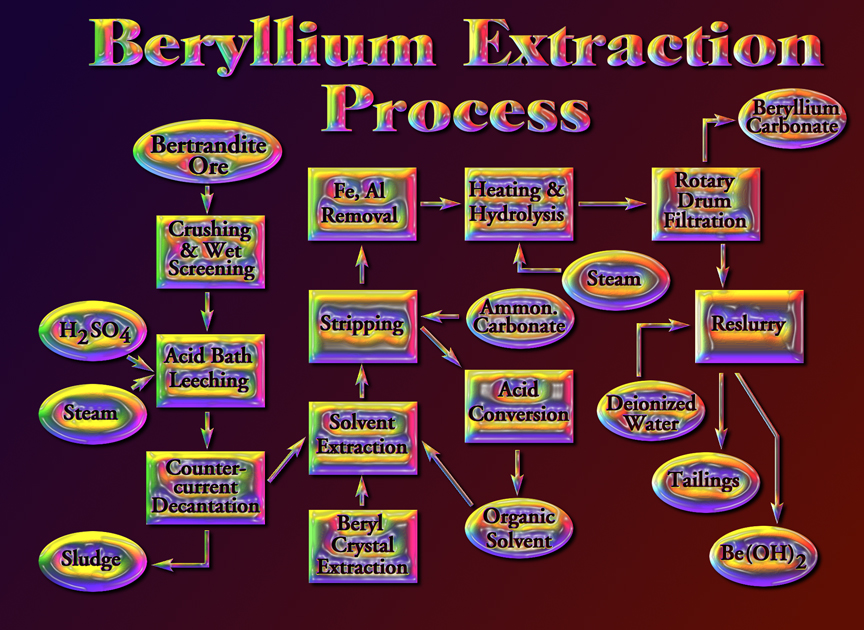
Process for Refining Bertrandite Ore
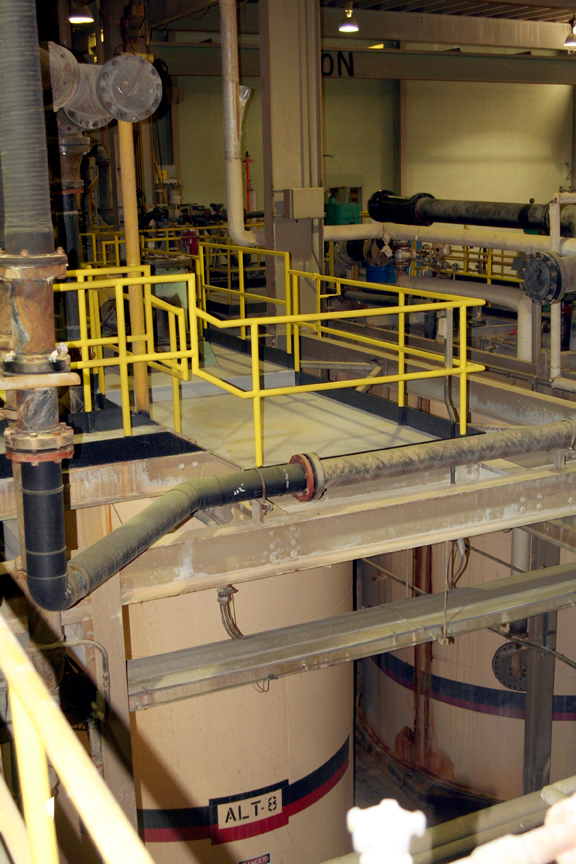
The solvent extraction process removes the beryllium by first crushing and wet grinding the ore in a ball mill, then leaching it with sulfuric acid and steam in rotating tanks at 95 ° C to dissolve the beryllium. Thickening agents are added which help to settle the sludge in a series of flotation tanks while leaving the beryllium sulfate in solution. The sludge is stirred by counter current decantation and pumped from tank to tank as the dissolved beryllium sulfate is washed over the side to continue the process. The remaining sludge is finally discarded to a tailings pile.
Sulfuric Acid and Steam are added to the bertrandite to dissolve the beryllium
The beryllium is then separated from the sulfate using an organic compound, then stripped from the organic by ammonium carbonate. Impurities of iron and aluminum are removed through steam hydrolysis, which leaves the beryllium in the form of beryllium hydroxide, which is vacuum drum filtered. Since beryllium dust is toxic, this entire process must be done in a sealed system, including the final packaging of the beryllium hydroxide into blue drums for shipment.
Panorama of the Brush Resources Beryllium Plant
There are a lot of impurities in the bertrandite ore; some that gave problems early on were the high sodium content, the high uranium content, and the zirconium. The leftover filtrate still has appreciable quantities of uranium, so it is pumped to evaporation ponds, then shipped elsewhere for final uranium processing.
Beryl Crystals Ready for Refining
Once it was proven that this process could compete economically with the beryl extraction process already being used, the go-ahead was given to build the Utah processing plant. A site was selected near the Union Pacific railroad tracks and the Sevier River north of Delta and south of Lynndyl in west central Utah. The plant was completed in 1969 and began processing ore that had already been mined and stockpiled. Brush Wellman was awarded the prestigious J. C. Vaalor Award for Chemical Engineering in 1970 for the implementation of this process. In 1978, an addition was built on the plant to allow the processing of beryl ore, making the Delta plant the only facility in the United States that processes either form of beryllium ore. When beryllium was identified by the U. S. government as a strategic metal for its critical uses in the aerospace industry, beryl ore was purchased from mines in Brazil and stockpiled. Brush Resources has now purchased this strategic stockpile and is extracting the beryllium from it.
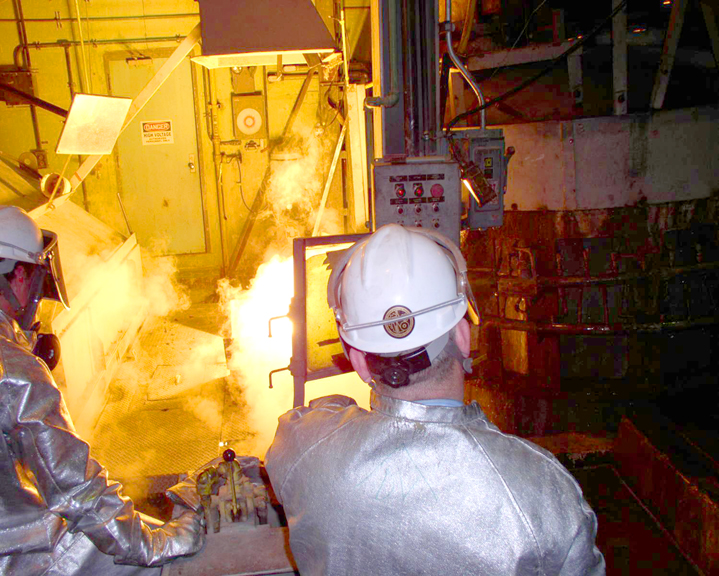
Pouring Molten Beryl Frit
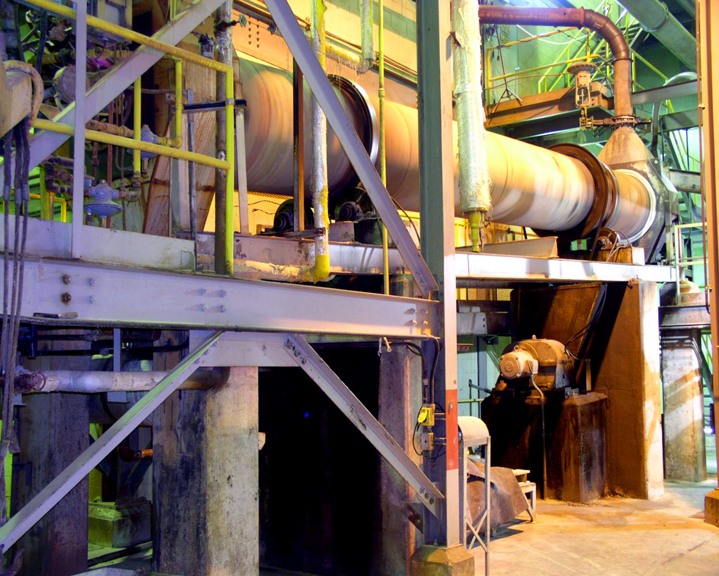
To recover beryllium from beryl crystals, the crystals must first be destroyed, since the beryllium is tightly bound in the beryl crystal lattice. The beryl is melted at 1700 ° C in a furnace, then quenched rapidly in water to break the crystal lattice and turn the beryllium particles into a frit, with the non-beryllium materials removed as slag. The frit is heat-treated at 1000 ° C in a rotary kiln, ground up in a ball mill, and leached with steam and sulfuric acid at 325 ° C in a rotating drum to dissolve the beryllium. This solution is added to the bertrandite solution in the flotation tanks to continue the process. In 1980, additional flotation tanks were added to accommodate the beryl solution.
Heat treater kiln
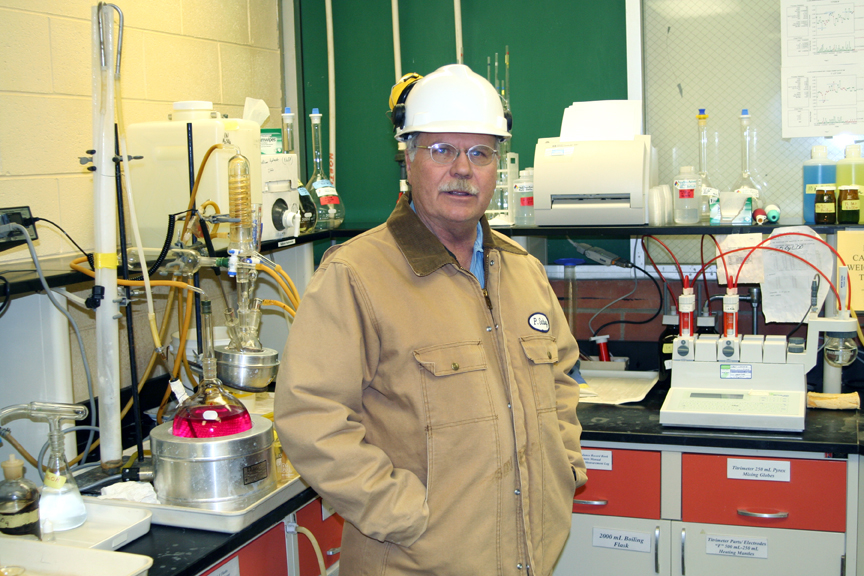
All of these processes require careful control and monitoring to improve yields and ensure safety. Using a Continuous Improvement Process, the Delta plant has added computer automation controls and improved laboratory analysis. New flocculent agents and organic solvents have improved the extraction yields, and the plant now processes ore at a 99% efficiency level. Around 400 tons of bertrandite and about 10 tons of beryl ore can be processed per day at the Delta plant.
Special thanks go to Phil Sabey for the tour of the Brush Resources plant and for providing the brochures, Powerpoint presentations, and photos upon which this post is based.
The next videos that will be completed for the Elements Unearthed Project are two episodes on the sources, mining, refining, and uses of beryllium. I’ve written a few posts previously about this topic, and as I continue to organize and prepare materials to use in the videos (which will be edited over the next week), I have created several diagrams that describe the process used for surveying and developing open pit mines at the Brush Resources’ Spor Mt. mine site in western Utah. You might say, “Beryllium? Why should I care about some rare metal that I’ll never use in my lifetime?” But you’d be surprised. You are already using beryllium (for example, the electrical contacts inside the automatic windows of your car use a beryllium-copper alloy because it can handle frequent changes in heat and resists corrosion better than many other alloys). Beryllium is also an essential metal for medical, nuclear power, and aerospace applications. I’ll discuss more of beryllium’s uses and its refining and sources in a later post, but in this post let’s talk about how the bertrandite ore is mined.
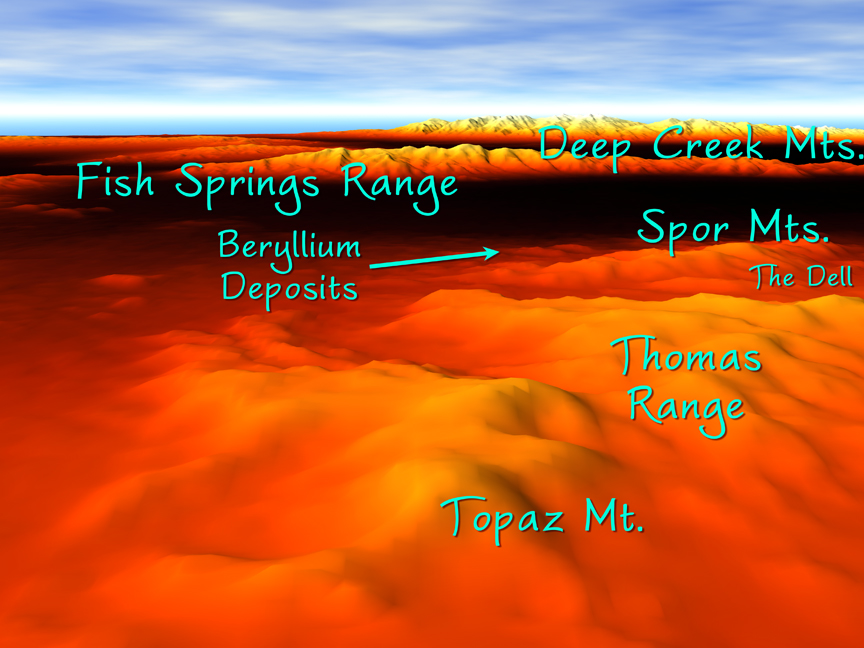
Location of Bertrandite in Western Utah
Mining Operations at Brush Resources
The bertrandite ore found in the Spor Mts. is very similar to clay (an aluminum silicate) and looks like common dirt except it has a slight pinkish color. It’s also associated with fluorspar or fluorite, which is often a deep blue to violet color. One is tempted to think the more colorful fluorite is the mineral we want, but it’s actually the crumbly pink coating found on the fluorite nodules. Elsewhere in the Spor Mts., the fluorite has been mined commercially.
The first attempt at mining the bertrandite ore was started by Anaconda on their claim. They tried hard rock mining, but the soft altered rhyolite of the ore body proved too dangerous to mine that way. One day, while the miners were all having lunch, the mine caved in. Fortunately no one was hurt, but it was determined then that the only safe method was open pit mining.
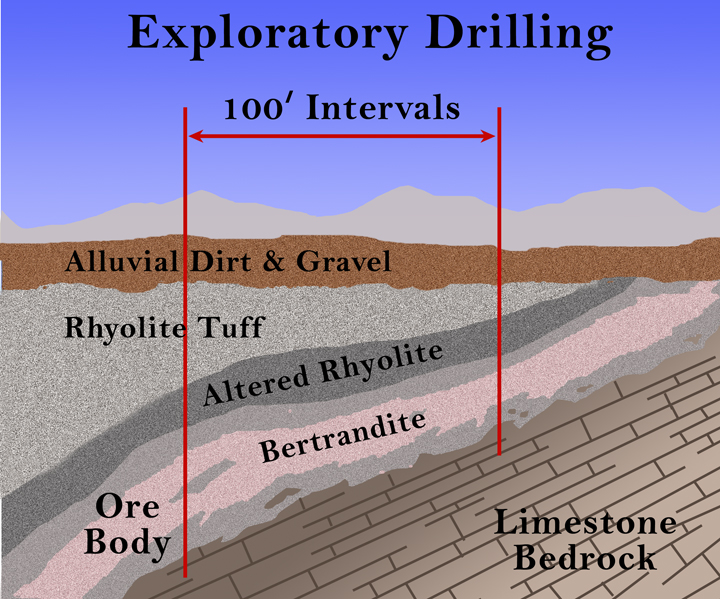
Exploratory core drilling
Potential mine sites are surveyed by drilling core samples every 100 feet to map out the general location of the ore bodies. The bertrandite deposits in the Spor Mts. are located in a mineralized zone of altered rhyolite tuff that overlies a bedrock of limestone. This soft and crumbly altered layer is overlaid by a tough, hard layer of unaltered rhyolite with about the same composition and hardness of granite. All of this is further overlaid by a layer of gravel, loose rock, and sand deposited by Lake Bonneville during the last ice age. Since the ore body is tilted, it occasionally reaches the surface (where it was originally discovered) and in other places dips so far below ground as to be unfeasible to mine. Several mine sites, such as the Blue Chalk and Roadside I sites have already been mined, but enough reserves have been mapped to last at least 50 more years at current production levels.
Planning an Open Pit Mine
Once the location of the ore body has been generally mapped out, mining engineers plan out an open pit structure that will reach the ore with the least disturbance to the overlying layers while keeping the sides of the pit terraced to safely prevent rockslides and excessive erosion. Once the plan is approved, a contractor is hired to remove the overburden, usually in the winter and spring months. The loose alluvial gravel and soil is removed first and set aside for later reclamation. The hard rhyolite is blasted and removed, and the altered rhyolite layer is also removed to within about seven feet of the bertrandite ore.
Removing the Overburden
A second phase of core drilling is carried out, with holes every 25 feet to more accurately map out the exact ore locations. For a typical ore body, between 40 and 60,000 cores are drilled and sampled every two feet. 3D structural maps are prepared to identify where various grades of ore are located. The ore is then removed carefully; a technician with a portable field berylometer walks before the bulldozer and stakes out the locations of the ore grades that are being removed; a self-loading scraper scoops up the ore and moves it to stockpiles where it is sorted by grade into the same pile. The ore is then transported by 18-wheeler to the processing plant near Delta, Utah, about 50 miles southeast. High-grade ore is mixed with low-grade ore so that all the bertrandite coming to the plant has about the same percentage of beryllium. The final ore has less than .65% beryllium, or about four pounds per ton.
I’ve been home from the NSTA conference for close to a week now. I’ve spent much of that time recovering and getting myself back on track. My shoulders have been sore all week from packing my laptop around the convention center and also packing around all the materials I got loaded down with at the booths. I also picked up a head cold (seems like every time I travel by air, this happens). I’ve since been following up on leads that I got at the conference, such as applying for grants I heard of, checking out opportunities, trying out new forms of Web 2.0 technologies, etc. Today I’m finally getting back to editing videos with the episodes on beryllium refining next up.
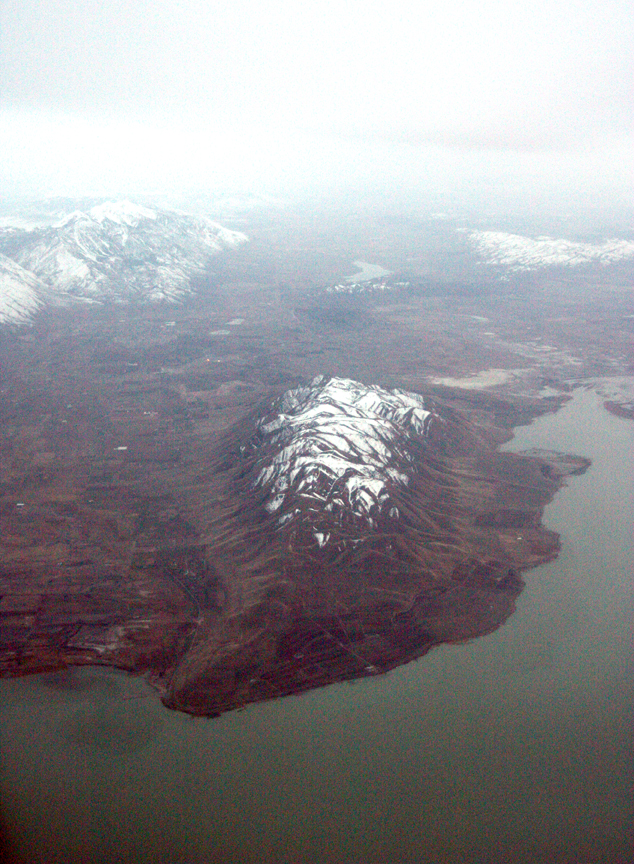
Utah Lake, West Mt., and Juab Valley
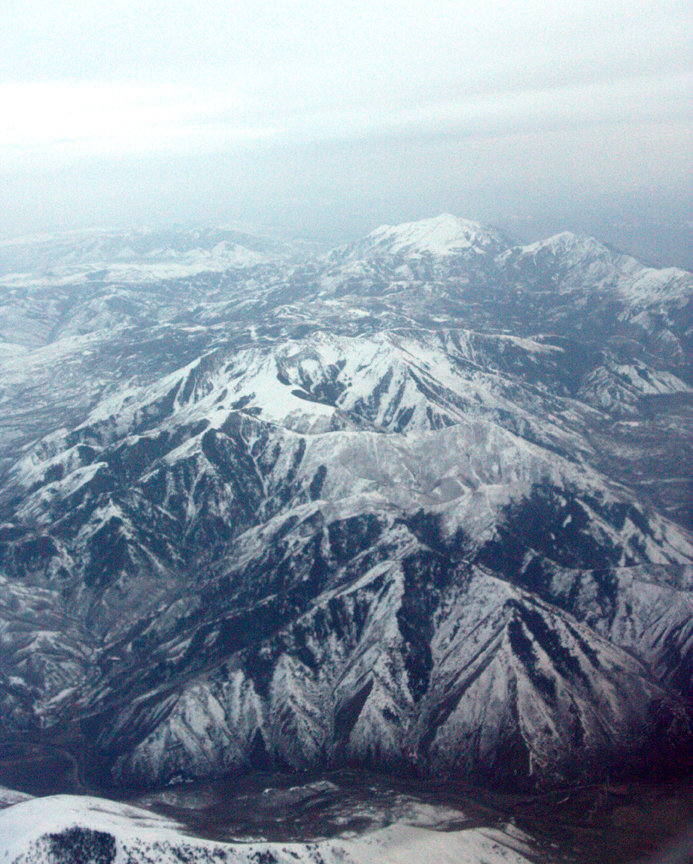
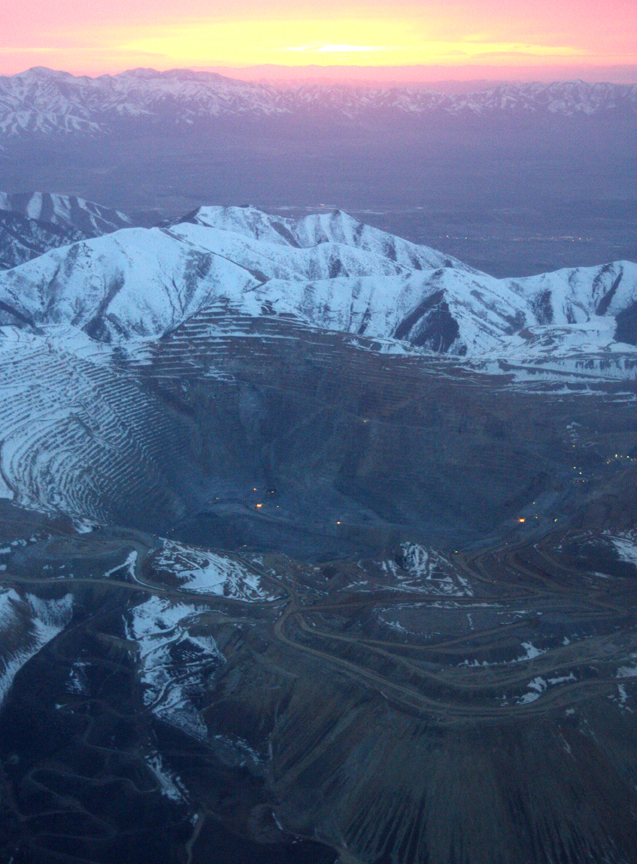
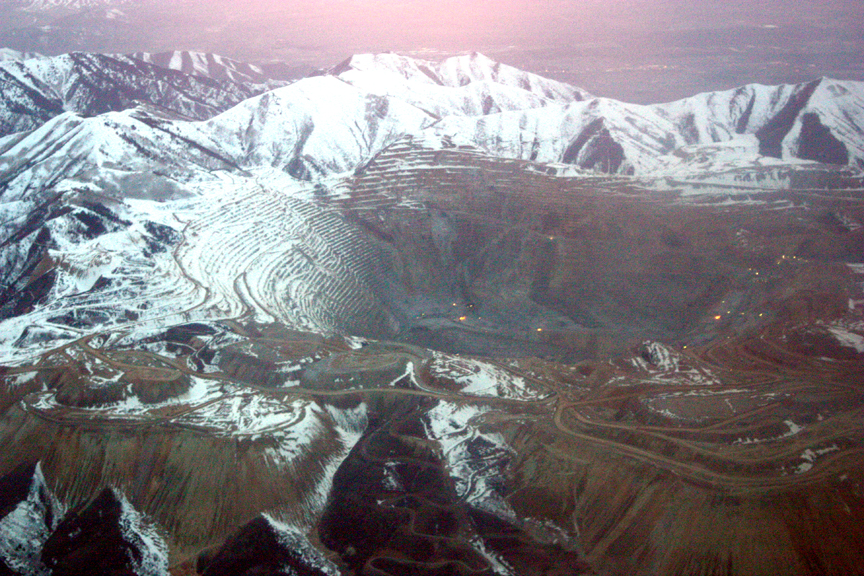
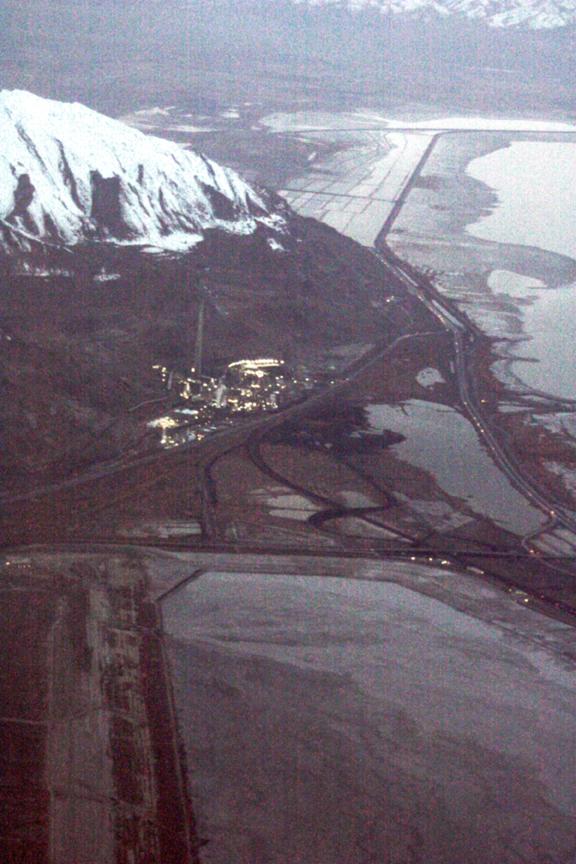
The trip back was uneventful. I ran into quite a few teachers in the airport taking my same flight from Philly to Salt Lake City. Some were from Utah, others from Reno or Phoenix or other connecting flights. I spent much of the flight napping or watching remastered Star Trek episodes (you really should check out the remastered “Doomsday Machine” episode – the planet killer finally looks like the “devil incarnate” that Com. Decker describes it to be). As we approached Salt Lake City, I saw the Wasatch Mountains ahead and I had a good view of the southern Wasatch down to Mt. Nebo as we flew over Hobble Creek Canyon, then turned over Utah Lake and headed north along the Oquirrh Mts. I could see that we would be in perfect position for photos of the Bingham Canyon Copper Mine (the biggest hole on Earth) so I snapped quite a few photos just as the sun set over the Deep Creek Mts. on the Utah-Nevada border. At some point, I hope to have some team(s) from Copper Hills High School or Bingham High School do episodes on the history and current operations of the Kennecott mine (now owned by Rio Tinto). I’ve been to the mine and through the concentration plant before, and it’s quite a process. Once the ore is crushed in ball mills, the copper is floated to the top of settling tanks using a floculent agent, then pumped to the smelter at Magna (where the large smokestack is just north of the Oquirrhs along I-80). There it is melted and poured into ingots for electrolytic purification. In addition to huge amounts of copper produced each year, they also produce zinc, molybdenum, and even 30,000 oz. of gold. Since the ore is less than 1% usable metals, it takes a gigantic operation for the economics of scale to be profitable.
Bingham Canyon copper mine and Oquirrh Mts.
My goal over the next several months is to produce as many new video episodes as possible. Already the Periodic Table episodes have been viewed about 500 times between this blog and YouTube. I am also planning to post them onto Teacher Tube, but the file sizes have to be <100 MB, which will mean high compression. I even had a request from a professor in Brazil to allow him to translate the videos into Portuguese. Once I have about five topics done, I’ll set up a dedicated website so that I can create an iTunes podcast series as well. Here is a list of topics for the next few months, in the approximate order in which I will complete them, hopefully at the rate of about two topics per month (with two episodes per topic, or about one episode per week):
Bingham Canyon copper mine
Beryllium mining and refining
Glass Blowing (History and Process, Art and Science)
Greek Matter Theories (Three parts: The Pre-Socratics, the Atomists, and Aristotle and Beyond)
Cement Making
Synthetic Diamonds (History and Discovery, Process and Uses)
Stained Glass (History and Process, Art and Science)
Properties of the Elements (featuring an interview with Theo Gray)
The Tintic Mining District of Utah (Three episodes: History, Life in a Mining Town, and Current Issues and Challenges)
Anthracite coal mining (The Lackawanna Coal Mine and Anthracite Coal Museum near Scranton, PA)
The Story of Centralia (visit to Centralia, PA)
Zinc Mining (Tour of the Sterling Hill Zinc Mine, Ogdensburg, NJ)
Lead Mining in Missouri (Tours of the Bonne Terre lead mine and the Missouri Lead Mining Museum)
The First Oil Well (tour of the Drake Oil Well in Titusville, PA)
Oil Wells and Refining in Kansas (the Kansas State Oil Museum in El Dorado)
Salt Mining in Kansas (the Kansas Underground Salt Mine in Hutchinson)
Early Alchemy (based on research conducted at the Chemical Heritage Museum last summer – focusing on Zosimos of Panoplis and Arabic alchemists)
Alchemy in the Middle Ages (all the supposed masters, including Ramon Lull, Roger Bacon, Paracelsus, Flamel, and many others)
Metallurgy and Mining in the Middle Ages (based on books by Birringuccio, Neri, Agricola, etc.)
The Rise of Chymistry (the origins of chemistry as a science in the works of Sennert, Boyle, Lavoisier, Dalton, and others)
Sources of the Elements (tours of the mineral exhibits at the Natural History Museum in Wash., D.C. and elsewhere)
Magna copper smelter and salt evaporation ponds
At the rate of two topics per month (which is pretty ambitious) it will take at least ten months to complete all these topics, or maybe by the end of 2010. I have much of the media (videotaped tours, photos, etc.) that I need for these topics already, it’s just a matter of creating the scripts, narration, and doing the editing. Once summer comes, I’ll be out gathering more information on other mining sites and adding to what I already have on these topics. By fall (pending funding) there will be additional teams of students out collecting more material. My overall goal (if you look at the post from November where I submitted the grant to NSF) is to produce over 100 episodes by the end of 2012, and by then to be covering Utah, Nevada, and Colorado. Sometimes I look at the mountain of work I have before me, then I think of how much the Periodic Table videos are already being used and realize the potential this project has. I also remember that the Bingham Canyon copper mine began as a mountain, too, and now it’s a gigantic hole. It’s only taken 100 years of constant digging . . . .
The NSTA conference in Philadelphia is over the convention center crews are tearing down the displays and signs and the teachers have pretty much disappeared, many flying out this morning back to their home states. I’m still here because this building has free WiFi for attendees, so I’m writing one more blog before flying back to Utah this evening.
I attended Eric Brunsell’s session this morning. I’ve known him since 2000 when he was with Space Educators directing the Solar System Educators Program at JPL. He is now a professor at the University of Wisconsin-Oshkosh and presented on the stages of inquiry learning, which isn’t limited to the narrowly defined scientific method (PHEOC) steps we learned in school. There are many methods of inquiry that scientists use. I talked with Eric a bit after, dropped off my evaluation forms from the day before, and hoofed it to the other side of the convention center (it takes up two city blocks) to a presentation on how and why to use Wikis in the classroom. The presenter had excellent ideas that will help the collaboration component of this project. I then attended the final session to learn how teachers in Tampa, Florida are using podcasting, video casting, and stop motion animation in their classrooms. Now I’m out in the hall blogging. My wife just called to suggest some corrections to last night’s blog (I was very tired and not all of it made sense).
It will take me this next week to follow up on all the leads, visit all the websites, and assimilate all the information I’ve learned here. I have to say that the experience has been well worth the time, effort, and expense. Next year’s conference is in San Francisco. I hope to be there.










 The Elements Unearthed