Feeds:
Posts
Comments

Archive for the ‘Uncategorized’ Category

Borneo Day 4: Monday, July 24, 2017
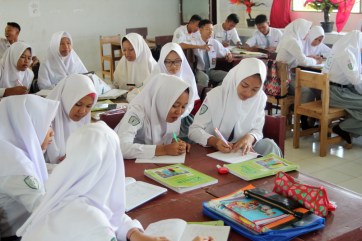
Taking notes in chemistry

The chemistry (kimia) class at SMAN 1 Mandastana near Banjarmasin, South Kalimantan.

Today we got to do what we came all this way for: to teach at a school in Borneo.

All schools in Indonesia start Mondays with an early morning flag ceremony, so we had to leave the hotel early to make it. After breakfast, Nazar picked us up in the lobby at 7:00. We drove across the Sangai Martapura and onto the road leading north out of the city that we had used the day before. We turned onto Jalan Ahmad Yani and headed toward the Barito River Bridge, but before getting that far we turned north onto a narrow country lane. This traveled straight through rice fields and past scattered houses to a wooden bridge across a canal, then turned west. I could see the school to our north, a blue building next to a grass field.
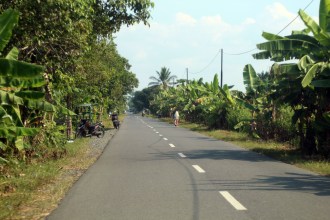
Country road

Jalan Achmed Yani, or the Trans Kalimantan Highway. We drove on this out of Banjarmasin to the northwest, then took a smaller country road to the school.

I recognized it from looking up their website and talking about it to my students. This is SMAN 1 Mandastana, the school where Nazar and his wife teach. We passed the school and immediately turned back north onto a somewhat worn cement road leading to the front entrance.
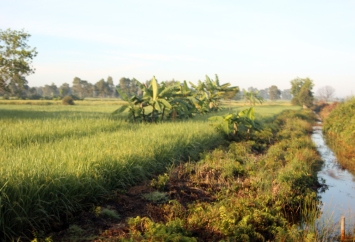
Ride paddie

The school is north of Banjarmasin about 15 km and is in the middle of rice fields. This is the view on the way to the school.

Nazar drove up to the entrance and we saw a sign hanging up welcoming Craig and I by name. We walked in through a breezeway into the school’s main office area and put our bags in the headmaster’s office (except my camera bag), then walked out into the main courtyard. The students and teachers were already assembled in ranks, waiting for our arrival. Our big moment had arrived!
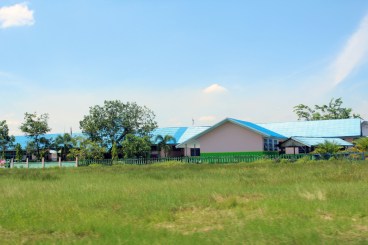
SMAN 1 Mandastana from road

SMA Negeri 1 in Mandastana, near Banjarmasin. This is the school the Craig Hendrick and I taught at for a week in Borneo.

It is hard to express how I felt. I was being given the honors of a master teacher, an education ambassador who had traveled all this way from America to teach at this school. It was difficult for my mind to accept that I deserved this level of respect. Yes, I had come from America to teach here, but although I have multiple award plaques and certificates attesting that I am a master teacher, I have never really believed it in my heart. I know I have so many ways to improve as a teacher, even after 26 years of doing it. I’ve known so many teachers who were more deserving than me, who should be here instead of me.
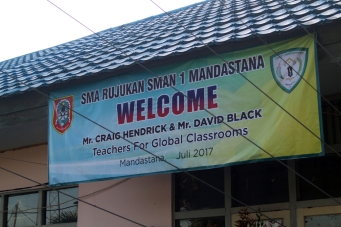
Welcome sign

Our welcome sign at SMAN 1 Mandastana.

I wanted to shout out that they had the wrong guy, that the name on the banner must be some other David Black and not me. Yet here I was – half way around the world, about to attempt to teach in a place I’d never heard of before to a people I knew very little about. How very presumptuous of me. Yet buried under all that uncertainty was a part of me that knew I had finally arrived, that all my hard work at being an education professional and presenting at all those conferences was finally paying off. That I deserved all of this. I wanted to bask in the attention. I wanted to run away. I was thrilled to be there. I was scared to death.
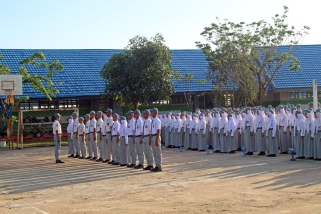
Students in ranks

Students at SMAN 1 Mandastana standing at attention during their Monday morning flag ceremony.

I finally decided that even if I didn’t know whether or not I was a master teacher, it didn’t matter. All I had to worry about was that I should be a teacher, nothing more. If the students will let me, I can find the common ground that will allow me to be what I know how to be.
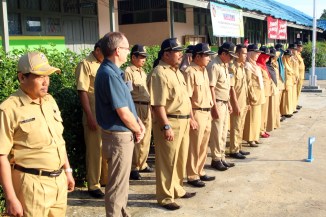
Craig with teachers

Craig Hendrick standing with the teachers at SMAN 1 Mandastana for the Monday morning flag ceremony.

We were asked to stand with the other teachers, who were wearing khaki uniforms. The students were in white shirts and blouses, white hijabs, and gray pants or dresses. They stood with their backs to the morning sun, but it was directly in our faces and already blazing hot. As the ceremony progressed, I stepped out of line a few times ostensibly to take photos but also to turn away from the sun for a few moments, as it was making my eyes water and I was beginning to sweat.
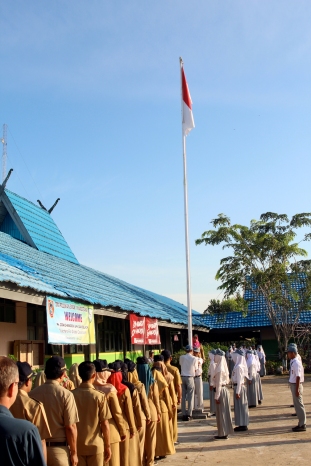
Raising the flag

Raising the Indonesian flag at the Monday morning flag ceremony of SMAN 1 Mandastana.

A squad of students marched in practiced formation to the flagpole and unfurled the red and white Indonesian flag. A group of girls sang the national anthem, and the squad attached the flag and slowly raised it until it reached the top as the anthem ended. A teacher recited the five Pancasila principles from a microphone on a podium while the students repeated. Then we were introduced and each made a few remarks while Nazar translated. The ceremony ended and we took some photos of us with the entire school.
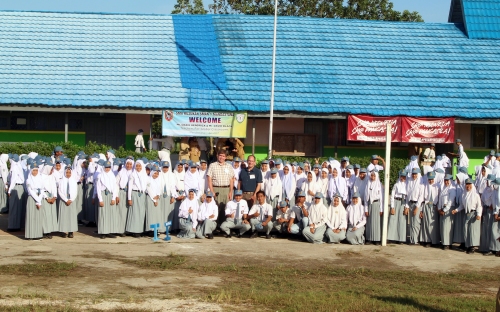
Craig and David with students

David Black and Craig Hendrick posing with the students of SMAN 1 Mandastana after the Monday morning flag ceremony.

As the students moved to their first period classes, we went into the headmaster’s office for a few minutes. He offered us some snacks and we answered his questions through Nazar. We were then ready to meet the students.
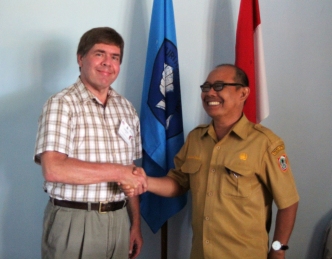
David with headmaster

Meeting the Headmaster (Principal) of SMAN 1 Mandastana.

There are two English teachers at this school. I went with Nazar and Craig went with the other teacher, whose English is also fairly good. The school is built in an almost enclosed letter C shape around a central courtyard, with the offices at the bottom of the C, the computer and language lab on the small right leg with the kanteen or cafeteria at the end and a separate wing almost completing the open part of the C. A new classroom was being built at the far end. On the left side, the longest side of the C, is classrooms with a tile walkway in front and a wooden walkway beyond along the inside edge. The front area of the courtyard is cemented and used for the flag ceremonies and for volleyball, basketball, and soccer. There is a small grassy area behind that, along with a greenhouse that is being built for the biology classes. The grass becomes more swampy as it goes further back, along the top curve of the C. The entire school is built up on stilts to prevent it sinking.
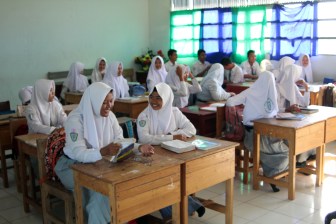
English class

Nazar’s English class at SMAN 1 Mandastana. This is the class that I first presented to, showing a slide show about my home, school, and family.

I walked with Nazar on the left side of the horseshoe. Racks of plants and flowers are growing across the tile walkway, causing us to step down onto the wooden walkway next to the swampy area. I wheeled my blue suitcase around these obstacles as best I could, until we could step up onto the tiles walkway for the top section of the C, where Nazar’s first class is located.
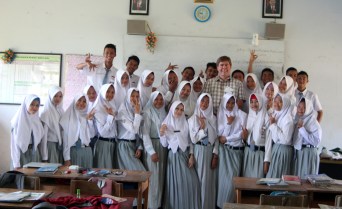
David with English class

Posing with the English class after our lesson. They like to take photos and selfies. They will pose seriously, then do a “freestyle” pose such as this one.

Since Indonesian students stay put in one classroom (except for PE or for classes that require specialized labs, such as Kimia or Fisika), the teachers are the ones to travel. Nazar’s morning English class was in the north wing. The students were excited to see me as I wheeled my stuff in and set up my computer. Nazar had grabbed a portable projector, as the one mounted on the ceiling in the room didn’t seem to be working. I had remembered to bring the power converter with me, so I was able to plug my computer into an extension power strip. I had remembered to bring a VGA cord and my conversion dongle, knowing that HDMI probably wouldn’t be available (but I had an HDMI cord, too, just in case – this is why my carry ons are so heavy). Fortunately everything worked, and I was able to project onto a light blue wall at the front of the class.
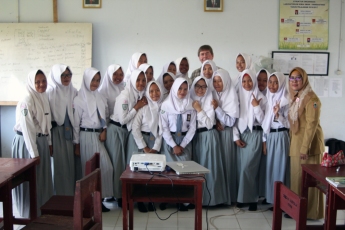
David iwith chemistry class

Posing with the girls in one of the chemistry classes at SMAN 1 Mandastana.

I had prepared two slide shows, one the night before about American Academy of Innovation and a second show with harder English about the trip my family made to the Four Corners region of Utah, Colorado, New Mexico, and Arizona at the end of June. This one was more about geography and geology.
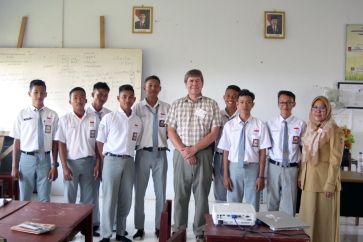
David with chemistry boys

Posing with the boys in the chemistry class. They wanted a separate photo from the girls. There were more girls than boys in the class. I don’t know if this is the case for all science classes or not.

I showed the first slide show during the first block of the period (45 minutes). Nazar translated for me. The students watched carefully, and exclaimed when they saw the photo of my school on a snowy day. They have never seen snow in their lives. After, I asked if they had questions but they were reluctant to speak, probably because they were afraid their English wasn’t good enough. A couple of students were able to ask a few questions.

When the bell rang, it sounded exactly like the tones played in the Hunger Games movies to announce that a contestant had died. Craig and I both found this a bit unnerving.
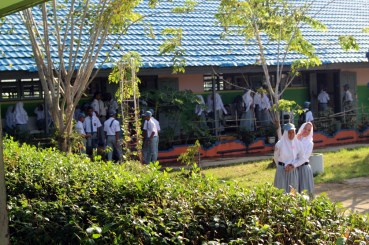
Going to class

The inner courtyard of SMAN 1 Mandastana. Since there isn’t snow or cold weather, there are not internal hallways, similar to schools in California. The students wear gray pants/skirts and white shirts/blouses with hajibs and/or hats on Mondays.

During the second block of the 90-minute class, I showed my higher-level slide show on the geography and geology of the western U.S. They were interested in the comparison slide I had made between Borneo and Utah and the other four corner states, that Borneo is 3.38 times larger than Utah and just barely smaller than all four states. But as I showed the various national parks (Taman Nasional) and our route, I could tell that the English was too hard for them. They had fewer questions than I had hoped. I picked things up by opening up my blue case and handing out flyers, brochures, and other materials I had been given at the Utah Valley Visitors Bureau the day before I left Utah. They were excited to get them and have something to practice on.
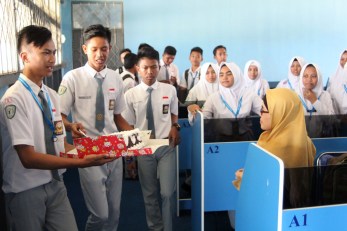
Happy birthday

A birthday cake for a student in the Language Lab room.

At the end of the class, all the students came up and insisted on taking group and individual photos, including many selfies. They wanted photos in normal pose and what they call “freestyle” which is to pose in a less formal fashion. As I was leaving the classroom, all the students came up and did something they had told us about, but which still came as a surprise. Each student took my hand and placed it against their forehead or cheek or kissed it. This is a normal sign of respect for teachers in Indonesia.
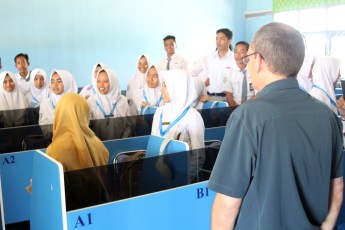
Craig with class

Craig Hendrick teaching in the Language Lab room to students at SMAN 1 Mandastana in Borneo.

The bell rang again (another dead contestant!) and Craig and I traded classrooms. The other English teacher was teaching in the chemistry classroom and we waited a few minutes while the chemistry teacher finished up her lesson. This was the second week of school, and she was reviewing mole fractions (mol fraksi), a subject I don’t often teach until deep into second semester. Even though she was speaking and writing in Indonesian, I was able to follow most of what she was doing as the language of science is fairly universal. Indonesians use Arabic numerals just as we do, and with many words transliterated from Latin in a phonetic alphabet, I was able to follow much of what was written. The teacher was lecturing and writing on the board while students took notes. I walked around and noticed that the students’ handwriting was extremely neat, better than any writing I’ve seen in America (including my own).
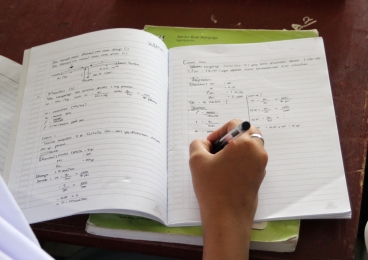
Mole fraction notes

Student notes on mole fractions (mol fractsi). Notice the neat handwriting.

Once the lesson was over, I set up the projector again and went through my slide shows. When I came to showing some of the activities my students have done, I had a slide showing two students doing a version of the flame test lab as a demonstration, a lab I’ve done many times. One of the students asked if they could do the lab (through the English teacher) and I looked at the chemistry teacher, who was still in the room, and said we’d have to see what materials she had.
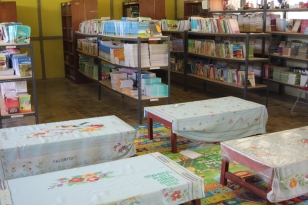
Library

The library at SMAN 1 Mandastana.

After the second slide show was done, I handed out more tourism brochures to these students. We took group photos and selfies again, and as they were leaving to go to mosque, they bowed their heads and kissed my hand as had the other class. This gets to the heart of my basic doubts about myself – that I don’t deserve the great respect they are showing me. Certainly I’ve never seen anything like it before. I wanted to bow back to them, but was told by Nazar later that I don’t have to do that.
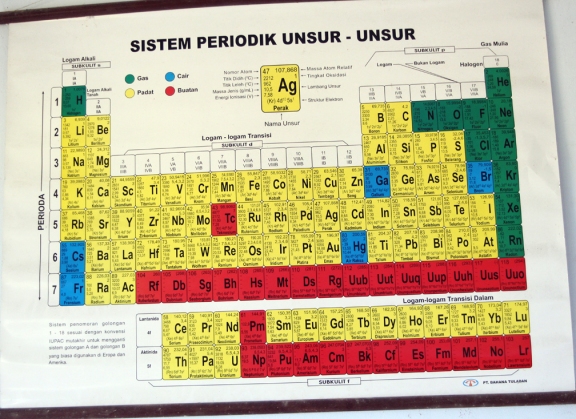
Periodic table in Indonesian

Indonesian periodic table. Most of the element names are based on the Latin root words, such as Kalium for potassium (K). Some of the elements, such as Tembago for Copper, must be Indonesian words that predate the introduction of western science.

After the class was over and the students left, we looked through the chemistry supplies and discovered enough materials to make the flame test work. We’ll try the lab tomorrow. While looking through the classroom, I took photos of the periodic table hanging up at the back of the room. I could recognize most of the elemental names, based on the original Latin names, such as kalium for potassium and natrium for sodium. Only a few elements, such as tembago (copper) or beso (iron), were unfamiliar. These must be names that predate chemistry as a science in Indonesia.
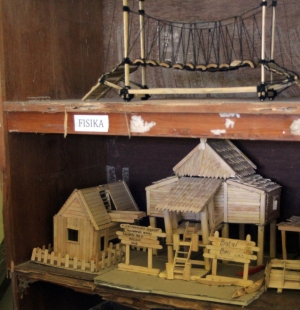
Banjar houses craft

Student crafts, including a traditional Bajarese house, on display in the library.

As I walked back to the teachers lounge, I thought of how things had gone and my impressions of it. All of my teaching career I’ve wanted to make a difference in the world, which I have done. There is a part of me that would like to be well known if not famous, perhaps even remembered by history. Whether or not this ever happens, I can at least say that for this week, I was shown the greatest respect I’ve ever known as a teacher.
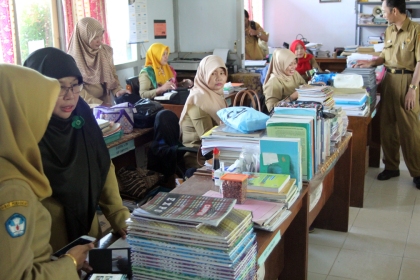
Teachers room

Teachers’ Preparation Room at SMAN 1 Mandastana. Overall, this school had a lot more light and seemed more airy than schools in Jakarta. There was no air conditioning, so ceiling fans and open windows were the only ventilation. Teachers wear khaki uniforms on Mondays.
Read Full Post »

Borneo Day 3: Sunday, July 23, 2017

Barito River bridge

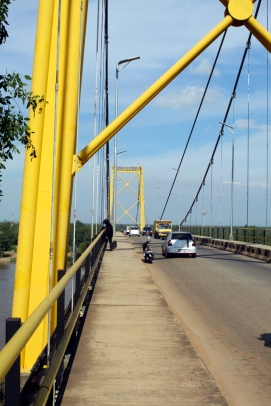
The Barito River suspension bridge, linking Kalimantan Selatan with Central Kalimantan.

We continued north through the outskirts of Banjarmasin, then turned northwest onto a major road, the Jalan A. Yani or Trans Kalimantan Highway, into Barito Kuala Regency, This road was built about 20 years ago and is the main connecting route from South Kalimantan to Central Kalimantan. Building roads in this area is difficult due to the swampy nature of the ground. This is all part of the Barito River estuary and delta, and any roadway has to be built up and foundations pounded to avoid sinking. But there was a major obstacle: the Barito River itself.

Barito River

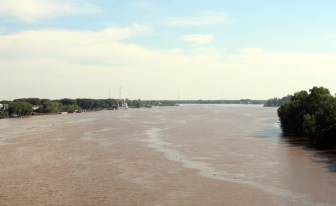
The Barito River, looking downstream from the suspension bridge. This is the largest and longest river in Borneo and a major route for trade and travel into the heart of Borneo.

At about one kilometer width, it isn’t quite as big as the Mississippi or the Columbia Rivers but it is certainly bigger than the Colorado or anything else in Utah. To connect the two provinces, a suspension bridge was built in the 1990s and opened in 1997. They chose a spot where the river is divided near one side by an island, home to a population of monkeys. The bridge spans the main river channel, crosses the island and the smaller river division on the far side, and has a total length of just over one kilometer.

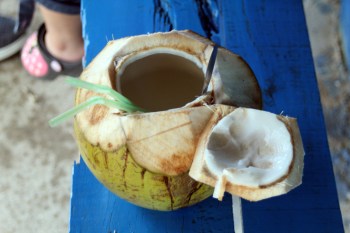
Coconut

Our coconut. Although I lived in the tropics for two years, I never actually tried a coconut until now. The milk is sour as well as sweet and the rind is tasty as well.

Once we reached the bridge, we drove out over it to the other side, then turned around and came back until we found a place to park at a coconut stand on the near side. Nazar, Craig, and I walked out over the bridge as far as the island. It is quite an impressive structure and at the time was the largest suspension bridge in Indonesia. It was a hot afternoon and the sun blazed in my face, but I enjoyed watching the large barges loaded with coal pulled by tug boats down the river. It dwarfed the Martapura, and is the longest and largest river in Borneo.

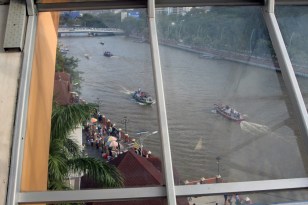
View from Siring Tower

View of the Martapura River from the Siring Towers. The top is closed to tourists right now because the large umbrellas on top blew off, but one of the guards knew Nazar and let us up on top.

We waited for a break in the traffic, then crossed the roadway and walked back on the opposite side of the bridge. Once we got back to the car, we decided to try a coconut, which I have never done before even when living in Taiwan. The little roadside stand had quite a stack of them, and an even larger stack of decomposing discarded shells. The owner took a machete and chopped off the top of the coconut. We took straws and took turns drinking the coconut milk inside. It wasn’t what I was expecting – I thought coconut milk was sweet, based on using canned versions for cooking. But this is the real, raw thing, and was a bit sour in flavor but refreshing on such a hot day. We then took turns with a spoon scooping out the white coconut rind. I think I like it toasted better instead of raw, but it was definitely worth the experience.

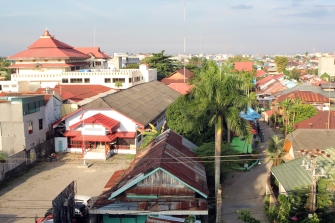
Banjarmasin

Banjarmasin as seen from the top of the Siring Watchtower.

Something I’ve neglected to explain in all of this is the difficulty we’ve had with finding enough drinking water. In Jakarta, the hotel provided six pint bottles of water for free, and we didn’t use all of it because we were in the hotel much of the time, with air conditioning. Now that we are outside much of the day in more direct sunlight and higher humidity than even Jakarta had, we are needed much more water. I bring a bottle with me everywhere we go. The Swiss Belhotel provides two pint bottles, but has other water in quart bottles for a nominal fee. I’ve had to use some of that, two, as I don’t dare drink the water from any sink even at the hotel. This is one expense that I don’t mind paying. Once I get back to Utah, 100° F temperatures will not bother me because the humidity is low. I knew to expect this after living in Taiwan for two years, but it’s not easy even if it is expected. I’ve had to take two showers a day and my clothes are saturated with sweat every afternoon. We aren’t working hard, but we are very tired at the end of each day just from the heat. If you visit Indonesia, just remember: it’s the tropics. There’s nothing you can do about it (unless you want to stay in your hotel room all day) so you might as well live with it. It’s part of the experience. Bring plenty of bottled water with you every day.

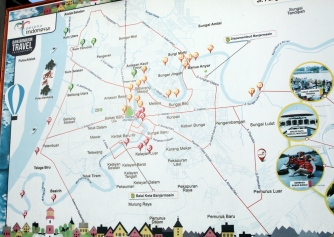
Banjarmasin map

A map of Banjarmasin at the Siring Watchtower along the Martapura River.

Back at the hotel, I spent the rest of the evening putting together a basic English slide show on my school to show the next day.

David by oldest house

David Black by the oldest house in Banjarmasin. Made of ironwood, it has been rebuilt. There is a museum inside.

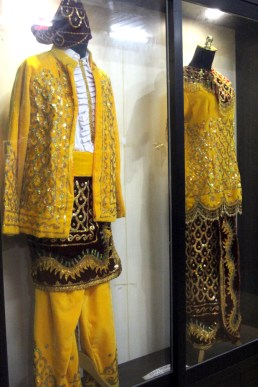
Banjar wedding clothes

Traditional Banjarese wedding clothes, inside the museum in the oldest house in Banjarmasin.

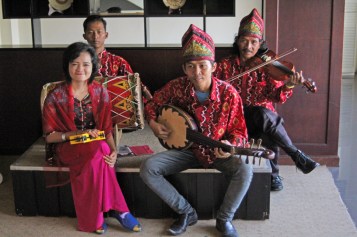
Traditional band

Traditional Borneo band in the lobby of the Swiss Belhotel in Banjarmasin.


Read Full Post »

Borneo Day 3: Sunday, July 23, 2017

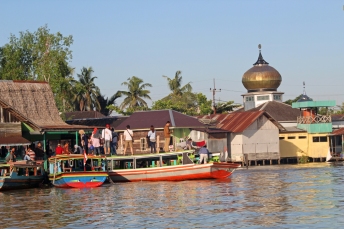
Popular spot

Water taxis unloading at a popular spot on the Martapura River. We were to eat here for lunch.

Nazar, his wife, and daughters picked us up at the hotel at 11:30. We drove along ever more narrow streets leading out of the city toward the northeast. I noticed we were paralleling the Martapura River, which we had just traveled on earlier that morning to visit the floating market of Lok Baintan.

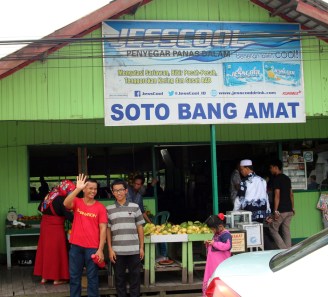
Soto bang amat place

Our restaurant for lunch, specialing in soto bang amat, a type of soto (stew) popular in southern Kalimantan (Borneo).

Nazar was a bit cryptic about where he was taking us, saying it was a surprise. We were on a kind of frontage road leading along the river; I had seen motorcycles and bicycles traveling along this road while on the river. Then I realized where we were heading – to the very restaurant I had noticed this morning where water taxis were dropping boatloads of people off and smoke was rising from grills.

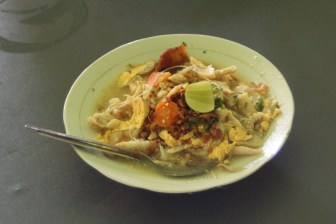
Soto bang amat

Soto bang amat. It is a stew with chicken, boiled egg, noodles, vegetables, rice, and lime. Very delicious!

This restaurant is famous as the best place to get soto bang amat, a type of stew with rice and noodles, boiled egg, and other ingredients. Each region of Indonesia has its own style of soto, and which is best is a hotly contested argument. We each got steaming bowls while another band playing traditional music entertained us. The restaurant was crowded and the sota bang amat was good. I tried not to think of what the “other ingredients” might be and just enjoy the experience, and found I quite liked it. Grills were smoking, cooking up skewers of meat which we didn’t try but which had quite a tantalizing odor.

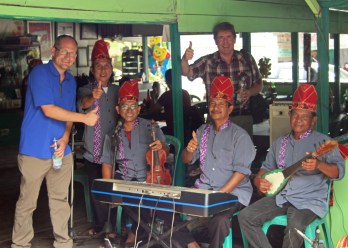
Craig and David with band

Craig Hendrick and David Black with a traditional band at the restaurant.

After the meal we posed for photos with the band, then picked up the car and headed back through Banjarmasin to our next destination: a major bridge across the Barito River.

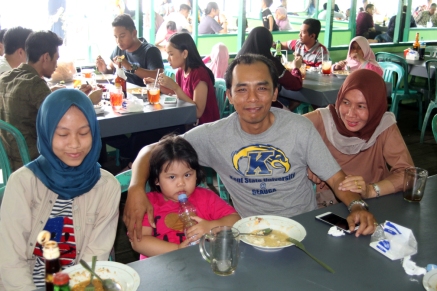
Nazar's family

Nazar’s family (except his son, who was practicing for the Indonesian Independence Day celebration).

Read Full Post »

Borneo Day 3: Sunday, July 23, 2017

First approach

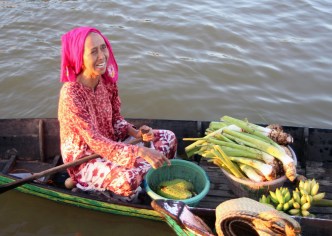
Approaching the floating market at Lok Baintan. Ladies in traditional clothing paddling long boats converged on our water taxi to sell fruit, vegetables, and souvenirs.

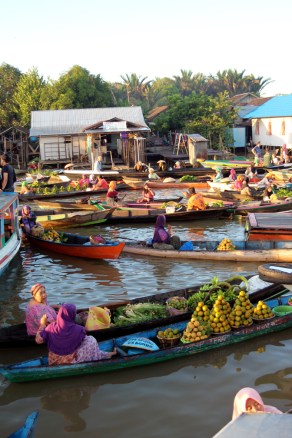
The sun rose up over the Martapura River as we reached the floating market of Lok Baintan. Ladies in traditional clothing were paddling small boats around the many water taxis, selling everything from fruits and vegetables to donuts and a sort of green gelatin. People in the taxis were paying money directly to the ladies for what they wanted and a brisk trade was going on, but mostly people were taking photos. I’ve never seen so many selfie sticks! There was even a drone flying overhead videotaping the market.

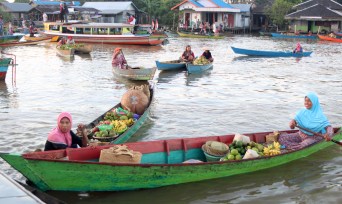
Floating market

The Lok Baintan floating market near Banjarmasin on the Martapura River. I love the stacks of oranges!

The early morning sun, which had just risen, shone brightly on the colorful boats loaded with wares. It was all good fun and quite picturesque. I enjoyed the carefully stacked oranges and soursop fruit, the small sweet bananas grown locally. A lady was cutting slices of mango to wrap in plastic for a customer, another selling huge shallots, a man and wife selling small souvenir recreations of the very boat they were in.

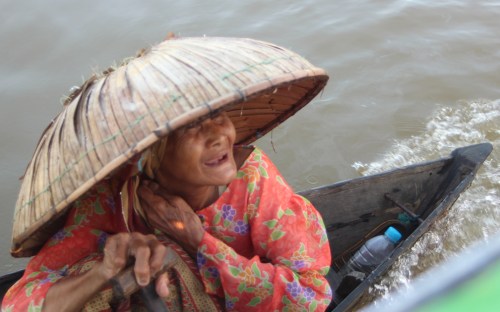
Lady in traditional hat

Lay in a traditional banana leaf hat selling wares from her boat at the Lok Baintan floating market.

All of these boats were weaving in and out of the water taxis crowded with tourists, who had climbed onto their roofs for a better look. I did the same – the slippery roof of our boat had dried enough that I could do so without too much danger.

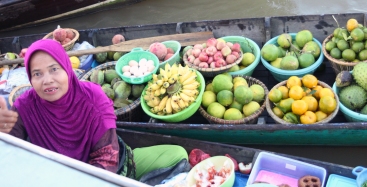
Fruit to sell

Fruit and vegetables to sell. Notice the stubby bananas that are common here – they are much sweeter and have a slightly peachy flavor compared with the bananas we are used to.

After watching the selling proceed for about 45 minutes, our boat backed away from the others and turned about to head back down the river. There was another foreigner staying at the Swiss Belhotel who was on the boat with us. He is from Austria and is in Indonesia setting up an online training program for the Indonesian government.

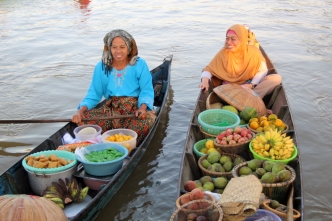
Two ladies in boats

Ladies selling fruit and vegetables from their long boats at the Lok Baintan floating market on the Martapura River.

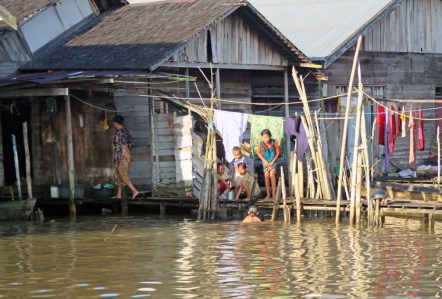
On our journey back to Banjarmasin we passed houses on both sides of the river with their back porches actually acting as docks into the river. The Banjar people are traditionally river people, living their lives on and making their livelihood from the river itself. Mothers and wives and grandmothers sat on the docks washing clothes or dishes, children splashed and swam, older gentlemen with bare chests were pulling up buckets of water to splash on themselves while vigorously scrubbing; this is how they shower. Women were doing the same, while remaining clothed in sarongs. Shops and stores lined the river and people were buying goods. Fishermen checked their nets; goods were transported up and down the river. I saw a man pass us with a load of coconuts.

Laughing lady with shallots

The Lady of Shallots. If you understand that reference, you win the Grand Sweepstakes for obscure literature quotes.

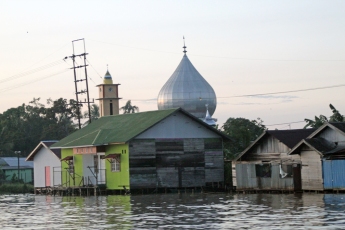
As we approached the city, the mosques (masjid) became more common, their domes and minarets shining in the early light. Near one, several water taxis were unloading people at what appeared to be an open-air restaurant based on the smoke from grills. It looked quite popular.

Craig-David-Nazar at market

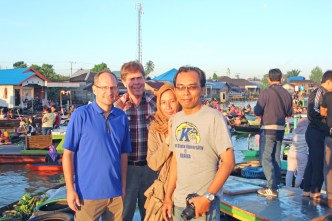
Craig Hendrick, David Black, Muhammad Nazaruddin, and his wife at the Lok Baintan market.

I enjoyed the bright colors of the houses and mosques. The Banjar people seem to like things brightly painted. Not all of the houses were in good shape – some were leaning, some were sagging, some were in poor repair or abandoned. It must be difficult to build and maintain houses built on stilts along a river that can flood at times. Nazar told us that Banjarmasin doesn’t have many tall buildings because the ground is too unstable and swampy; with its thousand rivers, and the boat traffic and water taxis, it is definitely the Venice of Indonesia.

David at floating market

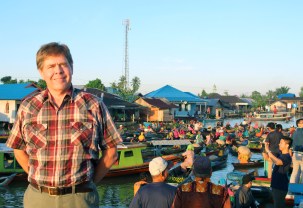
David Black at the Lok Baintan floating market on the Martapura River near Banjarmasin.

What had been a comfortable if humid morning had become hot in the bright sun as we approached the city. It was a Sunday morning, which is like Saturday for us, and many people were out riding water taxis, walking along the pier at Siring, dancing in the spray from the mouth of the giant spitting monkey statue, and generally enjoying the morning.

Along the river

Shopping at a small market along the Martapura River.

We arrived back at our hotel at 8:30. Nazar and his wife needed to go to the funeral of a neighbor, so Craig and I took the opportunity to have breakfast at the hotel and take naps. As we entered the hotel lobby there was a four-piece band playing traditional Indonesian music, dressed in beautiful costumes. I recorded them playing for a few minutes; now I have a soundtrack for my video. I took so many videos on the river that it required three tries and moving files to my hard drive before I could upload everything from my camera.

Morning swim

Taking a swim in the Martapura River. The people who live here bathe, wash dishes, drink, fish, and transport their goods all on this river.

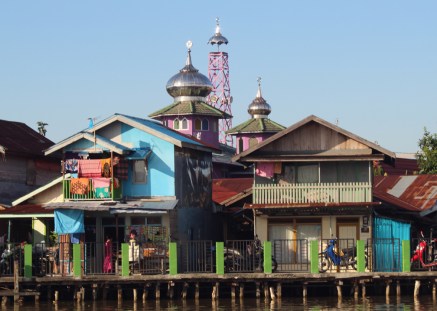
Purple tower mosque

Purple mosque and colorful waterfront on the Martapura River near Banjarmasin.

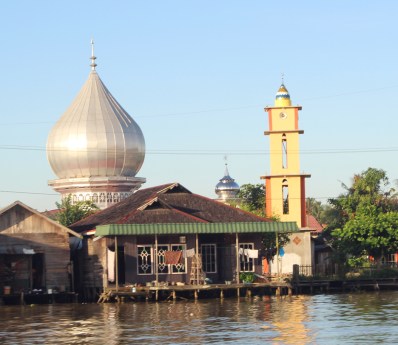
Early morning mosque 2

SIlver-domed mosque along the Martapura River in the early morning light.

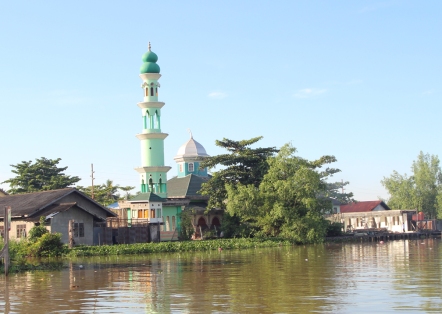
Green tower mosque

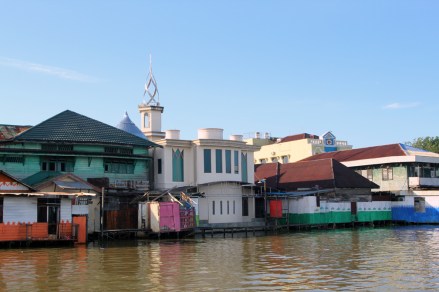
A mosque with a green minaret along the Martapura River near Banjarmasin.

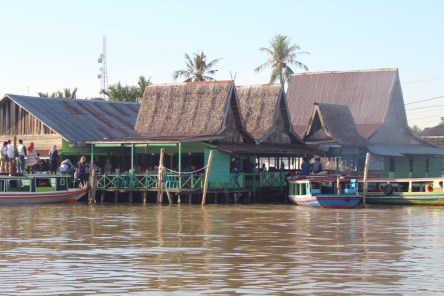
Soto bang amat from river

Several water taxis were unloading passengers here. Based on the smoke from the barbeques, it must be a popular restaurant. Notice the traditional Banjarese roofs.

Coconuts in boat

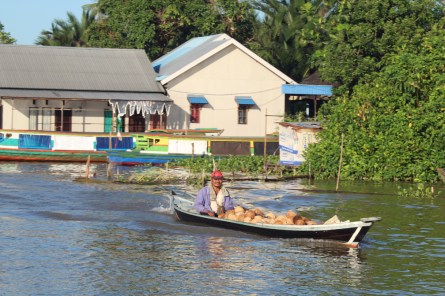
Transporting a load of coconuts up the river. Notice the water taxis docked at the house in the background.

Water taxi

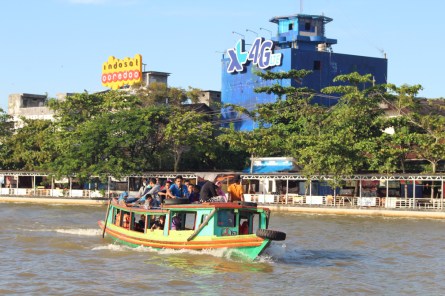
Another water taxi as we neared the dock in Banjarmasin. This was Sunday, which to people here is like Saturday for us – a day to enjoy the river and the morning.

Colorful waterfront

Colorful houses along the Martapura River as we approach Banjarmasin.

Read Full Post »

Borneo Day 3: Sunday, July 23, 2017

First light on Martapura RIver

Early morning light on the Martapura River as we travel to Lok Baintan and the floating market. The trees are coconuts and bananas, not tangerines, but close enough.

I woke up at 4:50, thankfully – the front desk forgot my 4:30 wake up call. I jumped in the shower and got dressed in the clothes I had laundered in the sink the day before. They were almost dry. I met Craig, Nazar, and his wife in the lobby at 5:20 just as they were ready to leave. We walked to the parking lot and to a dock on the river and boarded a water taxi. The early morning dew made the top wet and slippery in the predawn darkness, so I crawled under to the back seats as other people loaded in.

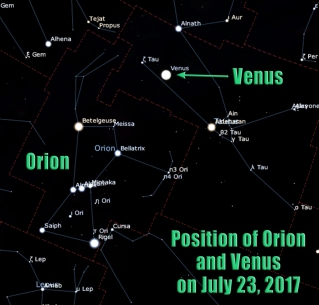
Orion and Venus

The relative positions of Orion and Venus at 5:30 am on July 23, 2017

We pushed off from the dock and began our journey up the river to the floating market. The stars were bright this morning, and Orion was rising in the east, much further north than I am used to. I had it upside down, and thought the bright star nearby was Sirius until we got far enough away from the city lights for me to see Orion’s sword. Then I could see that it had to be a planet. At first, I thought it was Jupiter, based on its color, but it was too bright and I remembered Jupiter is in Virgo near Spica right now. It was Venus, much higher in the sky than I have seen it before.

While I was thinking the planet might be Jupiter, a song came to mind that fit the occasion perfectly. It was “Lucy in the Sky, with Diamonds.” Now I know what this song has reference to, but that’s not what came to mind. There was an article written with this same name by an astronomer about how Jupiter may have a core of diamond, since carbon would rain down from the atmospheric methane and the pressure and heat in Jupiter are more than enough to convert it to diamond. Arthur C. Clarke used this idea in his book 2061: Odyssey Three, how people traveled to Europa to mine diamonds after Jupiter was converted into a star in 2010: Odyssey Two by Dave Bowman and the star people.

Pre-dawn mosque

A mosque along the Martapura River in the pre-dawn light.

Of course, it reminded me of the time when I got to personally ask Clarke a question. It was at a teacher conference in Cocoa Beach, Florida for the launch of the Mars 2001 Odyssey spacecraft. David Seidel arranged to call Clarke up in Sri Lanka and ask questions we’d already written on index cards. My question was: Do you ever see your dream of a space elevator coming true? He answered that there were two factors preventing it. The first was technology – we don’t have the materials to build a space elevator yet, although that is probably a matter of time. The other is more difficult: we don’t have any place to go. No destinations in space that would require a space elevator to reach, nor the will to build one.

Since then, we have discovered white dwarf stars with cores of diamond. One of them is in Centaurus, of all places. Here’s a link about it:

http://www.theage.com.au/articles /2004/02/17/1076779973101.html

As the eastern sky lightened I thought of these things and the words of the song echoed in my mind:

Picture yourself in a boat on a river,
With tangerine trees, and marmalade skies.
Somebody calls you, you answer quite slowly:
A girl with kaleidoscope eyes.

Cellophane flowers of yellow and green,
Towering over your head;
Look for the girl with the sun in her eyes
And she’s gone.

Lucy in the sky with diamonds . . .

Boats converging

Boats converging on the Martapura River to sell their wares at the Lok Baintan floating market. The skies turned a marmalade orange color just before sunrise.

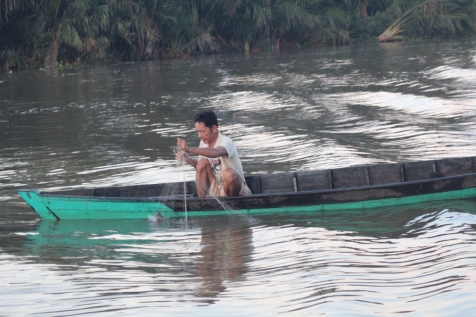
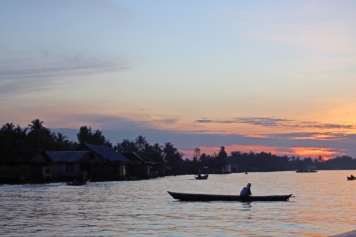
Orion and eventually Venus faded as the sky grew brighter in the east. People were beginning to stir from their houses on the river, walking out to the front porch to dip out buckets of water to wash themselves and cook breakfast. Fishermen were out on the river in boats tending their nets as our taxi meandered around the bends.

Sunrise on Martapura

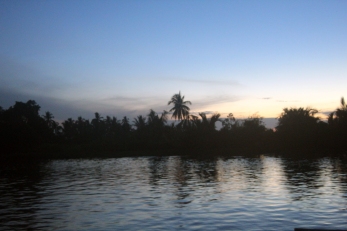
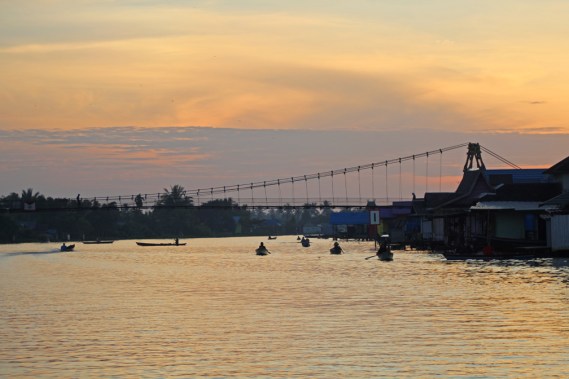
Marmalade skies over the Martapura River as we near Lok Baintan and the floating market.

The water and skies turned a marmalade gold color that complimented the brilliant greens of banana trees on the banks (not tangerine trees, but close enough) as we approached the floating market. The morning call for prayer rang out from the many large and small mosques (masjid) that we passed. Boats converged from all around. We reached the market just as the sun was rising.


Fishing nets

Fishing on the Martapura River. The Banjarese people that live along the river do everything here – live, bathe, drink, wash, fish, and transport.

Read Full Post »

Borneo Day 2: Saturday, July 22, 2017

Panning for diamonds

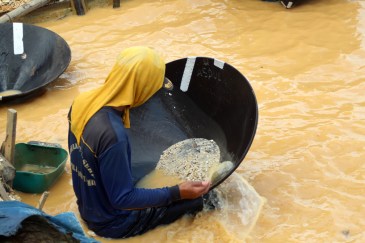
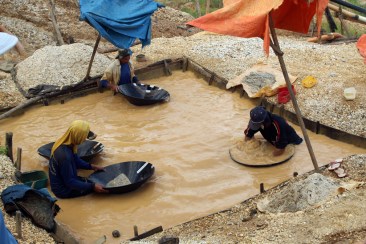
Panning for diamonds at the Cempaka diamond mine. The pans are very similar to panning for gold in California, but instead of flat bottoms they have conical bottoms.

After visiting the haunted house on the hill, we drove further toward Martapura on the Trans Kalimantan Highway. We needed to meet up with a colleague of Nazar’s, whose father works in the diamond mines, so we stopped at a convenience store called Indomaret. There are many of these throughout the country. I was getting hungry and thirsty, so I bought some Minute Maid Pulpy tropical punch and a Hungry Cow ice cream bar, which was really good.

Trisakti monument

A monument to the famous (and lost) Trisakti Diamond, found near this location.

Nazar’s friend arrived and he climbed into the car with us. We traveled a short distance further on the road, then turned off onto a smaller road leading into an open area with rice fields and swampy ground. On one side of the road was a monument in the shape of a large diamond: the famous Trisakti diamond discovered near here. Its whereabouts is not known.

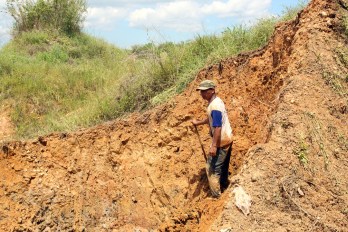
Digging mud

Digging in the mud. The first step is to dig out the mud and stones at the proper level where the diamonds are located, about 30 feet down from the mean ground level. This area has been reworked so many times that it has all been mixed up.

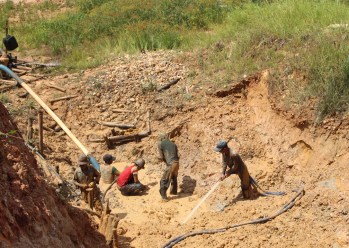
Spraying mud

The first step is to dig mud and rocks from the side of the hill and shovel down to the bottom of the pit, where water is pumped and sprayed to remove the larger stones. The smaller stones and mud are sucked up a pipe to a sluice box above.

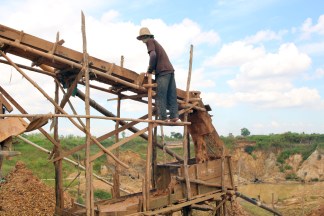
We parked by the side of the road and I took a few moments to spray myself with insect repellent, figuring I would need it here if anywhere. We walked along a narrow path through small hillocks to where the ground opened up into a large pit. Like everywhere in Indonesia, bright green vegetation grows everywhere, but underneath the soil is an orangish tan color. A group of men were working at the edge of this depression in a freshly dug pit. One man at the top was shoveling muddy soil down to the bottom and two men at the bottom were spraying the soil with water to wash out the larger rocks, then sucking it all up into a pipe under pressure. This pipe delivered the mud and gravel to a large wooden sluice box, where a man removes medium sized pieces.

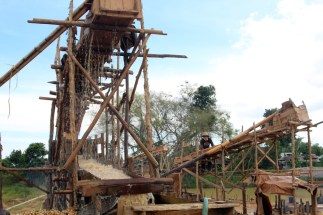
Leaky sluices

Sluice boxes. The mud slurry is pumped from the pit and washing down the rills where the larger stones are separated.

The smaller stuff and mud is carried by hand in a conical washing pan (just like the gold pans in California except with a pointed instead of flat bottom) to a walled-in area filled with water. Several men inside the water pit were sloshing the water around in the pans, gradually separating out the small gravel from the mud and searching through it for any diamonds.

Sluice

A sluice box. Larger stones are separated out by hand in the sluice and the mud and smallest stones are dropped into a filter box.

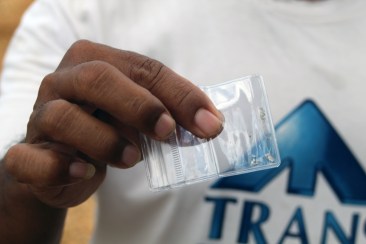
An older gentleman showed us a plastic bag with several small diamonds in it, about 1/10 carat each. He said they find quite a few of these each day, but larger diamonds are much more rare.

Looking for diamonds in pan

Searching for diamonds in the pan. The small stones, still with some mud mixed in, are carried to this walled pit filled with water where the slurry is swished around with water and the smaller stones settle to the bottom. The panner searches for a glint of light that indicates a diamond. The remaining pebbles are placed to the side and eventually worked again to look for gold and platinum.

In my research on this area, I found out that it has been worked and reworked for almost a thousand years; certainly the pits and hummocks look like they have been dug through many times. In years past, the pits had to be dug about 30 feet down to reach the diamond bearing gravels, and they would flood because this is a swamp, so wood was used to barricade the pits, tamped with grass to prevent the water from oozing in. Even so, they would often collapse. Now they have created a dam to wall off the swamp water so that the large pit doesn’t flood, but the soil is still very muddy.

Small diamonds

A bag with small diamonds found at the Cempaka mine. Although very small, at bout 1/10 carat, these diamonds are discovered fairly frequently here. Most of the larger stones have been discovered after a thousand years of digging.

It took some jumping over streams and hoses and climbing around to get to the panning pit. I was worried about getting mud on my new camera, but I did manage to get good photos and video of the whole process. Nazar’s friend told us that the miners are superstitious and that we should avoid doing certain things, or we would scare away the diamonds. One was to swear or use bad language. Another was to stand with our hands on our hips like a boss. I was trying not to do this, but in the photos taken of me, there I am with my hands on my hips. I hope I didn’t scare away the diamonds.

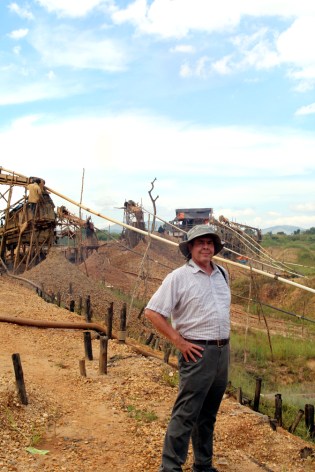
David at diamond mine

David Black standing like a boss at the Cempaka diamond mine. This is supposed to be bad luck to stand like this, with hands on hips, and will scare the diamonds away. Oops!

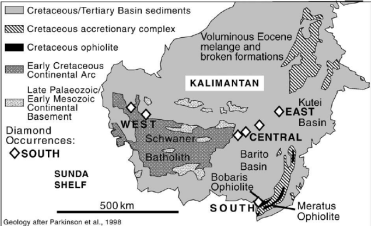
Before coming to Indonesia I researched this mine and discovered that the diamonds came from kimberlite deposits in the Meratus Mountains. They were washed here in rivers during the Cretaceous Period, when sea levels were higher. This area was at sea level and formed a delta into the ocean. In the over 66 million years since then, there hasn’t been much tectonic change in Borneo (unlike Java and Sumatra) and this area has remained largely intact, except that as sea levels dropped during the ice ages, the delta was subsequently buried under further sediment washed from the mountains. So now the miners have to dig down through 30 feet of mud. The gravel layer also has small deposits of gold and platinum in it. We could see the foothills of the Meratus Mountains in the distance. I wondered if there were any diamonds still in them thar hills. I don’t think the mother lode was ever found, just as the mother lode in California was never found.

Diamond geology-Kalimantan

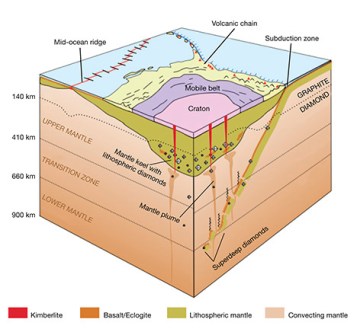
The source of the Cempaka diamonds is the Bobaris Ophiolite, which contains kimberlite deposits. Kimberlite is a volcanic vent that lifts the diamonds from deep in the earth (where pressure and heat are great enough to form them) to the surface. The diamonds were then eroded out of the kimberlite and deposited in a Cretaceous delta in what is now the Barito River basin.

There were several groups of men digging in separate locations along the walls in the larger pit, using diesel powered pumps belching smoke to pump the water and mud from the holes onto the wooden sluices. Other than diesel power, their techniques have remained largely unchanged over a thousand years. This mine may be the second oldest diamond mine in the world, after the famous Golconda mines in India. It hasn’t produced as many famous stones, but from time to time larger stones are still found. About ten years ago, a rare three-carat blue diamond was discovered here. This is just one pit of many in the general area, and they still find small diamonds. I know some commercial groups have studied areas near here and say there is quite a bit of potential even now.

Diamond and kimberlite diagram

The geology of Borneo during the Cretaceous Period was just right for diamond formation and uplift. Subduction along the proto-Indonesian margins carried graphite deep, where it formed into diamond. The volcanic activity produced large cratons and calderas with mantle plumes that lifted the diamonds toward the surface. Now Borneo is stable without volcanoes, compared with the rest of Indonesia.

From here the diamonds are sold to buyers in Martapura who polish and set the stones into jewelry. We were to visit that part of the process next.

Read Full Post »

Borneo Day 2: Saturday, July 22, 2017

House on the hill

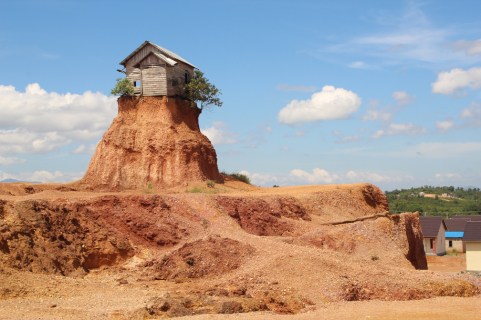
The house on the hill. Construction workers were cutting off the top of this hill to make room for more houses and tried to blow up this house. Each time they tried, something went wrong or the workers got sick. They decided the house was haunted and just left it while digging all the other dirt away. Now it’s become a tourist destination.

On our way to the diamond mines we stopped at a recent local landmark of sorts: the haunted house on the hill.

Near Banjarbaru a new subdivision of houses is being built, and they are leveling out a hillside to make more. As they cut into the hill, they had to tear down some existing shacks and buildings. Once such house was set to be destroyed by dynamite but the dynamite never went off. The construction workers, being somewhat superstitious, felt this meant the house was haunted and the ghosts didn’t want the house blown up. Another story is that every time a construction worker tried to tear it down, the worker got sick.

Hmmm

Hmmm . . . something’s not right here . . .

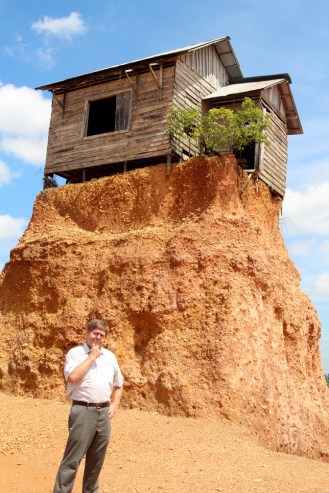
So they left the house there, sitting on the hill, and dug the hill out from around it. It now sits on a pillar of dirt and rocks about 20 feet high and just wide enough for the house. It is a bizarre sight that Nazar thought we would enjoy. It has become a popular new attraction and is being called Rumah Jomblo, or the Single House.

We drove in through the new houses and parked at the foot of the hill at the base of the pillar upon which the house sits. We walked around and climbed up to the top level and took photos. Craig created and posted a Google 360 image of the house, which I haven’t been able to find or I would provide the link. Craig took some photos of me in front of the house as well.

This is a very temporary attraction, as the pillar of soil will erode away after a few rainy seasons and the house will inevitably fall, ghosts or no ghosts. They canna’ change the laws o’ physics.

At house on hill

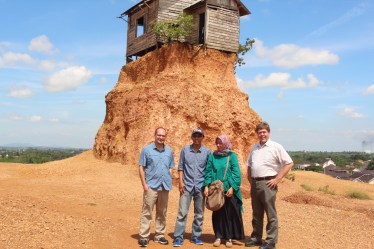
At the haunted house that sits on a pillar of dirt near Banjarbaru.

From a geology standpoint, I was interested in the muddy orange soil that seems ubiquitous throughout this part of Kalimantan. It has a lot of iron-rich clay with rounded gravel, a delta deposit if I ever saw one. These deposits were laid down when sea levels were higher during the Cretaceous Period, and are now the hills around Banjarbaru. From our view on the hill we could see the new provincial administration building a few miles away as well as the Meratus Mountains.

We were close to the diamond mines, our next stop.

Read Full Post »

Borneo Day 2: Saturday, July 22, 2017

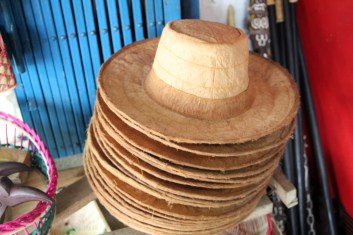
Bark hats

Hats made from the inner bark of the breadfruit tree, I couldn’t find one that fit, or I would have bought one.

Our first full day in Borneo was a Saturday, so we were going sightseeing. Craig and I met for breakfast in the buffet downstairs from the lobby. The food was pretty good, but not as extensive as the Le Meridién. The orange juice (jus jeruk) was delicious, and they had fresh pineapple and the small Indonesian bananas that are sweeter than what we get in America. They have an omelet bar where we could get scrambled eggs, and small waffles with honey. There were also some Indonesian and Italian foods, such as penne pasta, that were good but not exactly what I wanted for breakfast.

Nazar picked us up at 8:15 along with his wife and oldest daughter. We drove out of town on the Jalan A. Yani back toward the airport. The road was busy with early morning traffic – people heading to work or to market. We passed motorcycles laden with ducks and chickens, bundles of noodles, or other items to sell. The morning markets were obvious as there would be hundreds of parked motorcycles and many stalls by the roadway. We traveled on through the roundabout by the airport and continued on past it toward the city of Banjarbaru.

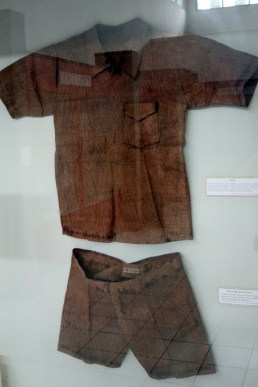
Bark britches

A bark shirt and britches, made from the inner bark of the breadfruit tree.

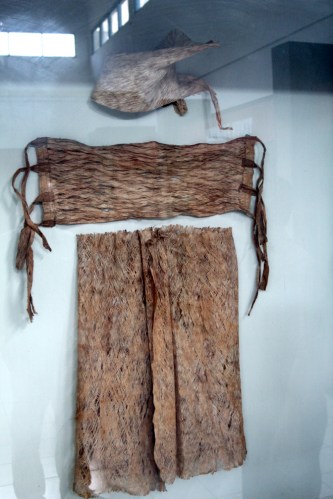
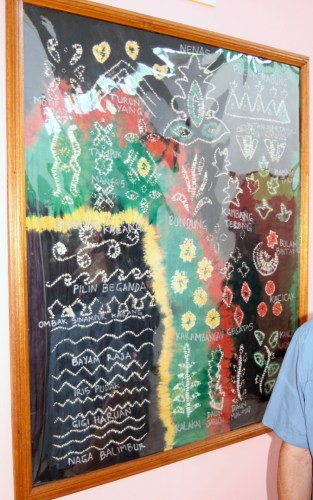
Our first stop was the Lambung Mangkurat Museum, about 36 km from Banjarmasin. This is a museum of Banjarese and South Kalimantan history and culture, built for the Ministry of Education in the 1970s. The central building is shaped like a stylized Banjarese house with a red roof. We first went into a side building that showed Banjarese art, including weaving and the sasirangan that is Kalimantan’s equivalent to batik. It is more like tie-dye and doesn’t use a wax resist process. It also displayed clothing such as loincloths, trousers, shirts, and hats made from the inner bark of the breadfruit tree, which is pounded until soft and formed into clothing.

Bark clothing

Clothing made from breadfruit bark at the Kalminantan culture museum. This type of clothing is still made for ceremonial purposes by the Dayak people of Kalimantan.

Sasirangan patterns

Here is a description of the different types of patterns produced by sasirangan techniques.

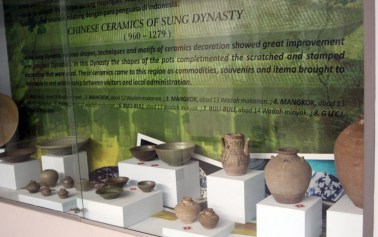
Next door was a display of pottery, including some local wares and jars that dated back quite a long time to the Buddhist and Hindu kingdoms of the 8th Century and from the Dutch colonies in the 17th through 19th Centuries. Some of the pieces shown were brought here from China from the Sung and Ming Dynasties. Quite valuable! Who knew I would see them here?

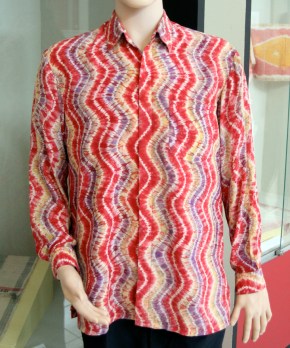
Sasirangan red stripes

Sasirangan is Borneo’s answer to batik and is more like tie dye (actually, I believe tie dye probably started as sasirangan). Here is a nice shirt with a wavy pattern.

The main building housed a variety of historic displays, including bones from the indigenous pygmy elephants that used to live here. A subspecies of Asian elephants still lives in a small area of northern Kalimantan. There were tools from primitive cultures going back to Java man. They had royal costumes and Dutch cannons, gamelon orchestra instruments and recreations of thrones and other artifacts. They had displays about Pengaran Antasari, a hero who led a revolt against the Dutch.

Sung dynasty bowls

Bowls and vases traded to Banjar rulers by Chinese merchants. These pieces are of Sung Dynasty age and origin.

Outside the main building in a shaded area under the stairs was a model of Borobudur. It is a giant Buddhist temple shaped like a mandala near Yogyakarta. I will be visiting there on my five-day extension trip in two weeks.

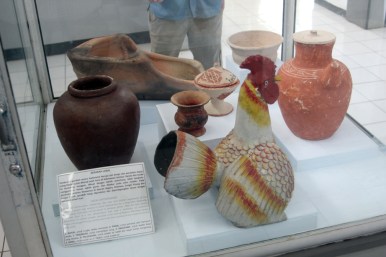
Kalimantan pottery

Native pottery from Kalimantan.

We got back in the car and continued on.

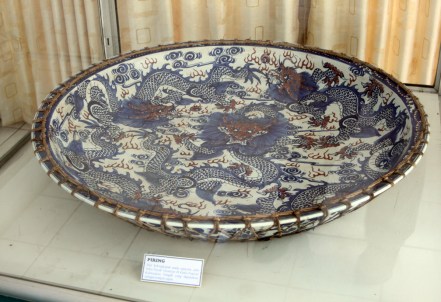
Piring bowl

A large Ming Dynasty bowl, or piring.

Read Full Post »

Jakarta Day 6: Thursday, July 20, 2017

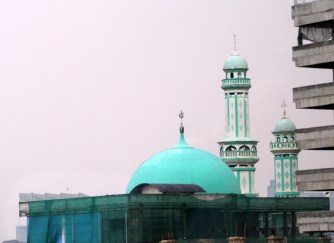
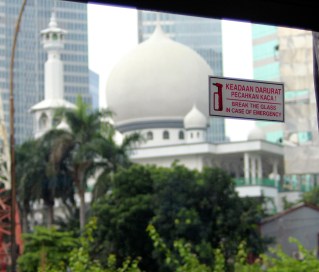
Aqua mosque

Mosques (masjid) come in a variety of designs and colors. Some commonalities are the domed tops and tall minarets, used for broadcasting the call to prayers by the muezzin.

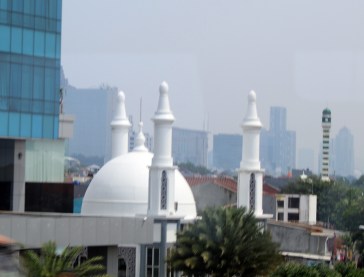
On our way back to the hotel, we passed along the expressway and I noticed the wide variety of mosques (masjid) throughout the city. No two are alike, and they are often brightly colored with ornate metallic domes or minarets. I’m used to the frequent LDS chapels all over Utah Valley, which are very similar to each other in appearance because they are built on common master plans. These mosques vary in interestingly different ways. Some neighborhoods have large mosques in good repair, others were smaller or older, their paint more faded or their metal domes a bit tarnished or tilted. I don’t know why one mosque would be in good repair and another not; perhaps some become more popular depending on the imam or muezzin. These get more donations and can build better-maintained mosques. Maybe there are other reasons.
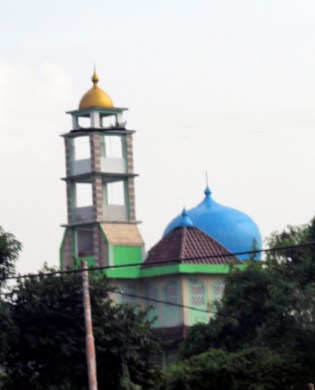
Blue dome mosque

Mosque with blue dome and golden domed minaret.

I saw that some mosques were small, attached to individual businesses. Even smaller businesses that can’t afford a mosque dome will have a musholla, or prayer room. I saw these as I was at restaurants and had to visit a bathroom – I would look into the musholla. They have a padded floor for kneeling; believers take off their shoes at the door and kneel down to pray with hats or hijabs on their head, the men in front and the women in back. The attitude is one of submission to Allah, acknowledgement that He is the One God and Muhammad is his prophet.

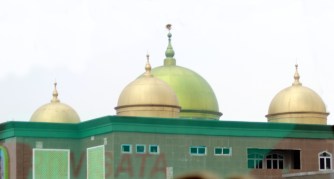
Green mosque

Green and gold mosque.

Although attendance at mosque during prayers is encouraged, the only mandatory time is the Friday afternoon prayer, when the entire community is required to attend. In many Islamic countries, this is the start of the holy day, from Friday noon to Saturday noon. In Indonesia they don’t practice the holy day observance, based on the saying in the Quran that the people should pray on Friday and then “disperse.”

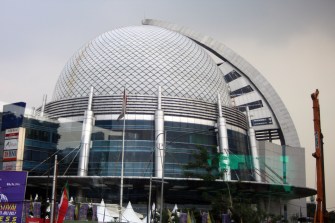
Observatory dome mall

This isn’t a mosque, but is a very unique building that is part of a shopping mall. It looks like some sort of hydraulic observatory.

At other times, people can pray wherever they are at. Even hotel rooms will often have arrow decals stuck on the ceiling, pointing toward Mecca so that guests can know which direction to kneel to pray.

Taj Mahal mosque

These photos were snapped out the window of our bus on the way back to the hotel. This particular mosque looks similar to the Taj Mahal in styling even if the color scheme is simple.

We arrived back at the hotel, ate lunch at the buffet, and had a brief meeting in the conference room to prepare for our flights to our host cities the next day. I spent the balance of the evening eating snacks in my room and uploading photos. I have been using Photoshop to clean up the best photos as I take them so I won’t have a huge backlog upon returning home. I’ve been sending them to Becca attached to e-mails, and she’s been posting them on her Facebook account, which reaches over 700 friends. Once I get these blog posts written and edited, I will have all the photos ready. Then creating the actual posts will proceed rapidly. I have also been uploading my cleaned photos to the group Google Drive account so others can share them. I also packed up my bags and arranged for the hotel to keep some of my carry on things at the Concierge desk (such as my travel pillow), as I would not need them in Kalimantan.

White mosque

A simple, modern style white mosque.

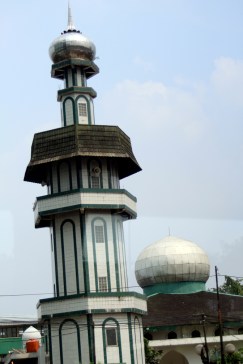
Tower mosque

A smaller mosque with interesting minaret tower.

Read Full Post »

Jakarta Day 5: Wednesday, July 19, 2017

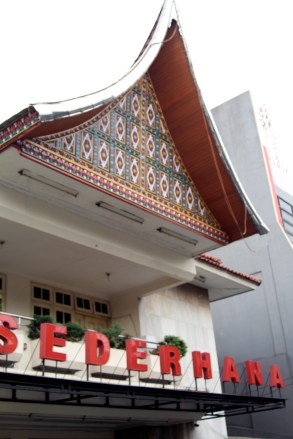
Sederhana restaurant exterior

Sederhana, a western Sumatra restaurant chain. We ate lunch there.

After our visit to SMAN 8 Jakarta, we boarded the bus and traveled to a western Sumatran restaurant. Along the way, we passed through several districts with businesses that seemed to specialize in one particular type of goods. There was the office supply district, selling office chairs and filing cabinets, among other things. There was the car repair district with shops and auto parts stores. And there was even a very small handicapped equipment district. I’m not sure what the advantage would be to congregate similar businesses in the same areas – perhaps it would be for customers, since if you know you need office supplies, then there is a particular area of the city where you go to find them. You don’t have to run around the whole city going from store to store. But I can’t figure out how this would be an advantage to the stores themselves. It would lead to increased competition and lower prices and less profits. Maybe concentrating customers more than makes up for increased competition.

Sumatran food

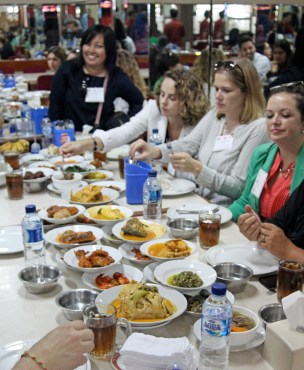
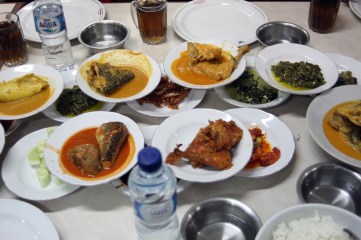
West Sumatran food is served in a series of small bowls and you only pay for what you eat. Any unused dishes go back in the warming oven for other customers.

We wound up back on the same loop we were this morning, wondering if we would be eating at Wong Solo after all. Instead, we stopped at an interestingly designed restaurant I had noticed this morning, called Sederhana. It had the steeply pitched roof corners of west Sumatran architecture, and Dewi explained this was the style of food of her native area.

We managed to find a place where the bus could pull over enough for us to get out and walk in. We sat at two long tables as the waiters brought out a large assortment of small dishes, all with different types of food. The style of eating here is somewhat like a buffet, but all the dishes are brought to your table and you pick the ones you want to eat and pay for only those. The ones not touched will be stacked back under the heat lamps for the next customers. So it was important that we not pick little bits from many dishes – we had to eat all of one dish before starting another of the same food.

West Sumatran dishes

Close up of Sumatran dishes, ranging from sliced cucumber to spicy chicken and curried fish.

It was pretty spicy stuff, but delicious. There was chicken in various sauces ranging from spicy roasted chicken with sambal to chicken in curry sauce. There was tasty beef rendang, grilled fish, vegetables cooked in coconut milk, and many more. I tried a variety, and liked some more than others. I’m not a big fan of curry, but can eat it if I need to. We had drinks such as Stroberi Fanta or bottled water, some dessert-like dishes such as flan or gelatin, and many more. We passed things around and tried to finish all the dishes we started.

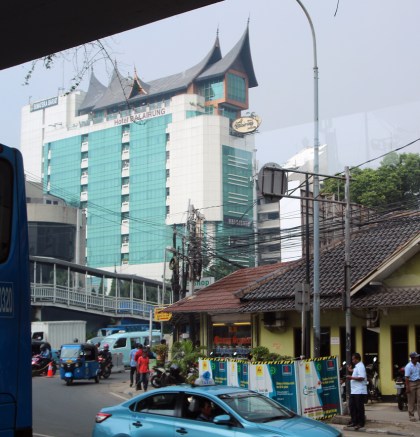
Bailarung Hotel

The Bailarung Hotel in Jakarta. The top floor is designed with traditional western Sumatran architecture.

The bus managed to park by the restaurant, so we boarded again and headed toward the new downtown area and U.S. Consulate for our next stop.

Read Full Post »

« Newer Posts - Older Posts »