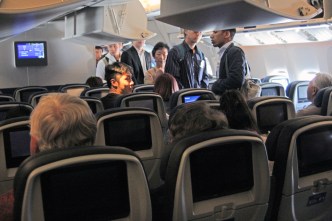
Feeds:
Posts
Comments

A Man of the People

Jakarta Day 2: Sunday, July 16, 2017
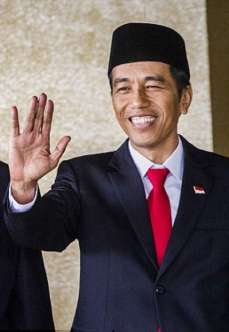
President-Joko-Widodo with hat

President Joko Widodo of Indonesia. I have to get me one of those hats!

After our batik class at the Museum Tekstil Jakarta, we boarded the Whitehorse bus and drove to the Grand Mall of Indonesia, the largest shopping mall in the country. I’ll talk in another post about my feelings about why shopping malls are popular here, but suffice it to say it is huge and contains many western style shops. It is divided into two large sections with a roadway passing between and walkways over the road. We got off the bus, went through a normal security checkpoint (very common here – all hotels have them when you enter) and went into the lobby of the East Mall.

We immediately ran into a large crowd gathered around someone near the far wall who was moving slowly along. Everyone had cell phones out and were trying to take photos. I asked a blonde American lady standing nearby who the person was, and she didn’t know. It must be some local celebrity, I thought, to gather such as crowd. Finally, an Indonesian person told me who it was: “Jokowi, Jokowi!”
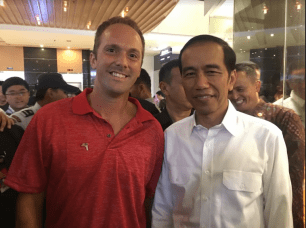
Doug with Pres

One of the TGC teachers, Doug, with President Joko Widodo of Indonesia.

It took a bit longer to realize that this is their nickname for Joko Widodo, the President of Indonesia. He had simply dropped by the mall to say hello and shake hands. No grand announcements or press event, no media circus unless you count countless cell-phone recordings, just a not-so-quick stroll through the mall to meet the people. Someone said he does this fairly often.
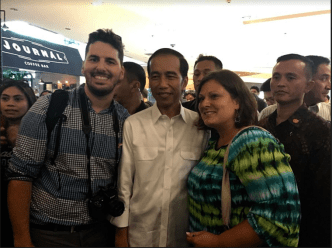
Matt and Jen with Pres

Matt and Jennifer with President Joko Widodo of Indonesia. I didn’t want to press my way into the crowd, so my own photos didn’t turn out very well.

This was amazing. Can you imagine Pres. Trump just dropping by a local shopping center to shake hands? Everything our president does is orchestrated months in advance with a team of Secret Security agents making arrangements for every detail long before. There can be no “dropping by” anywhere. This is the fourth most populous country in the world, after China, India, and the United States. Over 275 million people that he leads. And he only had a thin phalanx of security guards in black uniforms and a few mall cops (which must have been scared to death by the sudden responsibility). He was shaking hands and posing for selfies, working his way slowly around the ground floor and out the other side. The mall entrance had no more than the usual level of security check.
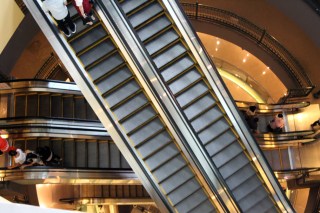
Escalator layers

Layers in the Grand Mall of Jakarta.

Several of our teachers seized the opportunity, and being larger than most Indonesians, managed to push their way forward through the crowd and even got their photos taken with Pres. Jokowi. It made Dewi very jealous. I am including the photos here.

We were supposed to get our own supper while at the mall. I used the money I borrowed from Nikki because I haven’t had the chance to change the U.S. cash that I brought. I carry it in the leg pouch that Gayla (my sister) loaned me. The exchange rate here is crazy – about 13,000 rupiah per U.S. dollar. That’s a lot of zeros. They went through a major devaluation and inflation period in the late 1990s, and it resulted in long-time president Soeharto stepping aside. This led, finally, to the democratic election of new presidents, of which Jokowi is the most recent. It will be a challenge to figure out the equivalent U.S. values of things and not have “sticker shock” when a drink of juice costs over 10,000 rupiah.
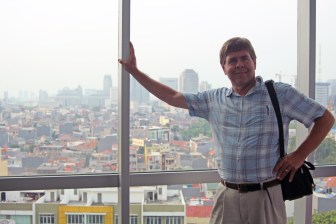
Me in mall

David Black at the top of the Grand Mall of Jakarta overlooking the city.

I bought some Minute Maid juice in a supermarket downstairs – I wasn’t hungry for supper. I wanted to see just how big this mall was, so I worked my way up to the top along with Jennifer and Matt. We found some windows looking out and a great view of part of Jakarta with colorful houses and tall buildings clustered in no apparent order or pattern. I took some panoramic shots. I am including one here, as well as photos looking down into the mall.
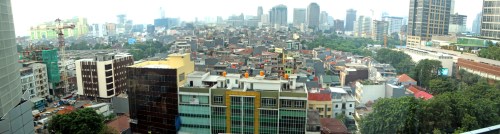
Jakarta panorama

A panorama of part of Jakarta from the top of the Grand Mall.

On the way back to the lobby, I stopped by a chocolate store to sample their products. They had nibs and other samples that were excellent, and claim to be a sustainable production. I hope to see cacao plantations and chocolate production on my five-day extension in Yogyakarta and Bali.
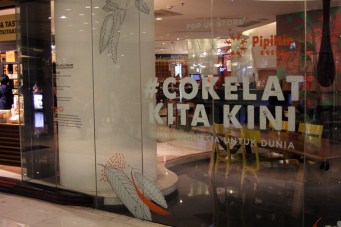
Cokelat store

Chocolate (cokelat) store in the Grand Mall of Jakarta.

We gathered in the lobby and got back on the bus outside, then worked our way back to the hotel. On the way, I took photos of the bougainvillea with pink, magenta, purple, white, and salmon/orange blossoms along the road, some food stalls selling bakso (meatball soup), which was made famous by being a food that President Obama liked on his visit here, and the wild power lines stretched all over the place, an electrician’s nightmare. I thought of the infrastructure challenges facing a rapidly developing nation, and how Jokowi’s leadership and popularity are changing the face of Indonesia as it joins the ranks of major nations on Earth. I can certainly see why he is popular.
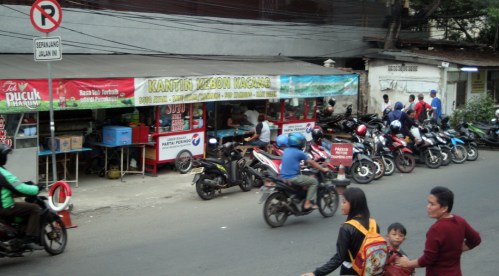
Food stands

Food stalls near the Grand Mall of Jakarta. You see these all over the city, including mobile food carts (like the one in the middle).
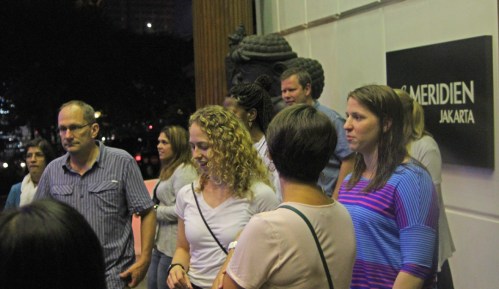
Outside Le Meridien

Back at the Le Meridien Hotel in Jakarta after a busy day.
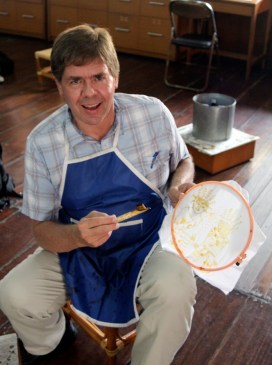
How to Make Batik

Jakarta Day 2: Sunday, July 16, 2017

Me doing batik

David Black working on a batik design of Ondel-Ondel at the Museum Tekstil Jakarta.

After our morning sessions at the hotel, we ate lunch at the buffet (the desserts were amazing) and boarded out Whitehorse bus to visit the Museum Tekstil Jakarta, or the Textile Museum of Jakarta. Sarah Sever had set up a class for all of use to learn how to make batik. I was very excited by this, as learning how to do batik is one of my main goals for what to learn in Indonesia.

In my STEAM it Up class, we tried batik at the end of the school year. I ordered a kit from Dharma Trading Company with wax, a canting (the wax pen), and other materials. The instructions were not detailed enough on how to heat the wax, how hot to keep it, or how to hold the canting. The wax was very difficult to keep molten without burning it, and it kept plugging the canting’s tip or not penetrating the cloth. We tried silk and linen, and our results were less than ideal. Then we had trouble getting the wax out of the cloth.

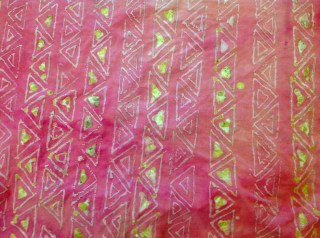
Attempted batik-triangle patterns

One of my STEAM it Up student’s attempts at doing batik. The wax kept clogging the canting and wouldn’t penetrate into the cloth. And it kept dripping.

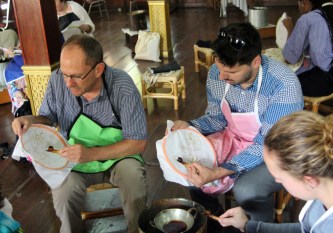
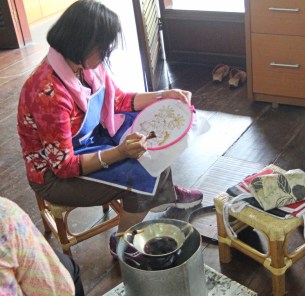
We walked to the workshop room, which had seats arranged around a series of small burners with wax melted in a bowl on top and cantings for each person. We chose pre-drawn patterns already in embroidery hoops, and a lady showed us how to dip and use the canting to trace the patterns. Where the wax soaks in to the cloth, the dyes won’t penetrate and the cloth is left white. It is a wax resist process.

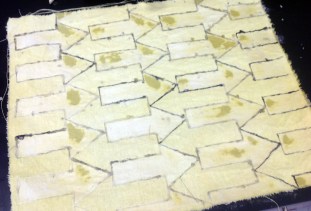
My own attempt at batik in STEAM

My own attempt at doing batik in the STEAM it Up class. I had the students create a tessellation, such as these arrows, by drawing around a stencil on a pre-died piece of linen. Then we applied wax using a canting. But it kept dripping and clogging.

My pattern was rather complicated, a pair of figures called ondel-ondel with elaborate costumes and headdresses. I saw two things immediately: the wax used here melts at a lower temperature and stays liquid longer that the wax I got from Dharma, which has too much paraffin in it. Here, the wax (or malam) has more beeswax and other ingredients and is more of a brown color.

Craig-Matt-Nikki batik

Craig, Matt, and Nikki working on their batik patterns using canting (wax pens).

You dip the canting into the wax to fill the small reservoir, then hold it at a 45° angle against the cloth, which is held on your left knee (if right handed). I had some trouble with the wax dripping and making splotches on the cloth, but found if I rubbed off any excess wax from the dipping process, this problem would minimize. It felt much like using a traditional pen to do pen and ink drawings; you have to rub off the excess to keep it from dripping there, too.

At Tekstil Museum

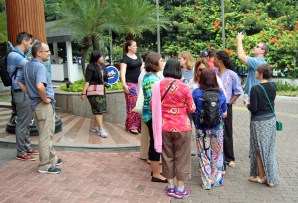
Teachers for Global Classrooms educators at the Museum Tekstil Jakarta.

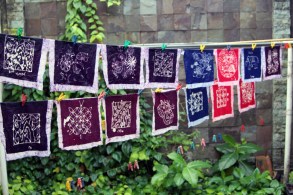
All the teachers enjoyed the process. I was one of the last ones done, and had to rush through waxing the opposite side of the cloth. The next step was to hand the cloth to the man doing the dyeing. We could do red or blue or a combined purple. I chose purple and videotaped him dyeing my cloth as well as others. The wax was then melted out in boiling water and the clothes hung up to dry.

Anu doing batik

Anu working on the same pattern I had: the traditional Ondel-Ondel dolls. Notice how she is holding the cloth at a 45° angle and tipping the canting at the same angle to avoid spilling wax (malam).

While they were drying, we stopped at the gift shop and I purchased some cantings and wax, using money borrowed from Nikki as I had not yet tried to exchange my U.S. dollars for Indonesian rupiah yet. I’ll talk about the exchange rate in a later post. We then took a tour through the museum, where they had examples of batiks from all over Indonesia. A wide variety of plants and animals are used to make the colors of the dyes. We then walked over to the separate museum on weaving techniques and styles.

Kate and Wendy see batik

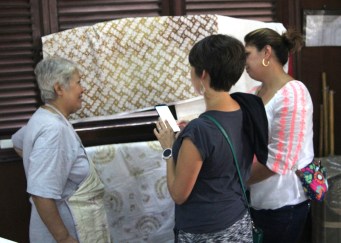
A master batik artist shows Kate and Wendy her work. She later gave Wendy one of her pieces.

After these tours, I went outside because it was stuffy in the non-airconditioned buildings. It was very humid outside, but at least there was some air moving in a slight breeze. It will be a challenge to adjust to the humidity.

Professional batik

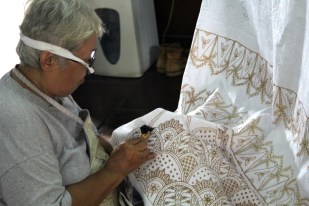
A master artist applying the malam wax using a canting pen. Notice the delicate hand work and how she is not dripping any wax. It is similar to learning how to do hand-dipped pen and ink. I just have to practice.

As I was walking around the grounds trying to find the restroom, the afternoon call to prayer (salat) rang out from several nearby mosques. This is not the first time I had heard the prayer call. In 1984, I traveled with my family to parts of Europe and Israel, and while in Jerusalem I visited the Dome of the Rock and heard the calls to prayer. The calls ring out loudly so that all people can hear wherever they are and whatever they are doing. These prayers are done five times per day, and begin with the Kalimah, a statement of belief that there is only one God and Muhammad was his prophet. This is one of the five Pillars of Islam. The imam for each mosque then decides a passage from the Quran to read, and the muezzin calls out the passage as a song, which is quite beautiful to listen to and rather haunting. I recorded some of it.

Everyones batik drying

Teacher batik hanging up to dry. We could choose red or blue or a combination. The border was painted on and cracked by one of the museum teachers.

Sarah collected our dried batiks. Mine wasn’t exactly a work of art, but it was much better than my earlier attempts in my STEAM it Up class. We re-boarded the Whitehorse bus and traveled gradually toward our next destination. I took photos of bougainvillea and other flowering plants along the way. I have missed the colorful flowers of the tropics.

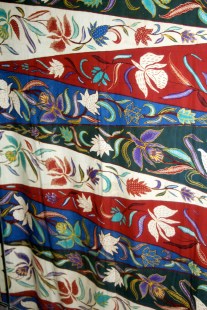
Batik sample

Batik sample in the Museum Tekstil Jakarta.

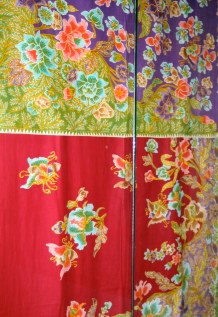
Batik sample 2

Other batik samples in the museum.

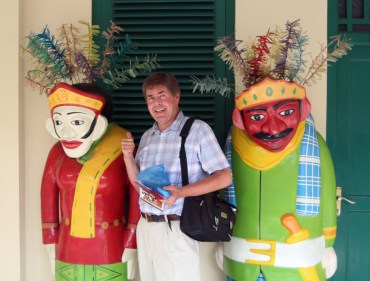
Me with ondel ondel

David Black with Ondel-Ondel statues. I bought some canting at the museum store for use in my classes at school.

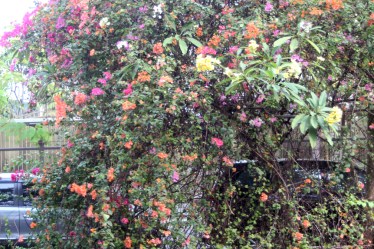
Flowering bushes

Flowering bushes, mostly bougainvillea. Although native to Mexico, this bush is now found throughout the tropics in Asia.

Jakarta Day 2: Sunday, July 16, 2017

Garuda pancasila

The Indonesian flag, with the golden Garuda holding the motto “Unity in Diversity” (old Javanese – Different but One). The five symbols in the shield are the Pancasila.

Now that we were all in Jakarta, we were ready to begin the final training for our field experiences at various schools across Indonesia. We spent the morning in a conference room at the Le Meridién Hotel learning about Indonesian customs and culture.

Dewi led our discussion. She began with a brief history of Indonesia, including the discoveries of Java Man, events leading up to Indonesian independence in 1945, and the governments of Sukarno and Soeharto. When the economy tanked in 1997, Soeharto was forced to step down and Indonesia has been a representative democracy ever since. She discussed the philosophy of Pancasila and the emblem of Indonesia, the Garuda bird with the shield divided into five sections representing the five principles of Pancasila: 1 – The Star, representing a unity of belief in one God (there are five recognized religions in Indonesia: Islam, Hinduism, Buddhism, Catholicism, and Protestant Christianity – of course, some of these five are polytheistic, such as Hinduism, so I’m not sure how the “one God” aspect works); 2 – The Gold Chain, representing a just and civilized humanity; 3 – The Banyan Tree, representing different roots growing into a common national unity; 4 – The Bull, representing a democracy based on the inherent wisdom of unanimity arising from deliberation among popular representatives; and 5 – The Rice and Cotton, representing social justice for all Indonesians.

We had a break with some tasty juices (pineapple and mango) and fried banana fritters and cookies.

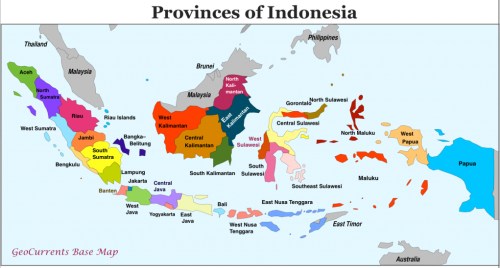
Provinces-of-Indonesia-Map copy

The provinces (states) of Indonesia. They are divided into Regencies (counties) and Districts.

After the break, Dewi went on about some of the customs and the many diverse cultures around the islands. She is originally from western Sumatra but now teaches in Jambi, which is in eastern Sumatra. The major islands of Indonesia (Borneo, Java, and Sumatra) are called the Greater Sunda Islands and are large enough to have many cultures and dialects on the same island. Western Sumatra has unique food, architecture, and customs compared with eastern Sumatra or the more conservative Muslims of Aceh in northern Sumatra. Some ethnic groups or tribes live in the deep interior and have unique languages and customs.

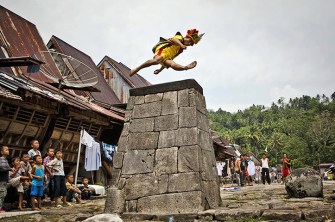
A villager wearing traditional costume jumps over a stone

The tradition of jumping the stone on Nias Island. To prove one’s manhood, you get a running start and vault off of a foot stone and over the top. There is no soft bar that falls when you hit it. Just hard stone.

I checked out a video from our local library about traveling in Indonesia, which also covered some of these ethnic groups. One group on Nias Island off the west coast of Sumatra have a kind of high jump tradition to test one’s arriving at manhood – you get a running start, vault off of a standing stone, and must clear a hurdle about six feet high. Dewi and the video both spoke of other ethnic groups, such as the Toraja of Sulawesi who have houses shaped like the hulls of boats and don’t burry their dead for a year, the Betawi of Java with the traditional black “Soeharto” hat (I’ve got to get one of these) and who have the Ondel-ondel puppets, the saman dance of Aceh province, or the plate dance of West Sumatra, where they break the plates at the end and jump on them barefoot, the kecak dance of Bali, the wayang puppets of Yogyakarta, and other traditions.

There are perhaps 200 or more dialects throughout Indonesia, and Bahasa Indonesia has become the official language as a way of unifying all these cultures together. Most people speak and read it as well as their local dialect and some English or other international language. Teachers wear a khaki tan uniform on Mondays and Tuesdays, black pants and white shirts with ties on Wednesdays, local batik patterns on Thursdays, and more casual clothing on Fridays and Saturdays. School goes six days per week, although Saturdays are more for activities and clubs.

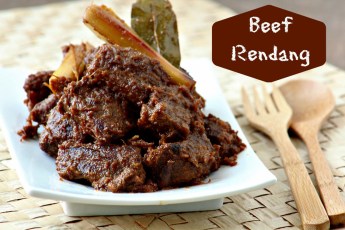
Dewi ended by talking about different Indonesian foods, such as beef rendang (a spicy beef dish from Sumatra), nasi goreng (fried rice), satay padang (rice cakes with sauce), soto (a noodle and rice stew), and bakso (meatball soup). She spoke of cendol, a drink made from sweet green beans and coconut, as well as other favorites. I expect to have the chance to try all of these over the next three weeks.

Beef rendang

Beef rendang, a spicy and savory dish from western Sumatra.

We would learn more particulars about the Indonesian education system tomorrow, but for now, our training was done for the day.
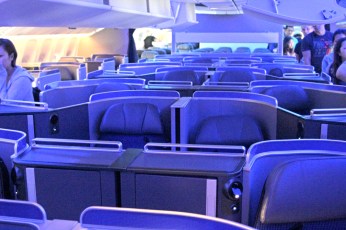
Jakarta Day 2: Sunday, July 16, 2017

Trania

A mango-coconut-lime smoothie, or what I prefer to call “Tronia.” This is my obscure Star Trek reference for the day . . .

Now that I am in Jakarta my blog posts will be a bit different. I am actually writing up all of the posts as one document, which I will continue to edit throughout my journey before starting to post them. I am trying to write them as much “in the moment” as I can to retain how I feel about each experience, yet some days I am skipping over to get other moments of deeper feeling written before my memories fade. I want to retain as much of a chronological order as possible for these posts, so that you won’t be confused, so I am waiting to post them until they are all done. But although largely in order of what happened each day, they will become more topical as events reinforce each other. Some small details that aren’t enough to discuss on one day may add up to more important ideas later. So I’m not writing them in order, but will post them in order. Maybe it doesn’t make sense to you, but it will work for me.

So my first topic is the relationship between food and feeling “at home” in a country. I am all for trying out Indonesian dishes, within reason. I’m not about to eat something from a roadside stall where I can’t be sure of how hygienic it is, but if I’m reasonably sure it is safe, I’ll try it. But I also know that eating unfamiliar food for a long time can do more than test one’s intestinal fortitude. It can lead to major feelings of homesickness. On my LDS mission to southern Taiwan, my parents would send occasional care packages from home. I always requested foods such as buttermilk powder and maple flavoring that I couldn’t get in Taiwan, so that I could cook buttermilk pancakes with maple syrup. I really missed good pancakes, for some reason. All the other ingredients I could find, but not those two. Eating food from home from time to time helped me accept being a stranger in a strange land.

And of all meals, breakfast seems to be the one I missed the most. Yes, I enjoyed the occasional sou bing you tyau (long scones like churros wrapped in a sesame bun and dipped into sweetened soy bean milk) or mantou (steamed bread) or even syi fan (runny rice), yet I still came back to pancakes with maple syrup as often as I could get the ingredients. I became a great pancake cook, even though I had never really made them at home. It’s funny what you miss, and how a little home comfort food can help you feel better.

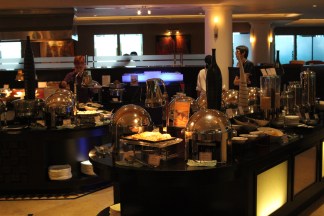
Breakfast

The breakfast buffet at the La Meridien Hotel. They have a little bit of everything, and it is all good. I especially liked the smoothies.

The Le Meridién Hotel has an excellent buffet for breakfast. On my first morning in Jakarta, after not sleeping as long as I had hoped (I woke up about 4:00 because my body thought it should be daytime), I wandered downstairs to the buffet at 6:30. It was good to shower and feel refreshed, but a good breakfast also helped with the psychological stresses of jet lag. I appreciated that the buffet included Indonesian and American foods (as well as some Chinese, Japanese, and other nationalities) so that I could try new things as I wanted but still have some comfort foods from home. There were pancakes and waffles (with maple syrup), an egg bar, pastries and donuts, and an array of more exotic choices. I tried many small samples to see what was good.

The mango-coconut-lime smoothie was excellent, and looked to me like Tronia from the Star Trek episode The Corbomite Maneuver. When I sent a picture of it to Becca, she posted it on Facebook and said anyone who could understand the reference deserved extra points. Terry Bruning, my old mission companion, said it looked like a drink a kid named Clint Howard might serve. Kudos to Terry for knowing it was Clint Howard who played Blayloc in the episode. He wins the obscure Star Trek reference prize for today!

Welcome to Indonesia

Jakarta Day 1: Saturday, July 15, 2017

Mie Yogya hot stuff

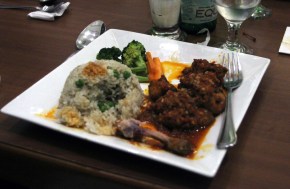
Mie Yogya, a very spicy dish of fried chicken, steamed rice, and vegetables. And I didn’t even add any sambal sauce.

We met in the lobby of the Le Meridién Hotel in Jakarta at 6:15 to board the bus to our welcome dinner. It was nice to see the other teachers, and they welcomed us and heard our tale of woe and our unexpected detour through Sydney. They arrived about 1:00 last night and at least had a good sleep all morning before heading to the National Monument this afternoon.

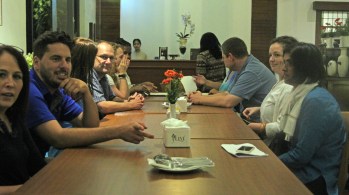
The restaurant was called Tjikini Lima, and we sat at a long table near the entrance and ordered various Indonesian dishes. I decided to try Mie Yogya, which turned out to be a very spicy chicken stew with steamed rice and carrots. It was delicious but my mouth was on fire. There is a good reason why they call these the Spice Islands. I was glad to have a water bottle, and I had also ordered a berry shake, which was more like an Italian soda in consistency but very good. It helped to cut the burn of the food. The flavor was amazing.

Welcome dinner

Some of the educators in the Teachers for Global Classrooms program at the Tjikini Lima restaurant in Jakarta, Indonesia.

I managed to stay awake enough through dinner, but found I was clumsy and very jetlagged – I dropped a bunch of utensils on the floor. Kate and Christie were kind enough to try to keep me talking and engaged, but I found I could not stop nodding off. I hope I can sleep well tonight.

Our in-country consultant is Dewi, a high school English teacher from Jambi on Sumatra. She is very funny and positive, the perfect host. We were also met by Novianti, the host teachers for Mike and Ursula, who will be staying in Jakarta for their host school experience.

Welcome dinner 2

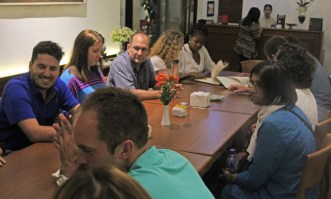
Teachers at our welcome dinner for the Teachers for Global Classrooms program in Jakarta, Indonesia.

Once we got back to the hotel I headed for my room and fell asleep almost immediately. This has been a very, very long journey and my first time across the Pacific Ocean in over 36 years. I’m happy to finally be here in Indonesia. Except for some major jet lag, I am ready to go!

Volcanoes Below

Trans-Pacifica Part V: Saturday, July 15, 2017

Sydney international terminal

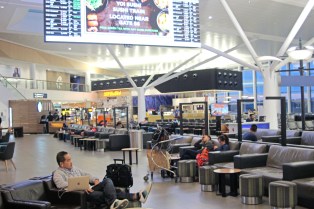
The International Terminal in Sydney Airport.

The final leg of our journey to Indonesia began in Sydney, Australia. The Garuda flight wasn’t in any hurry to board, probably because the plane got in a bit late. I walked over to the gate and asked if it was time to get our official boarding passes and they told me yes, but it took some time as the attendant wanted to know a complete, detailed description of my baggage, despite the customer service person in San Francisco going through the same details. As it turned out, I’m glad she did. Once the boarding began, they didn’t call out groups as in most boarding procedures except that they boarded business class first, then everyone else in a kind of mob. But we got onto the plane eventually, taxied out, and took off.

Sydney departure board-relax

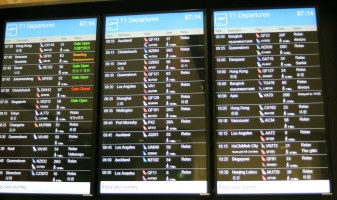
The departure board at Sydney International Airport. I like their advice for waiting: Relax! It’s also interesting to see departures to places like Ho Chi Minh City that you can’t get to from the United States.

This is wintertime in Sydney, but its latitude gives it a climate something like Southern California. The bays and inlets of Sydney Harbor shone invitingly from the air. I could see the downtown area, but never spied the famous opera house. No little clown fish or blue tang in the water, either. But it looks beautiful. I must return sometime. I don’t think staying in the airport without feet actually on the ground counts as having visited a place.

Currencies

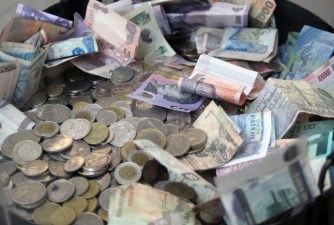
International currencies in a donation box at Sydney airport.

We flew south, then turned west and flew over the center of Australia. There wasn’t much to see, and I spent most of the time talking with my seatmate. His name was Paul and he was originally from Germany, working in Australia among other places, and on his way home to visit his wife and children in Jakarta. He had served for many years in the German Army as part of UN Peacekeeping forces around the world. He had five brothers, and all had been in the German military. Two brothers had died in the line of duty, one while rescuing hostages in Mogadishu, Somalia (I tried to find more information on this, but haven’t been successful). Paul had lost his left eye and been wounded in the left arm and leg when a land mine exploded, which he was tried to disarm in the former Yugoslavia. After this accident, he was put on Embassy duty, eventually winding up in Indonesia. Lost in the streets of Jakarta, a kind man took him home and fed him. He met the man’s daughter, became friends with the family, and married the daughter. Now semi-retired, he runs a security firm on the side.

Coast near Sydney

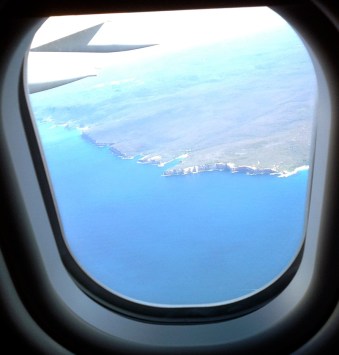
The coastline of Australia near Sydney Harbor as seen from our flight to Indonesia.

We crossed over Alice Springs – not much to see below, just flat desert with some meandering watercourses. At the northwest coast there were many ridges and islands, evidence of submerged valleys from the rise of oceans after the last ice age. Our flight attendants were very attentive (I guess that’s what their job title implies) and kept us well fed and watered. I learned a few Indonesian words, such as kamar kecil (restroom) and keluar (exit) from reading the signs on the airplane. After Australia a large stretch of ocean appeared with occasional rings of atolls below. I tried to sleep without much success. Finally, after six hours of flying, we saw the coast of a large island made visible by the stacks of clouds above it, clustered around a central volcanic peak. I took a few photos out the window. I’m not sure which volcano it was, but it was definitely a composite cone. Let’s hope I get to see a few of these up close! If one of them ever erupted while I was nearby, I would be like Pliny the Elder, last seen running toward Mt. Vesuvius as it erupted.

Sydney Harbor

Sydney Harbor as seen from our plane’s window. I was using an iPad camera here with low resolution and I am zoomed in quite a bit, so the image isn’t very good. Plus, it’s taken out of an airplane window, after all. The white blob at center left may be the Opera House. Hard to tell.

We crossed Java and turned for Jakarta as more clouds appeared below in ordered puffs over the sea. We landed about 30 minutes late and deplaned. We walked through embarkation (I got my passport stamped) and were met by representatives with a sign. Both Mike and Alicia had been told as they boarded the airplane that their luggage had not been transferred to the flight, so they had to fill out claims in the luggage department. Alicia had a change of clothes in her carry-on, but Mike was forced to wear the same clothes for three more days until his bags finally arrived at the hotel. My bags were on the flight, thank heavens, so I got a trolley and walked through customs (basically a hand-wave as the representatives just handed our forms to the officials and we walked on through). We had a car waiting for us outside the terminal. As we walked outside, I could feel the humidity soak into my clothes. I’m back in the tropics again. It’s been a long time – over 36 years.

Volcano from air

A volcano on Java as seen from our Garuda Indonesia flight to Jakarta.

We drove into Jakarta and it was a bit disconcerting to have the driver on the right side of the car – I kept thinking the driver was missing or that we were in an automatic car. Maybe in 10 years this will be true, although I don’t see it being successful in Jakarta’s heavy traffic. It took some time to get to the Le Meridién Hotel, as Jakarta is a huge, sprawling city. But we did arrive finally, put our bags through the security scanner at the front door, and got our rooms. Sarah Sever met us in the lobby and was visibly relieved to see us, after missing our connection through Narita with the rest of the group. She will be our mother hen for the next three weeks. We arrived at the hotel at 5:30 and our welcome dinner departs at 6:15. I had just enough time to go to my room (620) and shower and change, which felt wonderful after two days of flying in the same underwear and compression socks. My right leg is not happy.

Garuda flight from Sydney

Our Garuda International flight before leaving Sydney.

I am here at last. My adventure in Indonesia can finally begin!

Chasing the Night

Trans-Pacifica, Part IV: Date Unknown

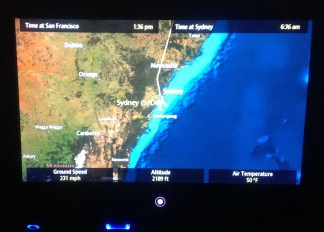
Interactive flight map

Interactive flight map of our approach to Sydney Airport.

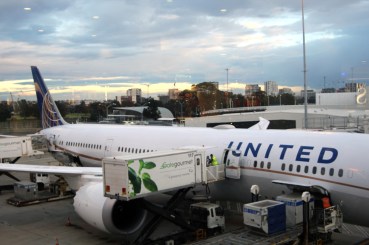
Our alternate flight on our journey to Jakarta took off on time, departing at 10:50 pm from Gate 92 at San Francisco’s International Terminal. It will be a 14.5-hour flight to Sydney, Australia on one of United Airline’s newest Boeing 787 jets. We were able to upgrade to Economy Plus class for a little extra legroom. Mike said it could be measured in inch-hours – how may extra inches of legroom you get per hour. I said we should make this the Metric Unit of relief from discomfort.

It’s a beautiful airplane, and one with digital screens in the back of the seat, which allow you to choose and watch a wide variety of movies and TV shows. I finished watching the National Geographic “Mars” series and watched “Rogue One” as well as trying to get some sleep. My daughter’s pillow came in handy, or my bum would have been even more sore than it already is. When I couldn’t stand it any longer, I got up, used the bathroom, and stretched out my legs. I’m glad I went to the gym and worked my legs out well Wednesday morning.

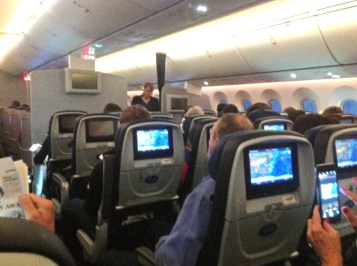
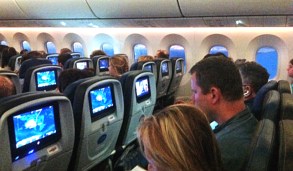
Sydney flight economy class

The economy class section of our 777 to Sydney. Most passengers are looking at the interactive map as we approach Sydney airport. We followed a great circle route across the Pacific Ocean.

It was interesting to chart our progress. One of the apps showed the current position of the airplane on a world map, alternating between close and worldwide views, and giving constantly updated information on airspeed, wind speed, distance traveled, distance yet to go, and the current time at our destination. Our own current time was a bit relative. It also showed the night and day portions of the world map, and I saw how we were chasing the night, heading southwest. This was the longest night I’ve ever had – about 18 hours all told from sunset in San Francisco to sunrise in Sydney. But as fast as we were going (about 540 mph), the Earth rotates faster. At the equator, it rotates about 25,000 miles in 24 hours, or 1100 miles per hour. At Utah’s latitude, it is more like 700 mph (I worked it out once – a nice problem in geometry for students). That means that even though we were chasing the night, dawn would eventually catch us. I saw how the dawn terminator moved slowly across Utah and California, across the Pacific, gradually but inexorably running us down.

We crossed directly west of Hawaii and headed southwest to Brisbane, then down the coast to Sydney. At some point we crossed over the equator – my first time to the southern hemisphere. I look forward to seeing the Southern Cross for the first time. Isn’t there a song about that? At about the same time, we intersected the International Date Line and lost a day. We’ll get a day back going home, but I will never know Friday, July 14, 2017. Jakarta is 13 hours ahead of Utah, almost halfway around the world and in a different hemisphere entirely.
We arrived on schedule at Sydney, circling around to land from the south as dawn began to brighten a pink-orange eastern sky. We checked our carry-ons through the International terminal and are now waiting for our flight: Garuda Air 714 out of Gate 50 to Jakarta at 11:00, if everything goes well.

Mike looks at map

Mike (center) following our progress on the interactive map.

I tried to talk with a retired law professor from Beijing who is flying with her daughter and two grandsons to Boston. My Mandarin Chinese is rusty, but we made ourselves understood. She has been to Taiwan before, where I lived for two years, and even visited Ah Li Shan there. I’ve been to Ah Li Shan and seen the sunrise over the mountains. It is a thought-provoking coincidence that two people from such distant places and backgrounds could have our lives intersect in these interesting ways. I once wrote a blog post about this – how as teachers we hope to be understood most of the time by our students, but how all individuals live in separate worlds that only intersect occasionally, and trying to communicate through these intersections is like trying to teach someone from another planet. My post is located here: Riding the Shadow Line.

How can I hope to intersect and communicate with students in Borneo, when we are from such different worlds? That is why my guiding question is to look for the commonalities between us, and science will be one such intersection. The laws of science are universal, and many of the words and processes are also universal. I hope to find other intersections, other points of common ground.

Sydney pre dawn

My first view of Australia from Sydney Airport.

Here’s hoping our flight today goes well and we arrive in Jakarta as scheduled. After our adventures over the last day, I won’t take that for granted any more. But then, this whole trip will be one adventure after another. They say adventures are what happen when things don’t go as planned. And they won’t, especially traveling to an unknown place to work with unknown people. Bring the adventure on! More stories to tell!

A Chance Encounter

Trans-Pacifica, Part III: Wednesday, July 13, 2017

After waiting in an excruciatingly slow line to get our alternate tickets, we had to work our way through Security again. We made it all the way through and discovered we had forgotten to empty our water bottles. I had completely forgotten, because I hadn’t thought I’d need to go through Security again. So I volunteered to go back out, dump out our bottles, and go back through. Fortunately, it was faster the second time

Alicia and Mike had gone on to Gate 92 for our 10:50 flight and had gotten some supper already. After plugging in my laptop to start re-charging it, I went upstairs and stood in line at a marketplace to get some fresh pizza. I was about to order when I heard someone calling “Dave! Dave!” I turned around and saw it was a former student of mine from Walden School named Libby. She graduated about four years ago, and has since finished her associate degree and is traveling to Bali through China to celebrate. Although I’m going to Bali, too, we won’t be there at the same time. She told me of others from the school that I had taught, and that she hopes to go on the one of the University of California schools and eventually get a law degree

It was great to see her, and what a coincidence to run into her here of all places, on her way to the same place I’m going. I got thinking about the influence I’ve had over 26 years of teaching, the number of students I’ve taught directly, the number I’ve impacted indirectly through workshops and other professional development activities I’ve done for their teachers, and how many people have read my blog posts and at least been slightly influenced. I tried to calculate this altogether and came up with somewhere between 750,000 and 1,000,000 people whose lives I’ve at least touched to a small degree, and thousands of people I’ve taught directly. This blog has been visited by hundreds of thousands of people itself, and my videos on YouTube have been seen by tens of thousands more. Now I’m traveling half way around the world in the hope that I can spread a bit of global perspective. Ultimately, however, it comes down to one student at a time, one day after another, one more chance to influence someone for good.

Trans-Pacifica, Part II

Boarding 777

Passengers boarding the 777 for our flight to Narita, Japan on Thursday, July 13, 2017. This was my first time on a Boeing 777.

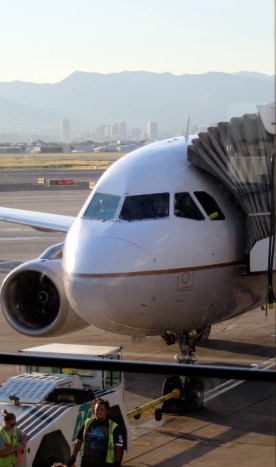
We flew into San Francisco International (SFO) over the south bay and landed, then taxied to our gate. Because we were late, the captain asked if those not in a hurry could wait to deplane until the rest of us had left. I hurried off the plane and asked a gate agent standing at the departure board how to get to the international terminal. She pointed the way, and I discovered that the agent in Salt Lake needed to come up with new definitions of what “just” and “around the corner” mean. It was quite a walk with my overloaded computer bag to find Gate 101, but I did it in about 20 minutes. As I descended the escalator into the gate area I saw Mike and Alicia, two other TC teachers, waiting in line to board. The flight was departing 15 minutes late, so I hadn’t needed to worry. Oh well.

We went through the boarding line and walked to the airplane. It is a brand new Boeing 777, and I have never seen a first class section like it. Each person has their own fully reclining seat with its own private compartment, counter, and computer screen. Not to mention slippers and other amenities. Perhaps someday I will be able to afford such seats, but not today. I found my seat (30D – just to the right of the left aisle) and put my camera in the overhead bin and my snack bag and computer bag below. Alicia was just behind me and Mike just ahead behind the bulkhead, where he has more leg room. Actually, the legroom here isn’t too bad – my knees don’t touch the seat ahead, which is much better than most domestic flights I’ve been on recently.
First class on 777

First class compartments on a Boeing 777. Each compartment has a reclining chair and is like a small sleeper car on a train. But these were not my seats.
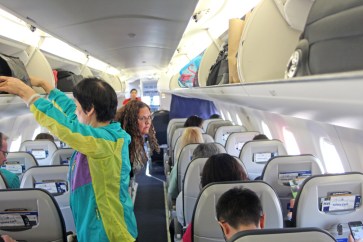
Everyone finished boarding and 12:00 (our new departure time) came and went. This plane has a built-in mini-computer (similar to an iPad) in the back of the seat before us, so I scrolled through the directory and found the Mars series by National Geographic, which I’ve watched the first episode of back in February. I started watching the second episode. The captain came on the intercom to announce that the delay was because of a radio transponder that wasn’t working right and had to be fixed before we could depart. They were working on it and would keep us updated.

I finished the second episode and went on to the third. The captain came on to say they had called in a ground support team and that a flight from Korea had had the same problem this day. So if it’s a continuing and persistent problem over multiple aircraft, why hasn’t it been fixed? Or why don’t they know how to fix it?

Time dragged on while we sat there and sat there. The third episode moved on to the fourth. 1:00, then 2:00, then 3:00 came and went. They came on the intercom to announce that a team from Boeing was looking into the problem. They let passengers off the plane to get food. I didn’t leave the plane, but did get up to walk around and use the bathroom. It was clear we would miss our connecting flight from Narita to Jakarta. Mike was keeping Sarah apprised of our situation.

Finally, around 5:00, they announced that the radio was fixed but that they now had to replace some of the flight attendants because they would go into overtime if they remained on the flight. They started to reboard the plane, and about 6:00 we went through the safety briefing (United is trying to copy the light tone of the Delta videos) and pulled away from the gate.

But our troubles weren’t over. Our taxi to the runway was delayed, and when we finally got close to taking off, the captain came on again – most apologetically, and said that the flight crew had timed out because of the delay. If we had taken off immediately, they would have been able to reach Narita just under the new regulated maximum flight times for flight crews. They had no choice but to taxi back to the gate and replace the flight crew.

So we turned around and headed back to the gate. The little indicator showing our plane on the map and our route across the Pacific had stayed in exactly the same place for six hours. Now the plane turned around but still didn’t move. It took us 15 minutes to return to the gate and another 15 minutes for United to find someone to extend the jetway. They were going to have a replacement crew standing by, but just before they got the door open they announced that the flight had been cancelled and we would be rebooked for a flight at 7:30 in the morning to Narita.

I am reporting this just as it happened but leaving out the groans and exclamations of disbelief that attended each of these announcements. It was past 7:00 before we got off the plane after going nowhere for seven hours. I realize that these problems were not entirely United’s fault (as compared with my experience getting to Omaha two years ago). But they could have managed the situation better. Knowing the flight attendants and flight crew were getting close to timing out, they could have replaced them before we taxied out to the runway instead of taking the chance.

Stuck in SFO

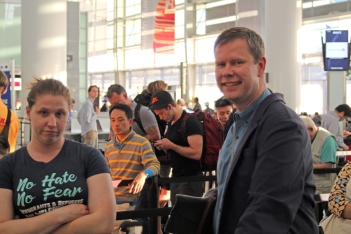
Alicia and Mike, fellow teachers going to Indonesia. We are stuck in a stationary line at the customer service desk waiting for alternate flights when our flight to Japan was canceled.

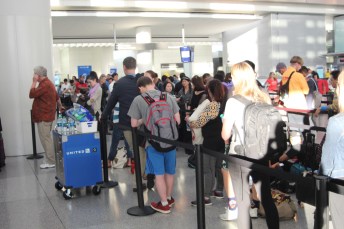
We walked to the customer service desk, which was outside of security, and found ourselves in the same sort of extremely slow line I’d experienced two years ago. Canceling a flight isn’t an uncommon problem, so it surprises me that it takes the agents over ten minutes to handle each customer given all flights are available online now. I know getting luggage off of one plane and onto another is also a challenge, but there should be a better system. The agent didn’t seem to know exactly what to do and had to call several people. They need more training and faster systems. Here you have customers that have already been inconvenienced (a euphemism if there ever was one) and are already upset. Then you make them wait an hour in a line that doesn’t seem to be moving (the first class passengers were done before we even got moving forward). It’s not a great way to insure repeat business. They could at least have pulled more agents up to use all of the available kiosks. But no. While waiting in the slow lane, I found an outlet near the front kiosk and charged up my computer partially again.

THe slow line

United did provide us with drinks and snacks while we waited in the slow line for alternate flights. We are almost to the front after 45 minutes.

We finally got to the front and they found an alternate flight to Jakarta through Sydney, Australia, leaving later that night at 10:50. They checked our baggage claim tickets to make sure our luggage would be transferred to the new flight and issued new boarding passes. Our final leg from Sydney to Jakarta would be with Delta airlines through Garuda air, so we got a voucher for that flight but would need to get boarding passes at the gate in Sydney. They also gave us $20 in meal vouchers.

I tried all day to keep a calm perspective and positive attitude to all of this. At least we didn’t have to go to a hotel and get up early, recheck our bags, and go through security early in the morning. This way we had about two and a half hours before we needed to board and could get a meal in the airport. And I get to see Australia from the air as we fly over it tomorrow. I am trying to develop a kind of Zen attitude about travel. We’ll get there eventually, and this way, we’ve got another interesting story to tell. But I will not willingly travel on United Airlines ever again. Enough is enough.

Salt Lake skyline

The Salt Lake City skyline as seen from the airport, July 13, 2017.

Here I go on another adventure – I’m heading west, then south, on my way to Jakarta, Indonesia. I’ve been chosen for the Teachers for Global Classrooms (TGC) program sponsored by the U. S. State Department’s Bureau of Education and Cultural Affairs. About 75 teachers out of 500 applicants were selected to travel to six countries: Indonesia, Senegal, Morocco, India, Columbia, and the Philippines. It is a teacher exchange program, in that teachers from developing countries are chosen to study English and education theory at colleges in the U.S. for up to one semester or five months, then return to their own schools to act as hosts for two American teachers.

I will be working with Muhammad Nazaruddin, who teaches English at SMA Negeri 1 Mandastana, or Mandastana Public High School # 1. This school is located in southern Kalimantan, the Indonesian part of Borneo, near the city of Banjarmasin. I am also working with Craig Hendricks of Indianapolis who teaches six grade STEM classes. We’ll be observing classes, teaching of American culture and STEM related lessons, and conducting a professional development session on technology integration for teachers from throughout southern Borneo. While in Kalimantan, we’ll get to see batik making, visit an actual diamond mine (wohoo!), see an island sanctuary for proboscis monkeys, visit the famous floating markets, and get to know a part of the world I never dreamed I would ever see. Me? This guy from a Podunk town in western Utah get to visit the rain forest and wilds of Borneo? No way! Yet, here I go.

I’ve been preparing for this for over a year now, what with taking an online course, having medical exams, attending a symposium in Washington, D.C., packing and repacking, getting a passport renewal and visa, etc. Yesterday (Wednesday, July 12, 2017) I spent at the gym to work my legs out, as they tend to swell up when I travel. I took Jonathan and William to swimming lessons, got some brochures from the Utah Valley Visitors Bureau down at the convention center to give to students in Mandastana, bought last minute supplies, packed, cooked baked ziti for supper and egg/sausage muffins for breakfast, watched the Season 10 premiere of Smallville with Becca, sent the receipts for the STEM Action Center grant, charged up all my devices, got the Kindle up and running, gassed up the car, dropped off The Year of Living Dangerously  and an Indonesia travel video at the library, and prepared in every way I could think of. I am as ready for this as I can be.

I got to bed at 2:30 and had to get up this morning at 4:15 to make my flight. We got the boys up and into the car in their pajamas and left home at 5:30. Becca drove me to the airport as a pink to orange sunrise lightened over the Wasatch Mountains. She dropped me off at United Airlines at Terminal 1. I waited through the lines and got my bags checked and my boarding passes. Security was busy but fast, although they had to pat me down and look over my laptop thoroughly. Given the recent ban on laptops coming in to the Unites States, I’m relieved that I made it through so easily.

I arrived at Gate B9 with an hour to spare before boarding, so I worked on cleaning up photos of our recent trip to Four Corners for my presentation in Borneo, until I realized that I was late boarding the plane – but they hadn’t started to board yet. So I looked at the status board above the gate counter and it said the flight was delayed for “air traffic control” issues in San Francisco. It was supposed to depart at 8:15 but was delayed until 9:38. I had a three-hour layover so I was still good. I went back to cleaning up photos. Then I saw that the board now read that our departure would be at 10:05. I asked the gate agent if there would be a problem and she said I should still be fine, because the international terminal was “just around the corner” from our incoming gate, and I’ll have about 45 minutes to reach my flight to Narita, Japan, before it departs. She said they would look after me, but this is United Airlines and I’ve had problems with them before (I will eventually post about my trip to Omaha). I would have chosen a different airline, perhaps Singapore Air, to take me to Jakarta. But since this is a U. S. State Department program, we have to fly under the regulations of the Fly America Act and use an American carrier.

Boarding flight from SLC

Boarding our flight to San Francisco.

At about 9:00 it was announced that we had a window of opportunity to reach SFO through a lull in air control, so we quickly boarded the plane and got our seats for a 9:25 departure. I’m all for seizing an opportunity when we get it. We taxied out and took off, and I hoped to myself this would be the only glitch in my journey. If only. Little did I know that worse was yet to come.

I sat by Stan Jensen from Castledale. He’s traveling to the Bay Area to see his grandson in a baseball tournament. He knows Duane Merrill well – they even coached little league baseball together. This world keeps getting smaller. While boarding the plane, I spoke with two different families who were Chinese and was surprised that my Mandarin was understandable at all. One family was from the mainland and heading back to BeiJing. The other was from Taipei in Taiwan who now live and work in America. They are on a vacation to ShangHai. Things have changed in the 36 years since I lived in southern Taiwan, when there were no relations between the mainland and Taiwan and no one traveled between them. Now relations are almost normalized.

I took some time on the flight to start my notebook/journal from which I have taken these notes. As I thought of the title for this post, it occurred to me that I’ve been fortunate with the opportunities I’ve had as a science teacher. I’ve kept my ears open to hear about these programs, and I’ve been even more fortunate to be selected for quite a few of them. Other opportunities will come, if I can only open up the windows to find them.

When other teachers ask how I’ve managed to do all of these things, I’ve responded, “Because I applied for them.” That seams to be a flippant answer, but what I mean from it is that I’ve looked for opportunities consistently and opened the windows by applying and re-applying if necessary. I’ve made my own fortune, so to speak, and haven’t given up if something is important enough. It took applying four times, once per year, to finally get accepted as the Educator Facilitator for the NASA Explorer Schools program, and so many other opportunities have come because I refused to let that particular window close. Success breeds success, and participating in the TGC program will undoubtedly lead to further opportunities later on. So as I finish the first leg of a grand adventure, I know great things still lie ahead, in Indonesia and beyond, even if I don’t yet know what they will be.