Feeds:
Posts
Comments

Archive for September, 2017

Jakarta Day 5: Wednesday, July 19, 2017

National Monument

The Indonesian National Monument in Jakarta

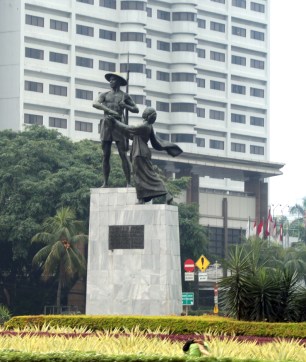
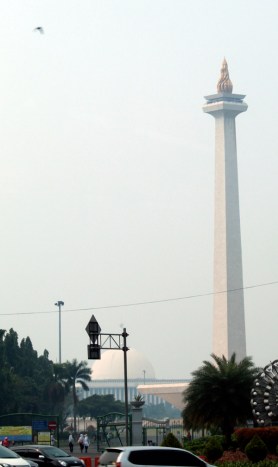
On our way to the U.S. Consulate in Jakarta we finally left the area of “loop” we’d been stuck in all day and headed toward the more modern section of Jakarta’s downtown. We passed several monuments, including a statue of a well-muscled man in a rice farmer’s hat with his wife holding a dish by his side. We also passed the National Monument – a pillar with a golden flame at the top.

We are in the process of building a new embassy in Jakarta, which will be ready by April, but for now rent out space in a building. We had to pass through two layers of security to get into the high rise and be ushered up an elevator and onto the floor where our briefing would take place. We had to surrender our passports and were given badges, similar to what we did the day before at AMINEF.

We were given two briefings, with the session led by Bill Little, Regional English Language Officer. The first was medical, and Dr. Barca explained all the possible ways we could get sick and how to avoid them. It basically boiled down to these suggestions: don’t eat the food, don’t drink the water, don’t breathe the air, and don’t touch the animals. By that, I mean don’t eat food from a roadside cart or any place we can’t verify it was prepared with hygienic methods, drink only bottled drinks and no ice, wear face masks in cities if we have allergies or asthma, and don’t touch the animals because they can have rabies or fleas (Black Death, anyone?) or other diseases.

Statue

Statue in the center of a traffic circle on our way to the U.S. Consulate in Jakarta.

Then we had a security/safety briefing by Dave Skall, the Regional Security Officer, which seemed a bit late since we had already been in the country for several days. He told us about some of the security threats. As a Muslim nation, Indonesia does have some terrorist activity. There was a bombing of a Starbucks in Jakarta in January 2016 that left seven dead including four terrorists. There have been bombings of hotels in Jakarta and nightclubs in Bali over the last 15 years that have killed over 200 people, and the threat level in Indonesia is considered high. But most attacks are targets of opportunity, where foreigners have been alone or not aware of their surroundings and have walked into dangerous situations. With a little common sense, we should be all right. We just have to learn how to be less of a target. He said trauma care is spotty here, so don’t ride a Gojek and don’t fall into an active volcano. Official protests of the government are common, so we should simply stay clear of them as moods can shift suddenly.

Bill finished up by saying that he’s been here over six months and hasn’t had any problems with ice, but we should be careful anyway. He spoke of his role as the consular representative for English learning exchange programs, and gave us Embassy bags with materials and flash drives of his programs to give to our host teachers. I asked if we could all get an Embassy bag, and he went and found some to give to each of us. Cool!

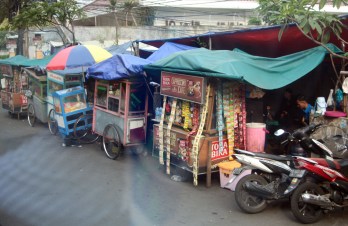
Snack carts

Hand carts for selling food in Jarkarta, Indonesia.

After going back through security and getting back our passports, we stood outside the annex’s front gate and waited a few minutes for our bus as clouds rolled in and it began to drizzle. It was threatening rain all the way back to our hotel.

With the possibility of rain, I didn’t want to venture out to find supper but was hungry enough that just eating snacks in my room wouldn’t be enough. After resting, I went back down to the lobby at 6:00 and met with several other teachers to eat at the Lebanese restaurant in the hotel. I had beef shish kabob and red lentil soup, both of which were delicious. It was the best lentil soup I’ve ever had. Several of our group are vegan or have severe allergies, so they had to ask quite a few questions of the waiters to make sure the food would be OK. It would be a challenge to travel to a foreign country with such food restrictions, and my hat is off to anyone who is brave enough to try. It takes quite a commitment to question all ingredients to make certain they are cooked correctly. I should be more careful eating all the pastries at the hotel’s buffet, since I am a Type II diabetic, but at least I don’t have to eliminate all starches and sugars, simply try to limit them as best as I can, and it is usually easy to tell which foods to avoid.

Read Full Post »

Jakarta Day 5: Wednesday, July 19, 2017

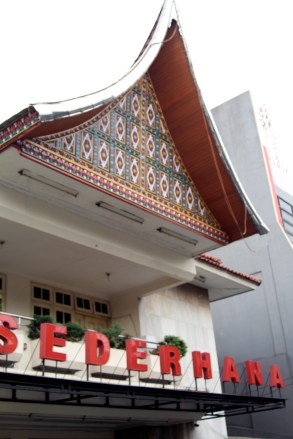
Sederhana restaurant exterior

Sederhana, a western Sumatra restaurant chain. We ate lunch there.

After our visit to SMAN 8 Jakarta, we boarded the bus and traveled to a western Sumatran restaurant. Along the way, we passed through several districts with businesses that seemed to specialize in one particular type of goods. There was the office supply district, selling office chairs and filing cabinets, among other things. There was the car repair district with shops and auto parts stores. And there was even a very small handicapped equipment district. I’m not sure what the advantage would be to congregate similar businesses in the same areas – perhaps it would be for customers, since if you know you need office supplies, then there is a particular area of the city where you go to find them. You don’t have to run around the whole city going from store to store. But I can’t figure out how this would be an advantage to the stores themselves. It would lead to increased competition and lower prices and less profits. Maybe concentrating customers more than makes up for increased competition.

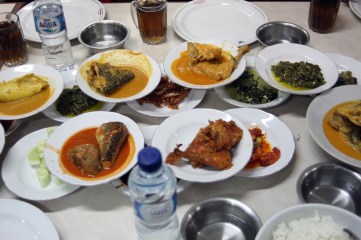
Sumatran food

West Sumatran food is served in a series of small bowls and you only pay for what you eat. Any unused dishes go back in the warming oven for other customers.

We wound up back on the same loop we were this morning, wondering if we would be eating at Wong Solo after all. Instead, we stopped at an interestingly designed restaurant I had noticed this morning, called Sederhana. It had the steeply pitched roof corners of west Sumatran architecture, and Dewi explained this was the style of food of her native area.

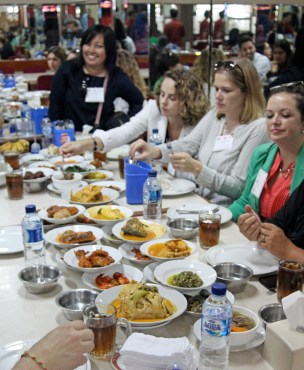
We managed to find a place where the bus could pull over enough for us to get out and walk in. We sat at two long tables as the waiters brought out a large assortment of small dishes, all with different types of food. The style of eating here is somewhat like a buffet, but all the dishes are brought to your table and you pick the ones you want to eat and pay for only those. The ones not touched will be stacked back under the heat lamps for the next customers. So it was important that we not pick little bits from many dishes – we had to eat all of one dish before starting another of the same food.

West Sumatran dishes

Close up of Sumatran dishes, ranging from sliced cucumber to spicy chicken and curried fish.

It was pretty spicy stuff, but delicious. There was chicken in various sauces ranging from spicy roasted chicken with sambal to chicken in curry sauce. There was tasty beef rendang, grilled fish, vegetables cooked in coconut milk, and many more. I tried a variety, and liked some more than others. I’m not a big fan of curry, but can eat it if I need to. We had drinks such as Stroberi Fanta or bottled water, some dessert-like dishes such as flan or gelatin, and many more. We passed things around and tried to finish all the dishes we started.

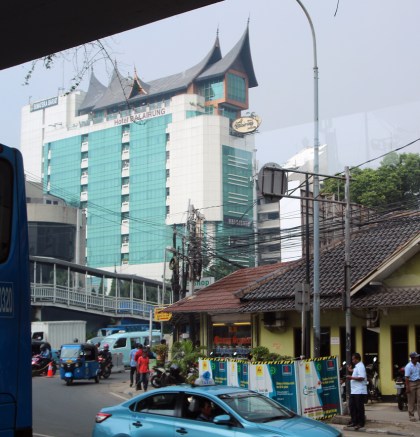
Bailarung Hotel

The Bailarung Hotel in Jakarta. The top floor is designed with traditional western Sumatran architecture.

The bus managed to park by the restaurant, so we boarded again and headed toward the new downtown area and U.S. Consulate for our next stop.

Read Full Post »

Jakarta Day 5: Wednesday, July 19, 2017

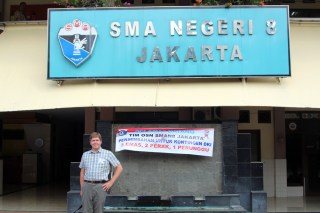
David by SMAN 8 sign

David Black standing by the sign for SMAN 8 Jakarta (Jakarta Public High School # 8).

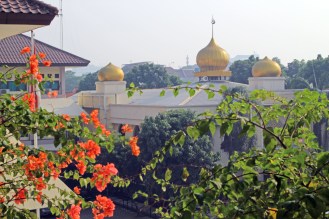
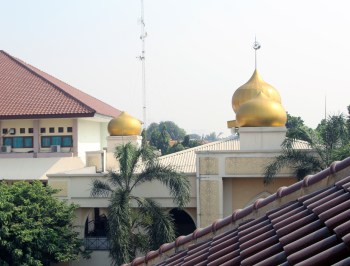
We had traveled through narrow, winding streets and across railroad tracks to get here, but once we arrived at SMAN 8 Jakarta, it was in a quiet neighborhood. This public high school is in a low-lying area of the city, and I was immediately impressed by the nice mosque that stood at the entrance to the school.

Although it is a regular public school, most schools in Indonesia have religious facilities such as a mosque or mushollah (prayer room) for students to use during prayer times and as part of their Islamic or Character studies classes. The United States places a strong value on separation of church and state, brought on by the persecutions of the Church of England or Lutherans against many religious groups (such as the Pilgrims, Quakers, and Puritans) who then came to America seeking religious freedom. It was built into the original Bill of Rights. But other countries don’t have such a value, and they establish state approved religions. Indonesia recognizes five religions officially, and in theory all are allowed to create religious facilities at school and hold religious classes. In some places, such as Bali and the Maluku Islands, Muslims are the minority. But in most of Indonesia, they form the majority religion with about 87-90% of the total population, such as in Jakarta. So there is a beautiful mosque with golden domes at the entrance to this public high school, and classes are arranged so that students can attend the noontime call to prayer.

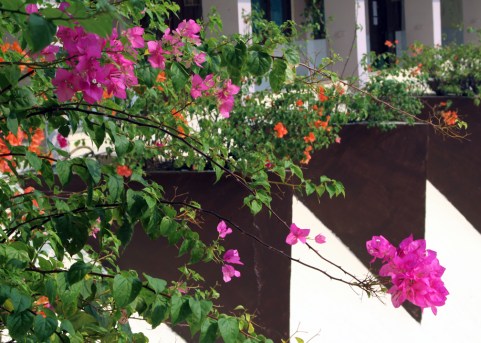
Mosque with bougainvillea

Bougainvillea and school mosque at SMAN 8 Jakarta.

This might seem strange to some Americans, who tend to think that the way we do things must be the only way to do things, but its not unusual in many countries. Being from Utah it is not strange to me. We have LDS Seminary available to Utah students; although the seminary buildings must not be on school property, they are usually adjacent or nearby the schools, and students are allowed to have “released time” periods to attend seminary classes. This time doesn’t count toward graduation requirements, so seminary students have less periods with which to meet those needs, but with only 22 credit hours required, it’s not hard.

School mosque

The school mosque at SMAN 8 Jakarta. Indonesia does not have the value of separation of church and state that Americans have. Religious education is a required part of their school curriculum.

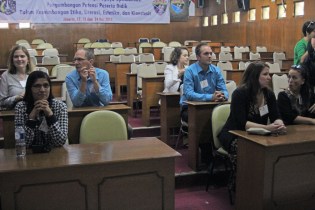
This school is considered a model high school in Jakarta and we could tell that they are much more accustomed to having visitors. There wasn’t a sign welcoming us, nor any great fuss about us. We were shown to an auditorium room and given snacks and water against the heat and waited awhile for the assistant principal to arrive. A teacher there who has been an ILEP alumnus greeted us and answered some questions while we waited. They had a nice Promethean board in the room, with a fancy computer control station to run it, and all the male teachers were looking it over as the female teachers discussed the dress code and daily operations of the female teachers who were there.

At SMAN 8 Jakarta

In the auditorium room at SMAN 8 Jakarta.

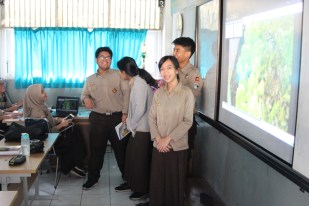
We were shown around the school, and went in to some of the classes. They had nicely colored bougainvillea growing in planters along the inner railing, and many trophy cases showing excellence in academic competitions, such as Science Olympiad. They have had students win all the way to the international competition, which is an amazing accomplishment. We watched a group of students presenting in a biology class, and other students asking excellent questions.

Biology presenters

Students presenting in a biology class at SMAN 8 Jakarta.

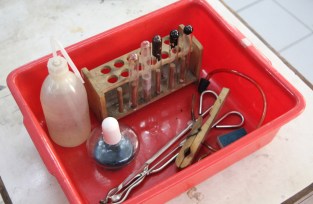
We saw a math class that Mike was especially interested in, since he is a calculus teacher. We talked with students in an English class, and I walked into the Kimia (chemistry) lab and saw the standard supply kit – alcohol lamp, a few beakers, a test tube rack, and a few test tubes. Not much, but at least here the equipment was well used. The biology lab room was well stocked with microscopes, models of various body parts, and even preserved specimens in jars. The computer lab was well equipped. We were shown the teacher preparation room, with more trophies, and I discovered that the word for teacher in Bahasa Indonesia is “guru.” Next to the Guru Room was the Guru Toilet. I had to take a photo. I think maybe I should insist that my students call me Guru.

Chem equipment

Lab station kit for the chemistry lab. Notice the well-used test tubes and alcohol burner. They don’t have much, but they use it to good advantage.

We walked to the principal’s office and were shown a plaque designating this school as one of the top schools in the country, an accomplishment that they were very proud of.

School philosophy

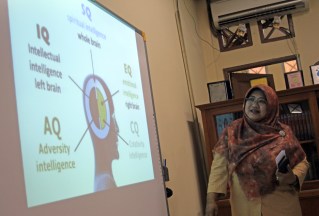
Five areas of intelligence according to the faculty of SMAN 8 Jakarta, an award-winning school in the city.

The assistant principal spoke to us about the school’s philosophy. SMAN 8 considers and builds its programs around five aspects of intelligence: Intellectual Intelligence (IQ), Spiritual Intelligence (SQ), Emotional Intelligence (EQ), Creativity Intelligence (CQ), and Adversity Intelligence (AQ) – what we are calling “grit” at American Academy of Innovation, or the ability to learn from failure and be persistent. Most schools in Indonesia consider only the first three, but this school believes that creativity and persistence are important things to teach to students. He said this is the main key to this school’s success.

Explaining school

We might not agree with how spirituality is one of the central values of Indonesian education, because we are so conditioned to see religion as completely separate from school. And yet it is not separate in the lives of our students or of the teachers in our school; it just isn’t talked about much. Back when I taught World Civilizations in California, I would teach about Buddhism, Hinduism, Daoism, Judaism, Zoroastrianism, and other religions as part of the culture and history of different civilizations and no one batted an eye. Yet when I talked about Christianity as an important aspect of western civilization, the students would start to protest that I shouldn’t be teaching religion in school. I had to point out that I had already been teaching about religions all year, and that you can’t understand the central motivations of a civilization without knowing about religions or the spiritual beliefs of its peoples.

Rest Makes Rusty

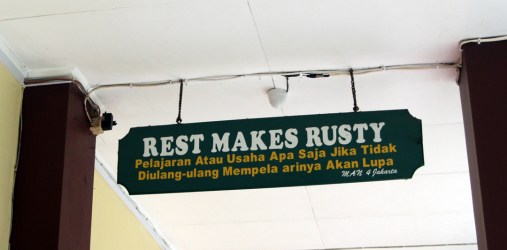
Indonesian schools all have signs hanging up with mottos and sayings in English and Indonesian. This one is at SMAN 8 Jakarta.

My own school, although it hasn’t put its values in exactly these terms, also believes that creativity and grit are important for our school. We are supposed to be reading Grit by Angela Duckworth over the summer, but I haven’t been able to find a copy in my local library yet. We’re also reading Creative Schools by Sir Ken Robinson, which I read last summer. His thesis is that the factory model of education that is so prevalent in most American schools is literally crushing the creativity out of students at a time when it is so needed in our country.

Trophies

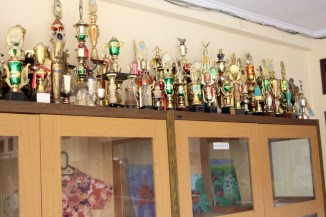
Just a few of the many awards and trophies at SMAN 8 Jakarta, and award-winning school in Indonesia.

If this is true, and SMAN 8 Jakarta is any indication of where Indonesian schools are headed, then we have much to worry about as we will soon be out competed by this rising country, the fourth largest country in the world.

Guru toilet

Gurus need toilets, too.

We walked out into the central courtyard and took some photos by the school sign, then walked to our pariwisata (tourist) bus, which was waiting for us.

Bougainvillea

Bougainvillea growing around the courtyard at SMAN 8 Jakarta.

Headmaster with group

Headmaster of SMAN 8 Jakarta with the Teachers for Global Classrooms group.

Read Full Post »

Jakarta Day 5: Wednesday, July 19, 2017

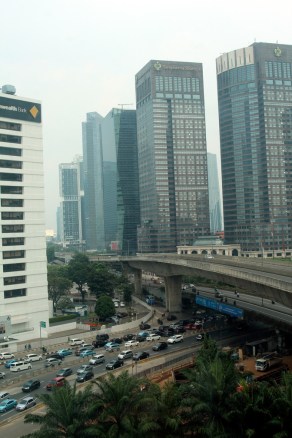
View from hotel

View from the Le Meridien Hotel looking down on traffic on Jalan Jend. Sudirman and Jalan Kh. Mas Mansyur. This is around noon and the traffic is rather light compared to normal.

As we were traveling today in our Whitehorse tourist bus, we had to make our way through some very narrow streets in a crowded area of Jakarta, and we got to see how Indonesian traffic works in great detail.

I’ve heard it said that Jakarta’s traffic is among the most snarled in the world, and I can see how it has that reputation. But I want to say at the outset that after over three weeks in Indonesia, and seeing all sorts of crazy driving and jammed streets, I never did see any accidents or dented cars or motorcycles or even people yelling at each other over traffic frustration. No road rage. So even though I don’t know how, it somehow works.

Directing traffic

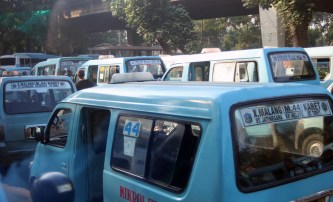
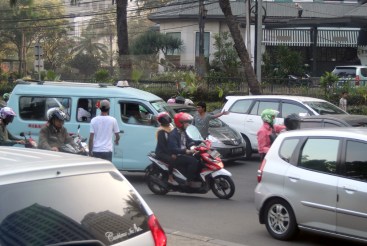
The man in grey is stepping out to direct traffic through a turn around opening. The light blue van by him is a bemo, or taxi van.

On our way to the public high school this morning, we had to travel for a distance in the opposite direction as the school in order to find a break in the wall between the lanes of traffic. You see, the two directions usually have some barrier between them inside towns or cities. This prevents head on collisions, but there are not very many lights at intersections (at least in Jakarta) so to go one direction, you sometimes have to travel the opposite way until you come to a break that allows you to do a U-turn and go back the way you need to.

Since there are no turn lanes, any cars or motorcycles, Gojeks, and bemos trying to do the same as you have to stop in the fast lane to make the turn, backing up traffic for blocks and also blocking the oncoming traffic. This would create hopeless bottlenecks except that volunteers step forward, sometimes wearing safety vests, to direct traffic through the U-turn breaks for a small fee. These volunteers actually make their living accepting the coins and bills that drivers hand them for their services. You see the same thing in parking lots where people need to back up and there isn’t much room – someone will step forward to help direct drivers and get small tips for their efforts. Drivers keep a pile of loose change for this purpose. The road systems in Jakarta seem oddly designed at first – this is partly because they drive on the left, so it always seems that things are backwards. The local streets are on ground level, and the faster expressways are elevated but have only limited access and egress points, so it can take some slow driving locally to get to an on-ramp to a toll road where traffic moves much faster.

Gojek drivers

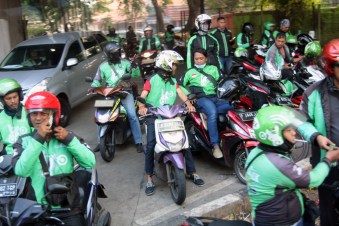
Gojek drivers waiting for fares. These are like Uber but on motorcycles.

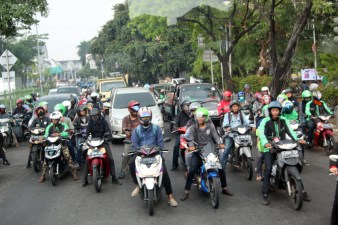
Everything is complicated by the large numbers of motorcycles. I saw no bicycles in Jakarta, but quite a few in other places in Indonesia. The motorcycle drivers are very bold and will squeeze through the smallest spaces, suddenly accelerating to get around slower cars and intertwining through all the other traffic. The roads have lane markers but they seem to be basically ignored as motorcycles weave across the lanes. A larger vehicle like our small tour bus has a hard time making it through all of this. I was certain I would see squished motorcyclists everywhere we went, but never saw even one accident or injury.

Blue bemos

Blue bemo vans, which are shared ride taxis with benches in back.

This would not work in the United States because we are not used to motorcycles. We don’t know how to look out for them or keep an eye out for their independent and unpredictable behavior. I remember living in Taiwan in the southern city of Kaohsiung, where there were several traffic circles. There were many motorcycles, Vespas carrying whole families, three-wheeled motorcarts, ox carts, overloaded bicycles, taxis, and assorted other vehicles. Throw in a couple of Mormon missionaries on oversized bicycles with ridiculous yellow signs and it was like Chinese roulette: let’s see who gets out alive! I had a few close calls and a sprained ankle or two, but somehow we survived. It is a different style of driving.

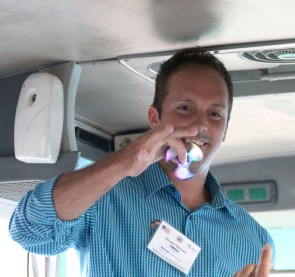
Doug with spinner

Doug with a fidget spinner he bought from a street vendor while we were stuck in traffic.

Jakarta doesn’t have much room for sidewalks. Businesses grow up along old roadways, but with more vehicles every year, the roadways need to be expanded leaving no room for sidewalks or much for parking in front of the businesses. Sometimes cars have to park in the slow lane to go into a business, causing more snarls. This is complicated by the many stalls and mobile carts along the sides of the roads selling food, souvenirs, toys, and everything else you can name from bakso to satay to nasi goreng. Drivers stop to buy their wares where there isn’t enough room for the food cart let alone a parked car or motorcycle. And wherever the traffic jams up, vendors jump into the snarls with bags of goodies on their heads to sell to the backed up drivers, everything from fidget spinners to newspapers to amplang fish crackers.

Moped mobility

Motorcycles are the most common type of vehicle. They weave in and out of traffic and basically ignore traffic lanes.

Wherever there is a little bit of room or a quiet corner, food carts congregate and men are parked playing chess or waiting for customers. Many of these are Gojek drivers, which is like Uber but on motorcycles. They wear bright green jackets, and they are much more common than taxis now. Getting around is much faster on a motorcycle since they are more maneuverable, so people prefer Gojeks to taxis. I think it would scare me to death, and we were told on no account to use their services.

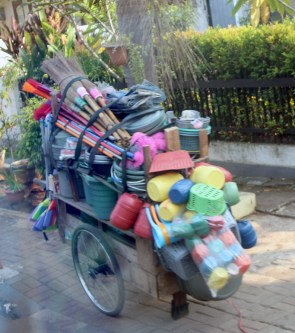
Loaded cart

A loaded hand cart full of house wares to sell. These carts add to the complexity of Jakarta’s traffic.

So on our way to the school this morning I tried photographing some of this and captured a few videos. My sense of direction is messed up, and I’ve never figured out which way we’re going or much of how we got there; I’m just glad someone else was driving all the time. I think we traveled about three-four miles in an hour. Maybe less.

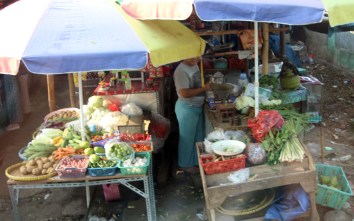
Marketplace

Vegetables for sale in an open market we passed through.

After we finally got onto the expressway, we traveled a few miles and exited back to the surface streets. The driver was trying to find the way to the school, and had to go around in a loop a few times until he found the narrow alley through which he squeezed the bus. Around the circuit we passed another school, a bunch of bemos parked awaiting customers, Gojek drivers hanging out, Gado Gado Boplo food joints, and a sign for a Wong Solo restaurant. It became a running joke: that Wong Solo must be Han Solo’s long lost brother.

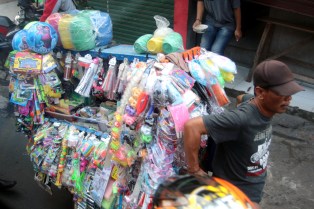
Trinket cart

A cart full of trinkets and toys to sell, being pulled by hand through the open market.

Once we found the alleyway we had to move slowly, because there was not room for a bus and a car to both squeeze through except in a few spots. We passed an area of an open market, a few neighborhood mosques, and then entered a slightly larger road that twisted its way until we crossed some railroad tracks and found the entrance to the school. We exited the bus and walked down a side street a short distance and entered the school itself.

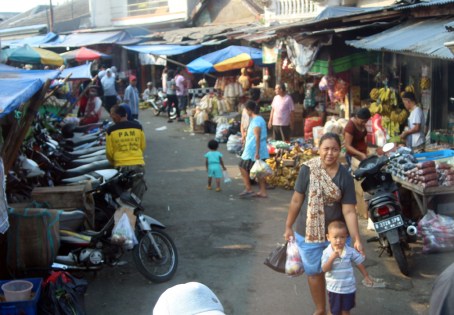
Open market

Open air market. All the motorcycles parking here on these narrow streets with stalls selling food makes for a bottle neck every morning.

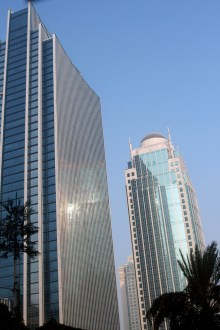
Early morning architecture

High rise buildings are becoming more common in Jakarta, but they don’t always have adequate parking planned with them and therefore add to the problem. Jakarta has no room to grow sideways inside the city, so it has to grow up.

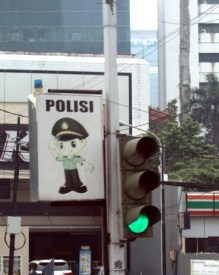
Cartoon cop

There are occasional clashes between the police (polisi) and citizens in Indonesia, and the people don’t have much confidence in their police, because of bribery, kickbacks, protection rackets and other factors. One of those factors could be that they represent themselves as cartoons.

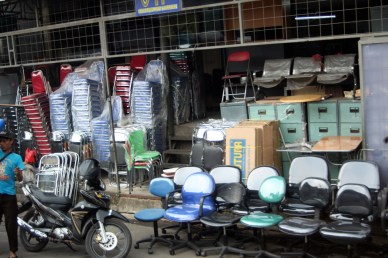
Office supply district

Businesses tend to cluster in districts. This is a shop in the office furniture district.

Read Full Post »

Jakarta Day 4: Tuesday, July 18, 2017

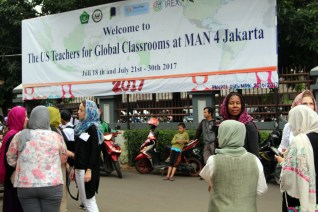
Banner at school

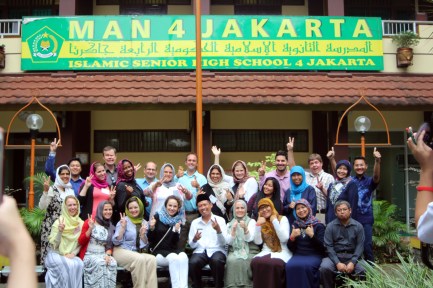
A banner welcoming us to MAN 4 Jakarta, a madrasah (Islamic) high school on the outskirts of the city.

After returning to the hotel, we had an hour’s break to freshen up then we boarded the bus on our way to our first school visit. This is the school of Novianti, our Jakarta consultant, who will be the host teacher for Mike and Ursula. It is called MAN 4 Jakarta (Madrasah Aliyah Negeri) and is an Islamic or madrasah school on the outskirts of Jakarta. It took us about 45 minutes of travel through local streets and expressways to get there, and the bus pulled in to a slightly muddy open field next to the school that served as a parking lot. We exited the bus, and discovered a large banner unfurled at the entrance to the school in our honor.

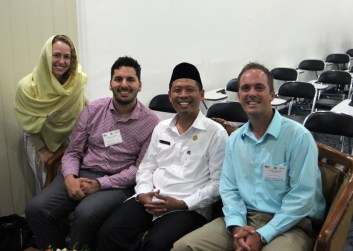
Nikki-Matt-Doug with Headmaster

Nikki, Matt, and Doug with the headmaster at MAN 4 Jakarta.

We were met by the headmaster (principal), who walked us through the school to a small auditorium room (but all on one level) with a low stage at the front. On the way there we passed through two inner courtyards with plants, flowers, and vegetables growing. It was quite a beautiful setting. This school (and most others we saw) is built with an inner courtyard with several levels (lantai) that have walkways rimming the central court that enter into classrooms arranged on the outside, the entire building in a U shape, or in this case, a double-U shape.

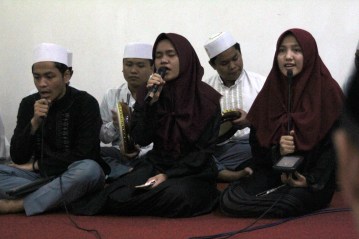
Singers

High school singing group with traditional instruments.

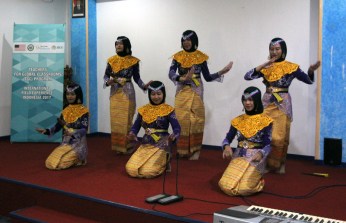
The headmaster said a few remarks, and Sarah presented him with a certificate. The school had chosen two students with good English (they probably had a contest to determine this) as the Masters of Ceremony, and they announced the program. A group of girls in costume danced a traditional dance, students sang songs with percussion instruments, and a boy and girl sang with guitar and electric piano. They had practiced a long time. After the program, we had a question and answer session where the students prepared questions and read them to us in English, and teachers volunteered to answer. Most of them were fairly expected, except the one about what we think of President Trump. Mariya, the Director of ILEP, gave a carefully neutral, politically correct answer to that one.

Dancers 2

A traditional dance done by the students of MAN 4 Jakarta.

While the program was going on, they fed us snacks and plastic cups covered in plastic film with water in them. After the program, the students had prepared a meal at the back of the room. It was bakso, a kind of meatball soup. The meatballs can be either beef or chicken, and they are boiled and served with broth, rice noodles, green onions, and other ingredients. Often some sambal sauce is added to give it an extra kick, but the soup is tasty enough without it. It was very good, and has become one of my favorite foods in Indonesia. When Pres. Obama visited Indonesia, he was asked what his favorite food was and he replied, “Bakso!”

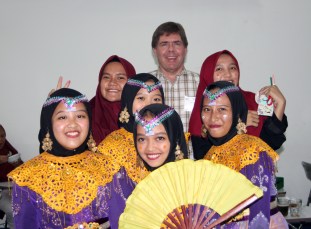
David with dancers

David Black posing with the dancers after the program.

After the program we talked with the students and took photos. One student asked me questions about this blog site (elementsunearthed.com) and our STEAM it Up dye labs. The students here are certainly well prepared, if they are reading our blogs to get ready for our visit. After saying goodbye to the students, we were shown around the school and then walked back to the bus. After boarding, we drove back to the hotel. I have to say, I was very impressed with the warm welcome and student preparation for our visit. It was a fun trip, and I am looking forward even more to teaching in Kalimantan next week.

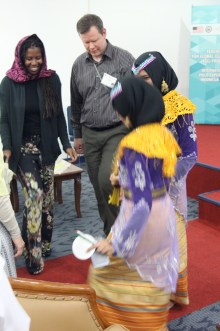
Ursula and Mike learn dancing

Ursula and Mike learn some dance steps. This was to be their host school next week.

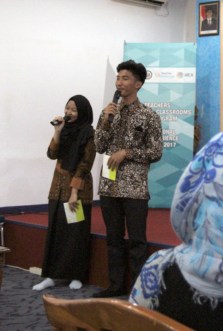
Masters of Ceremony

Two students chosen to be the Masters of Ceremony.

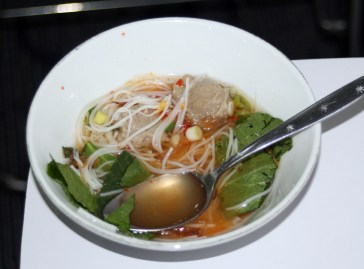
Bakso

Bakso soup, made from beef meatballs, spinach, noodles, green onions, etc. I added some red sambal sauce, which gave it quite a kick. Very tasty!

Casual group shot

Freestyle shot of the Teachers for Global Classrooms group with the headmaster and teachers of MAN 4 Jakarta, a madrasah high school.

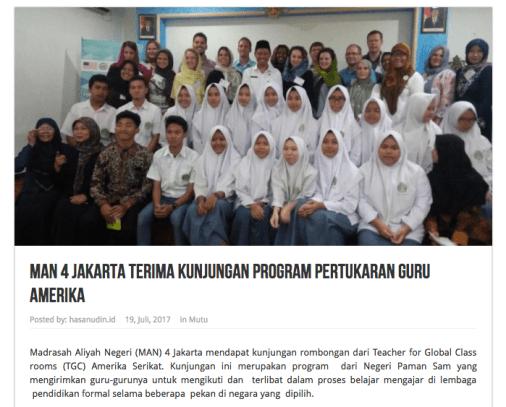
MAN 4 Jakarta article

Official photo of our visit on the MAN 4 Jakarta website. The students shown here were part of a question and answer session we held as part of the program. I like that we are referred to as American gurus (their word for teacher).

Read Full Post »

Jakarta Day 4: Tuesday, July 18, 2017

AMINEF logo

Logo for AMINEF (the AMerican INdonesian Exchange Foundation), which administers the Fulbright Scholars program, among others.

After breakfast we met in the lobby and walked to a nearby building. We provided our passports and received IDs to go through the building’s security, then took the elevators up to the 11th floor where AMINEF is located.

AMINEF stands for the AMerican INdonesian Exchange Foundation, and they are the ones that manage and provide training and in-country assistance for the Fulbright Scholars program, ILEP, scholars in residence, post-doctoral research scholars, as well as other opportunities such as a program for U.S. college students to come to Indonesia to teach English for a year called the English Teaching Assistants program.

We met in a classroom with desks, and the discussion was led by Jerry Chamberlain, the Acting Director. He said that approximately 80 scholars come to Indonesia to do research in any one year, 20 ETAs teach in schools, etc. Indonesians traveling to the States to teach Bahasa Indonesia in colleges also coordinate through AMINEF.

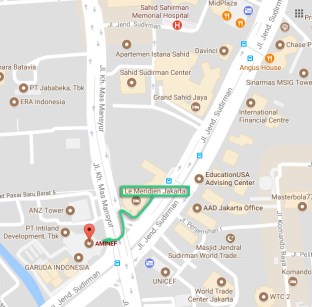
Le Meridien and AMINEF map

AMINEF was close to the Le Meridien Hotel. We only had to walk out to the nearby side street, along the sidewalk a short distance, then under the overpass to the Intiland tower.

Several of the ETAs and program assistants (Adeline, Shelby, Mike and Astrid) were there to answer questions about their experiences and observations of Indonesian schools. They have had a challenge getting enough U.S. student applicants to fill the need, and asked us to refer anyone we know who might be qualified. They are looking for recent college graduates with English teaching experience. Mike is here to help with the program for a second year, after teaching English in a local vocational school last year. The school was 80% boys, and he only saw each class once per week in one 90-minute class. The core subjects meet twice per week. He said it was hard to build relationships that way. Shelby taught in southwestern Sulawesi.

They provided some insight into what we could expect as we went to our host schools. Teachers have a central room for preparation, but not much gets done as it is more for socializing (sounds like most teacher lounges I’ve seen). Group and hands-on projects are rare, and the most usual method of teaching is lecture and note taking.

They said the most frustrating things about teaching in Indonesia were the frequent holidays that we don’t have the cultural background to anticipate (they celebrate the holidays of all the major religions here) and that teachers sometimes don’t show up for classes for various reasons. Students are expected to work quietly until the teacher arrives. Sometimes school is cancelled for local celebrations which aren’t on the calendar, so we need to be flexible.

Some of the good points of teaching in Indonesia are that students give instant respect to teachers, and that teaching is an honored profession here. Students are always prepared with notebooks and pens/pencils. Although there are religious differences and divisions, most people work for coexistence and there isn’t much in the way of ethnic strife.

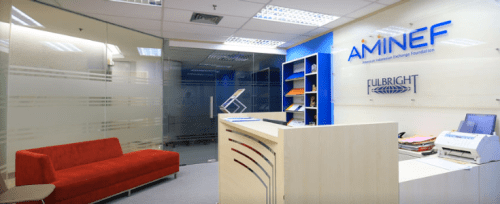
AMINEF lobby

The lobby and front desk of AMINEF in Jakarta.

Mariya concluded our discussion by describing more the history of TGC and its growth. They have only moved to accepting elementary teachers in the last two years. All of these programs are ran under the U.S. State Department through third party organizations such as IREX or AMINEF, and are dependent on national priorities. TGC is one of the few programs that focuses on secondary education and building experience and capacity for global competency in U.S. teachers.

They fed us a boxed lunch of ayam goreng (fried chicken) while we talked with the students. We took group photos in the AMINEF lobby, then said our thank-yous and took the elevator back down to the lobby. We got our passports back and walked back to our hotel.

Read Full Post »

Jakarta Day 3: Monday, July 17, 2017

Leko restaurant

The restaurant we ate at in the Grand Mall.

In the evening on my third day in Jakarta, Indonesia, we traveled back to the Grand Mall of Jakarta to eat supper at an Indonesian restaurant called Léko. Dewi, our in-country representative, knew the owners (a former student of hers, I believe) and ordered a variety of Indonesian dishes and drinks for us to try. They ranged from savory beef ribs to extremely spicy chicken with a hot sambal sauce. One of my favorites was a grilled fish – it wasn’t too spicy and was very tasty, especially the skin.

Waiting for bus by hotel

Our group, waiting for the bus outside the hotel.

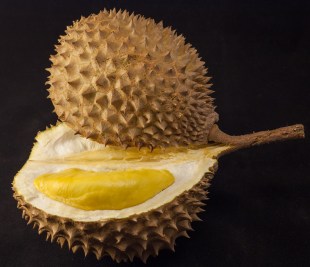
I asked Dewi if the durian fruit smoothie was good and she said I had to try it, as did two other teachers sitting with me. Durian is considered the “king of fruits” in southeast Asia, and grows up to 30 cm long and can weigh up to 3 kg. Its name derives from the spiky protuberances that grow on the husk.

Durian_in_black

Inside the durian fruit

What I didn’t know is that people have differing reactions to the smell and taste of the fruit. Some people find it has a pleasant aroma. Others find that it smells of rotten onions, body odor, or other worse things. It is known to attract flies. It is banned from some hotels and businesses. I tried it and found it interesting at first, then it got stronger and more unpleasant the further down I sipped. It tasted to me like three-week old unwashed repeatedly used gym socks. Not that I’ve ever tasted gym socks, but you know what I mean.

I tried another teacher’s cendol, which was OK – kind of a sweet green been mixed with coconut milk. The lychee smoothie (sometimes spelled litchie or lici in Bahasa Indonesia) was good but sweet. But I couldn’t finish the durian fruit smoothie, and after the meal, the taste lingered; every time I burped or hiccupped, there it was again.

Durian fruit

Es durian, or ice durian. Not something I’m going to try.  It even smells bad just to walk past it. Now, if it was passion fruit slush, I’d be all over it, sketchy ice or not.

I’m not here to eat only American foods and drink American drinks. I’m here to experience Indonesian culture and to learn. An adventure of this sort requires the willingness to try new things, knowing that sometimes the result can be unpleasant. I know I won’t like everything I try. But so far I’ve enjoyed the food and loved the drinks. Now I know I’m one of those people that have a bad reaction to durian fruit. Sometimes knowledge comes at a price.

After dinner we had an hour for shopping. I’m not much of a shopper, unless it’s for souvenirs or gifts, and all the shops I saw here were decidedly Western. Even the posters and mannequins were of Americans or Europeans and the prices expensive. So I watched the people, trying to see if I could understand why this mall was so popular. I noticed that not many Indonesians had bags for purchases – oh, some had smaller items they had bought, but nothing really big or expensive. The downstairs grocery stores selling western food items and the restaurants seemed busy, but there didn’t seem to be as much purchasing as one would see in an American mall.

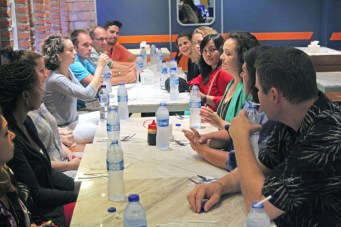
Group at Leko

The group of us at the Leko restaurant.

So do the Indonesians come here to be seen and hang out? Certainly to an extent – they were dressed much more nicely than most Americans would be at a shopping mall. But to my eyes there was something more than merely hanging out. What could be the purpose of building such a monument to Western styles and products?


I asked Dewi and was expecting something profound, something that would give me insight into the Indonesian soul. But I found it was for the same reason many Americans go to a mall: they like to window shop. In other words, they like to see the products and imagine what it would be like to have them; they visualize a future time when they can afford them. They’re just like us in this respect. Although I’ve never understood the attraction of shopping without buying (since I’m of the “I came, I saw, I bought, I left” – mentality – a real Veni, Vidi, Vici type of person), it speaks to my central research question that there is fundamentally no difference between the types of aspirations Indonesians and Americans have, and how the shopping mall is an expression of an ideal of what our lives can be like. The Western dominated media seen around the world has imposed our vision of the good life on Indonesians as well as Americans. I just hope that Indonesia doesn’t lose what is uniquely good about itself in the quest to become like the rest of the world.

Ancient and modern

A western Sumatran style of architecture. Notice the many tangled electric lines. It’s like this throughout the city.

As a final note to the day, I thought about how some societies have built walls to keep others out, be they the Great Wall of China or the border patrols of the United States or the demilitarized zone between North and South Korea or unspoken rules that keep some types of people out of sight. Some walls, such as immigration restrictions and tariffs, are social instead of physical. Some are based on the fear of others and their “foreign ways.” This shopping mall represents the opposite; a kind of homogeneity of styles and cultures. There were many women dressed in western fashions, others wearing hijabs or even full burkhas, but all acting and shopping and laughing just like any crowd in a shopping mall in the United States. We can build walls of fashion or laws or customs and try to hide away from others, or hide others away from us, but we are more alike than not, more similar in beliefs and aspirations than we realize. I do not feel like a stranger or a foreigner here. I may not yet speak the language well, but I am learning and I feel a part of a common humanity in this city half way around the world.

Feed a man a fish

Feed a man a fish, and you feed him for a day.

Read Full Post »

Jakarta Day 3: Monday, July 17, 2017

Global Ed imageOn Monday we spent most of the day at the hotel learning about the Indonesian Education system. I’ll provide a summary of what we learned in this post.

We began in the conference room with Mariya, the director of ILEP (International Leaders in Education Program), which is the mirror program to Teachers for Global Classrooms. Teachers from 15 or so developing countries apply and are accepted to the program each year. The U.S. State Department pays their way to the United States for five months to attend universities, learn English, and take education pedagogy classes. These then return to their home countries and become our host teachers once there are enough in a country to support an entire cohort of 12-16 teachers.

Indonesia’s education system is definitely a top-down hierarchical structure, beginning with President Widodo at the top, then overseen by the Minister of Education, Muhadjir Effendi, and the Minister of Research, Technology, and Higher Education, Muhammad Nasir, for public secular schools (about 84% of the total). From there, it is directed by the provincial governors. There are 12 years of compulsory education: six years of primary school, three years of junior high, and three years of senior high, which can be in an academic or a vocational school.
Jakarta skyline

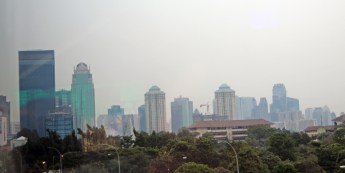
A smoggy day in Jakarta.

There are two parallel systems of schools in Indonesia. The first is the regular public schools, or negeri schools, such as the SDN or Sekolah Dasar Negeri (primary schools); the SMPN or Sekolah Menengah Pertama Negari (school medium first public, or junior high schools); and the SMAN or Sekolah Menengah Atas Negeri (school medium upper public, or senior high schools). The second system is the madrasah, or religious schools (usually Islamic). These are also supported by government funds under the Ministry of Religious Affairs. At the high school level, for interested students or for students that don’t pass the mandatory senior high academic entrance exams, there are vocational schools teaching technology, engineering, art, crafts, hotel management or hospitality, tourism, IT, agriculture, forestry, cooking, legal clerking, and other fields. These schools are called SMK schools, or Sekolah Menengah Kejuruan.

There are some private schools and some students are home-schooled. Private schools charge fees and tuition and usually have better facilities, such as more labs, Internet access, lower class sizes, and air conditioning. Trust me, air conditioning is a major plus. About 7% of the population attends private schools.
Panelists

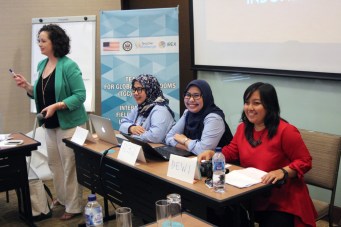
Sarah Sever with panelists. Dewi is on the right in red.

Students with special needs are not mainstreamed in the pubic schools but attend a Sekolah Luar Biasa or Extraordinary School. These are usually boarding schools and costly, so must students with special needs are simply not educated. When I asked about this, the common answer is that teachers/schools lacked the facilities or training to handle such students or that it would cost too much to make regular schools accessible or to provide accommodations.

No training is provided for special education, and the disabled are not often seen in public. During all my time in Indonesia, I saw one man in a wheelchair without legs (he was at a restaurant parking lot asking for handouts – this was the only begging I saw in the country, and he was treated with respect, not as a beggar), and one child with Down Syndrome in a shopping mall being led by his mother. No one else. Surely there are more people with disabilities. It seems they are out of sight and out of mind. As the father of a child with Down Syndrome, I hope this changes for them. Mainstreaming is good for disabled students and regular students as well, but it took an act of congress and a great deal of commitment for it to happen here.

Teacher training is provided through various universities across Indonesia, and some programs have laboratory schools (such as the school we were to see on Thursday). All teachers are employees of the government and have comparable salaries across all provinces, which can be an issue as it therefore becomes difficult to attract teachers to some of the more remote provinces such as Papua New Guinea. Teachers can request to teach in their home provinces, but they are ultimately assigned by the central government.
Group with panelists

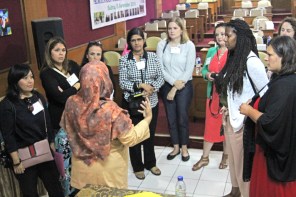
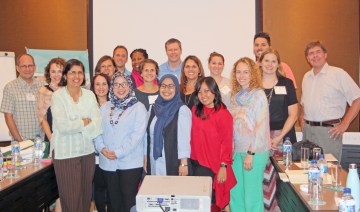
Indonesia cohort of teachers with the Teachers for Global Classrooms program in Indonesia with our panelists.

Education standards and curriculum are determined centrally by the government and leave very little room for local interpretation. Textbooks are centrally decided and provided, as are lab supplies such as beakers, alcohol burners, and chemicals. As I was to discover, this doesn’t mean they are used equally from school to school or that all teachers have sufficient professional development for doing hands-on labs. All teachers are required to provide a detailed syllabus with a complete breakdown of how many days and hours spent on each concept and an academic calendar with analysis of effective days, or days per subject/concept. They also must provide lesson plans for each day (some flexibility is allowed), and both syllabus and lessons are placed in binders in a central location in each school so that substitutes can access them. Teachers are also required to keep attendance lists, journals/notes on the effectiveness of their lessons, and student journals.

Day to day operations are somewhat different than American schools, as students basically stay put in a room and teachers move around, except in specialized classes such as science where students need the lab spaces and therefore move to them. The exact schedule each day was something I never quite figured out, as it seemed to be rather fluid from day to day. In general, a teacher was in a room for about 90 minutes divided into 45 minute sections. The overall calendar for the year is hard to figure out – I looked over the large one at SMAN 1 Mandastana and there were no-school days for Ramadan and Idul Fitri (post Ramadan feast days), Christmas Break, a break in the fall and spring, but also days blocked out for testing, etc. Since Ramadan progresses with the lunar phases each year, the school calendar has to make adjustments around it.
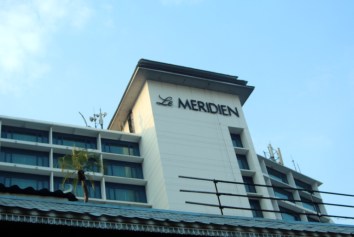
Le Meridien Hotel

The Le Meridien Hotel, where we held our training session today.

By the time students get to high school, they are either in an SMK school in a specific area of study or they are in an academic high school (SMAN) in one of three “major” tracks: sciences, social sciences, or languages. There are some general education courses, such as Islamic studies, that cross all majors, but the students specialize. Language students take classes in 3-4 different languages, including Bahasa Indonesia and English, if teachers are available. Science track students take Civics, Bahasa Indonesia, English, Math, Biology (Biologi), Chemistry (Kimia), Physics (Fisika), Economics, History, Sports, Art, and Local Studies. There is no earth science, geology, or astronomy taught in high school as separate classes, although concepts from these fields may be incorporated into other classes or be taught at the junior high level. I didn’t see any evidence of them being taught in high schools.

After lunch we had several educators at the college level provide a panel discussion. They spoke of some of the training and distribution challenges and how there are gaps in quality in various parts of Indonesia. Because of a government requirement that a school must have at least nine teachers, some small schools have a very high teacher to student ratio, whereas teachers in Jakarta can have 36-42 students in a class. Overall, Indonesia has a 1:15 ratio, one of the lowest in the world. In addition to inequalities in teacher quality and student ratios, leadership is an issue. School administrators typically are selected from the ranks of regular teachers without additional training. They are “teachers with extra tasks.”

But given all these issues, education is seen throughout Indonesia as a valuable and respected career path and teachers are treated as professionals. Parents generally trust teachers and don’t ask questions or challenge them (this can be both a good and a bad thing). Because teachers are relied on so much, most parents are not very involved and parent teacher organizations (PTAs and PTOs) are almost non-existent.
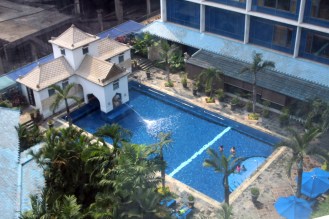
Hotel pool

The pool at the La Meridien Hotel. I never actually went swimming in it.

Indonesians seem open to making changes in their education system, as seen by the yearly tweaks made to the curriculum and course schedules, but because of a centralized hierarchy, change is slow. Certification programs to improve teacher qualifications are only about ten years old, and older teachers are still resisting. Decentralized education is beginning. Differentiation in salaries is starting to be used to draw teachers to remote provinces. Additional control over education is moving to the provinces, such as the now required local studies course, which is decided at the provincial level. Infrastructure improvements to old schools and outdated labs are a continuing challenge and always will be.

It will be interesting to see how things change here over the next ten years as Indonesia enters the ranks of the developed countries. It will be interesting to see how education in the United States changes over the next ten years as well. I hope to be a part of that change.

Read Full Post »
Jakarta Day 2: Sunday, July 16, 2017

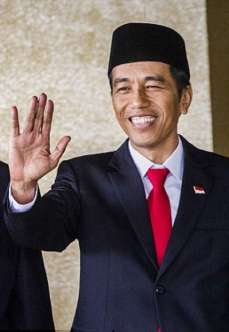
President-Joko-Widodo with hat

President Joko Widodo of Indonesia. I have to get me one of those hats!

After our batik class at the Museum Tekstil Jakarta, we boarded the Whitehorse bus and drove to the Grand Mall of Indonesia, the largest shopping mall in the country. I’ll talk in another post about my feelings about why shopping malls are popular here, but suffice it to say it is huge and contains many western style shops. It is divided into two large sections with a roadway passing between and walkways over the road. We got off the bus, went through a normal security checkpoint (very common here – all hotels have them when you enter) and went into the lobby of the East Mall.

We immediately ran into a large crowd gathered around someone near the far wall who was moving slowly along. Everyone had cell phones out and were trying to take photos. I asked a blonde American lady standing nearby who the person was, and she didn’t know. It must be some local celebrity, I thought, to gather such as crowd. Finally, an Indonesian person told me who it was: “Jokowi, Jokowi!”

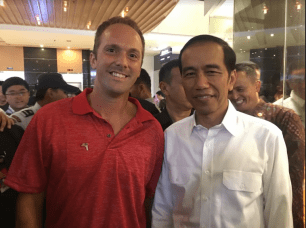
Doug with Pres

One of the TGC teachers, Doug, with President Joko Widodo of Indonesia.

It took a bit longer to realize that this is their nickname for Joko Widodo, the President of Indonesia. He had simply dropped by the mall to say hello and shake hands. No grand announcements or press event, no media circus unless you count countless cell-phone recordings, just a not-so-quick stroll through the mall to meet the people. Someone said he does this fairly often.

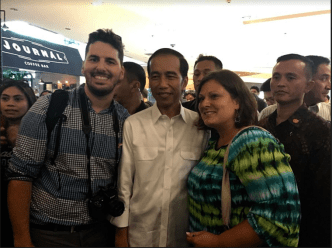
Matt and Jen with Pres

Matt and Jennifer with President Joko Widodo of Indonesia. I didn’t want to press my way into the crowd, so my own photos didn’t turn out very well.

This was amazing. Can you imagine Pres. Trump just dropping by a local shopping center to shake hands? Everything our president does is orchestrated months in advance with a team of Secret Security agents making arrangements for every detail long before. There can be no “dropping by” anywhere. This is the fourth most populous country in the world, after China, India, and the United States. Over 275 million people that he leads. And he only had a thin phalanx of security guards in black uniforms and a few mall cops (which must have been scared to death by the sudden responsibility). He was shaking hands and posing for selfies, working his way slowly around the ground floor and out the other side. The mall entrance had no more than the usual level of security check.

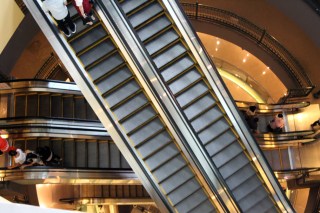
Escalator layers

Layers in the Grand Mall of Jakarta.

Several of our teachers seized the opportunity, and being larger than most Indonesians, managed to push their way forward through the crowd and even got their photos taken with Pres. Jokowi. It made Dewi very jealous. I am including the photos here.

We were supposed to get our own supper while at the mall. I used the money I borrowed from Nikki because I haven’t had the chance to change the U.S. cash that I brought. I carry it in the leg pouch that Gayla (my sister) loaned me. The exchange rate here is crazy – about 13,000 rupiah per U.S. dollar. That’s a lot of zeros. They went through a major devaluation and inflation period in the late 1990s, and it resulted in long-time president Soeharto stepping aside. This led, finally, to the democratic election of new presidents, of which Jokowi is the most recent. It will be a challenge to figure out the equivalent U.S. values of things and not have “sticker shock” when a drink of juice costs over 10,000 rupiah.

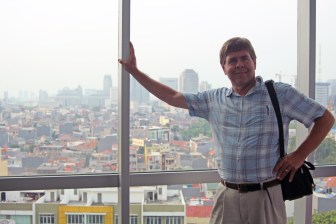
Me in mall

David Black at the top of the Grand Mall of Jakarta overlooking the city.

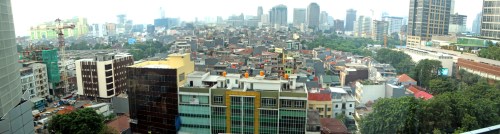
I bought some Minute Maid juice in a supermarket downstairs – I wasn’t hungry for supper. I wanted to see just how big this mall was, so I worked my way up to the top along with Jennifer and Matt. We found some windows looking out and a great view of part of Jakarta with colorful houses and tall buildings clustered in no apparent order or pattern. I took some panoramic shots. I am including one here, as well as photos looking down into the mall.

Jakarta panorama

A panorama of part of Jakarta from the top of the Grand Mall.

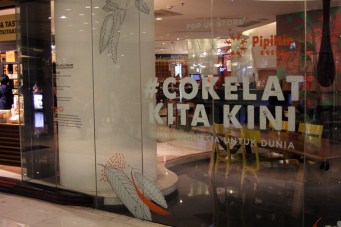
On the way back to the lobby, I stopped by a chocolate store to sample their products. They had nibs and other samples that were excellent, and claim to be a sustainable production. I hope to see cacao plantations and chocolate production on my five-day extension in Yogyakarta and Bali.

Cokelat store

Chocolate (cokelat) store in the Grand Mall of Jakarta.

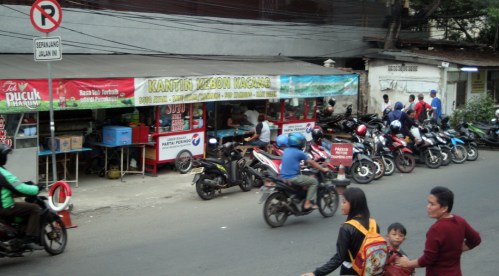
We gathered in the lobby and got back on the bus outside, then worked our way back to the hotel. On the way, I took photos of the bougainvillea with pink, magenta, purple, white, and salmon/orange blossoms along the road, some food stalls selling bakso (meatball soup), which was made famous by being a food that President Obama liked on his visit here, and the wild power lines stretched all over the place, an electrician’s nightmare. I thought of the infrastructure challenges facing a rapidly developing nation, and how Jokowi’s leadership and popularity are changing the face of Indonesia as it joins the ranks of major nations on Earth. I can certainly see why he is popular.

Food stands

Food stalls near the Grand Mall of Jakarta. You see these all over the city, including mobile food carts (like the one in the middle).

Outside Le Meridien

Back at the Le Meridien Hotel in Jakarta after a busy day.

Read Full Post »
Jakarta Day 2: Sunday, July 16, 2017

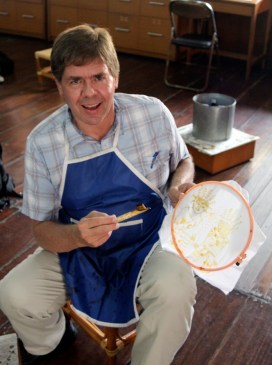
Me doing batik

David Black working on a batik design of Ondel-Ondel at the Museum Tekstil Jakarta.

After our morning sessions at the hotel, we ate lunch at the buffet (the desserts were amazing) and boarded out Whitehorse bus to visit the Museum Tekstil Jakarta, or the Textile Museum of Jakarta. Sarah Sever had set up a class for all of use to learn how to make batik. I was very excited by this, as learning how to do batik is one of my main goals for what to learn in Indonesia.

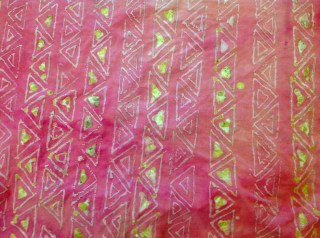
In my STEAM it Up class, we tried batik at the end of the school year. I ordered a kit from Dharma Trading Company with wax, a canting (the wax pen), and other materials. The instructions were not detailed enough on how to heat the wax, how hot to keep it, or how to hold the canting. The wax was very difficult to keep molten without burning it, and it kept plugging the canting’s tip or not penetrating the cloth. We tried silk and linen, and our results were less than ideal. Then we had trouble getting the wax out of the cloth.

Attempted batik-triangle patterns

One of my STEAM it Up student’s attempts at doing batik. The wax kept clogging the canting and wouldn’t penetrate into the cloth. And it kept dripping.

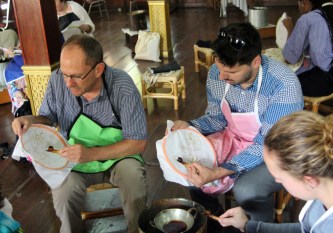
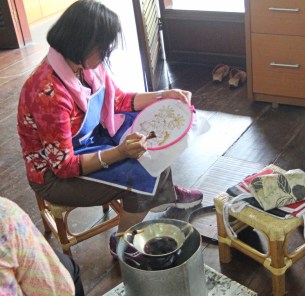
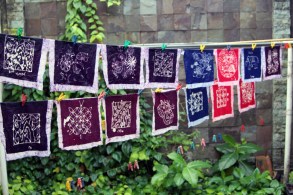
We walked to the workshop room, which had seats arranged around a series of small burners with wax melted in a bowl on top and cantings for each person. We chose pre-drawn patterns already in embroidery hoops, and a lady showed us how to dip and use the canting to trace the patterns. Where the wax soaks in to the cloth, the dyes won’t penetrate and the cloth is left white. It is a wax resist process.

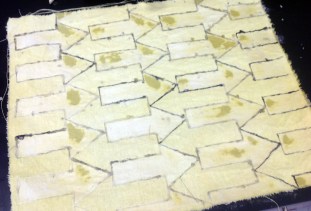
My own attempt at batik in STEAM

My own attempt at doing batik in the STEAM it Up class. I had the students create a tessellation, such as these arrows, by drawing around a stencil on a pre-died piece of linen. Then we applied wax using a canting. But it kept dripping and clogging.

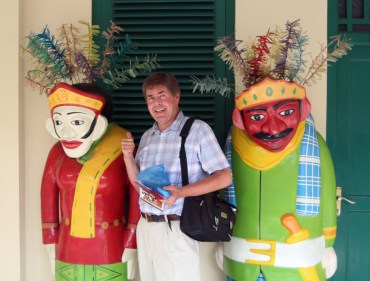
My pattern was rather complicated, a pair of figures called ondel-ondel with elaborate costumes and headdresses. I saw two things immediately: the wax used here melts at a lower temperature and stays liquid longer that the wax I got from Dharma, which has too much paraffin in it. Here, the wax (or malam) has more beeswax and other ingredients and is more of a brown color.

Craig-Matt-Nikki batik

Craig, Matt, and Nikki working on their batik patterns using canting (wax pens).

You dip the canting into the wax to fill the small reservoir, then hold it at a 45° angle against the cloth, which is held on your left knee (if right handed). I had some trouble with the wax dripping and making splotches on the cloth, but found if I rubbed off any excess wax from the dipping process, this problem would minimize. It felt much like using a traditional pen to do pen and ink drawings; you have to rub off the excess to keep it from dripping there, too.

At Tekstil Museum

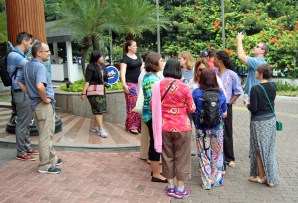
Teachers for Global Classrooms educators at the Museum Tekstil Jakarta.

All the teachers enjoyed the process. I was one of the last ones done, and had to rush through waxing the opposite side of the cloth. The next step was to hand the cloth to the man doing the dyeing. We could do red or blue or a combined purple. I chose purple and videotaped him dyeing my cloth as well as others. The wax was then melted out in boiling water and the clothes hung up to dry.

Anu doing batik

Anu working on the same pattern I had: the traditional Ondel-Ondel dolls. Notice how she is holding the cloth at a 45° angle and tipping the canting at the same angle to avoid spilling wax (malam).

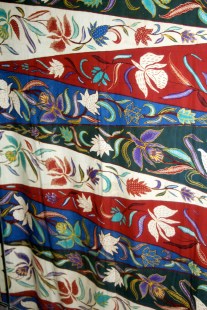
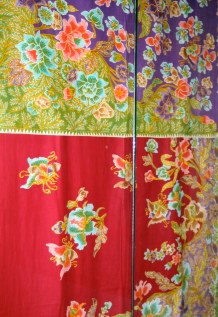
While they were drying, we stopped at the gift shop and I purchased some cantings and wax, using money borrowed from Nikki as I had not yet tried to exchange my U.S. dollars for Indonesian rupiah yet. I’ll talk about the exchange rate in a later post. We then took a tour through the museum, where they had examples of batiks from all over Indonesia. A wide variety of plants and animals are used to make the colors of the dyes. We then walked over to the separate museum on weaving techniques and styles.

Kate and Wendy see batik

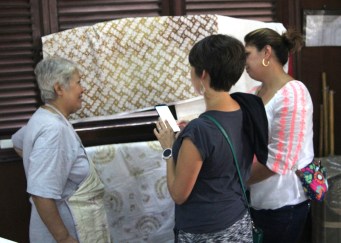
A master batik artist shows Kate and Wendy her work. She later gave Wendy one of her pieces.

After these tours, I went outside because it was stuffy in the non-airconditioned buildings. It was very humid outside, but at least there was some air moving in a slight breeze. It will be a challenge to adjust to the humidity.

Professional batik

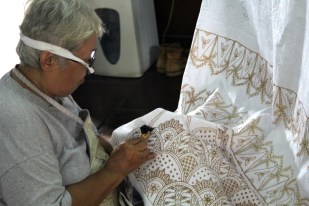
A master artist applying the malam wax using a canting pen. Notice the delicate hand work and how she is not dripping any wax. It is similar to learning how to do hand-dipped pen and ink. I just have to practice.

As I was walking around the grounds trying to find the restroom, the afternoon call to prayer (salat) rang out from several nearby mosques. This is not the first time I had heard the prayer call. In 1984, I traveled with my family to parts of Europe and Israel, and while in Jerusalem I visited the Dome of the Rock and heard the calls to prayer. The calls ring out loudly so that all people can hear wherever they are and whatever they are doing. These prayers are done five times per day, and begin with the Kalimah, a statement of belief that there is only one God and Muhammad was his prophet. This is one of the five Pillars of Islam. The imam for each mosque then decides a passage from the Quran to read, and the muezzin calls out the passage as a song, which is quite beautiful to listen to and rather haunting. I recorded some of it.

Everyones batik drying

Teacher batik hanging up to dry. We could choose red or blue or a combination. The border was painted on and cracked by one of the museum teachers.

Sarah collected our dried batiks. Mine wasn’t exactly a work of art, but it was much better than my earlier attempts in my STEAM it Up class. We re-boarded the Whitehorse bus and traveled gradually toward our next destination. I took photos of bougainvillea and other flowering plants along the way. I have missed the colorful flowers of the tropics.

Batik sample

Batik sample in the Museum Tekstil Jakarta.

Batik sample 2

Other batik samples in the museum.

Me with ondel ondel

David Black with Ondel-Ondel statues. I bought some canting at the museum store for use in my classes at school.

Flowering bushes

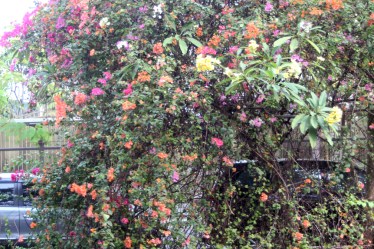
Flowering bushes, mostly bougainvillea. Although native to Mexico, this bush is now found throughout the tropics in Asia.

Read Full Post »
« Newer Posts - Older Posts »